Thoughts
and opinion on this or any other articles can be shared with
Ambedkartimes.com and comments are always appreciated towards
but Ambedkartimes.com/Editor does not have the same opinions
as others. The views expressed in the articles/news published
in the site www.ambedkartimes.com
are that of their writers, and it is not implied that Prem
Kumar Chumber, Editor / www.ambedkartimes.com endorses them.
Prem K. Chumber
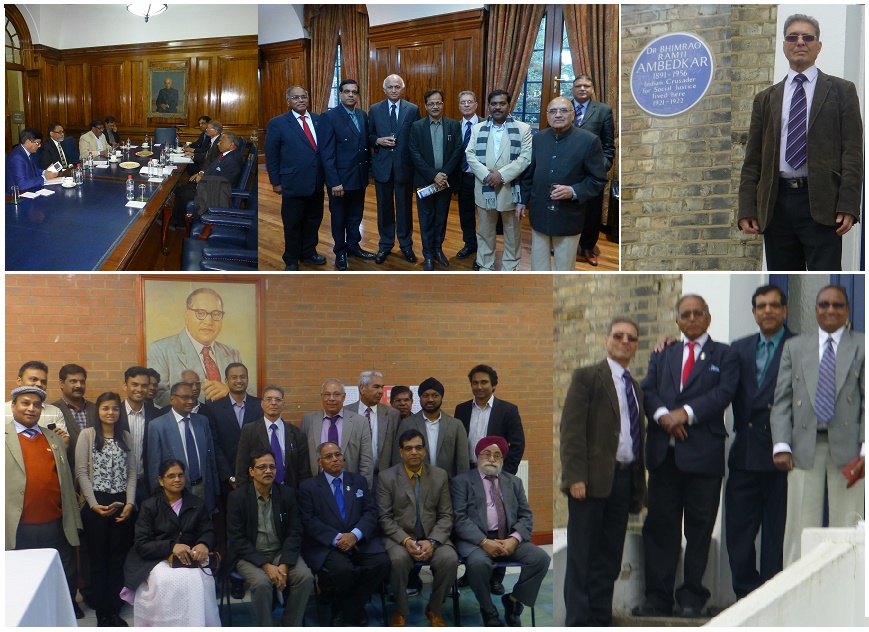
DR AMBEDKAR SEMINAR AT HOUSE OF LORDS
AND MUSICAL TRIBUTE AT NEHRU CENTRE
Dear friends, 1. Sarnang –A musical of portrayal of Dr B.R. Ambedkar-Monday 24 April 2017, Nehru Centre, 8 South Audley Street, London W1K 1HF 2. Dr Ambedkar-Life and Works- Wednesday 26 April 2017, 5.00-6.30pm-8.30pm Committee Room 3, House of Lords, Westminster, London
To mark Dr Ambedkar’s 126 birth anniversary, the Federation of Ambedkarite and Buddhist Organizations UK (FABO UK) has organized the above two events in association with the Nehru Centre and Lord Harries of Pentregarth respectively. We would like to invite you to attend the above events.
Singer, lyricist Rajesh Dhabre and his wife Dr. Bhavana to mark Dr Ambedkar’s 126 birth anniversary will depict the life and works of Dr Ambedkar through their musical compositions. Rajesh has written and composed four albums since 2010 released by HMV, Saregama, Zee Music and LM Music. These albums have featured well known singers including Bharat Ratna Lata Mangeshkar, Asha Bhonsle, Sonu Nigam and Pankaj Udhas, Shan, Shrya Ghosal and many more.
The event is free and you can book your place on the following link or alternatively by contacting us. www.eventbrite.co.uk/e/sarnang-a-musical-portray-of-dr-brambedkar-rajesh-dhabre-dr-bhavana-monday-24th-april-2017-0630pm-tickets-32405587986
We have been organizing seminars/talks on Dr Ambedkar at the House of Lords for a number of years. Very many dignitaries from both of the Houses of the UK Parliament, Ambedkarite activists from around the world, and academics, have participated in our events and spoken on Dr Ambedkar as a maker of modern India through his Constitution. They have also recognized him as a leading global figure on equality and human rights, the civil rights movement, and an outstanding economist. Mr Rob Marris MP, Baroness Flather, Lord Alton, Dr Alpa Shah, London School of Economics have already agreed to attend and speak.
Places are limited and strictly controlled because of security reason. We would be delighted if you are able to attend. It would be helpful if you let us know by the end of this month that you are available for this event so that the arrangements for your invitations are made in time.
Please circulate this information to your contacts.
Looking forward to hearing from you.
With best wishes, Arun Kumar,
General Secretary, FABO UK Mob: 07909 828750 C. Gautam: Joint Secretary, FABO UK Mob: 07956 918053, Ms Santosh Dass MBE, President, FABO UK Mob: 07902806342
President, FABO UK Mob: 07902806342
Posted at www.ambedkartimes.com on April 4, 2017
Ambedkar house in London
Dear Friends,
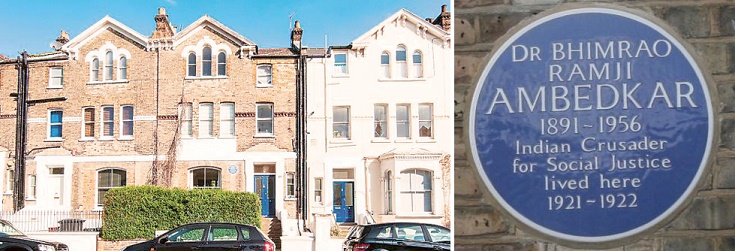
10 King Henry’s Road, Chalk Farm, North West London – the house where the champion of human rights and the Father of the Indian Constitution, Dr Ambedkar lodged from 1921-22 whilst at the LSE and Grays Inn, is a place of pilgrimage for Ambedkarites around the world. This house was purchased by the Government of Maharashtra in September 2015 following a proposal by the Federation of Ambedkarite and Buddhist Organisations UK that the £3.1million property be turned into fitting memorial to Dr Ambedkar.
In November 2015 the Prime Minister of India inaugurated 10 King Henry’s Road during his visit to the UK. The ground floor was hurriedly refurbished for the PM’s visit. The rest of the house still requires further renovation and FABO UK has been following this up.
Mr Rajkumar Badole, Minister for Social Justice and Special Assistance, Government of Maharashtra visited the house again this week to accelerate the development of the Ambedkar Memorial and set up an Advisory Committee. The Committee, under the Chairmanship of India’s High Commissioner to London, was announced and met for the first time on 2nd February.
The Committee comprises:
The High Commission of India (HCI) Shri YK Sinha; Mr Surendra Kumar Bagde (GOM) Mr. Sunil Kumar (HCI); Ms Santosh Dass MBE (FABO UK); Mr. C. Gautam (FABO UK); Mr. Jograj Ahir (Shri Guru Ravidass Sabha, Southall); and Mr. Sukhdev Sahai Hira, social worker.
We now look forward to early progress. Below are some links to some recent media coverage. http://indianexpress.com/article/india/maharashtra-minister-sets-up-committee-for-ambedkar-memorial-in-london-4503884/ http://www.hindustantimes.com/world-news/panel-formed-for-br-ambedkar-memorial-in-london/story-LMyq3sLGNEXBB3znLATwqL.html
Regards, Arun Kumar, General Secretary O7909828750
Federation of Ambedkarite & Buddhist Organisations UK
Posted on www.ambedkartimes.com February 4, 2017
ISSUE OF ATROCITIES AGAINST DALITS
RAISED IN THE BRITISH PARLIAMENT
Following a Joint Statement by a number of organisations in the UK including Federation of Ambedkarite and Buddhist Organisations UK (FABO UK), Anti Caste Discrimination Alliance UK (ACDA UK) sent on 18 August to the British Government, United Nations Secretary General and UN Human Rights Commission regarding the continuous atrocities against Dalits in India especially in Gujarat, Lord Alton of Liverpool has asked written questions in the House of Lords for British government’s response. Q
Asked by Lord Alton of Liverpool
Asked on: 05 September 2016 Foreign and Commonwealth Office India: Dalits HL1541
To ask Her Majesty’s Government what assessment they have made of the findings of India’s National Crime Records Bureau that, in a three-year period there was an almost 40 per cent increase of crime against Dalits throughout India; that in 2015, in Gujarat, there was a 163.3 per cent increase in crime against Dalits; and that sexual assaults against women and rape are listed as the top crimes against scheduled castes. Q
Asked by Lord Alton of Liverpool
Asked on: 05 September 2016 Foreign and Commonwealth Office India: Minority Groups HL1542
To ask Her Majesty’s Government what assessment they have made of the Joint Statement of UK anti-caste organisations submitted on 18 August to the Prime Minister, the Foreign Secretary, the United National Human Rights Commissioner and the UN Secretary General, and whether they will press for those British organisations that submitted the Joint Statement to be given the opportunity to express their concerns to the United Nations office in Geneva and to report on the condition of Dalits and minorities in India.
Arun Kumar
General Secretary Federation of Ambedkarite and Buddhist Organisations, UK (FABO UK).
Posted on www.ambedkartimes.com September 11, 2016
A DREAM FINALLY COMING TRUE –
AN INTERNATIONAL MEMORIAL TO
DR. BABASAHEB AMBEDKAR IN LONDON
After tense months of delays, on 26 August 2015 the Government of Maharashtra exchanged contracts on 10 King Henry’s Road, NW3. This house, located near Primrose Hill in north London, was where Dr Bhimrao Ramji Ambedkar lodged in 1921-22. Dr Ambedkar (14 April 1891 – 6 December 1956), popularly known as Babasaheb, was an Indian jurist, economist, politician and social reformer who inspired the Modern Buddhist Movement and campaigned against social discrimination against Untouchables (Dalits), women and labour. He was Independent India's first law minister and the principal architect of the Constitution of India. Ms Santosh Dass, MBE, President of the Federation of Ambedkarite and Buddhist Organisations UK, comments,
“I am delighted that Mr Raj Kumar Badole, Minister for Social Justice and Special Assistance at Government of Maharashtra, via the High Commission of India in London, has exchanged contracts on 10 King Henry’s Road, NW3.
This follows my proposal to GOM in September 2014 that the house be bought by GOM and turned into an educational and cultural centre. Generations of Indians in the UK and visitors studying, interested or inspired by Dr Ambedkar’s key roles in furthering social justice, human rights and equal treatment issues will be able to visit. He is a figure on par with William Wilberforce and Dr Martin Luther King. Additionally, its five bedrooms could be used as accommodation for Indian students from Dalit backgrounds while doing post-graduate studies in the UK.
FABO UK has a long history with this site. As part of the celebration of the centenary of Dr Ambedkar’s birth, organised under the auspices of FABO UK, English Heritage in 1991 recognised its historic significance and installed a ‘blue plaque’ on the exterior of the property with the words “DR BHIMRAO RAMJI AMBEDKAR 1891-1956 Indian Crusader for Social Justice lived here 1921-22”.
Whilst in this house Dr Ambedkar enriched his academic studies and strengthened his resolve to challenge the impact of the Caste System and British Rule in India. It was also during this time that India’s Government was struggling with the falling value of the Indian Rupee – the backdrop to his thesis The Problem of the Rupee: Its origin and its solution.
There is a lot of work to do on the house before it can be opened to visitors.
We look forward to working with GOM and the High Commission in London in the months and years to come to ensure that this cultural and political heritage site is put to uses of which Dr Ambedkar would approve.
FABO UK would like to take this opportunity to thank the following key people in India and the GOM for their tireless and unflinching enthusiasm and support in making our vision a reality: Mr Raj Kumar Badole, GOM’s Minister for Social Justice and Special Assistance, His Excellency, Mr Ranjan Mathai, High Commissioner of India in London, and his team, Mr Vinod Tawade, GOM’s Minister of, Higher & Technical Education and Cultural Affairs, Mr R K Giakwad IAS (Indian Administrative Services), Ex-Secretary & Commissioner Social Justice Department, Mr Ramdas Athwale, MP, Padma Shri Kalpana Saroj, and Mr Ramesh Katke, Deputy Registrar GOM. Notes to Editors
Contact Ms Santosh Dass 0044 7902 806342 for more information or press interviews
FABOUK estimated the house would cost GBP 4 million. This includes the current asking price for the property as advertised at GBP 3.1 million; Stamp Duty; legal costs, house insurance costs, and the necessary renovations to the property. FABO UK
In the UK there are a number of organisations with a common interest in following the teachings of Dr Ambedkar and traditions of Buddhism. FABO, UK with its Head Office in Southall, West London, was formed in 1985 as a central UK body to strengthen these organisations’ loose or informal associations. It is a voluntary and non-profit making organisation. FABO UK has a number of objectives. One key one is to propagate the teachings of Dr Ambedkar and Lord Buddha. Over the years the numbers of organisations with a common interest that have joined FABO UK have fluctuated yet grown. FABO UK is run by an elected Executive Team. The current President of FABO UK of Ms Santosh Dass, MBE took up the position September 2013.
The joint General Secretaries are Mr Arun Kumar and Mr Gautam Chakravarty. Federation of Ambedkarite and Buddhist Organisations UK
Buddha Vihara 12 Featherstone Road Southall West London MIDDX UB2 5AA E: cgautam@ambedkar.org.uk U: www.ambedkar.org.uk Tel: +44 7956 918053
Ambedkartimes.com takes pride in congratulating the “Federation of Ambedkarite and Buddhist Organizations UK” (FABO UK) on this great achievement. Prem Chumber
Posted on www.ambedkartimes.com August 27, 2015
AMBEDKAR MEMORIAL IN LONDON COMES TO REALITY
A three member delegation of the government of Maharashtra (GOM) including Minister for Social Justice and Special Assistance, Raj Kumar Badole, Minister of State, Dilip Kamble and Principal Secretary Ujjwal Uke visited London from 23rd to 28 April to hold talks with the Indian High Commissioner (IHC), solicitors and evaluators to finalise the purchase of the house 10 King Henrys Road, in North London where Dr Ambedkar stayed during his studies at the London School of Economics during 1921-22.
Proposal to buy this house and turn into a memorial to Dr Ambedkar, his life and works was submitted by the Federation of Ambedkarite and Buddhist Organisations UK (FABO UK). It was proposed to convert the property into a cultural and educational centre that generations of Indians in the UK and visitors interested or inspired by Dr Ambedkar’s key roles in furthering social justice, human rights and equal treatment issues could visit.
After visiting the house, the delegation had discussions with the Indian High Commission officials and the solicitor firm to complete the legal formalities.
On Monday, 27 April, a meeting with the members of Federation of Ambedkarite and Buddhist Organisations UK (FABO UK) represented by Ram Pal Rahi, Vice President, Arun Kumar, General Secretary, Gautam Chakravarty, Joint Secretary and Mr. Pritam Lal, First Secretary IHC took place at India House. Arun Kumar thanked Mr Badole and the Maharashtra government for accepting the proposal of FABO UK to purchase the property and turn into an Ambedkar memorial. He further added that the timely decision taken by the Social Justice Minister had saved the house slipping to another buyer. In his response, Mr Badole said “The government of Maharashtra has accepted FABO UK’s recommendations. We have appointed two companies to conduct the valuation process of the house and the entire process is likely to be completed by the end of May. We are committed to buy the house and we will buy it.” Talking on the historicity of the house, Gautam Chakravarty said, “It took us 20 years to seek the necessary permission to install the memorial outside 10 King Henrys Road and eventually the ‘blue plaque’ was installed by English Heritage on 6 December 1991.”
Ambedkar Chair: The minister also initiated talks for a chair in Ambedkar’s name at London School of Economics (LSE) where Dr. Babasaheb Ambedkar had studied, linking it with two new scholarships for Indian students. Mr Badole also broke the good news that “LSE has positively replied to our proposal and informally agreed to set up a Chair in the name of Dr Ambedkar and scholarships for Indian students. I have asked the LSE to send a former proposal for the chair and the running costs. The government of Maharashtra will provide the funds. ”
FABO UK officials visited the property along with the surveyor and Mr. R.K. Gaikwad IAS Retired (former Commissioner for Social Welfare). Mr Gaikwad is a staunch Ambedkarite who lobbied the GOM in Mumbai on behalf of FABO UK.
Ms Santosh Dass, MBE, President of FABO UK said: “I am delighted that Mr Raj Kumar Badole, Minister for Social Justice and Special Assistance in the Government of Maharashtra has finally made arrangements to secure Dr Ambedkar's former residence in north London. This follows my proposal to the former Chief Minister of the GOM on 1 September 2014. There are many committed followers of Dr Ambedkar including Mr C Gautam and Mr Arun Kumar in the UK and Mr R K Gaikwad and Mr Ramesh Katke in India who have worked tirelessly since last September to make our vision a reality. I am also delighted that my proposal for Ambedkar scholarship at LSE for which we were working on since 2014 has also been accepted.
It is important to inspire young Dalits to fulfill their potential around the world. 10 King Henry’s Road will house a number of students from Dalit background who come to study in the UK and also be a focal point in the West to spread Dr Ambedkar’s message about equality, human rights and social justice. For untold generations of people to come, 10 King Henry’s Road will become a place of pilgrimage for people around the globe inspired by the fractious history of civil rights, the potential successes of social activism and, of course, Dr Ambedkar's legacy. "
On the last leg of his itinerary, Mr Badole visited Ambedkar Hall in southall and had an open meeting with the followers and admirers of Dr Ambedkar. He appreciated FABO UK’s work and hoped to work together in future to develop the Ambedkar Memorial in London. He also met scholarship holder students from Maharashtra and listened to their grievances.
Posted on www.ambedkartimes.com May 10, 2015
CASTE PREJUDICE
HAS BECOME GLOBAL
An upper-caste Gujarati family who ran a grocery shop in the US wanted to know the name of the Indian sitting next to them in a private van in Pennsylvania. When his name did not reveal his caste, they probed further and asked for his surname. He said he was South Indian and didn't have a surname.
"I told them I knew why they were asking me these questions. They wanted to know my caste," says Sakya, who told them he was dalit. Over the next few days they sat as far away from him as possible while travelling together. Sakya, a PhD in history, says he has never faced any racial discrimination from white Americans; it's his own countrymen that have discriminated against him.
Education qualifications do little to erase the caste biases that Indians carry with them. A recent survey by the National Council of Applied Economic Research (NCAER) and the University of Maryland, US revealed that one in four Indians continue to practise untouchability in some form in their homes.
It's the same story across continents. The National Post writes of how, for dalits of Canada's British Columbia, the barbs are subtle. "They come in seemingly innocuous questions about your family village or last name...They show up in careless conversation, among friends, behind closed doors. A messy house is referred to as a chamar house."
Indian immigrant Kamlesh Ahir told the newspaper: "It doesn't matter if we are a doctor, teacher, because we belong to the lower castes.... They think we are bulls-t. We are zero....I'm in Canada ... But the bulls-t castes are still here. We live it every day."
"When Hindus move to other countries, the caste system transmigrates with them. Wherever Indians migrate to America, they build temples. They also export a Brahmin priest to perform the rituals in the temple. In this way the same structure repeats itself," says noted dalit scholar Kancha Ilaiah.
While New Jersey has one of the largest Hindu temples in the US, dalit entrepreneur Deelip Mhaske, a prominent member of the Indian community, is never invited to any cultural or religious Hindu function such as Diwali and Holi.
"The dalit gurdwara in Burnaby (British Columbia) was founded in 1982 after dalit worshippers felt unwelcome in an upper-caste gurdwara," writes Cheryl Chan in Canada's National Post. Chan points out the irony of the fact that Sikhism does not officially have a caste system.
A year ago, the British parliament officially outlawed caste discrimination. A UK government study had found evidence of caste-based discrimination at the workplace, in the delivery of services and in the education system. Coventry, a city in Central England, saw one of the most degrading cases of caste discrimination. "An elderly dalit lady was receiving home care from the city council, which would send a council worker to her house to bathe her. One of the council workers happened to be an Indian of a higher caste. When she discovered the lady was dalit, she refused to give her a bath," recalls Lekh Pall, an activist with the Anti-discrimination Alliance.
People often hide their identity as dalits as they do not want to be discriminated against, says Dr Sushant Godghate, a doctorate in engineering who lives in Japan. "I had an Indian colleague in Japan who I knew to be Buddhist (dalit convert). When I asked him if he would like to take part in the Ambedkarite movement in Japan he refused, saying he was not from the community," says Godghate.
Recently an upper-caste Hindu in an office in Japan overheard a dalit colleague talking of organizing protests over the brutal murder of three members of a dalit family in Maharashtra last month, an incident reminiscent of the Khairlanji killings. The dalit colleague says he and the upper-caste Hindu co-worker would earlier hang out together, but after this incident, the upper-caste colleague began to avoid him.
Recent protests in New York over the killings in Maharashtra saw several other groups join in, from African American church groups to Arab artists. However, upper-caste Indians were conspicuous by their absence.
In a paper on Australia's South Asian diaspora, Deakin University researcher Amit Sarwal argues that "despite the modern nature of South Asian diaspora in Australia and despite the egalitarian nature of Australia and even if caste as an institution cannot be practiced publicly or caste consciousness has not survived, this consciousness has very subtly merged into class consciousness and a demonstration of social status in relation to others. The 'others' being those who do not belong to the same jati, linguistic group and economical level..."
When an upper-caste Indian who has grown up in a deeply hierarchical society leaves India, he wants someone to dominate, says Chandra Bhan Prasad, mentor at the Dalit India Chamber of Commerce and Industry. "Africans in Durban say Indians treat them worse than whites do. For them, blacks are like dalits. But in countries like the US, where they have no one else to suppress, they turn on dalits," says Prasad. http://m.timesofindia.com/home/stoi/deep-focus/Prejudice-even-in-pardes/articleshow/45322711.cms
Posted on www.ambedkartimes.com November 30, 2014
TURNING DR. AMBEDKAR’S FORMER LODGINGS IN LONDON INTO A MEMORIAL FOR THE REMARKABLE MAN AND CRUSADER FOR SOCIAL JUSTICE
Arun Kumar
Ms Santosh Dass, MBE, President Federation of Ambedkarite and Buddhist Organisations UK said: “I am delighted that the Government of Maharashtra has supported the Federation of Ambedkarite and Buddhist Organisations UK’s initiative to purchase the house where Dr Ambedkar lodged whist he was studying at the London School of Economics. We are still awaiting official confirmation.
English Heritage has already recognised the historicity of 10 King Henrys Road, NW3 by installing a ‘blue plaque’ on the property. This was unveiled in December 1991 by Roy Hattersley MP, the then Deputy Leader of Labour Party. In this house where he lodged, Dr Ambedkar enriched his academic studies and strengthened his resolve to challenge the impact of the Caste System and British Rule in India.
Dr. Ambedkar left a huge body of writings spanning forty years that cover a range of subjects, amongst them, history, economics, anthropology, politics, philosophy and law. These writings are proof-positive of his prowess, his intellectual rigour and his clarity of thought that must be shared with present and future generations.
There is a long way to go. If our initiative is successful, the property will be turned into a memorial to Dr. Ambedkar, his life and works. The house will be a cultural and educational center that generations of Indians in the UK and visitors interested or inspired by Dr. Ambedkar’s key roles in furthering social justice, human rights and equal treatment issues can visit. The bedrooms would be ideal for some students from Dalit background from India who complete their post graduate education in the UK and visitors to London as part of Dr. Ambedkar missions worldwide.
FABOUK would like to take this opportunity to thank the following key people in India and the Government of Maharashtra for their tireless and unflinching enthusiasm and support in making our vision a reality: Dr. Nitin Raut- Cabinet Minister Government of Maharashtra (GOM), Mr. R K Gaikwad IAS (Indian Administrative services), Ex Secretary & Commissioner Social Justice Department, Mr. Ramesh Katke Deputy Registrar GOM, Dr Vijay Kadam, Social Activist, Mr. Siddharth Kharat Private Sectary to Dr. Raut, Mr. Lalit Khobragade Officer on Special Duty to Minister.
Arun Kumar General Secretary, Federation of Ambedkarite & Buddhist Organisations, UK (FABOUK)
Posted on www.ambedkartimes.com September 15, 2014
INDEPENDENCE DAY CELEBRATIONS IN LONDON
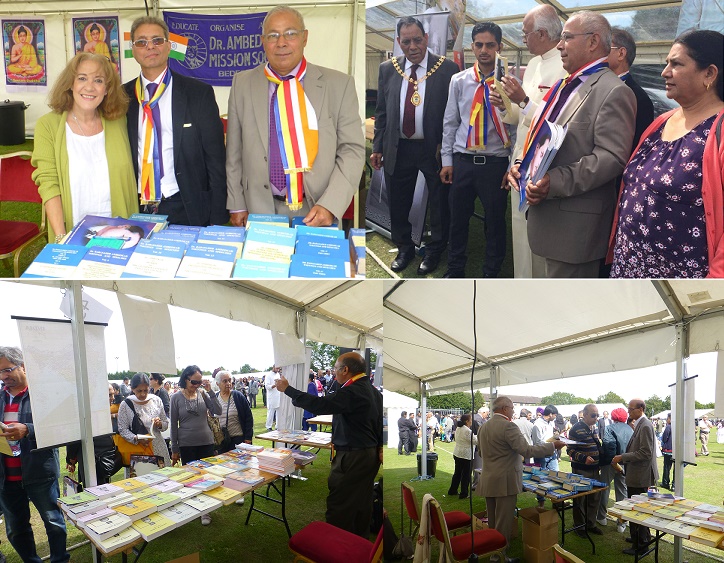
The annual celebration of India's Independence Day took place on 24 August at the Indian Gymkhana Club in West London. The event was organised by the Indian High Commission. Thousands of people from various communities participated. The event included the annual raising of the India flag by the Mr. Ranjan Mathai, India’s High Commissioner to London and live music and dance entertainment. There were also about 50 stalls hosted various organisations - some of them providing refreshments and food and others advertising their products. India House had invited the Federation of Ambedkarite and Buddhist Organisations UK (FABOUK) to host a stall at the event. FABOUK and the Ambedkar Mission Society, Bedford, had a large stall and displayed Dr Ambedkar and Buddhist literature and portraits of Dr Ambedkar. Hundreds of people visited the stall and over 300 copies of a Dr Ambedkar souvenir were given to interested visitors. Mr. Ranjan Mathai along with senior India House officials also visited the stall and appreciated the display.
One of the visitors remarked that in his view the Dr Ambedkar stall was one of the best and most educative. A documentary film director, Christine Booth from the Pacifica Films also visited the stall and showed a keen interest in Dr Ambedkar. She talked at length about the contribution of Dr Ambedkar to the human rights issues, gender equality and the revival of Buddhism. Ranjit Boadh, Harbans Virdee, Mr. & Mrs Pirthi Kaeley and Arun Kumar managed the stalls.
Posted on www.ambedkartimes.com August 30, 2014
CASTE DEBATE IN
WESTMINSTER HALLJULY 9, 2014
A special
report by
Arun Kumar
(General Secretary)
Federation of Ambedkarite &
Buddhist Organizations UK
Please find attached the transcript of yesterday’s debate in the house of Commons on Caste Discrimination in the UK sponsored by Adam Holloway MP for Gravesham. The Minister’s response in the Parliament has no real answer to the question about the unnecessary delays to the consultation and implementation of the caste legislation.
Our thanks goes to the MPs who participated in the debate especially to Adam Holloway who secured the debate on the delay to the implementation of legislation on caste discrimination.
It appears that we have a long way to go to achieve our objective and we must get prepared for this battle.
CASTE DISCRIMINATION
4.42 pm
Mr. Adam Holloway (Gravesham) (Con): It is a great pleasure to serve under your chairmanship, Dr. McCrea, and I thank the Minister for allowing me to ruin her afternoon. I am sure she had other things that she would have preferred to be doing.
Why are we having this debate? I went to the Brandon Street Gurdwara in Gravesend a few months ago, and I was amazed by the strength of feeling over a petition on caste discrimination. Since then, I have been around the country with my hon. Friend the Member for Witham (Priti Patel), who is the Prime Minister’s diaspora champion, and I visited Leicester, Southall and the constituency of my hon. Friend the Member for Bedford (Richard Fuller). I did not realize that quite so many people in the UK suffer because of “traditional”—if that is the right word—caste systems originating in south Asia.
According to a survey on one of these castes, published by the Anti-Caste Discrimination Alliance, 58% of Dalits—that is to say the untouchables, the Chamars, or whatever else people want to call them—believe they face discrimination because of their caste. Much more interestingly, 80% believe that the police would not understand caste discrimination if it was reported to them. Some Dalits are being ignored for promotion. They are victims of humiliation or harassment and sometimes they face being fired.
So is there a form of hidden apartheid within our shores? After some brave and necessary moves by our Home Secretary to outlaw such things as forced marriage, can we really continue to excuse ourselves for not putting people who practice this casteism on the wrong side of the law?
There has been a timeline to this. In November 2009, the Anti-Caste Discrimination Alliance published its report, “Hidden Apartheid—Voice of the Community”, highlighting lower-caste experiences of caste discrimination. Between April 2009 and April 2010, during parliamentary debates on the Equality Bill, Dalit organizations sought to persuade parliamentarians to include caste as a new protected characteristic.
On 1 October 2010, the Equality Act 2010 came into force. The caste power found in section 9(5)(a) of the Act allows amendment by ministerial order
“to provide for caste to be an aspect of race”.
In December 2010—I am halfway through these dates now, by the way—an independent research report asked for by the last Government was published by the National Institute of Economic and Social Research. It suggested that caste discrimination and harassment were falling outside the Act. The coalitions Government are still considering that report.
In August 2011, Amardeep and Vijay Begraj, a married couple—he had been working in a solicitor’s firm as a manager, and she had been working as a solicitor—came before the courts. The argument was that he, and I think she, as well, had been fired because their union, being from different castes, had not been approved of. The Home Secretary then publicly considered whether to add the caste system to the equality law.
9 July 2014: Column 135WH
Mark Reckless (Rochester and Strood) (Con): Many of my constituents attend the Gurdwara in Gravesend to which my hon. Friend referred, but more still are members of the Ravidassia community in Strood.
Dr. William McCrea (in the Chair): Order. Two Members are standing.
Mr. Holloway: I was so interested in what my hon. Friend was saying—that is what happened there. I am sorry, Dr. McCrea.
Mark Reckless: My understanding was that the Government had given a commitment that it would bring in this order, so why has it not happened?
Mr. Holloway: The Government will tell us in a moment, which is part of the reason why I have called this debate.
On 1 March, the Minister present made a statement. She announced that the Government were thinking of taking an educational approach to this and would use Talk for a Change. However, the NIESR criticized that, saying that it only raises awareness and does not assist people being discriminated against by their employer, nor by such things as day care centres.
The Government then asked the Equality and Human Rights Commission to review and make recommendations. In April 2013, the Minister was asked to sign the ministerial order and on 29 July, the Government published their caste discrimination legislation timetable. It will run up to and beyond the 2015 general election. On 5 February, the Begraj tribunal was abandoned, because the judge recused herself when she was told by a third party that a witness in the case had had their home smashed up by an unknown group. On 28 February, the EHRC published its two reports on the matter and called on the Government to add in the necessary protections on caste.
Let me just give a brief outline of caste in the UK. According to the 2011 census, about 4.5 million in this country are of south Asian origin. Of those, about 20% are from the untouchables, the Chamars, the Dalit community—I think it is about 860,000 people.
What is the Hindu caste system? Who are these 1 million Dalits in the UK and where do they fit in? Imagine a pyramid and at the very top, there are the gods, and then there are four castes. The top caste, the elite, are the Brahmins; these are the people who traditionally were the priests. Then there are the Kshatriyas; they are just below the Brahmins and were traditionally the warriors and the kings. Below them, there are the Vaishyas, who were the merchants and the farmers. Below them, at the bottom, there are the Shudras, who were the servants. Below even them, by this narrative, right at the very bottom—sometimes not even included in pretty pyramids like the one I have here in my notes—are the Dalits. They are known to some as the handlers of filth, or the untouchables.
This really is happening in the UK. After lunch, we were looking on Twitter. People can have a look themselves. They should look for “Brahmin for life”, “Jat for life” and “Brahmin boys look out for each other”. There are even dating websites. There is nothing wrong with that, but what about www.brahminmatrimony.com or this from www.asiansinglesolution.com? X is an
9 July 2014: Column 136WH
“Attractive, down to earth, caring, Hindu Brahmin girl with strong values and morals”.
As previously mentioned, 80% of the Dalits in the survey said that they did not believe that the police would understand if caste-based discrimination was reported to them.
Richard Fuller (Bedford) (Con): I am very pleased that my hon. Friend called for this debate. Does he share my concern at what I would characterize as the nonchalant, “Who cares?” ignorance of discrimination being pursued by the current Government’s policy in this regard? Somehow they believe that the discrimination that he has just spoken about will magically end at the workplace—that somehow because there is discrimination protection outside, we do not need to have any protections inside the workplace. Does he not think that that is nonchalant?
Mr. Holloway: I will come on to that, and I know that the work that the Minister is doing also applies to it.
There has been recent court action. There was the successful case of Tirkey v. Chandok, in which the claim for caste discrimination was allowed. However, these are just what I think are called first instance decisions and are not binding. According to Swan Turton Solicitors, there was a conflicting ruling in an earlier case, Naveed v. Aslam, in which the tribunal rejected any claims for caste discrimination. It was stated that the reason was that the Government still had not exercised their power to amend section 9(5)(a) of the 2010 Act.
The simple fact is that at present, if a person in the UK is harassed because of their caste in places of employment or education or where they receive public services such as health and social care, there is no legislation in place to protect them. Let us not overstate this, but in the past few weeks I have repeatedly come upon people who have said, for example, that they feel like they are looked down on by members of what would be traditional castes. People have told me of their disapproval of inter-caste marriage. I have heard anecdotes about some people not having had the choice of marrying the person whom they would like to marry. I have even heard about people who have not felt welcome at certain places of worship.
Gareth Johnson (Dartford) (Con): I congratulate my hon. Friend on securing the debate. I know that he is very well respected in the south Asian community in his constituency, which neighbours mine. Will he comment on what I have found? I do not know whether my experience is similar to his own. I am talking about just how shocking the caste system and discrimination within it can be. We see classism existing in every community, but this goes way beyond that to create a great deal of friction between different groups of people. Most concerns come from within those communities themselves.
Mr Holloway: That is a great point. What my hon. Friend is talking about is the fact that in our areas we have a lot of Sikhs, and of course among the central tenets of the Sikh faith are tolerance, equality and so on. I know that the Sikhs, certainly on our shared patch, are working on it, but this occurs far more widely across the south Asian communities in our country.
9 July 2014: Column 137WH
What is the reason for saying that we need some sort of legislation? It is as I have suggested. In the area of employment, there is the example of a manager of a bus company in, I think, Southampton who had to deal with a demand from someone that his shifts be changed so that he would not have to work with someone of a lower caste. Twenty per cent. of Dalits felt that they had been informally excluded from social events, informal networks and so on.
In the area of health, the Anti Caste Discrimination Alliance reported a few cases. One related to an elderly woman who was being looked after. Her carer, who was from a “higher” caste, found an icon indicating that the person she was looking after was from a lower caste, and the son of the bedbound woman found that his mother had not been washed for a number of days. We have had examples of physiotherapists refusing to treat people of lower caste. In the area of marriage, we have heard of the Begraj case. We have heard of people feeling unable to marry outside their caste.
What could legislation do? It could send the message that castes have never existed in Britain and really should not. It would protect people in workplaces, schools, hospitals and so on.
The Government’s commitment on these issues has been welcomed by victims of caste discrimination and forms just one part of the wider reforms being put forward. The Home Secretary has outlawed forced marriages, which are, as she rightly put it,
“a tragedy for each and every victim”.
Female genital mutilation is also illegal in this country. I am not sure, therefore, that we can necessarily use the argument that we might upset certain people in the south Asian community.
I forewarned the Minister of these three questions. First, the Government have published a timetable for caste discrimination legislation. Why does it run up to and beyond the 2015 general election? Secondly, will the Government involve the relevant groups and communities in their preparation of the public consultation document? It would be very good to see the involvement of some of those groups in that consultation. Finally, in plain English, when will the consultation document be published; does the Minister expect any further delays?
Dr. William McCrea (in the Chair): The Minister will start her winding-up speech at the latest at two minutes past 5. She will have 10 minutes in which to wind up the debate.
4.56 pm
Jeremy Corbyn (Islington North) (Lab): I will be very brief so that the Minister will have plenty of time to reply. First, I pay enormous tribute to the hon. Member for Gravesham (Mr Holloway) for securing this debate, for the way in which he has spoken on this subject today and for his willingness to grant me a few minutes of his time. I am very grateful for that.
I am one of the trustees of the Dalit Solidarity Network and a member of the all-party group for Dalits, the chair of which is Bishop Harries, a Member of the House of Lords. Together with the director of the Dalit Solidarity Network, Meena Varma, I have been to the
9 July 2014: Column 138WH
United Nations in Geneva to raise issues of Dalit discrimination in India and many other places, but also, clearly, in this country.
I will briefly put on the record the enormity of the situation. Around the world, 260 million people are Dalits —scheduled castes. They suffer grievous discrimination, terrible poverty, appalling levels of crime committed against them and, in most of India and Nepal and other places, appalling standards of living. Every week, 13 Dalit people in India are murdered. Five Dalit homes are repossessed every week. Three women are raped every day. Eleven Dalits are beaten every day. A crime is committed against Dalit people every 11 minutes in India.
The Ambedkar constitution is an excellent document. Dr Ambedkar was himself a Dalit. It absolutely outlaws discrimination and has some provision for protected employment for people of the scheduled castes. It is a very effective document, but raising these matters with the Indian Government or the Indian high commission is extremely difficult; they are quite resistant to having good discussions about it.
As the hon. Gentleman pointed out, discrimination also exists in this country. There are roughly 1 million Dalit people in Britain. As a result of both the case that he brought up, which was one that we raised in Geneva at the UN Human Rights Council, and the debates that took place in advance of the Equality Act 2010, we are in a situation in which we are relying on the Government now to introduce regulation to put it on the face of the law in this country that it would be illegal to discriminate on the basis of caste.
In getting to this position, the Government of the day in 2010, the then Labour Government, with my right hon. and learned Friend the Member for Camberwell and Peckham (Ms Harman) as the Minister leading on the Bill, accepted an amendment put forward by my hon. Friend the Member for Hayes and Harlington (John McDonnell) that required the Government to undertake research on caste discrimination in this country. That research demonstrated clearly that there is serious discrimination, and the Committee on the Elimination of Racial Discrimination said, in terms, that the British Government had an obligation to introduce the legislation. The Minister, I am sure, will tell us that consultations are taking place. I agree with consultations; everything should be consulted on, but there should be a limit to the time in which that is done. I am very disappointed that, at the moment, the introduction of the regulation will take us past the end of this Parliament and into the next Parliament. I would like to see something done in this Parliament and I hope that the Minister will give us good news on that.
My final point is that it is never popular to stand up for people who have been grievously discriminated against. I am really pleased with the way in which a number of Members have raised the matter today. Discrimination is wrong in any circumstances and against anybody, and people should be treated with dignity and respect. Our purpose today is to get into British law that clear declaration; at the same time, that will give us the moral authority to talk to others about it. I hope that the Minister will agree to introduce regulations quickly. Above all, I hope she will agree to attend a meeting with the members of the all-party group, which I am sure others could also attend, so that we can have a longer discussion about the matter. The time has come to act and not delay.
9 July 2014: Column 139WH
5 pm
The Parliamentary Under-Secretary of State for Women and Equalities (Mrs. Helen Grant): It is a pleasure to serve under your chairmanship today, Dr. McCrea. I thank my hon. Friend the Member for Gravesham (Mr. Holloway) for securing the debate, and I thank other hon. Members who made important contributions.
The Government has always said that there is no place for unlawful discrimination or prejudice in society. That applies to caste-related issues as much as it does to race, religion or belief. My hon. Friend and the hon. Member for Islington North (Jeremy Corbyn) drew attention to instances of caste hostility and prejudice in our society, and I would like to make it clear how much the Government sympathise with people in such situations. The experience of such antagonism and exclusion from one’s own community must be incredibly distressing. My hon. Friend and others have urged the Government to press on with introducing legislation to make caste discrimination unlawful, and that is exactly what we are trying to do.
Many hon. Members will recall caste being debated during deliberations on the Enterprise and Regulatory Reform Bill last year. It was the will of Parliament that a duty be imposed to make caste an aspect of race for the purposes of the Equality Act 2010, and we are well aware of that duty. However, we are also aware that during parliamentary debate on this matter, speakers from all the main parties acknowledged that caste was a particularly sensitive and complex area. Some have suggested that caste legislation should be easy to introduce, but that is simply not the case. There are a number of complexities, and there is no general consensus on caste in the UK, even among communities that are most affected by it. Some have campaigned long and hard for the introduction of specific caste-related legislation, but others—who are equally well informed—do not believe that caste discrimination exists and consider that legislation is, therefore, unnecessary. That does not negate the duty on the Government and the votes in Parliament last year, but it means that we need to prepare a consultation document which, as far as possible, commands the confidence of the relevant groups.
In July 2013, we set out our timetable leading up to the introduction of caste legislation. The process was thorough and detailed, and it was designed to ensure that future legislation was fit and proper. The Equality and Human Rights Commission has been helpful in taking the initiative forward. To start the process, the EHRC commissioned some independent research into identifying a possible definition of caste. The research was also to consider which of the current exceptions for race would apply equally to caste, and to identify whether any new caste-specific exceptions should be included in legislation. The research was intended to inform the contents of the Government consultation that was due to be issued in spring 2014. However, although the EHRC duly published its initial research reports in February 2014, two issues arose earlier this year that have had significant implications for the public consultation.
The first was the unanimous agreement that whatever we did, we did not want to entrench people’s identification with a specific caste within society. That is why a review clause was included in the Enterprise and Regulatory Reform Act 2013 to allow for future consideration of any caste provisions to make sure that they remain
9 July 2014: Column 140WH
Appropriate and necessary. That clause cannot be exercised until at least five years after the Act comes into force, which it did in May 2013. The EHRC had originally intended to commission a second research phase that would establish much-needed baseline data that could be used as a starting point for consideration of whether caste legislation was doing its job and stopping unlawful discrimination. Unfortunately, on further consideration the EHRC felt that that research would not be possible and that it might be intrusive and ruin good relations in communities. We have discussed those problems with the EHRC and we are now deciding how best to establish baseline data. We are conducting a feasibility study on the matter.
Richard Fuller: Will the Minister give way?
Mrs. Grant: I am sorry, but I have no time and I have got a lot to talk about, so I will push on.
The second issue concerned a recent employment tribunal case, Tirkey v. Chandok, in which the tribunal found that caste already had legislative protection because it is inherently an aspect of the ethnic origins provision of race in the Equality Act. I want to make it clear that the finding of a single employment tribunal does not set any legally binding precedents for other tribunals. However, the decision reopens concerns that have been debated in Parliament about the extent to which the Government must recognize links between domestic equality law and our international obligations, the relationships between those obligations and future provisions covering caste discrimination, and how such provisions might be framed.
We believe that we need to address those two developments—the Tirkey case and the lack of baseline data—as thoroughly as possible for the purpose of the public consultation. We need to assess the feasibility of any further research into caste discrimination, given the limited success that previous researchers have had in producing clear, generally accepted evidence. We also need to assess the consequences if higher courts were to take the view that caste discrimination is already unlawful under the Equality Act, which might call into question the use of further, specific provision. That is why we have announced that the consultation will have to be put back until the autumn.
My hon. Friend the Member for Gravesham has asked me to deal with three questions, which I will go into in a little detail although not in the order that he mentioned them. He asked whether the Government would involve the relevant groups and communities in the preparation of the public consultation document. Many groups have recently had the opportunity to take part in the research commissioned by the Equality and Human Rights Commission, which was published in the “Caste in Britain” reports. The Government have studied those carefully. I also look forward to the groups responding to the consultation and commenting on our proposals.
Richard Fuller: Will the Minister give way?
Mrs. Grant: No, I will not; I have got very little time.
My hon. Friend the Member for Gravesham asked me to confirm when I expected the consultation document to be published, and whether I expected any further delays. We anticipate that the consultation will happen later in the autumn. I am as anxious as he is to get on with it, and I do not expect any further delays.
9 July 2014: Column 141WH
The final question my hon. Friend asked was about why the timetable goes beyond the general election in May 2015. We set the timetable purely and simply because we felt that that was a sensible amount of time in which to do the job properly. It is a complicated and sensitive matter and we have to be careful. At the end of the day, we want to get it right. The process includes two full public consultations followed by debates on an affirmative order; it will take some time to do that exercise correctly.
I accept that the delay will disappoint certain Members, and others, but our duty to the public is to ensure that any legislation that the Government introduce meets the mandate given to us by Parliament. In this case, we need to ensure that legislation would provide thorough and proper protection for all those who need it and that the ongoing need for and merits of that legislation can be thoroughly and properly evaluated. To do that properly may take a while, but it is essential to get the detail of such important matters right. I hope that hon. Members present, and others, will have the patience to wait until we are able to consult fully later on this year.
9 July 2014: Column 142WH
Richard Fuller: Will the Minister give way?
Mrs. Grant: Yes, I will now, and with pleasure.
Richard Fuller: I am very grateful. If I may, I would like to ask my hon. Friend the Minister a direct question. She has talked through many reasons for delay; if the issue was discrimination based on gender or race, would she personally be as comfortable about the arguments for delay that she has presented today for those suffering discrimination based on caste?
Mrs Grant: All I can say is that I believe that any form of discrimination is absolutely unacceptable and I will seek to deal with it as quickly and effectively as possible. That relates to caste, colour, race or any form of discrimination, because it is abhorrent and I know how much hurt and damage it can cause.
Question put and agreed to.
5.11 pm
Sitting adjourned.
Posted www.ambedkartimes.com on July 10, 2014
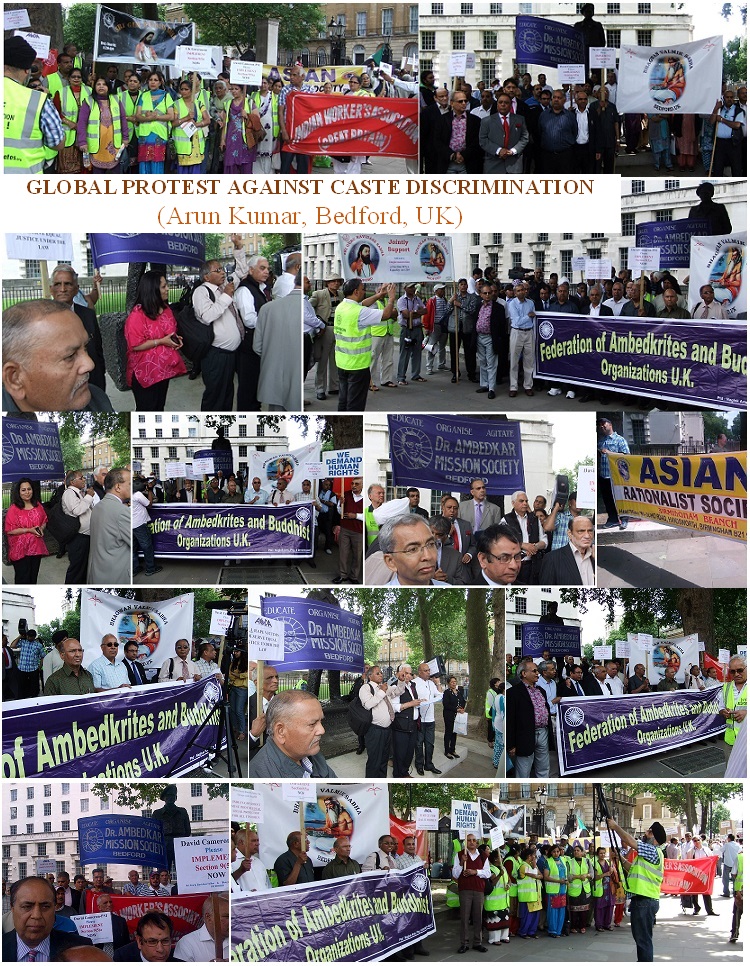
GLOBAL PROTEST AGAINST CASTE DISCRIMINATION (Arun Kumar, Bedford, UK)
21st June, 2014 will be remembered as a historic day in the Dalit history when for the first time NRIs settled in various countries came on streets simultaneously to protest against the caste based discrimination and ill treatment being met to them on the basis of their birth. In solidarity with Dalit organisations across the World, on this very day, a demonstration against caste discrimination took place in front of the 10 Downing Street, the official residence of the British Prime Minister. This was a second demonstration by Dalits held in the month of June. It was organised by the Anti-Caste discrimination Alliance UK and supported by a number of organisations including Federation of Ambedkarite and Buddhist Organisations UK, Ambedkar Mission Society, Bedford, Southall Black Sisters, Indian Workers Association, Sri Guru Ravidass and Bhagwan Valmik Sabhas across UK and several other organisations. The purpose of the protest was to raise awareness with UK Government policy-makers, Parliamentarians, and the Press about the key issues that impact on socially excluded groups like Dalits, atrocities against them including the rape and violence against women and girls in India. It also intended to promote the draft UN Principles and Guidelines for the Effective Elimination of Discrimination based on Work and Descent established by the UN Human Rights Council.
A petition including a joint statement signed by numerous Dalit and non-Dalit organisations demanding the government to implement without further delay the law agreed by Parliament to outlaw Caste-based discrimination in the UK, was handed over to the Prime Minister. The protesters also asked the British government to use their clout to stop atrocities against Dalits especially caste based rapes and violence against women.
The call for Global action against caste based discrimination was given by the US based organisation, International Commission for Dalit Rights (ICDR) and joined by many cross faith Dalit and non-Dalit organisations (including those representing Ambedkarites, Buddhists, Christians, Muslims, Ravidassia and Valmikis). At the same time, the protest events also took place in New York, San Francisco and Los Angeles in USA and Toronto in Canada and raised the voice against human rights abuses in India and abroad.
Posted www.ambedkartimes.com on June 27, 2014
Posted www.ambedkartimes.com on June 27, 2014
A special report by Arun Kumar (General Secretary) Federation of Ambedkarite & Buddhist Organizations UK
Posted on www.ambedkartimes.com , June 9, 2014)
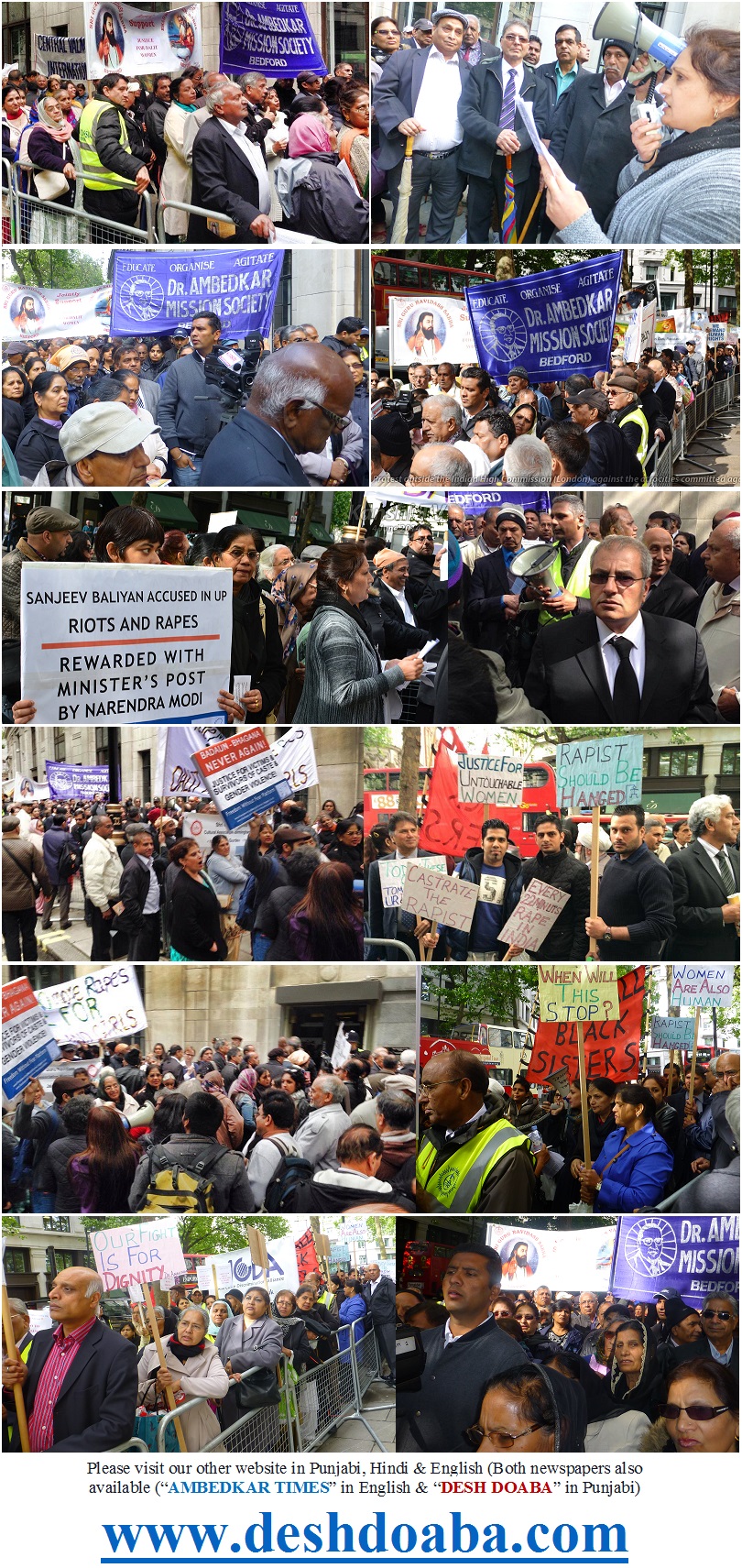
A special report on the demonstration organized by the Freedom without Fear Platform and attended by various organizations from all over UK against the daily occurrences of rapes in India. A memorandum was handed over to the Indian High commissioner
Arun Kumar (General Secretary) Federation of Ambedkarite & Buddhist Organizations UK
We the undersigned women’s organizations, South Asian community organizations and Dalit and anti-caste discrimination organizations in Britain are writing to you to express our acute concern about the ongoing horrific attacks on Dalit and oppressed caste women and children across India, including most recently, the appalling gang-rape and lynching of two girls aged 14 and 15 in Badaun, Uttar Pradesh, on Wednesday 28th May. Only two months earlier, four teenage Dalit girls aged 13-18 were raped by ‘higher caste’ landowners in Bhagana in Haryana, and the survivors are still fighting for the arrest of the rapists.
We note that:
These caste/gender atrocities are not confined to one state but have been occurring across the country - from Bathani Tola and Bathe in Bihar to Khairlanji and Khadra in Maharashtra.
These are taking place with the collusion of the police as recently highlighted by the UN Special Rapporteur on Violence Against Women. In many cases the police themselves are the perpetrators.
There has also been collusion by public prosecutors and the judiciary, which has led to acquittals of the guilty.
Public figures who have been responsible for rapes and murders of minority, Dalit and Adivasi women have been rewarded and promoted – two of many examples are Muzaffarnagar-accused Sanjeev Baliyan, now made a central government Minister, and Police Superintendent Ankit Garg awarded for gallantry after supervising the rape and torture of Soni Sori.
We urge you therefore to ensure that:
In the Badaun case: The police involved in the rape-murders must be prosecuted: In the FIR lodged by the police, the culprit policemen have been charged only with abetment (120B) whereas they should be named as the accused and
Section 166A (which refers to police and other public servants refusing to do their duties) also should be invoked in the case. The government must take measures to guarantee the security of the families of the victims since police are among the accused.
In the Bhagana case:The eviction today from Jantar Mantar of the rape survivors and their families who have been forced to protest in Delhi for many weeks must be stopped. Their demands must immediately be met: all those named by the survivors must be arrested; the Dalit community in Bhagana must be given land and guaranteed security as is their right; full compensation must be provided to the Bhagana rape survivors.
Inthe cases of the Bathani Tola and Bathe massacres and mass rapes carried out by the Ranvir Sena in Bihar: all those convicted on the evidence of eyewitness survivors have been subsequently acquitted by the Patna High Court. These acquittals must be overturned. The Amir Das Commission investigating the Ranveer Sena which was hastily disbanded before it could make its findings public, must be reinstated.
Sanjeev Baliyan who is a main accused in the Muzaffarnagar riots and mass rapes of Muslim women in U.P. (and has continued to break the law, taking out inflammatory victory processions against Prohibitory Orders) must be removed from his post as Minister of State for Agriculture and Food Processing in the central government immediately.
The Atrocities Act which is specifically designed to address caste violence must be applied in all cases of caste/gender violence against SCs and STs.
Yours sincerely,
Sarbjit Johal, Freedom Without Fear Platform
Amrit Wilson, South Asia Solidarity Group
Santosh Dass, Federation of Ambedkarite and Buddhist Organisations (UK)
Ravi Kumar, Anti Caste Discrimination Alliance
Davinder Prasad, British Organisation of People of Asian Origin
Bholi Randhawa, Shri Guru Ravi Dass Mission International (Kanshi TV)
Desraj Bunger, Sri Guru Ravidass Sabha, UK, Europe and Abroad
Satpal Muman, CasteWatch UK
Faquir Chand Sahota, Central Valmik Sabha (UK)
Eugene Culas, Voice of Dalit International
Pastor Raj, Minority Christian International Federation
Baljit Banga, Newham Asian Women’s Project
Pragna Patel, Southall Black Sisters
Sumanta Roy, Imkaan
Anjum Mouj, Rape Crisis England and Wales
Balvinder Saund, Sikh Women's Alliance UK
Shahida Choudhury,Women’s Networking Hub
Posted by Freedom Without Fear Platform at 14:07No comments: Email ThisBlogThis!Share to TwitterShare to FacebookShare to Pinterest
Labels: Badaun, Bhagana, Dalit women and girls, gender violence, India Monday, 2 June 2014 BADAUN-BHAGANA-NEVER AGAIN! DEMAND JUSTICE FOR THE VICTIMS AND SURVIVORS OF GENDER/CASTE VIOLENCE! Wednesday 4th June 4.30 - 6.30pm Indian High Commission The Aldwych, London WC2 (nearest tube is Holborn)
The appalling gang-rape and lynching of two Dalit girls aged 14 and 15 in Badaun, Uttar Pradesh, India on Wednesday 28th May is the latest in a long line of horrific murders and sexual assaults perpetrated on young Dalit women across India recently. Only two months earlier, four teenage Dalit girls aged 13-18 were raped by ‘higher caste’ landowners in Bhagana in Haryana, and the survivors are still fighting for the arrest of the rapists.
Dalit women and girls are facing an onslaught of gender, caste, and class based violence in which the Indian state collaborates. Less than 1% of rape cases of Dalit women by non-Dalits end in conviction. The level of impunity is so total that the perpetrators feel confident to finish off their vile crimes by murdering the victims and leaving their bodies on display. Are the lives of young Dalit women so expendable?
In the Badaun case, the police refused to investigate when the girls’ families reported them missing and even threatened to kill them if they filed a case, and two policemen have now been charged with conspiring with the higher caste rapists. In Bhagana, the courageous survivors and their families have been forced to travel to Delhi and stage an ongoing protest to demand the arrest of the rapists –after the police refused to register cases against the powerful men named by the girls in their testimonies.
Dalit women have been targeted for sexual violence wherever Dalit communities are challenging oppression and exploitation. In Bhagana, the four girls were raped in ‘revenge’ after Dalits demanded that the upper caste controlled village council hand over the land which had been allocated to them by the government, and protested against eviction and harassment. In Bihar, the Ranvir Sena, a landowners’ army aligned with Narendra Modi’s ruling Bharatiya Janata Party, targeted Dalit and Muslim women for horrific violence when the rural poor organized for land and a living wage.
The recent election victory of Narendra Modi and the BJP has further emboldened upper caste and economically powerful rapists. The Brahmanical-patriarchal ideas of the Hindu right, in which Dalit women’s lives have no value, are being combined with intensified neoliberal economic policies which leave Dalits and other exploited and marginalised people even more vulnerable. While Modi tried to reach out to Dalits in his election campaign, his close ally Baba Ramdev’s offensive remarks about Dalit women as the sexual property of upper castes exposed once again the misogynistic casteism of the Hindu right. In the wake of the Badaun case, Modi has condemned the appalling levels of gender violence in opposition-ruled UP, but the fact that he has given a Ministerial post in his government to Sanjeev Baliyan, one of the main accused in the Muzaffarnagar communal violence in UP last year which involved mass rapes of Muslim women, sends out a very different signal.
The last year and a half has seen a powerful movement against gender violence in India. But the Badaun and Bhagana cases painfully underline once again that the struggle continues, and can only succeed if the lethal connections between gender, caste, class and communal violence are recognized and fought.
Dalit groups and progressive and left women’s groups and students organisations in India are on the streets demanding justice for the victims and survivors of Badaun and Bhagana. Join the solidarity protest outside the Indian High Commission in London on Wednesday 4th June from 4.30 to 6.30pm.
Supported by
Anti Caste Discrimination Alliance; BOPA; CasteWatch UK; Central Valmik Sabha UK; FABOUK; Imkaan, Newham Asian Women’s Project; Rape Crisis England and Wales; South Asia Solidarity Group; Southall Black Sisters; Sri Guru Ravidass Sabha, UK, Europe and Abroad; Shri Guru Ravi Dass Mission International (Kanshi TV); Voice of Dalit International; Women’s Networking Hub Posted on www.ambedkartimes.com , June 9, 2014)
Posted on www.ambedkartimes.com , June 9, 2014)
FABO UK welcomes the reports Caste in Britain
Dear All,
The Federation of Ambedkarite & Buddhist Organisations UK (FABO UK) welcomes the reports Caste in Britain by the independent researchers commissioned by the Equality and Human Rights. These reports follow months of stakeholder engagement that included FABO UK's input. The EHRC has delivered on its commitment to produce the reports. Now the Government needs to meet theirs and issue the promised consultation before the end of March 2014 and finally begin the process (without further unnecessary delay) to implement the law agreed by Parliament in April 2013.
Arun Kumar General Secretary Federation of Ambedkarite & Buddhist Organisations UK
(07909828750)
Posted on www.ambedkartimes.com , March 3, 2014)
Fight for Justice
continues -FABO UK
The Annual General Meeting of the Federation of Ambedkarite and Buddhist Organisations UK, took place on Sunday 22 September 2013 at the Ambedkar Centre, 12 Featherstone Road, Southall, Middlesex, West London. Five member organisations - : Dr Ambedkar Memorial Trust, London, Buddha Dhamma Association, Southall, Ambedkar Mission Society Bedford, Punjab Buddhist Society UK, Dr Ambedkar Mission Society Glasgow - participated in the meeting.
The Government’s delay on the implementation of the legislation to outlaw caste discrimination was discussed. The protracted timetable of two years announced by the Government was agreed as nothing more than a mere ploy to stop the implementation of the legislation agreed by Parliament. This clearly signals that the government does not want to see the implementation of the law during its term. The government’s attitude was strongly condemned. FABO UK will continue to support and participate in the campaign for early implementation of the legislation to outlaw caste discrimination in the UK.
It has been over six decades since independence, but atrocities on Dalits and especially on Dalit women continue to increase day by day. The India Government must ensure fast track courts that deal with cases of rape work to ensure that timely justice is provided to the victims. The legal system in India must also provide justice for victims of caste oppression.
Dr. Ambedkar was one of the greatest advocates of human rights and equality of treatment. He devoted his life and work to provide justice for victims of discrimination. To maintain the legacy of Dr. Ambedkar, participants in the meeting took a pledge to continue to work against inequality and injustice and raise the concerns of the neglected and suppressed people.
Elections for the key positions in FABO UK were held during the meeting. We are delighted to announce that the following members were elected unanimously under Chairperson of Election Commissioner, Mrs. Hiroo Parmar:
President: Ms. Santosh Dass MBE, Vice President: Ram Pal Rahi, General Secretary: Arun Kumar, Joint Secretary: C Gautam,
Treasurer: Sohan Lal Gindha, Public Affairs: Gira Ashok Chakravarty
Arun Kumar
General Secretary
Federation of Ambedkarite and Buddhist Organisations UK
Buddha Vihara,12, Featherstone Road, Southall, , Middsex, London UB2 5AA
E: fabo@ambedkar.org.uk U: www.ambedkar.org.uk Tel; Tel: 0044 7956 918053/07909828750
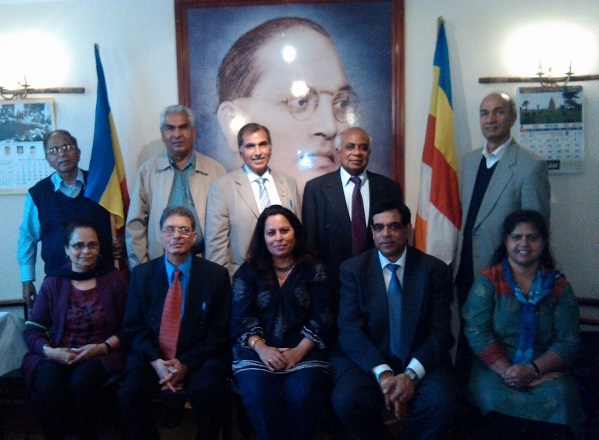
Picture caption: Sitting from left to right: Dhamma Chakravarty, Arun Kumar, Santosh Das, Ram Pal Rahi, Surjit Birdi,
Standing from left to right: C. Gautam, Hukam C Mehmi, Sohan Lal Ginda, Madhav Rao Patil, Bakshi Birdi
First Ambedkar Day celebrated in Africa - Africa chapter of Ambedkarism (fight against caste system) begins .....
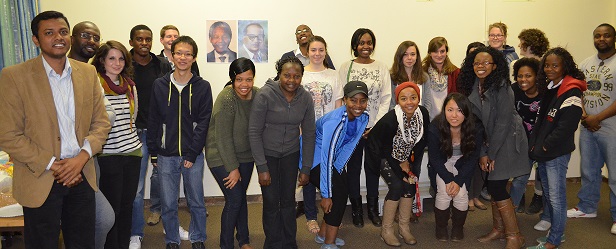
Johannesburg, 24th July, 2013 - Here in South Africa, University of the Witwatersrand, International House Committee organised "Ambedkar-Mandela" day. Seeking the rare occasion of Madela's 95th and Ambedkar's 122nd Birth Anniversary. International House Committee organised the event celebrating the two heroes that fought for the upliftment of the marginalised sections of societies in two parts of the world. This event was an imperative of South-South co operation where the two human rights champions were celebrated.
The event was presided by the Chairperson of the I-House, Mr Suraj Yengde (India), and Treasurer Ms Ntee Mbhele (South Africa). Participants from Europe, Africa, America's and Asia were present in the round table discussion on the issues of Caste and Racism. Everyone shed the light on their experiences in South Africa celebrating Mandela's legacy.
In the Chairperson's address Suraj Yengde provided insights on the India's downtrodden sections of society introducing the atrocious nature of caste system. Comparing with the world's existing discrimination, he stressed caste system in India is world's oldest surviving discrimination. This programme was the first event in Africa that celebrated two champions of human rights introducing Ambedkar's contribution in the fight against discrimination through the caste system. Following the address, there was a question and answer session where participants expressed their interest and curiosity in unveiling the realities of caste system. Ms Chaimae Charifi (Morocco) provided critical insights on the existing discriminatory practices in South Africa.
Programme concluded with exchange of thoughts and the way forward to end the existing discriminatory practices. I-House Committee Secretary Ms Pokuaa Banson (Ghana), Sports Officer Mr Rafael Kalumbu (Namibia), Entertainment Officer Mr Nepo Moloi (SA), and Exchange Student Rep Ms Tamara (Japan) were present. Posted on www.ambedkartimes.com July 30, 2013
“THE
RISING”
HAS FINALLY ARRIVED IN THE UK
Arun
Kumar
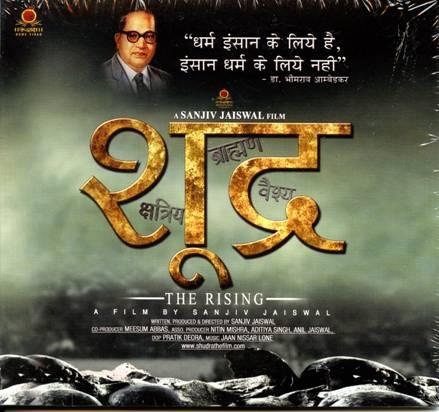
Shudra:
The Rising is a Hindi language period film with subtitles
in English set in the Indus Valley Civilization with a
storyline based on the beginning of caste system in ancient
India. Shudra is based on about 250 million people born
Out Castes in Hindu Varna system. They were treated as
Unclean & Impure, so much so that nobody ever even
touched them or even allowed their shadow to fall on upper
caste. They were named differently at different times
such as 'DASYU', 'DAS', Chandala, Antyaja, Out Caste,
lower Caste and "Shudra- The Untouchable". "Shudra-
The Rising" highlights the depth that evil human
mind can succumb, to cling on to power and supremacy.
An out caste man 'Shudra' died for want of a sip of water,
a child is publicly killed for uttering Holy Mantras,
a pregnant woman is forced in the physical submission,
a wounded man dies in need of medicine, all for one crime
only.....Born in the caste of "Shudra-The Untouchable"
The initial part narrates the invasion of the people of
west Asia to India. They were of the Aryan race and they
took over the local tribe
Dear Friends,
Much awaited film ‘Shudra- The Rising’ has finally
arrived in the UK. Priced at £7.99 (£6.00 plus
p & p £1.99). All DVD’s are sent via 1st Class
Recorded post. Pack includes one audio and video. To get the copy: Please pay via
bank transfer into the following bank account: Bank: Lloyds
TSB, A/c No: 00856609, Sort Code: 30 – 90 – 66,
OR Send cheque for the amount of £7.99, payable to:,
‘Ambedkar Mission Society, Bedford (UK)’. For
further details, please contact: Pirthi Kaeley:
01234404727, email: p.kaeley28a11@sky.com Arun Kumar: 07909828750,
email: arun.kumar@ntlworld.com Alternatively you can also
buy from eBay on the following link: http://www.ebay.co.uk/sch/i.html?_trksid=p3902.m570.l1313
&_nkw=shudra-the+rising+2012&_sacat=0&_from=R40
tribe
and started controlling them. Finally their learned scholar
Manu wrote a code book of caste system which turned the
local population as the Shudras (lowest of the low), who
were imposed with cruel rules in the society. They were
suppressed and exploited at every level of their lives by
the upper caste people. The film shows various rules imposed
on the Shudras such as walking with a bell around their
ankles and a long leaf as tail. The film also sheds a light
on the struggle by the Shudras.
This film is a must see for everybody who wants to know
the history and effect of caste based discrimination on
the Indian society.
The proceeds of this film will be given to the Rudraksh
Productions for their future project which is again on the
bravery of Dalits in ‘The Battle of Koregaon’-
a saga of fight between the Mahar soldiers and Peshwas.Posted
onwww.ambedkartimes.com , January
21, 2013
Shri
Guru Ravidass Sabha Vancouver, BC (Canada) celebrating 127th
birth anniversary of Babu
Mangu Ram
Muggowalia Ji
on
SUNDAY, January 20, 2013 at Shri Guru Ravidass Temple, 7271
Gilley Avenue, Burnaby, BC
For more information please contact: Tejpal
Gangar (778) 319-5431
SILENCE
OVER DALIT RAPE VICTIMS ARE
THEY NOT THE DAUGHTERS OF INDIA?
Arun
Kumar Ambedkar Mission Society,
Bedford, UK
Delhi saw an unprecedented public outrage over the recent cruel
gang rape and vicious attack on the 23 year old girl. This incident
brought out many people to protest against this heinous crime.
This brutal attack must be strongly condemned and perpetrators
of this offence severely punished so that no body dare to commit
such a crime in future.
Judging the public anger, it appears that no such incident had
happened before Delhi rape case. What happened in Delhi is not
an exception. Many more cases are hushed up regularly or are not
reported. The National Crime Records Bureau records reveal that
during 2011 India witnessed 228,650 crimes against women, 24,206
of them of rape and 35,565 of kidnapping and abduction and majority
of them were belonging to Dalit communities. Most of the crimes
against Dalit women go unnoticed. In the most horrific cases of
sex abuse, Dalit women have not only been raped, but mutilated,
burned, paraded naked through villages, and even forced to eat
human faeces.
Either the people are ignorant or just turn their blind eye to
such incidents. Nobody from the so called civil society took notice
of those crimes. In spite of all these sex offences against Dalit
women, victims do not get even half the response neither from
the social organizations nor from the media as was given to Delhi
gang rape victim. A rape is a rape and all women deserve the same
media attention, same justice, the same mass protests and the
same political will.
India’s middle class wears such glasses from where they
can only see the crimes committed against the upper castes. Their
heart throbs only for their own clan. Women folk from the Dalit
communities mean nothing to them. Society must feel guilty and
act against atrocities against women irrespective of their caste
or class.
Double
standards of the upper middle class raise many questions which need
answers. Shenali Waduge raises a very valid question, “While
rape in any form is abhorred and should be severely punished by
all nations what needs to be answered is what makes the recent gang
rape by 6 men of a 23 year old on a bus in Delhi any different from
the gang rape of a 16 year old Dalit women by 8 men who having taken
photos of the crime had circulated it amongst the village leading
to her father committing suicide out of shame?”(1) This Dalit
girl was raped in September 2012 and Shenali questions why there
were no mass protests, no media attention for her or calls to arrest
the perpetrators but the recent rape has turned into a mass protest
all over India? Can somebody from the civil society answer these
questions?
Similarly
where were all Indians when Khairlarnji massacre occurred in 2006
when a Dalit family was lynched in Maharashtra? In Khairlanji, on
29 September 2006, 44-year-old Surekha Bhotmange and her daughter
Priyanka Bhotmange were stripped, paraded naked, and raped repeatedly.
Surekha's sons Roshan and Sudhir were slaughtered. The entire village
was involved. The Bhotmanges were Dalits. The Bhotmanges have been
forgotten. After all, two Dalits are murdered every day in India.
(2) The Indian media didn’t even bother to cover this incident
until Dalits in Nagpur came on streets to protest. Unfortunately
all India was sleeping as if the Dalit women were not the ‘daughters
of India’.
Dalit
rape victims in Ajmer district in Rajasthan are waiting for justice
for the last seven years. There are 68 reported cases of rape in
the district since 2006 but only one accused has been convicted
in 2007. Just in the months of September and October, 2012 around
19 Dalit women were raped in Haryana. An 18 year old Dalit girl
in Badhshapur village in Patiala committed suicide on December 26,
six weeks after being raped by three men as she couldn’t tolerate
humiliation and tormenting by police and culprits anymore. Her mother
stated that when she went to complain to the police they humiliated
the girl with lewd questions. On 5th January, a 16-year-old Dalit
girl was abducted, raped and forced to eat some poisonous pesticide
by an upper-caste man and dumped outside her house in a village
in Faridkot district in Punjab.
The
tale of sexual abuse doesn’t end here. In an article in Counter-currents,
Cynthia Stephen quotes a Dalit girl from a village in Tamil Nadu
as saying “There is no girl in our lane who has not been coerced
or raped by the dominant caste men when they go to the fields to
fetch water or for work.”(3) Men from the dominant castes
threaten the Dalits with dire consequences if they dare complain
to the police. Sexual violence against Dalit women is a systemic
way of enforcing status quo of the Dalits. Rape is often used as
a tool for political and social subjugation of Dalit women. Rural
areas are full of such incidents. Vast majority of crimes against
Dalit women are not reported owing to fear of social exclusion and
threats to personal safety and security. Every village in India
has such tales to narrate.
Instead
the leaders such as RSS Chief Mohan Bhagwat give us lesson on Indian
culture and advocates that gang rapes and sexual abuses happen only
in urban areas as a result of Western influence and not in rural
areas. If this Hindu ideologue tries to preach us about ancient
Hindu culture, he must feel ashamed of Davdassi system in South
India where girls as young as 6 years old become “brides of
gods” and are raped by men of higher castes in temples. Young
women are also later forced into prostitution through this system.
Violent atrocities occur regularly in the names of tradition and
religion. When are we going to get rid of hypocrisy? Other holy
man blamed girl for the rape as she didn’t beg enough for
mercy. Women are placed on the pedestals and are worshiped daily.
On the other hand, the same women are treated as toys to play with
and discard them when they are not needed. There is a plenty of
evidence in Hindu scriptures where women’s low status is justified.
The verses from the scriptures are still recited where cattle, drums
and women are considered worthy of beating. That is why Dr. Ambedkar
publically burnt down Manusmrity, a manifestation of inequality
and cruelty towards women, and condemned other scriptures which
contain humiliating strictures against women. Women don’t
want the status of goddesses but need equal treatment and respect.
Unprecedented
outcry and coverage surrounding the recent Delhi gang rape has forced
the government to act fast. They have set up a fast track court
for a quick trial and also a commission to bring changes in the
law to deal with rape cases. They are positive steps to pacify the
feelings of general public but one should not have high expectations
from the politicians, police and administrators. As a result of
the high profile rape case in Delhi, it is expected that police
would be more vigilant and conscious and act promptly. But right
under their nose another women was raped on 6th January, 2013 and
her body was dumped in Noida, suburb of Delhi.
Of
course there are flaws in the laws relating to rapes and other offences
against women. But what is worst that even the existing laws are
not implemented fairly and speedily. Speaking on the merits of the
constitution, the architect of the Indian constitution, Dr. B.R.
Ambedkar stated, “I feel, however good a Constitution may
be, it is sure to turn out bad because those who are called to work
it, happen to be a bad lot. However bad a Constitution may be, it
may turn out to be good if those who are called to work it, happen
to be a good lot. The working of a Constitution does not depend
wholly upon the nature of the Constitution”. Same principle
implies to the existing legislation on sexual abuse. The problem
lies in the lack of political will to implement laws. It doesn’t
matter how good laws are made to prevent sexual offences, it depends
upon the law enforcing agencies how quickly the offender is caught
and prosecuted. So far the laws have done little to change the attitudes
and are often ignored.
The
ground reality is that politicians, administrators, police and even
judiciary collude with each other and offender gets free to offend
again. Justice Ashok Ganguli, retired judge, Supreme Court of India,
himself admitted on national Television that judiciary didn’t
treat women with dignity. The cases pertaining to sexual violence
are delayed for 10-15 years. Justice delayed is justice denied.
In majority of cases, the kith and kens or supporters of politicians
and bureaucrats are involved in such cases. That is why police don’t
dare to take action against those culprits. Even they, themselves,
face criminal charges pertaining to sexual offences. According to
the National Election Watch (NEW) and Association for Democratic
Reforms (ADR), in last election there were 260 contesting candidates
from various political parties who were charged under different
sections of Indian penal Code for crimes against women such as outraging
modesty of a woman, assault, insulting the modesty of a woman etc.
What justice is expected from these people? Such politicians should
be named and shamed in public, expelled from the political parties
and debarred from the public office
What
we need is the overhaul of administration and police. Coupled with
tough laws, it is essential that an intensive training is imparted
to the officers dealing with the atrocities on women. Only women
police officers should be deployed to handle such cases where victim
feels free to lodge the complaint. They need an easy access to the
police. Fast track courts are important to deal with all sexual
offences so that victim is given justice in a specific time limit.
Most importantly, Indians must change their mind set and treat women
with respect and give them equal status irrespective of class or
caste. It is only possible if every member of the society feels
responsibility and is sincere to treat women with respect and dignity.
Mere lip service won’t help. One must be bold enough like
Dr. Ambedkar to condemn, if needed, the religious dogmas which preach
hatreds against women.
References:
1. Shenali Waduge, ‘Rape In India: Why Are There No Mass Protests
For Raped Dalit Women’ Eurasia Review on 28th December, 2012,
2. Anand Teltumbde, 'Khairlanji - A strange and bitter crop'
3. Cynthia Stephen, ‘Feminism And Dalit Women In India’
Countercurrents.org,16 November, 2009 Posted on
www.ambedkartimes.com (January 12, 2013)
RAVIDASSIA
RELIGION A Historic Milestone in Creating a Separate
Identity Arun
Kumar, Bedford, UK
The Census
of the United Kingdom known as the 2011 Census took place on 27th
March. 2011. Much awaited results of this Census were published
on 10th December, 2012 which proved to be a milestone in the history
of the Ravidassia community in the UK. For the first time ever,
Ravidassia is listed as an independent religion distinct from
other religions. Though the followers of Shri Guru Ravidass Ji
migrated to UK in thousands, they were not recognized as a separate
community. They were considered either a part of Hindus or Sikhs
and were nonexistent in the official records. The Department for
Communities and Local Government bases its funding decisions on
population estimates. The census reports are used to assist the
planning and allocation of resources, policy-making and decision-making.
As Ravidassia community was missing from the records, there was
no funding available for the benefit and development of their
community. Now the United Kingdom became the first country in
the World to recognize Ravidassia religion as a separate entity.
Census results show that eleven thousand people declared them
as Ravidassia. Jubilant Rai Karra, campaigner for Ravidassia Religion
stated, “The figures are not great but it is a beginning.
As the media was not in their favor, it was difficult to convey
the message of Census to the Ravidassia community. We put across
this message through the word of mouth, leaflets and the road
shows in the Shri Guru Ravidass Guru Ghars (Religious places).
Now Ravidassia community has its own media ‘Kanshi Radio’,
‘Kanshi TV’ and newspapers, more and more people are
becoming aware of their identify. UK will show a way to the Ravidassia
community living in various countries to assert their identity
and be counted.” The campaigners are hopeful that numbers
of Ravidassia community will spurt up in many folds in the next
census in UK.
Ravidassia
religion is deeply rooted in the Ad-Dharm movement started by
Ghadri Baba Babu Mangu Ram Muggowalia in 1920s. The main objectives
of the Ad Dharm movement were to carve out an independent identity
for the untouchables. Ad-Dharm appealed to many people and various
Dalit communities including Valmikis also joined this movement.
In spite of all types of pressures and hardships, the Ad Dharmis
succeeded in registering “Ad Dharm” as a separate
religion for the lower castes in Punjab in the 1931 census. Even
the British government in India recognised “Ad-Dharam”
as a separate religion.
From 1920
to 1946, it played a significant role to mobilize the masses and
bring consciousness amongst the down trodden people of Punjab.
Unfortunately due to factionalism, its influence was greatly reduced.
As Ad-Dharm was dominated by the Chamars, Valmikis parted away
from this movement and it ended up the religion of just one caste
group- Chamars. Ultimately emergence of Dr. Ambedkar’s Scheduled
Caste Federation and Republican Party of India absorbed this movement
and virtually lost its impact on Punjab’s social and political
scene.
In spite
of its decline, the spirit of separate identity remained buzzing.
The followers of Shri Guru Ravidass Ji preferred to call themselves
Ad-Dharmi or Ravidassi. The booklet “Ad-Dharma” –The
way of Guru Ravidass Ji’ published jointly by Wolverhampton
Multi-cultural Education Service and Shri Guru Ravidass Dharmik
Sabha, Wolverhampton, UK, explains the religious beliefs, customs
at the time of birth, marriage, death etc and the way of life
of Ad-Dharmis. This booklet is produced for the benefit of teachers,
students and those who are not familiar with Ad-Dharmis. In introduction,
it says that Ad-Dharm means first faith, original religion or
basic religion with deep roots in India. It also says, “Ad-Dharmis
are also known as Ravidassis because they honour Sahib Shri Guru
Ravidass Ji as their foremost thinker and spiritual leader. They
are neither Hindus nor Sikhs. They share many beliefs with Sikhs
and some with Hindus but they are a distinct movement.”
According to ‘Religions in the UK – A Multi-Faith
Directory’, published by the Derby University, “Ravidassis
who are settled in the UK strictly follow the teachings and philosophy
of Shri Guru Ravidass Ji and worship Guru Granth Sahib since forty
one hymns composed by Shri Guru Ravidass are included within it”
It reflects that Ravidassis worship Guru Granth Sahib not out
of devotion but because hymns of Guru Ravidass are included in
it. Though they worship Sikh scripture, but they are not prepared
to call themselves Sikhs. Ravidassia’s religious places
are called either Bhavans or Temples instead of Gurudwaras. Quami
Nishaan Sahib (symbol on the Ravidassia flag) HAR was adopted
by Guru Ravidass Sadhu Sampardai Society in consultation with
Shri Guru Ravidass Sabha UK and other organisations in India and
abroad and was registered vide Reg. No. A-48-807-co dated 6th
March, 1987. This Nishaan Sahib is hoisted at most of the Ravidass
Bhavans/Temples. They also greet each other with ‘Jai Gurudev’,
‘Dhan Gurudev’.
Caste related
incidents in Punjab especially Talhan incident and assassination
of Sant Rama Nand compelled the followers of Shri Guru Ravidass
Ji part away from Sikhism. . To avoid further bloodshed on the
name of religious code of conduct (Maryada), Dera Sach Khand Ballan
declared “Amrit Bani- Shri Guru Ravidass Ji Maharaj”
as their religious scripture. Though their forefathers such as
Sahib Shri Guru Ravidass Ji, Ghadri Baba Babu Mangu Ram Mugowalia
and Dr. B. R. Ambedkar struggled whole their lives to eradicate
caste divisions, polarisation on caste basis appears to be right
opposite to their teachings. It would have been better if a common
name such as “Ad-Dharm” was given to the new religion
where everybody irrespective of his/her caste felt comfortable
to join.
Now Ravidassia
religion has become the religion of one caste (Chamar) and the
people from other castes will be reluctant to join this newly
formed religion. It may take some time for the followers of Shri
Guru Ravidass Ji in Punjab to change their mindset and adopt this
new identity. But its popularity is increasing in the other states
of India and more and more people are opting for this new alternative.
It appears that in the coming years, this religion will become
a force to reckon with and become a solid pressure group for their
empowerment. Another big time campaigner and one of the founders
of Ravidassia separate identity, Gurdev Lagah said, “We
may have some reservations the way this religion was declared,
but now it is done and we must support it.” Sensing the
feelings of young and old, it appears that more and more people
will support and follow this new identity. The supporters of Ravidassia
community in the UK, Kanshi Radio and Kanshi Television which
are heard and seen in 57 countries will also facilitate to mobilise
the rank and file to join this new emerging religion.
Posted on www.ambedkartimes.com (December 28, 2012)
EUROPEAN
PARLIAMENT
CONDEMNS ATROCITIES ON DALITS
(Arun
Kumar, Bedford, UK)
Indian
authorities have so far been able to hide the caste problem under
the carpet and always denied the caste based discrimination. Recently
Dalits have become more vocal and exposed the false propaganda of
the government. They are voicing their concerns at the international
forums. Consequently the caste issue is no longer hidden from the
outside World.
On
December, 13, European Parliament in Strasbourg debated caste discrimination
in India and adopted a strongly worded resolution to condemn the
continued human rights violations, increasing number of atrocities
committed against Dalits and the Indian Government’s inability
to take a firm action against the culprits. European Parliament
also deplored the non-intervention by police in acts of violence
against Dalits.
Acknowledging the significant efforts to make legislation to eradicate
caste based discrimination, Parliament urged the Indian authorities
at federal, state and local level to honour their pledges and implement
and amend if needed existing legislation particularly the Scheduled
Caste and Scheduled Tribes Atrocities Act in order to protect Dalits
from caste oppression. European Parliament also urged the EU’s
and the Member States’ representations in India to include
the issue of caste discrimination in their dialogues with the Indian
authorities, and to prioritise programmes addressing caste discrimination,
including in education, and programmes
Following
is the full text of resolution passed by the European Parliament
Caste discrimination in India
PE502.571European Parliament resolution of 13 December 2012 on caste
discrimination in India (2012/2909(RSP))
The
European Parliament,
– having regard to its previous resolutions, in particular
that of 1 February 2007 on the human rights situation of the Dalits
in India and those on the Annual Reports on Human Rights in the
World, notably that of 18 April 2012 ,
– having regard to the International Covenant on Civil and
Political Rights,
– having regard to the International Convention for the Elimination
of Racial Discrimination (CERD), and to its General Recommendations
XXIV, as ratified by India,
– having regard to the government proposal put forward by
Mukul Vasnik, Minister of Social Justice and Empowerment, on ‘The
Prohibition of Employment as Manual Scavengers and their Rehabilitation
Bill, 2012’, presented to the Indian Parliament on 3 September
2012,
– having regard to the statement of 19 October 2009 by the
UN High Commissioner for Human Rights, Navi Pillay, and her appeal
to UN member states to endorse the draft UN Principles and Guidelines
for the Effective Elimination on Discrimination based on Work and
Descent,
– having regard to the recommendations arising from the UN
Special Procedures and UN treaty bodies, as well as to those in
the two Universal Periodic Reviews on India of 10 April 2008 and
24 May 2012,
– having regard to the recommendations of 9 July 2012 of the
UN Working Group on the Universal Periodic Review on India,
– having regard to the deep concern expressed on 6 February
2012 by the UN Special Rapporteur on human rights defenders regarding
the situation of Dalit activists in India,
– having regard to the ongoing Maila Mukti Yatra, the nationwide
march of thousands of people for the eradication of manual scavenging
which between 30 November 2011 and 31 January 2012 crossed 18 of
India’s states,
– having regard to the EU-India thematic dialogue on human
rights,
– having regard to Articles 2 and 3(5) of the Treaty on European
Union,
– having regard to Rules 122(5) and 110(4) of its Rules of
Procedure, A. whereas India has made
enormous economic progress, and as one of the BRICS countries now
plays an important role in world politics; whereas, however, caste
discrimination continues to be widespread and persistent; B. whereas India’s
Constitution grants its citizens equal status, and discrimination
based on caste and untouchability is deemed illegal in its Articles
15 and 17; whereas Dalits have served in the highest political functions;
whereas India has laws and regulations intended to protect Scheduled
Castes and Scheduled Tribes, such as the 1976 Protection of Civil
Rights Act and the 1989 Scheduled Castes and Scheduled Tribes (Prevention
of Atrocities) Act; whereas Indian Prime Minister Manmohan Singh
has made several strong statements about prioritising combating
violence against Dalits; C. whereas, despite these
efforts, an estimated 170 million Dalits and indigenous Adivasi
in India continue to suffer from severe forms of social exclusion;
whereas the ILO estimates that the overwhelming majority of bonded
labour victims in the country are from Scheduled Castes and Scheduled
Tribes; D. whereas manual scavenging,
despite being legally banned, continues to be widespread, with hundreds
of thousands of almost exclusively female Dalits performing this
form of servitude, Indian Railways being the largest single employer
of manual scavengers; E. whereas Dalit and Adivasi
women are the poorest of the poor in India, face multiple discrimination
on the basis of caste and gender, are frequently subjected to gross
violations of their physical integrity, including sexual abuse with
impunity by members of dominant castes, and are socially excluded
and economically exploited, with a literacy rate of only 24 %; F. whereas according to estimates
the vast majority of crimes against Dalit women are not reported
owing to fear of social ostracism and threats to personal safety
and security; whereas in one particular case in Haryana state a
16-year-old Dalit girl was gang-raped in the village of Dabra (Hisar
district) on 9 September 2012; whereas her father committed suicide
after discovering what had happened and the police only decided
to take belated action when faced with mass protests; G. whereas on 20 November
2012, in Dharmapuri (Tamil Nadu state), a mob of approximately 1
000 people from higher castes looted and torched at least 268 houses
in Dalit communities, with no intervention from the police officers
present; H. whereas the Protection
of Women from Domestic Violence Act of 2005 lacks effective implementation,
and whereas the pervasive prejudice against women in the police,
the legal system, the medical establishment and the political class
impedes the dispensing of justice; I. whereas the conviction
rate under the Scheduled Castes and Scheduled Tribes (Prevention
of Atrocities) Act continues to be very low, providing no deterrent
against crimes; J. whereas, according to
various local and international sources, between 100 000 and 200
000 girls – the majority of them Dalits – are allegedly
trapped in bonded labour in spinning mills in Tamil Nadu which supply
yarn to factories that produce garments for western brands; 1. Acknowledges the efforts at federal, state,
regional and local level in India to eradicate caste discrimination;
applauds, furthermore, the clear stance against caste discrimination
taken by many Indian politicians, Indian media, NGOs and other public
opinion makers at every level of society; 2. Remains, however, alarmed at the persistently
large number of reported and unreported atrocities and widespread
untouchability practices, notably manual scavenging; 3. Urges the Indian authorities at federal, state,
regional and local level to honour their pledges and to implement
or, if necessary, amend the existing legislation, notably the Scheduled
Castes and Scheduled Tribes (Prevention of Atrocities) Act, in order
to effectively protect Dalits and other vulnerable groups in society; 4. Underlines, particularly, the need for victims
to be able to safely register their cases with the police and judicial
authorities, as well as for serious follow-up by the police and
judiciary of reported atrocities and other cases of discrimination; 5. Calls on the Indian Parliament to act on its
plans to pass a new Bill prohibiting employment of manual scavengers
and securing their rehabilitation, and on the Indian Government
to take the necessary measures for its immediate enforcement; 6. Calls on the Indian authorities to repeal those
provisions of the Foreign Contribution (Regulations) Act which do
not conform to international standards and potentially undermine
the work of NGOs, including Dalit organisations and other organisations
representing disadvantaged groups in Indian society, by impeding
them from receiving funds from international donors; 7. Calls on the Council, the Commission, the High
Representative of the Union for Foreign Affairs and Security Policy
/ Vice-President of the Commission (HR/VP), the EU Special Representative
on Human Rights, and the EU Member States to develop an EU policy
on caste discrimination and to endorse the draft UN Principles and
Guidelines for the Effective Elimination of Discrimination based
on Work and Descent in the UN Human Rights Council; 8. Welcomes the Union Cabinet's approval in September
2012 of the Child & Adolescent Labour (Prohibition) Act, banning
employment of children below 14 years across all sectors and below
18 years for hazardous sectors; calls on the Government of India
to take effective implementing measures in order to rapidly reduce
what is still one of the highest number of working children in the
world and to introduce legislation for a full ban on child labour
in accordance with the International Labour Organisation guidelines; 9. Calls on the EU’s and the Member States’
representations in India to include the issue of caste discrimination
in their dialogues with the Indian authorities, and to prioritise
programmes addressing caste discrimination, including in education,
and programmes with particular focus on women and girls; expects
future EU cooperation with India to be assessed as to how it would
affect caste discrimination; 10. Instructs its President to forward this resolution
to India’s Prime Minister, India’s Minister for Law
and Justice, India’s Home Minister, India’s Minister
of Social Justice and Empowerment, the Council, the HR/VP, the Commission,
the EU Special Representative for Human Rights, the governments
and parliaments of the EU Member States, the Secretary General of
the Commonwealth, the Secretary-General of the UN and the President
of the UN General Assembly.
Posted
on www.ambedkartimes.com (December 18, 2012)
Poona
Pact and Beyond
(Arun Kumar, Bedford, UK)
September 24th
is a very significant day in the history of Dalit movement.
It is the day when after thousands of years of slavery, an agreement
between the representatives of the indigenous people of India
and the ruling Aryan class was signed to give legitimate representation
and share to the members of Depressed Classes. After successful
argument in the Round Table Conferences, Dr. B.R. Ambedkar was
able to convince the British government for a separate electorate
for the Untouchables by which they were to elect their own representatives
in the Lok Sabha and the provincial legislative assemblies as
similar provisions were already available for the other minorities,
including Muslims, Christians, Anglo Indians and Sikhs. But
Gandhi bitterly opposed this award and began fast unto death.
A huge pressure was put on Dr. Ambedkar to change his mind.
The people of Depressed Classes (Dalits) were being threatened.
Had Gandhi died as a result of fast, there would have been a
huge bloodshed. To avert the danger to the lives of his people,
Ambedkar withdrew his demand of separate electorate and an agreement
was reached at Yerwada Central Jail, Poona on 24th September,
1932. Now this agreement is popularly known as Poona Pact. This
Pact was incorporated in the government of India Act 1935 and
later on in the Constitution of Independent India.
Dr. Ambedkar was never happy with this agreement. He complained
of blackmail by Gandhi as he was forced to sign the pact under
the impact of coercive fast. Ambedkar denounced it the very
next day expressing his views, “The untouchables were
sad. They had every reason to be sad.” He kept denouncing
it till the end of his life in 1956. He denounced it in private
discussions, public meetings, relevant writings, in fact on
all the occasions that demanded denunciation. Commenting upon
Gandhi’s fast, he said “There was nothing noble
in the fast. It was a foul and filthy act. The fast was not
for the benefit of the Untouchables. It was against them and
was the worst form of coercion against helpless people to give
up the constitutional safeguards of which they had been possessed
under the Prime Minister’s Award and agree to live on
the mercy of the Hindus. It was a vile and wicked act. How can
the untouchables regard such a man as honest and sincere?”
Ambedkar was well aware of the loss suffered by the Schedules
Castes by losing separate electorate. He made clear, “If
the Poona Pact increased the quota of seats for the untouchables
it took away the right to the double vote given to them by the
communal award. This increase in seats can never be deemed to
be a compensation for the loss of the double vote. The second
vote given by the Communal award was a priceless privilege.
Its value as a political weapon was beyond reckoning.”
The Joint Electorate is a form in which the Hindus get the right
to nominate a member of Scheduled Caste to set nominally as
a representative of the Scheduled castes but really as a tool
of the Hindus. There a sizeable number of Dalit MLAs and MPs,
most of them feared they would not get re-elected if they aggressively
raise their voices against Dalit oppression. Though we have
got constituencies reserved for Dalits, it is unfortunate that
those who act like rubber stamps, without aggressively opposing
any oppression, are being preferred by caste forces. Babu Kanshi
Ram explained this phenomenon in his much acclaimed book, ‘The
Chamacha Age’ in which he says that Poona Pact has produced
stooges not the real representatives of Bahujans.
It is true that Poona Pact lacks the spirit of proper and real
representation, but it cannot be denied that it played a vital
role in transforming the economic and social conditions of Scheduled
Castes/Tribes. Today whatever the progress is seen in their
conditions, Poona Pact is a contributory factor. The policy
of reservation has helped Dalits to achieve high positions.
Mr. K.R. Naryanan became the President of India, highest office
in India. K.G. Balakrishanan served as the Chief Justice of
India, Meera Kumar as Speaker of Lok Sabha, Ms. Mayawati as
a Chief Minister of Uttar Pardesh, India’s biggest and
most populous state. There are numerous administrative officers
in Central and state governments which was unimaginable without
the Poona Pact. Enlightened government employees helped political
leadership. Prime example is Babu Kanshi Ram who was able to
organize them and his leadership emerged as a result of Backward
and Minority Communities Employees Federation (BAMCEF). Even
the emerging middle class in the Dalit communities is a consequence
of Poona Pact. The government employees are giving their children
a good quality education. Consequently they either get good
employment or start their own small businesses which help them
to improve the economic condition of their families which raise
their social status in the society.
With the introduction of privatisation, liberalisation, globalisation
and disinvestments, many government industries and public sector
undertakings have already been sold off. As a result, thousands
of jobs in the public sector have been lost. The technology
has also reduced the job market. Privatisation has an adverse
effect on Dalits. There is no clause for reservation being added
into the disinvestment deals struck between the government and
the private sector. It is a clear subversion of caste-based
reservation and keep the Dalits away from jobs. Reservation
in the government service is not only the way for empowerment;
Dalits must think and act beyond that. It doesn’t matter
how much we oppose globalisation and privatisation, it is going
to stay in future and we will have to adjust ourselves into
the new system. We have to change our strategy and adapt ourselves
accordingly. In the latest study, 97% of executives or board
members in the listed companies belong to the upper castes.
Private companies are either owned or managed by the family
members or a particular caste group, Dalits have no chance to
get opportunity in those positions.
Educated
Dalit intellectuals are beginning to realise that Dalits will
have no place in the market economy. To find a new strategy to
overcome this situation, in January 2002, a Dalit conference was
held in Bhopal. Over 300 Dalit intellectuals unanimously adopted
the Bhopal Declaration containing 21 points identifying the area
of intervention for uplifting of Scheduled Castes/Tribes and their
participation in the public and private sector. On 26th January
2002, in his Republic Day address to the nation, the then President
of India, Mr. K.R. Narayanan endorsed this declaration, which
generated a serious debate throughout the country. The concept
of diversity came into forefront for the first time. The main
theme of the Bhopal Declaration is that there must be an equal
participation of all sections of the society in the activities
of all key institutions be it governance, education, institutions
and trade. Every government and private organisation must implement
Supplier Diversity from socially disadvantaged businesses and
Dealership Diversity in all goods and services. The reservation
must be compulsory in the private and corporate sector in the
same proportion as in the public sector and in the government
institutions and develop the capacities and skills of Dalits to
help them cope up with the demands of these different sectors.
To
accelerate this momentum, another International Dalit Conference
took place in Vancouver, Canada on 16-18 May 2003. Endorsing the
Bhopal Declaration, the Conference asked for rightful and proportionate
share of Dalits in India’s national institutions, wealth
and capital. The community should have equitable access to means
of production and economic empowerment. Because of the Bhopal
and Vancouver Declarations, the reservations to Dalits in the
private sector were given prominence in the minimum common programme
of United Progressive Alliance (UPA) but unfortunately it remained
in the manifesto. Most of the industry houses opposed and gave
emphasis on quality education to Dalits so that they are able
to compete with others. But Dalit intellectuals such as Chander
Bhan Parsad, Mr. D. Shyam Babu and others were also stressing
upon the need to implement contract/suppliers/dealership diversity,
giving surplus land to landless labourers and diversity into educational
institutions. Some of the Dalit entrepreneurs came together and
established their own Dalit Chamber of Commerce and Industry (DCCI).
On the demand of DCCI the Central government decided that all
ministries would make 4% of their annual purchase from micro,
small and medium enterprises run by SCs/STs. Dalit activists believe
that mandatory purchases from Dalit units would boost entrepreneurship
among poor classes with assured state clientele and without the
fear of competition from entrenched businessmen.
Dalits
are well under represented in the main stream media. There is
hardly any recognisable Dalit face on television, films or in
English national newspapers. Poona Pact has helped in many ways
but there is lot to be done to alleviate poverty, eradicate caste
and set up society based on equality, liberty, fraternity and
equal justice-the dream of Babashaeb Ambedkar. Dalits must give
importance to education, organising themselves and struggle for
their rights. Unfortunately, a lot of Dalits give first priority
for organising and hence jump into the process of organising themselves
at the cost of their education. This will impact the growth of
the community. Education should be the top priority for them.
Since the introduction of Indian Constitution, a number of amendments
are made for the empowerment of Dalits, but these provisions are
never implemented. It is only possible if Dalit representative
capture the temple of power, Parliament and state assemblies and
enforce laws enshrined in the constitution. Poona Pact has served
its purpose and now it is our duty to work beyond that. Posted
on www.ambedkartimes.com , September 24, 201
VOTE
FOR
DR.B.R AMBEDKAR &
SAHIB KANSHI RAM JI
Jaibhim
All,
Currently a survey is being conducted by IBN Lokmat news channel
about Greatest Indian after Mahatma Gandhi who is the most influential,
iconic & inspirational and has impacted the society.
Hence my
humble request to all of you that please votes for our legendary
heroes DR. Babasaheb Ambedkar and Babu Kanshi Ram Ji.
You can vote Ambedkar on this no. 08082891002 and Babu Kanshi
Ram Ji on 08082891006 by giving misses call. You can vote maximum
ten Indians. But don’t miss our icons.
You'll
receive following SMS if you able to vote successfully. "Thank
you. Your vote has been registered for Dr.B.R.Ambedkar. You
can also vote on face book. For complete list visit: TheGreatestIndian.in".
Please spread this information to your contacts. Thanks.
With kindest regards, Arun kumar (Posted
on June 11, 2012)
AMBEDKARITE
MOVEMENT IN THE WESTERN HEMISPHERE Arun Kumar, Joint Secretary, Federation of Ambedkarites &
Buddhist Organisations, UK.
(The installation of bronze busts of Dr Babasaheb Ambedkar
in London School of
Economics and Columbia University in New York means that
the world renowned
educational institutes on both sides of the Atlantic which
contributed towards the
nurture and growth of Dr. Ambedkar’s prodigious
intellectual skills and scholarly
acumen now have memorials to one of the greatest figures
of modern India.)
Ambedkar
connection with the United Kingdom goes back to 1920s when he
came to London to study in the London School of Economics. Perhaps
he was the first Indian to acquire a Doctorate of Science in
Economics from this world renowned institution. Later on as
Labour Minister, he sent many students for higher studies to
London. Whether anybody stayed back or not is not known. The
history of Ambedkarite movement could be traced back to early
fifties when Dalit pioneers started arriving in the UK. They
began to celebrate Baba Saheb Dr. Ambedkar’s birth anniversaries.
As those early pioneers were influenced by Dr. Ambedkar’s
Buddhist conversion, they established Bhartiya Buddhist Society.
In 1964, Barrister Khobragade, General Secretary, Republican
Party of India (RPI) was invited. In his presence, Republican
Group of Great Britain was set up to support Republican Party
of India. The members of this group continued to propagate Dr.
Ambedkar’s ideals by inviting Republican leaders and arranging
number of conferences and functions. With the split of RPI,
this group also disintegrated.
The
followers of Dr. Ambedkar wanted to carry on Dr. Ambedkar’s
message of equality, liberty, fraternity and equal justice.
As majority of migrants were from the Punjab origin and were
settled in the midlands, they set up Dr. Ambedkar Memorial Committee
of Great Britain, Wolverhampton in 1969. This committee opened
Buddha Vihara in 1976. As a large Buddhist community emerged
in Wolverhampton, a purpose built Buddha Vihara and Dr. Ambedkar
Community Centre was opened in 1991 to commemorate the Ambedkar
Birth Centenary. In 2003, an Ambedkar Museum was added to this
community centre in which important memorabilia such as Dr.
Ambedkar’s glasses, a fountain pen and suit etc were placed.
These items were donated by Late Nanak Chand Rattu, the personal
secretary of Dr. Ambedkar.
In
1972, Bheem Association came into existence in Bedford. Later
on the name of this Association was changed to Dr. Ambedkar
Mission Society, Bedford. It played a pivotal role in highlighting
the plight of Dalits at international level. It sponsored Late
Bhagwan Das to give testimony in the 36th Session of the United
Nations Commission on Prevention of Discrimination of Minorities
held at Geneva in August 1983. It also gifted a bronze bust
of Dr. Babasaheb Ambedkar to the people of Vancouver, which
was displayed for exhibition in the International Dalit Conference
in Vancouver on May 18th 2003. This precious gift was accepted
by the Simon Frasier University in Vancouver, and was installed
on 14th October 2004.
A
number of organisations on the name of Dr. Ambedkar and Lord
Buddha surfaced in various towns. Ambedkar International Mission,
East London, Ambedkar Memorial Trust, London, Buddha Dhamma
Association, Southall, Ambedkar Buddhist Organisation, Birmingham,
Ambedkar Mission Society, Glasgow are some of the organisations
working to promote Dr. Ambedkar’s thought throughout the
United Kingdom and the World. Numerous Ambedkar Centres and
Buddha Viharas were also opened. Though these organisations
were doing an excellent work in their respective towns, there
was no coordination and collective effort to propagate Ambedkar
ideology. To coordinate between various Ambedkarite groups,
Ambedkar Buddhist Council, UK (ABC, UK) was formed in 1982.
For a wider participation from various groups, the Federation
of Ambedkarite and Buddhist Organisations, UK (FABO, UK) was
formed under the Chairmanship of Late Sohan Lal Shastri who
visited UK in 1985. The main objective of the Federation was
to coordinate, cooperate and formulate a centralised collective
effort not only to promote Babasaheb but also to become a voice
of the down trodden people of India. The attention of the world
had to be drawn to the continuing oppression of Dalits in India
and the campaign for their human rights. It thus is a unified
front for Ambedkarite, Buddhist and Dalit activists to raise
the concerns at a national and international level. Strength
can only come through unity and organisation. Part of the motivation
for this organisation in Britain was the awareness on the part
of its founders that those Indians now living abroad have a
moral obligation to maintain active connections with their homeland.
At
the approach of Ambedkar Centenary year, FABO, UK set up Ambedkar
Centenary Celebration Committee, UK (ACCC, UK) and launched
it at the House of Commons in April 1989. Due to some dedicated
Ambedkarites, the Centenary Celebration became a great success,
which lasted altogether for four years. Prior to the Centenary
Year, Dr. Ambedkar’s life and mission were not widely
known in the UK. The activities undertaken by the Centenary
Committee ensured that the attention of the public, media and
prominent figures in political life was drawn to Babasaheb’s
vital contribution to the protection of human rights, modern
India and the significance of his movement in the modern world.
These events comprised exhibitions, seminars, lectures and cultural
programmes. Several interviews and talks were given on TV and
radio. Good coverage of all events and the meaning of the Centenary
Celebration were secured in the media. The committee was asked
to appear on television to highlight the problems of the downtrodden
in India. Articles and write-ups appeared in several newspapers,
both the ethnic minority and the British press. TV programmes
such as ‘In the Footsteps of Ambedkar’, ‘Caste
at Birth’, ‘Its My Belief’, ‘Encounter’
and ‘The world This week’, all examined the issue
of untouchability in India and its legacy abroad; all brought
wider attention to these issues and portrayed Dr. Ambedkar’s
concept of a just society . FABO, UK helped Late Kenneth Griffith
to make a documentary film on Dr. Ambedkar, which was shown
on BBC 2 television on 12th October, 1996. During the shooting
of Dr. Jabbar Patel’s film ‘Babasaheb Ambedkar’,
the Federation helped the crew by providing accommodation and
transport. Some of the members took time off from their work
and spent ten days with the crew to help them.
Two
grand functions took place at the House of Commons and the Royal
Commonwealth Society, with many VIP guests; a prestigious function
was also organised at Gray’s Inn (where Babasaheb was
called to the Bar). On 14th April, a bronze bust of Babasaheb
Dr. Ambedkar was installed in the London School of Economics
(LSE) from where he obtained the degree of D Sc (Eco). On February
19, 1997, a function was arranged to plant an Indian Beans Tree
(Calalpa Bignoides) in the walks at Gray’s Inn, Holborn,
London WC1, in remembrance of Dr. B.R. Ambedkar in the presence
of the Treasure of the Honourable Society of Gray’s Inn,
Hon. Judge Esyr Lewis QC, the Rt. Hon. Lord Bingham of Cornhill,
Lord Chief Justice of England and other distinguished legal
luminaries. The Committee published four souvenirs in magazine
format, which were acclaimed internationally by Scholars for
their contribution to a deeper understanding of Dr. Ambedkar’s
work. The Federation was also asked to present a paper on Ambedkar’s
movement at a UNESCO Conference in Paris.
A
commemorative plaque was installed at 10 King Henry Road, Hampstead,
London, the house where Dr. Ambedkar lived during his time of
study in London in 1921-1922.The FABO, UK arranges every year
a peace walk from 10 King Henry's Road to LSE, Houghton St,
London, WC2A 2AD on 6th December to remind how Dr Ambedkar used
to walk from his residence to LSE covering a long distance.
A bronze bust of Babasaheb was also installed at the Indian
High Commission in London. Chief Eleazar Chakwuemeka Anayaoku,
then Commonwealth Secretary General did the unveiling of the
bronze bust at the India House where Late Michael Foot, a former
leader of Labour Party was also present. He termed Ambedkar
as ‘a giant amongst (political) giants’. On April,
1995, a statue of Dr. Ambedkar was unveiled under the auspices
of the Federation in an Adivasi tribal remote area at Valod,
District Surat in Gujarat State. The statue was unveiled by
the Vice President, Mr. K.R. Narayanan before a gathering of
over 10.000 people.
On
October 24, 1995, another bust of Dr. Ambedkar was presented
to the Columbia University, New York where Dr. Ambedkar studied.
This installation of bust means that the world renowned educational
institutes on both sides of the Atlantic which contributed towards
the nurture and growth of Dr. Ambedkar’s prodigious intellectual
skills and scholarly acumen now have memorials to one of the
greatest figures of modern India.
For
many years, numerous groups from UK are campaigning to bring
caste into the ambit of British law. To oppose this campaign,
the Hindu Council, UK issued a detailed report ‘The caste
System’ denying the prevalence of caste existence and
its impact on society. They also claimed that the caste system
was nothing to do with Hindu religion and in fact it was an
invention of the foreign rulers i.e. British and Muslims. In
response to this report, Late Chanan Chahal, President of FABO,
UK issued a counter report ‘The Evil of Caste –The
caste System as the largest systemic Violation of Human Rights
in today’s World.’ This report was published and
released jointly by the Federation of Ambedkarite & Buddhist
Organisations, UK (FABO, UK) and the Dalit Solidarity Network
UK (DSN, UK) in the House of Commons on 19th January 2009. This
report was extensively quoted in the study launched by the British
Government Equalities office and published by the National Institute
of Economic and Social Research (NIESR). The report accepted
the existence of caste discrimination and is lying on the table
of minister for its acceptance.
The members of FABO, UK didn’t confine their activities
to UK only but also went to attend various seminars and conferences
in numerous countries to carry out Dr. Ambedkar’s message
of human dignity.
The annual event of the commemoration of April 14 (the date
of Babasaheb’s birth) continues to be celebrated by the
Federation at a location in the heart of London and a garlanding
ceremony at the portrait and bust statue of Dr. Ambedkar in
the Ambedkar Hall at the High Commission of India.
With
the hard work of Late Shekhar Bagul and Dr. P.L. Ganvir, the
Department of History and Economic History has set up an annual
Ambedkar Memorial Lecture at the Manchester Metropolitan University.
To make necessary arrangements for this lecture, Ambedkar Memorial
Committee was also established. Every year an eminent person
is invited to give lecture. On this day, an exhibition of the
work of Baba Saheb Dr. Ambedkar is also displayed.
Ambedkarites
in the UK established Punjab Buddhist Society, UK to build a
monumental Buddha Vihara in Punjab on the 50th Golden Jubilee
of the great conversion by Dr. Ambedkar. They built Takshila
Maha Buddha Vihara at Ludhiana at the cost of over two crores
of rupees. This Buddha Vihara is functioning successfully as
a Buddhist Training Centre. It is one of the biggest Buddha
Viharas in the northern India.
Dalit
Solidarity Network (DSN, UK), Voice of International (VODI),
Caste Watch UK and Anti Caste Discrimination Alliance, UK (ACDA,
UK) are other organisations working for the cause of victims
of caste oppression. DSN, UK is one of the major organisations
which is engaged in exposing the caste based discrimination
(CBD) in India, UK and other countries and also working towards
their empowerment. They have been able to solicit the support
of many MPs, unions and church leaders. They are working in
collaboration with the International Dalit Solidarity Network
based in Demark. They have endorsed Ambedkar Principles based
on the employment laws accepted by UN to give proper representation
to Dalits in various sectors. These principles were framed by
International Dalit Solidarity Network, Denmark. VODI, UK is
also raising the concerns of downtrodden people of India and
proposing to start some development work. Caste Watch UK and
ACDA, UK are established with the one objective to bring caste
based discrimination under British law. All these organisations
don’t consider themselves Ambedkarites but they cannot
ignore Ambedkar’s contribution towards elimination of
caste and his work to impart them with equal social, economic,
religious and political freedom.
Contribution
of Dr. Ambedkar to eradicate CBD and his work to improve the
conditions of oppressed people are being recognised in academic
and political circles not only in India but also all over the
World. On the demand of Dalit network Netherlands, on 30th June,
2011, Dutch Parliament adopted a motion by two third majorities
requesting the Minister of Foreign Affairs to continue an active
approach to combat CBD and improving the position of over 250
million Dalits in south Asian countries. It was also requested
to raise issue on the European Union, UN organisations, the
World Bank and the International Monetary Fund. Parliament was
further asked to accept Ambedkar Principles as an integral part
of the Corporate Social Responsibility (CSR) policy of Dutch
and the European companies including in the supply chain who
are active in the countries where CBD is practised.
During
1980s, many Punjabis migrated to various countries in Europe
and majority of them settled in Germany. They formed Dr. Ambedkar
Mission Society of Europe with headquarters in Frankfurt. They
celebrate Dr. Ambedkar’s birthday in various countries
of Europe such as Italy, France, Portugal and Spain.
Ambedkar
movement is getting stronger in the Roma community (derogatory
referred to as gypsies across Europe) of Hungary. This movement
is spearheaded by Derdak Tibor, a sociologist and a former member
of Hungarian Parliament and the Roma leader, Orsos Janos. They
both visited Maharashtra in 2005 and were quite inspired by
the social transformation of Dr. Ambedkar and his work amongst
Dalits and now they are trying to deploy Ambedkarite ideas in
their struggle for equal rights for the Roma community. They
founded Jai Bheem Network, embraced Buddhism and opened three
schools named after Dr. Ambedkar in Sajjokaza, Ozd and Hegymeg
for Roma children. (Report in The Hindu, 22nd November, 2009).
Now they run four institutions in small villages near Miskolc,
North East Hungary providing primary and secondary and vocational
courses. Dr. Ambedkar Gymnasium is run in the Barsod County
and is a special needs secondary school having 400 students;
most of them come from extremely poor Roma community. All these
Ambedkar institutions are run with the help from Hungarian state,
Buddhist community and private funding. Mr. Orsos Janos travels
all over Europe to talk on Roma issues and the effect of Ambedkar
ideology on the Roma community.
Babasaheb
Dr. Ambedkar was closely associated with USA through Columbia
University from where he earned his masters degree in 1915 and
his PhD in Economics in 1928. In 1952, Columbia University conferred
on him with an honorary degree Doctorate of Law. Later on a
bronze bust of Dr. Ambedkar was donated to the university by
the Federation of Ambedkarite and Buddhist Organisation, UK.
This bust had been installed in the Lehman Library at the School
of International and public Affairs and the pedestal was donated
by the Ambedkarites of New York and New Jersey. In USA, Ambedkar
movement came into lime light during late 70s and early 80s
when an organisation called VISION (Volunteers in Service of
India’s Oppressed and Neglected) demonstrated against
the atrocities on untouchables during late Mrs. Indira Gandhi’s
(then Prime Minister) visit to USA. Many newspapers flashed
this news all over USA and UK. In 1981, On behalf of this organisation,
Dr. Laxmi Berwa became the first person to give testimony in
the UN Human Rights Commission in regard to the plight of untouchables
and violation of their human rights. Ambedkar Centre for Justice
and Peace (ACJP) was founded in the USA in 1991 by Yogesh Varhade.
ACJP is a global organisation with its headquarters at Mumbai
and at Kingston, Pennsylvania, USA. Mr. Varhade is a Global
President. ACJP played a significant role to highlight the issue
of downtrodden and neglected people of India at the international
arena. They participated in many conferences and raised this
issue in the various UN bodies. On 24th November, 2006, ACJP
protested against the killings of Dalits in India and presented
a memorandum to the Ambassador at the Permanent Mission of India
to the United Nations and to the office of the UN Security General’s
office. Raju Kambe is a staunch Ambedkarite and always in the
forefront to carry on Babasaheb’s caravan. He was greatly
instrumental in organising first Dalit International Convention
in 1998 in Kuala Lumpur and again he was one of the major organisers
of Second International Ambedkar Convention held in December,
2011.
Prem
Kumar Chumber runs "Ambedkar Times"
from Antelope, California both monthly newspapers in English
and in Punjabi and on line as well. From its name, it reflects
that the editor gives more prominence to Ambedkar thought. These
papers have helped to make the people aware about the contribution
of Dr. Ambedkar to provide equal rights to the suppressed and
neglected people of the society. (Recently he started on
April 13, 2012 an other news paper in Punjabi named “DESH
DOABA” ).
Before
the US President’s visit to India in November, 2010, Dalits
from all over the World and particularly from USA reminded Barack
Obama regarding the position of Dalits in India and the man
behind to ameliorate their conditions. Keeping in view the feelings
of millions of Dalits, President Barack Obama, in his address
to the Indian Parliament made a statement "We believe that
no matter who you are or where you come from, every person can
fulfil their God-given potential, just as a Dalit like Dr. Ambedkar
could lift himself up and pen the words of the constitution
that protects the rights of all Indians,"
Based in Vancouver, Chetna Association of Canada is a secular
organisation representing the people from all walks of society
but mainly from Dalit communities. This organisation has raised
the profile of Dalit issues through seminars, public talks and
screening films. The highlight of their work is International
Dalit Conference held in Vancouver in 2003 which discussed the
reasons for the backwardness of Dalits and the ways and means
for their empowerment. In this conference, a bronze bust donated
by Dr. Ambedkar Mission Society, Bedford, UK was displayed and
later on installed in the Simon Frazer University, Vancouver.
Recently a talk is in progress to name a 40 seat hall in the
university on the name of Dr. Ambedkar. They continue celebrating
Dr. Ambedkar’s birth anniversary every year. Recently
they celebrated 30 years of Ambedkarism in Canada. Dr. Ambedkar
International Coordination Association of Canada has also been
established in Vancouver. This association helps the needy Dalit
children in education in India.
Based
in Toronto, Indian Buddhist Society of Canada is entirely based
on the Ambedkar Buddhism. Its members are spread all over the
country. Anand Bali runs e-paper, Bheem Patrika from Toronto.
Recently he visited UK to solicit support to build Ambedkar
Centre and has set up Buddh Vihar Dr. Ambedkar Community Centre
328 Passmore Av, Unit 20 Scarborough, Ont MIV-5J5. Raju Kamble’s
presence in Calgary gave an impetus to Ambedkar movement and
many programmes were organised in memory of Dr. Ambedkar.
Indians
have been able to sweep the problem of caste prejudice under
the carpet. But with globalisation and modern technological
advancement in communication, no issue could be kept hidden
for long time. Keeping in view the nature of caste discrimination,
Mandrika Rupa, a film maker from New Zeeland made a documentary,
‘Hidden Apartheid’ in which she depicted Dr. Ambedkar
as a champion fighting for the cause of the suppressed and neglected
people.
With
the increasing popularity of Ambedkar and his movement, he is
becoming a World phenomenon. Sensing the interest people showing
in the liberation movement of Ambedkar, soon he will be considered
one of the leading icons who fought for equality, liberty, fraternity,
equal opportunity and equal justice and his name will be mentioned
along with Martin Luther King Junior and Nelson Mandela.
“Author is a human rights activist, follower
of Dr. Ambedkar involved in his movement in UK since 1977, had
served in number of organisations in various capacities. Currently
he is General Secretary of Dr. Ambedkar Mission Society, Bedfortd
and Joint Secretary of FABO, UK”.
Posted on June 6, 2012
AMBEDKAR
BIRTH CELEBRATIONS
- A SHOW OF UNITY
Arun
Kumar
(Bedford, UK)
On
20th May, 121st birth anniversary of Dr. Bheem Rao Ambedkar
was celebrated jointly by all the Dalit organisations namely
Dr. Ambedkar Mission Society, Sri Guru Ravidass Sabha and Bhagwan
Valmik Sabha, Bedford at Sri Guru Ravidass community Centre,
Bedford. These three organisations are organising such functions
for a number of years and workedcollectively to include caste
based discrimination in the British law. They have set up a
precedent for others to work together for a common cause leaving
the issues behind on which the opinions differ. In his welcome
address, Mr. Om Parkash Bagha congratulated everybody for coming
together on one platform and hoped that in future such programmes
would continued to be organised. The function opened with two
minutes silence in memory of a staunch Ambedkarite, late Mr.
Mehar Singh Dhariwal who passed away in January this year.
In his
opening remarks, Arun Kumar expressed satisfaction over the
emergence of Dalit media such as ‘The Punjab Telegraph’,
‘Samaj Weekly’, ‘Kanshi Radio’ and ‘Kanshi
Television’ to voice their concerns. The main media never
bothered to cover Dalit stories. Similarly in USA, Ambedkartimes
and Desh Doabarun by Prem Chumber are also playing a very positive
role in bringing awareness amongst Dalits and others to buid
a society on the basis of dreams of our forefathers. To expose
the false conception that there is no caste based discrimination
in the state of Punjab, a hard hitting documentary film ‘Caste
Violence and Slavery in Modern Punjab’ made by Mr. Pirthi
Kaeley and Arun Kumar of Dr. Ambedkar Mission Society, Bedford
was screened in which horrendous atrocities on Dalits were shown.
Dr. Raj
Chand, Chairman of Anti Caste Discrimination Alliance, UK gave
a presentation on the latest situation on the campaign to include
caste based discrimination in the British legal system. Ho told
that in spite of recommendations from their own report and also
UN human Rights, the British government is reluctant to accept
the recommendations and trigger Article 9(5) A of the Equality
Act, 2010. Referring to the report ‘Evil of Caste’
by late Mr. Chanan Chahal, Mr. C. Gautam, General Secretary,
Ambedkarite and Buddhist Organisations, UK (FABO, UK) saidthat
FABO, UK not only campaigned against caste discrimination but
also supported other organisations to include in the British
Law and promised to continue to do so in future. He also mentioned
about the proposal to have International Dalit Conference in
London for which delegates from USA, Malaysia met in the Ambedkar
Hall in West London and are meeting again in Paris to mobilise
the support for the conference.
Mr. Sat
Paul, Cultural Secretary, Sri Guru Ravidass Sabha, Bedford suggested
that it was a time to have a mutual understanding to stand against
the injustice and eradicate inequality. That would be the biggest
tribute to Dr. Ambedkar who devoted whole of his life to that
cause. Mr. Ajit Jakhu, Director of Kanshi Radio stated that
it is broadcast in 53 countries on sky television. He promised
that Dalit issues would be given priority and all are welcome
to participate in discussions on radio. He hoped that Kanshi
Radio would be able to create unity amongst various Dalit communities.
Mr. Lekh Pal raised the question of Adivasi people who are falsely
branded as Maoist and being killed.
Mrs. Nirmala
Chahal wife of late Mr. Chanan Chahal pledged that she would
continue to contribute to the mission of Babasaheb Dr. Ambedkar.
Poetry was recited by Mr. Ram Pal Rahi, President, Punjab Buddhist
Society, UK. Tributes to Dr. Ambedkar were also paid by Mr Rattan
Lal Sampla, Harbans Virdee and Harbhajan Singh. Mrs. Santosh
Gill from Bhagwan Valmik Sabha, Bedford, Giani Kuldip Singh,
Amrik Singh and Balbir Singh from Sri Guru Ravidass Sabha, Mr.
K.L. Chand and Raj Manak entertained with their melodies. Programme
concluded with vote of thanks from Mr. Tarsem Kalyan, President,
Bhagwan Valmik Sabha, Bedford. The event was broadcast live
by the Kanshi Radio. To continue to show the strength of unity,
it was decided to organise an eye camp jointly by three organisations
in one of the remote area of Punjab. Posted on June 7, 2012
MISSING
FROM THE INDIAN NEWSROOM
Robin
Jeffrey
Opinion>>
Lead, The Hindu, April 09, 2012
http://www.thehindu.com/opinion/lead/article3294285.ece?homepage=true
The
media's failure to recruit Dalits
is a betrayal of the constitutional
guarantees of equality and fraternity.
There
were almost none in 1992, and there are
almost none today: Dalits in the newsrooms
of India's media organisations. Stories
from the lives of close to 25 per cent
of Indians (Scheduled Castes and Scheduled
Tribes) are unlikely to be known —
much less broadcast or written about.
Unless,
of course, the stories are about squalor
and violence. An analyst once summed up
the treatment of African-American and
Hispanic issues in the American media:
such people “rarely travel, eat
or get married,” if all you knew
about them was what you learned from the
media.
Is
it a calamity that Scheduled Castes and
Scheduled Tribes are almost completely
absent from newspapers and television?
Of course it is. It's a calamity for at
least three reasons.
First, it means that the Constitution
is not being lived up to. The Constitution
promises “equality” and “fraternity.”
There's something deficient about “equality”
if a quarter of the population is missing
from the Fourth Estate. And it's hard
to fraternise — to practise fraternity
— with people who aren't there.
Second,
a fitting presence in newsrooms, and the
varied coverage that it brings, mitigates
the resentment of people who are ignored
and discriminated against. Recognition
of tribulations and achievements combats
discrimination. And if meaningful changes
do not happen, resentment will bubble
up destructively — as it already
does in areas of Maoist influence in eastern
India. Constant, probing stories about
the triumphs and agonies of people on
the margins help to effect remedies and
turn barriers into bridges.
A
section overlooked
Third, genuine media people, who believe
in the old New York Times tag about ferreting
out “all the news that's fit to
print,” can never be satisfied with
producing a newspaper, a magazine or a
bulletin that robotically overlooks a
quarter of the population (except when
there's violence and squalor of course).
Grizzled city editors (city editors are
always grizzled) used to pose a single
question to self-satisfied reporters at
the end of the day: “What REALLY
happened out there today, boys and girls?”
It ought to flash in lights in every newsroom.
The
Dalit absence from the media has been
focussed on sporadically since 1996. That's
when Kenneth J. Cooper, the Washington
Post correspondent, himself an African-American,
tried to find a Dalit media person in
New Delhi. Cooper wrote about his failure
to do so, and B.N. Uniyal publicised Cooper's
inquiries in the Pioneer. “Suddenly,
I realised,” Uniyal wrote, “that
in all the 30 years I had worked as a
journalist I had never met a fellow journalist
who was a Dalit; no, not one.”
Not
a single SC, ST
Nothing had changed by the time I published
India's Newspaper Revolution in 2000.
Nothing had changed by 2006 when a survey
on the 10th anniversary of the Cooper-Uniyal
inquiry found not a single SC or ST among
more than 300 media decision-makers. And
nothing much had changed a year ago when
the Tamil journalist, J. Balasubramaniam,
wrote a personal account in the Economic
and Political Weekly.
Kenneth
Cooper, now a media consultant and editor
based in Boston, began a distinguished
career on the St Louis American, an African-American
daily that was commercially successful.
If there are similarities between the
plight of African-Americans in the past
(and present) and Dalits today, then why
are there no Dalit-oriented media voices
like Ebony or Essence magazines or the
old St Louis American or Chicago Defender?
Part of the answer lies in the fact that
Dalits lack advantages that Black America
enjoyed (though “enjoy” is
hardly the right word) even in the 1920s.
Most important was a black middle class
of shop-owners and professionals. Such
people could buy advertisements and put
up capital to back a publication. Black
America worked in a single language, English,
and had networks of churches and their
pastors who provided respected leaders,
education and connections. Martin Luther
King was one of many. Black America was
also less divided internally: caste among
African Americans was not a problem, though
skin tone may have been.
If
you're inclined to say, “Good journalists,
regardless of caste, cover stories objectively”
or “Quotas and reservations are
the bane of modern India — only
ability counts,” consider the nationalist
experience. Did the old elites who confronted
British rule feel they were satisfactorily
represented in The Statesman and the Times
of India? They didn't. And The Hindu,
Amrita Bazar Patrika, the Hindustan Times,
Young India and many others were the result.
Babasaheb Ambedkar said it well: “with
the press in hand it [is] easy to manufacture
great men.”
What
might be done to put a Dalit presence
into media? Two suggestions. Neither an
answer, but both worth considering.
Two
suggestions
To begin with, the Editors' Guild could
commit itself to carrying out an annual
census of newsroom diversity of the kind
that the American Society of News Editors
(ASNE) began in 1978. In that year, “people
of colour” were 4 per cent of people
in U.S. newsrooms, though they were close
to 30 per cent of the American population.
The target was to reach more than 20 per
cent by 2000. They missed the target.
In 2011, “minorities” were
about 13 per cent of American newsrooms,
though they constituted 36 per cent of
the U.S. population. (That includes African
Americans, Latinos, Native Americans and
Asians). The new ASNE target date has
been set to 2020.
Such
targets in India would be difficult. (Targets,
remember. Not “reservations”
or “quotas”). Caste is so
raw and sensitive. But if major organisations
took a lead in conducting and publishing
an annual audit of diversity, and included
women and Muslims in such an audit, an
embarrassment factor would kick in. Lesser
organisations might feel obliged to follow
or be singled out for ridicule.
A
middle class is growing slowly among people
at the bottom of India's pyramid (BOIP).
People near the bottom, most of whom are
Dalits, need a publication that looks
at the world from their perspective —
bottom up, not top down. A BOIP middle-class
needs a first-class publication —
an Ebony or an Essence, two of the glossy
magazines of Black America that report
achievements as well as outrages.
Classy
& different
A slick, view-from-below magazine (English
and Hindi) would cover stories from the
margins in ways that people at the margins
would recognise. And its journalism could
be so compelling that others would want
to read it for its classiness and its
difference. In a tiny, budget-conscious
way, the Dalit-focussed publisher, Navayana,
already tries to do this in the book trade.
Such
a publication would need to be run by
a trust, and some of the capital would
need to come from a Dalit middle-class
itself. But the corpus of the trust could
be built from donations from people-of-goodwill
from all backgrounds and from one-off
contributions from governments. Rs. 100
crore would make a realistic target —
a mere $20 million, the cost of a couple
of mid-priced battle-tanks or a small
slice of 2G spectrum.
What
about television? For about a year-and-a-half
before I first came to India in 1967,
I wrote a daily television column for
a small-town newspaper in western Canada.
I watched a lot of U.S. and Canadian television.
There were no Black people on TV. When
I came back to North America in 1970,
Flip Wilson, an African-American comedian,
had a popular TV show. Something dramatic
had happened. Thirty-eight years later,
the U.S. elected a Black President.
Are
there any Dalits anchoring a programme
or going regularly to camera on a major
Indian television channel? My contacts
tell me there aren't. It will be a big
moment when that changes — and a
daunting burden on the person who breaks
that barrier.
Achieving
“equality” and “fraternity”
in India may be harder even than the path
that African Americans have had to follow.
There are more divisions, fewer resources
and huge disparities. But until there
is diversity on television screens and
printed pages, the promises of the Constitution
will be unfulfilled, unthinking prejudice
will persist and simmering resentment
will grow. Media diversity is a matter
of national self-interest as well as justice.
(Robin
Jeffrey is Visiting Research Professor,
Institute of South Asian Studies and Asia
Research Institute National University
of Singapore. The article is based on
the Rajendra Mathur Memorial Lecture delivered
in New Delhi on 31 March, 2012.)
Posted on April 09, 201
Dear
Editor, We must congratulate Mr. Robin Jeffrey
for raising this vital issue of lack of Dalit
representation in the mainstream media.
In USA, American Society of Newspaper Editors
took a decision in 1978 to raise the minorities’
representations from a pathetic 3.95% to the same
level as their share in the population. The papers
started special programmes such as scholarships,
ethnic and racial censuses, training schemes and
job fairs to recruit historically disadvantage
minority groups. Today two thirds of all newspapers
with circulation 100,000 plus draw 15-20% of their
journalists from racial linguistics minorities
like blacks and Hispanics. Thus, 16.2% of the
New York Times, 19.5% of Washington Post, 18.7%
of Los Angeles Times and 17.1% of Wall Street
Journal’s staff belong to such minorities.
In the Western countries, the spirit of diversity
is taken seriously and it has become a part of
Corporate Responsibility. But in India this spirit
is missing. That is why Dalits hardly find a place
in the business, educational institutions and
media. In his article, ‘In Search of a Dalit
Journalist’, Mr. B.N. Unigal states that
there is not a single Dalit journalist in the
English language press from the population of
well over 250 million Dalits (Dalit Diary). Mr.
Chandra Bhan Prasad, a Dalit writer is right when
he says “In the US you have black billionaires,
industrialists, black film stars, black professors.
In India, university professorships are closed
to us. We don’t have one millionaire. There
is neither one Dalit newspaper editor nor a newscaster.”
The caste intelligentsia, which controls media
and public institutions, doesn’t find it
necessary to examine the reasons for not given
due representations to these people. What Mr.
Robin Jeffery has stated now Dalits are crying
since 2003. First in January 2002 Bhopal Declaration,
Dalit intellectuals wanted an equal participation
of all sections of the society in the activities
of all key institutions be it governance, education,
institutions media or trade.
To further these objectives, another International
Dalit Conference took place in Vancouver, Canada
on 16-18 May 2003. Endorsing the Bhopal Declaration,
the Conference asked for rightful and proportionate
share of Dalits in India’s national institutions,
wealth, capital and media. It was for the first
time Dalits demanded to begin a proper and concrete
time bound programme to include diversity in companies’
mission statements and implement them. Whether
the people realise or not, Vancouver Conference
became a path breakings step for the empowerment
of Dalits. But unfortunately no newspaper establishment
in India has come up with the American style idea
to give representation to Dalits. Dalits need
to keep up the pressure on the government make
diversity mandatory in the media. If they don’t
must lose government grants and advertisements. Arun Kumar
My
final words of advice to you are educate,
agitate and organize; have faith in yourself.
With justice on our side I do not see
how we can lose our battle. The battle
to me is a matter of joy. The battle is
in the fullest sense spiritual. There
is nothing material or social in it. For
ours is a battle not for wealth or for
power. It is battle for freedom. It is
the battle of reclamation of human personality.
Dr. B.R. Ambedkar
63RD
INDIA’S REPUBLIC DAY CELEBRATIONS (Report by Arun Kumar, Joint Secretary, FABO
UK)
India’
63rd Republic Day was celebrated at Ambedkar Hall, Southall by
the Federation of Ambedkarite and Buddhist Organisations, UK on
29th January, 2012. Mayor of London Borough of Ealing , Councilor
John Gallagher, Southall M P, Mr. Virendra Sharma, Satpal Muman,
Chairman Caste Watch UK, Harbans Balli, Guru Ravidass Supreme
council, UK, Fr. Khushi representing Holi Trinity Church and VODI,
Maria Dass of Southall Ambedkarites Forum, Sina Mani, President,
British Organisation of the People of the Inidan origin (Bopio),
Madhavrao Patil, President of Dr Ambedkar Memorial Trust and K.
Sucha, President, Bahujan Samaj Party Supporters, Southall participated
and addressed in the function. Among other distinguished guests
were Faqir Chand Virdee, Santosh Dass, MBE and Dr Jagdish M Kaushal.
Shailendra Khairnar presented his one of art work to the local
Mayor.
The function began with one minute silence in the memory of a
staunch Ambedkarite, Mr. Mehar Singh Dhariwal of Dr. Ambedkar
Mission society, Bedford who passed away on 29th January.
C. Gautam, General Secretary, FABO, UK said that in India Republic
Day is celebrated with great pump and show but on this occasion
people often forget the contribution made by Dr. Ambedkar to frame
this document. Mr. Virendra Sharma, MP termed the India constitution
one of the best in the World which has kept India together. He
suggested that there was a lot to be done to ameliorate the conditions
of the unprivileged people. Constitution provides all provisions
but they needed implementation. Sinna Mani accused Brahmanism
for all ills of India. Until or unless caste is eradicated, inequality
will remain. Satpal Muman explained that India’s constitution
was a unique and not a copy of other constitutions. He further
stated that Babasaheb believed in equality, liberty, fraternity
and equal justice and he made all of them the pillars of democracy
in India.
A short film on the importance of 26th January and Dr. Ambedkar’s
vision to make India a great nation was also shown. This film
was made especially for this occasion by Pirthi Kaeley and Arun
Kumar of Dr. Ambedkar Mission society, Bedford.
The programme was anchored by C. Gautam, General Secretary of
FABO UK and vote of thanks proposed by Bakshi Birdi, President,
Buddha Dhamma Association, Southall.
The vegetarian lunch was provided by Shri Guru Ravidass Supreme
Council UK.
Kanshi Television did full coverage of the event and it will be
shown on the Venus channel-805 in near future. Posted on February 2, 2012
MR.
MEHAR SINGH DHARIWAL PASSED AWAY
Ambedkartimes.com sends its condolence
to the Dhariwal family, relatives and friends on their
biggest loss. Prem Chumber
Dear
All,
With heavy heart and great sorrow, I am to inform all of you
that Mr. Mehar Singh Dhariwal passed away suddenly on 29th January,
2012 aged 62 years. His sudden and untimely demise has left
the entire community in a state of shock. He was one of the
founding fathers of Dr. Ambedkar Mission Society, Bedford and
remained active till his last breath. He served the Mission
Society in various capacities and was always in forefront to
organise Society’s functions. He was also a leading member
of the Punjab Buddhist Society, UK and helped to build Takshila
Maha Buddha Vihara, Ludhiana (Punjab).
He
was well respected in whole of the community. He was regular
visitor to the Peace Pagoda at Milton Keynes. Mehar Singh and
his family always had food stall to provide refreshments to
the devotees at the annual ceremony of the Peace Pagoda since
its opening about 32 years ago. He played a prominent role in
spreading Babasaheb Dr. Ambedkar and Lord Buddha’s message
throughout UK and India. He will be greatly missed but never
forgotten. He survived his wife, three sons and three grandsons.
Our deepest sympathy goes to the family. Arun Kumar, Dr Ambedkar Mission Society,
Bedford.
Posted at www.ambedkartimes.com
on January 31, 2012
HUNDREDS
CONVERTED TO BUDDHISM IN PUNJAB
Arun
Kumar,
Bedford, UK
The Ambedkarite people in India celebrate the festival of Ashok
Vijaya Dashmi, since the Mauryan Emperor Ashoka is believed to
have converted to Buddhism on this day. Also Dr. Ambedkar had
converted to Buddhism on this day at Deekshabhoomi, Nagpur in1956,
which fell on October 14 in that year.
Nowadays
Ashoka Vijaya Dashmi is being celebrated all over India by the
followers of Dr. Baba Sahib Ambedkar. The grand festival and congregation
is held at Nagpur, Maharashtra, where millions of people gather
to remember the Dhamma-Chakra Pravartan done by D. Ambedkar and
to celebrate Ashoka Vijaya Dashmi
Ambedkarite
people celebrate it by organizing community celebrations, with
speeches and entertainment programme containing Buddhist theme
followed by meals. Similar programme was organised on 6th October
at Takshila Maha Buddha Vihara Ludhiana, Punjab. The highlight
of this programme was a conversion to Buddhism by over 500 followers
of Dr. Ambedkar. The converts were given forms to fill in that
they were converting to Buddhism with their own free will under
no coercion from anybody. Twenty two oaths given by Baba Sahib
Dr. Ambedkar were administered by Mr. Ram Pal Rahi, President,
Punjab Buddhist Society, UK. Well over 4000 people attended the
function. This programme was arranged by the Ambedkar Sena Registered,
Punjab in cooperation with Takshila Vihara Trust, Punjab Buddhist
Society, UK and Punjab. Mr. Ram Pal Rahi, President, Punjab Buddhist
Society, UK presided over the function and Mr. H.L. Virdee was
a chief guest. Mr. and Mrs. Bihari Middha, Mr. and Mrs Dhanpat
Rattu Mr. Rattan Lal Sampla, and Mr. Chaman Lal Chahal, all from
UK attended the function. Representatives from Vishav Boudh Sangh,
Punjab, Dr. Ambedkar Naujauvan Dal, Ludhiana, Budhha Ankur Bheem
Joyti Smiti, Ludhiana, Sanghmita Budh Vihar Parbandhak Committee,
Phagwara, Ambedkarite International Coordination Society, Canada
also participated. Bhikkhu Devindra from Lucknow and Bhikku Bodhi
Palo from Mahahrashtra specially came for this function.
It
must be reminded that Takshila Maha Buddha Vihara, Ludhiana is
the biggest and first of its kind in Punjab constructed with the
cost of over two crores of rupees by the followers of Baba Sahib
Dr. Ambedkar in India and abroad under the guidance of Bhante
Chandrabodhi and Punjab Buddhist Society, UK. This Vihara is named
after the great ancient Buddhist city Takshila (now in Pakistan)
where World’s first university existed in which students
came from various parts of the World to study in different disciplines.
Takshila Maha Buddha Vihara, Ludhiana is in fact a Bhikkhu Training
Centre (Seema) where Bhikkhus would be trained and sent to other
states especially northern parts of India.
Function
opened with the welcome speech by the head monk from Takshila,
Bikkhu Prigya Bodhi representing Bhikkhu Karjkar Shakha followed
by the Buddhist prayers. He narrated that Maharaja Ashok converted
to Buddhism on that very day with great fanfare. Later on the
Hindus copied that festival and attached to slaying of Ravana
by Rama. He appealed to the people to celebrate this day as a
Buddhist day not as a victory of Rama over Ravana. Mr. H.L.Virdee
explained that Buddhism was an ancient religion belonging to our
forefathers. To embrace Buddhism is just going back to our own
religion leaving behind all false philosophy, rituals and ceremonies
which made us poor. Narrating the background of Takshila Maha
Buddha Vihara, Mr. Ram Pal Rahi said, “Many people have
contributed to build this monumental place and want to see this
place a centre of Buddhism not only in the state Punjab but also
in whole of Northern India. The followers of Dr, Ambedkar must
take this place to such a glory that whenever somebody visits
Punjab, he or she must make a point to see Takshila as they used
to do in ancient times.” He appealed to people to make more
contributions so that incomplete work is completed.
Mr.
Rajinder Kumar, General Secretary, Ambedkar Sena Registered Punjab,
assured that there would be more such programmes in future. To
achieve a political power, the Cultural Revolution is must. He
further stated that the mind set of the people of Punjab got to
be changed by making them realised the cause of their sufferings.
Bhante Jagatanand and Bhante Chandrakirti gave Buddha talk in
Punjabi. Mr. Sanjeev Kumar Advocate, Pawan Kumar and R.L. Boudh
also spoke. Mr. Sohan Sehjal recited poetry from his new book.
A Punjabi book ‘Buddh di Gatha’ written by Mr. Sohan
Sehjal and published by Mr. Ram Pal Rahi was released on this
auspicious occasion. Mr. Simran Kaler made a documentary film
on the history of Takshila and revival of Buddhism in Punjab.
Mrs.
Nirmala Chahal and Dr. Ambedkar Mission Society, Bedford provided
food in memory of late Mr. Chanan Chahal, a prominent Ambedkarite
from UK whose services for Ambedkartie movement and Takshila Maha
Buddha Vihara can never be forgotten. Posted
on November 8, 2011
UPA
GOVT SET TO MAKE 4% OF ITS YEARLY BUY FROM DALIT-RUN FIRMS
Sidhartha & Subodh Ghildiyal, TNN | Sep 12, 2011, 02.02AM
IST
NEW DELHI: The Centre is set to make it compulsory that 4% of
its annual purchases be made from units run by dalits and tribals,
in what will be its strongest bait for classes which hold the
key to political battles at the Centre and states.
The
4% purchase quota proposal from ministry of micro, small and medium
enterprises (MSME) is part of the policy that 20% of government
procurement be done from MSMEs.
Preferential
procurement has been an early poll promise of UPA and its delivery
after seven years in power is set to be seen through the prism
of Uttar Pradesh elections where Congress is vying with dalit
czarina Mayawati to recapture some political space after decades
in the wilderness.
Activists
believe that mandatory purchases from dalit units would boost
entrepreneurship among poor classes with assured state clientele
and without the fear of competition from entrenched businessmen.
The demand gained ground in the new economy where job quota was
shown to have limitations of reach.
The
quantum of business available for dalit entrepreneurs may be big.
An OECD estimate had suggested that government purchases amounted
to 30% of GDP, thereby making business of Rs 94,000 crore available
for dalit units. But even by the lower estimate based on Centre's
spending pattern, Rs 25,000 crore may be available to units set
up and run by SCs and STs.
This
year, the Centre budgeted to spend around Rs 12.5 lakh crore,
of which defence spending and interest payments add up to Rs 5
lakh crore while subsidies are estimated at Rs 1.4 lakh crore.
So, procurement by MSMEs would be around Rs 1.2 lakh crore.
It
is not a small figure going by Centre's first tentative steps
after years of reluctance in the face of strong lobbying. A sub-committee
of the cabinet committee on dalit affairs in UPA-1 had recommended
that 30% of government purchases be made from SCs/STs. The inspiration
for purchase quota comes from Digvijay Singh regime in MP where
it formed part of state policy after Bhopal declaration.
The
move, at once part of affirmative action plan, is bound to attract
attention of social justice observers. For Congress, it would
be a way to blunt the criticism among SCs/STs after failing to
extend the frontiers of job reservation to private sector as promised
in UPA-1. Its proposal for 5% quota in private enterprises which
availed government funding met with lukewarm response and has
been put in deep freeze.
If
enacted now, Congress could use it as a weapon to contrast its
achievement with the work done by Mayawati regime for dalits,
a segment Rahul Gandhi has been trying hard to woo from its first
choice BSP. Congress needs big ticket decisions to back its chances
in April polls in UP and is working hard on a clutch of measures
including a new land acquisition bill. Dr.Rajesh Paswan,
Ph.D. (JNU)
Associate Professor and Head, Dept. of Post Graduate Studies and
Research in Hindi, N.R.E.C.College Khurja U.P.203131 Posted on September 13, 2011
(Forwarded by Arun Kumar UK
AARAKSHAN-A
SOLUTION FOR EQUALITY
By: Arun Kumar, Bedford, UK
Bollywood
film ‘Aarakshan” is very much in the news these days.
‘Aarakshan’ means reservation in Hindi – the
affirmative action for Dalits (Scheduled Castes/Scheduled Tribes
and other Backward Castes) in government jobs and educational
institutions. For the first time this issue has been discussed
openly in the popular cinema where the film maker has tried to
address the concerns of the people opposing reservation.
The
government policy of reservation had always been Controversial.
Voices against this policy had been raised time to time. But media
always played with the emotions of the people and gave one sided
story i.e. against reservation to stir up public opinion to stop
reservation in government jobs and education. The objective of
reservation was to narrow down the gap between socially and economically
backward classes and the upper castes enjoying monopoly in social
and economic fields. Even after 64 years of independence, the
gap still exists and rather becoming wider. It must be reminded
that Reservation is not what the members of Dalits, who represent
25% of Indian population demanded. It was a demand for a separate
electorate under the leadership of Baba Saheb Dr Bhim Rao Ambedkar
advocated in the Round table Conferences in London and accepted
by the British Government. Mahatma Gandhi opposed Bhim Rao Ambedkar
and went to fast unto death against separate electorate. To save
the life of Mahatma Gandhi, an agreement was signed in Poona in
1932 which is known as Poona Pact, 1932 and present policy of
reservation came into existence.
With
the globalisation and privatisation, the government jobs became
scarce and the unemployment increased. As it was difficult to
get into government jobs, students turned to professional qualifications.
As there was a monopoly of upper castes in the premier institutions
for professional courses, entry of Dalits threatened their domination
and upper castes turned against reservation.
Past experience reflects that media always sided with upper castes
in regard to the government policy of affirmative action. This
time media again created a big hype. Obviously Dalits were suspicious
about the motives behind this film and started opposing its showing.
The state governments got so much scared that some of them prohibited
its exhibition in the cinemas fearing tension in the society.
Even Mr. K.R. Punia, National Commission for Scheduled Caste asked
to show the film before its release.
On
the contrary there is nothing wrong with the contents of the film
and all suspicions are baseless. This film ‘Aarakshan’
deals with the issue of merit, social inequality and commercialisation
of education and explains how Dalit students are systematically
harassed and discriminated by reminding them of their social status.
Commercialisation of education is further preventing the brilliant
Dalit students to get into these institutions. This fact is further
elaborated when one of the characters in the film says in a sarcastic
way that Dalits would be able to get into these institutions on
the basis of reservation but how could they pay the capitation,
tuition and other fees.
The
film is a befitting reply to those who oppose the reservation
on the basis of merit; capability, equality etc. The film gives
a clear message that the objective of equality can only be accomplished,
if socially and economically backward people are given extra help
and it is only possible through affirmative action. It promotes
equality in the society. The film must be shown tax free so that
most of the people watch it and understand the real reason for
reservation. Everybody should watch this film and make their own
minds but it is a must for non-Dalits as it sheds more light on
the necessity of reservation to eliminate inequality. The dialogues
spoken by a Dalit (hero of the film) are quite appropriate to
expose false notion of merit and capability.
The director of the film, Mr. Prakash Jha and his team must be
congratulated for taking this bold step to make such a film on
contemporary issue that has remained untouched so far. Posted
on August 18, 2011
BABA
SAHIB DR. AMBEDKAR
BIRTH DAY CELEBRATED AT BEDFORD
Report
:
Arun
Kumar, Bedford
On Sunday
29th May, 120th birth anniversary of Dr. Ambedkar was jointly
celebrated by Dr. Ambedkar Mission Society, Bedford, Sri Guru
Ravidas Sabha Bedford and Bhagwan Valmik Sabha Bedford at Bedford.
From the last few years these organisations are trying to bring
all communities on one platform so that in future they are able
to work on common issues. Due to this initiative, a large number
of people from various communities from all over the country
came to pay tributes to Babasaheb Dr Ambedkar. The theme of
this event was caste based discrimination.
Mr. Om
Parkash, President of Sri Guru Ravidas Sabha Bedford welcomed
all guests and opened the function. Paying tribute to Dr. Ambedkar,
Mr. Sat Paul stated, “The dream of Dr. Ambedkar would
be only fulfilled when the castes are abolished. Racial discrimination
in the West and apartheid in South Africa have been abolished,
now the caste needs to be eradicated.” Inspired from the
ideals of Dr. Ambedkar, many organisations campaigned to include
caste discrimination in the British legislation. Dr. Raj Chand,
vice President, Anti Caste Discrimination Alliance gave a presentation
on the history and the current situation of the Equality Act.
He explained that now the government’s own survey confirmed
the existence of caste discrimination in the UK but Government
seems to be reluctant to accept the findings of the report.
He stressed on the need for solidarity and keep on campaigning
until the objective is achieved. He congratulated Bedford organisations
for setting an example in that direction.
Councillor
Mohamed Yasin, Speaker of the Bedford Borough Council was surprised
to know the greatness of Dr. Ambedkar. He said, “Being
born into an oppressed community, to become a first Law Minister
of independent India and write its constitution was a marvellous
achievement. Dr. Ambedkar didn’t use his education for
himself but the whole community. That is what makes him unique
amongst others. To create a fair society based on his ideals
would be a true tribute to him.”
Quoting
from Prof. S.K. Thorat’s report on caste discrimination
in the All India Institute of Medical Sciences, New Delhi, Mr.
Arun Kumar explained that though various provisions to outlaw
caste discrimination were made in the Indian constitution, but
they have become only show case for the outer World. A film
‘Death of Merit’ was shown where Dalit students
in the premier institutes were tortured and discriminated in
such a way that they are forced to commit suicides and this
trend is increasing day by day. Dalits are systematically discouraged
to enter into higher education. This film was well received.
Mr. Ram
Murti Suman, President of Federation of Ambedkarite & Buddhist
Organisations, UK stated, “True Ambedkarism is to fight
against caste and until or unless caste is there, discrimination
would remain. Ambedkarites in the UK have been campaigning against
caste discrimination for the last the forty years but people
have just begun to realise the effect of castes. I am happy
that message has gone through. Barriers need to be broken.”
The
Chief Guest, Mr. Vidya Bhushan Ravat, a Human rights campaigner,
film maker and Ambedkarite writer termed Ambedkarism as a concept
to unite people not to divide. He referred to a new concept
not only in UP but also in all India of portraying an icon from
a caste and worshipping him or her. He further stated that,
“By doing so they are strengthening caste and Brahmanism.
Instead of uniting they are getting divided which is a very
disturbing development and that concept is an anti Ambedkarism.
He travelled various countries. People talk about civil rights
movement and King Martin Luther Junior but not many know about
Ambedkar. It is our duty especially NRIs to make aware the people
of the World about the contribution he made to uplift the oppressed
people. He advised that Dalits must not depend upon on government
jobs only. They should become entrepreneurs and start businesses.
They should be in all fields. On positive note, he suggested
to celebrate our achievements. Due to Dr. Ambedkar’s efforts,
Dalits are now at high positions in all fields but a lot to
be done. Talking on land grab movement, he said that Dalits’
land had already been grabbed on the name of development.
Dr. Diepisiye
Kuku, a sociologist from America who spent several years at
Delhi University talked about his experiences as a black American
and the civil rights movement in USA. He compared the civil
rights movement with the Dalit movement. He was shocked to see
the agitation by doctors with brooms in their hands against
reservation in medical institutes in Delhi. The doctors were
suggesting that if Dalits became doctors, only cleaning jobs
would be left for upper castes. He said that this type of attitude
from upper castes reminded him about the treatment of black
people meted out by the white people in America. R.L. Sampla,
Dharm Pal Nahar, Mrs. Raj Dhariwal, Mrs. Nirmala Chahal and
many others spoke on the occasions. Sat Paul, Sam Kalyan and
Arun Kumar conducted the programme. A ladies group from Bhagwan
Valmik Sabha, Gianni Gurmit Singh and group from Sri Guru Ravidas
Sabha, and Mr. K.L. Chand recited missionary songs and entertained
the audience. Posted on June 1,
2011 Please
click here for report in Punjabi : http://ambedkartimes.org/
BABASEVAK
SHEKHAR BAGUL PASSED AWAY
We are very
saddened to learn today that Babasevak Shekhar Bagul passed away
in the morning of 21st December in Manchester. He was 75. He was
not only very staunch follower of Babasaheb, but also a pioneer
of the Indian Buddhist movement in the UK. Before moving to Manchester
he was on high position for sometime with British Council in London.
With
the hard work and dedication of Mr. Shekhur Bagul, Department of
History and economic History, Manchester Metropolitan University,
UK has set up the Ambedkar Memorial Committee at the Manchester
Metropolitan University. An Ambedkar Memorial Lecture in the university
takes place every year and an eminent person for this lecture is
invited. On this occasion, an exhibition of books and photographs
on the life and mission of Dr Ambedkar is also organized. We have
lost a truly dedicated disciple of Lord Buddha and mission of Babasaheb
Ambedkar. His detailed obituary will be followed after his funeral.
Funeral details will be followed shortly.
Further
details: Ven. Bhikkhu Tejwant, Punjab Buddhist Society,
UK, Tel - 01902 656665, pbs_2004@yahoo.co.uk
C Gautam: Tel - 07956 918053. 07877 273815, cgautam@ambedkar.org C. Gautam, General Secretary, Federation of Ambedkarite
and Buddhist Organisations, UK
Buddha Vihara, 12, Featherstone Road, Southall, Middx. UB2 5AA
E: fabo@ambedkar.org.uk, Tel: 0044 7956 918053 Posted
on December 28, 201
FEDERATION
OF AMBEDKARITE & BUDDHIST ORGANISATIONS - UK
NEWS RELEASE: Caste based discrimination confirmed by an
independent research commissioned by Government Equalities
Office
Equality
Act 2010 doesn’t cover Caste based discrimination (CBD)
but contains a provision that, ‘by order of a Minister,
case may be treated as an aspect of race’. The Government
commissioned research in 2010 through National Institute for Economic
and Social Research (NIESR) to identify whether caste discrimination
and harassment exists in relation to aspects covered by the Equality
Act 2010. After extensive study and interviews, NIESR and Government
Equalities Office have come up with a report ‘Caste discrimination
and harassment in Great Britain’ published on 16 December
2010 in which existence of CBD in the UK is officially confirmed.
We welcome this eagerly awaited report.
In its conclusion,
the report says, “The study found evidence of caste discrimination
and harassment in Britain in areas relevant to the Equality Act
2010, namely in work and the provision of services. It also found
evidence of caste discrimination and harassment in other areas,
namely education (pupil against pupil bullying), voluntary work
(dismissal), worship and religion and public behaviour (harassment
in public places). The consequences of these could be severe for
the victims”. That is what we had been campaigning for the
last 35 years and finally our argument has been accepted. Federation
of Ambedkarite & Buddhist Organisations UK (FABO, UK) highlighted
this problem many times especially in its report ‘The Evil
of Caste : The Caste System as the Largest Systemic Violation
of Human Rights in Today’s World’ by late Chanan Chahal
released in the House of Commons on 21st January, 2009. This report
has been extensively quoted in the study published by Government
Equalities Office. Now we appeal to the British government to
accept the findings of NIESR’s report and include CBD in
the British law so that legal protection is provided to the victims
of caste discrimination and they stop suffering silently.
We are greatly
thankful to many Members of Parliament, Lords, academics, NIESR
team, various organisations especially Dalit Solidarity Network,
UK, Anti Caste Discrimination Alliance, UK, Caste Watch UK, Voice
of Dalit International, UK who gave their valuable support and
time to campaign against CBD. The victims of caste deserve our
deep appreciation for coming forward to give their testimony before
the NIESR’s team without which this achievement was impossible.
Arun Kumar (Joint Secretary)
Federation of Ambedkarite & Buddhist Organisations, UK,
Buddha Vihara, 12, Featherstone Road, Southall, Middx. UB2 5AA,
E: fabo@ambedkar.org.uk, Tel: 0044 7956 918053 18th December,
2010 Posted on 18th December, 2010
Dear
Editor (Ambedkartimes.com),
I learnt about the Parinirvana of Shri Bhagwan Dass. Our heartfelt
condolences to the bereaved family and the community. Shri Bhagwan
Dass was a scholar and intellectual not only of the dalits but also
the society at large. His contribution in carrying forward the Mission
of Dr. Ambedkar was great. May God grant peace to the departed soul.
(Ramesh Chander), Ambassador of India to Belarus Posted
on November 20, 2010
Dear
Editor (Ambedkartimes.com),
Shri Bhagwan Das was very dear to all of us. I personally
learnt a lot from close interaction with him. He was a great Ambedkarite
who had the honour to know and meet Baba Sahib Dr. B.R. Ambedkar
in person. He was the first true Ambedkarite who published the speeches
of Dr. Ambedkar in the late 1960s from Bheem Patrika in Jalandhar.
In teaming up with another legendry Ambedkarite from Punjab, Shri
L.R. Balley, Shri Bhagwan Das pioneered the sincere cause of publishing
Ambedkar literature in a big way in English as well as vernacular.
He devoted his entire life for the cause of the upliftment of the
socially excluded sections of the Indian society. His passing away
is rally an irreparable loss for all of us never to be filled up.
However, he would always be with us through his seminal works on
Dalit literature that he had produced over his life-long persistent
intellectual efforts and grass-roots activism. I empathise with
you, your family and all the fellow Ambedkarites. Ronki Ram (Dr.)
Chairperson, Dept. of Political Science, Panjab University, Chandigarh Posted on November 18, 2010
SHRI
BHAGWAN DAS IS NO MORE.
He will live among us through his works for the Mission
Ambedkartimes.com
condoles the death of Shri Bhagwan Das, a legendary Ambedkarite,
who deeply spread the mission and philosophy of Baba Sahib Dr. B.R.
Ambedkar especially in Punjab and in whole India in general. He
was the pioneered in publishing the speeches of Baba Sahib Dr. Ambedkar
under the title Thus Spoke Ambedkar in four volumes at a time when
there was no literature available on Baba Sahib’s views. He
was a renowned scholar of Urdu and Hindi as well. He wrote extensively
in Hindi too.
Shri
Bhagwan Das was the founder member of the World Conference on Religion
and Peace (India Chapter) with its headquarters in New York and
Geneva. He was also the Director, Asian Centre for Human Rights;
member of the Governing Board and Executive Committee of Asian Conference
on Religion and Peace having its headquarters at Tokyo; and President
of the Dalit Solidarity Programme. He remained active in his endeavours
towards the mission up till his last breath.
Ambedkartimes.com pays floral tributes to the legendary Ambedkarite.
His inspiration will always be with us to achieve the mission. Prem Kumar Chumber
Editor-in-Chief (Ambedkartimes.com)Posted on
November 18, 2010
MR.
BHAGWAN DASS OUR GUIDE & MENTOR
By
Arun Kumar
Hearing
the news of the passing away of Mr. Bhagwan Das Ji, a wave of shock spread
through out the Ambedkarite movement in the UK. He had a special relationship
with the UK people. I feel privileged to see and meet Mr. Bhagwan Das.
I had read most of his books especially his ‘Thus Spoke Ambedkar’
series. I was greatly impressed and influenced by his writings. I had
an opportunity to meet Mr. Bhagwan Das in 1983 for the first time when
he visited UK on the invitation of Dr. Ambedkar Mission society, Bedford.
This Society had a long association with Mr. Das. Some of the NRIs in
Bedford set up an organisation called Bheem Association in 1969. Due changing
circumstances and to connect with the mainstream Ambedkarite movement,
Mr. Bhagwan Das suggested to change the name. Hence Dr. Ambedkar Mission
Society, Bedford came into existence.
Mr.
Bhagwan Das was one of the few Ambedkarite scholars involved in highlighting
the plight of Dalits at international level. He was one of the founder
members of the World Conference on Religion and Peace (WCRP). He attended
many sessions of the (WCRP) held in Kenya, Japan, Malaysia, USA and many
other countries. Dr. Ambedkar Mission Society, Bedford was a part of most
of his ventures in one way or the other. He gave testimony in the 36th
Session of the United Nations Commission on Prevention of Discrimination
of Minorities held at Geneva in August 1983 on behalf of Dr. Ambedkar
Mission Society, Bedford and many other organisations from India and abroad.
Before going to Geneva, he stayed with us about one week. At that time
he was staying with late Mr. Chanan Chahal. I used to spend every evening
with him.
While
preparing his testimony, Mr. Das said that it would be nice if a few copies
of his testimony are made for distribution to the delegates. It would
leave a long lasting impact. At that time there was no facility of modern
computers and photocopying. We bought an old type cyclostyle copier. Mr.
Dass typed his speech on stencils and we made copies. We all finished
this work about 2 O’clock in the morning. Over hundred copies were
made which Mr. Das took with him to Geneva
After
this testimony, the Indian Muslim, Sikh and Hindu delegates turned against
him and conspired to omit his name from the next session of WCRP to be
held in Nairobi, Kenya. Mr. Das asked us to write to the Secretary General
of WCRP and explained the situation. A letter was written to the Secretary
General, Dr. Homer A. Jack and request was made for inclusion of Mr. Das
in the delegation list as he was the only voice of the voiceless people
in India. Dr. Jack was a genuine person. He thanked the Ambedkar Mission
Society, Bedford for letting him know the conspiracy and assured us that
Mr. Das would attend the conference. Das Sahib was invited as an ‘expert
on the Asian Affairs’. All Indian delegates kept a distance from
him. Indian High Commissioner in Nairobi invited all Indian delegates
for dinner but boycotted Mr. Das. Bhagwan Dass ji told me later on that
boycott incident went in his favour as delegates from other countries
came to know the truth and Mr. Das became a regular invitee to the future
conferences. Since then we were in regular contact with each other.
In
1988, Federation of Ambedkarite & Buddhist Organisations UK had a
preliminary meeting to celebrate Ambedkar Birth Centenary in the UK. Mr.
Bhagwan Das was also present in this meeting. The meeting was held under
his Chairmanship. On his initiative, an organisation ‘International
Ambedkar Institute, UK’ was set up to take Ambedkar thought in the
premier institutes in the UK and do some research work. Renowned actor
and film maker, late Kenneth Griffiths was elected as a Chairman who later
on made a documentary film on Baba Sahib Ambedkar. During this visit,
Das Sahib came to Bedford where he was interviewed by the BBC Radio, Bedfordshire
and Chiltern Radio. I requested the BBC presenter for a copy of his interview.
He was kind enough to send me the original recording of his interview.
During
the Ambedkar Birth Centenary years, Mr. Das visited UK several times.
Most of the time, he stayed with Mr. M.S. Bahal and Mr. C. Gautam as all
Centenary Celebration activities were in and around London area. They
took him around. He took part in many conferences and seminars. He addressed
the gathering at the inaugural function of Ambedkar Birth Centenary at
the commonwealth Hall, the Royal Commonwealth Society on 14th April 1990.
Again he gave a talk at the Great Hall of Honourable Society of Gray’s
Inn on 21st February 1991. As I was a part of the Centenary Celebration
Committee, UK, I often met him in every function. During his visits, he
always spared some time for us and came to Bedford.
As
a President of Dalit Solidarity Programme (DSP), he was invited to give
talk in Edinburgh University in Scotland. He gave a presentation by showing
a short film narrating the history and present conditions of Dalits. Because
of a long distance from Bedford and the paucity of time, he was unable
to come to Bedford. Instead late Mr. Chanan Chahal, Mr. Dhanpat Rattu,
Mr. Satpal Paul and I went to see him.
Once
discussing about globalisation and privatisation, he clarified that our
people are more adversely affected than others. He gave an example that
our people were employed as sweepers in the municipalities. With this
new mantra of privatisation the sweepers were being made redundant. Before
this privatisation, they had permanent employment with all benefits of
a government employee such as job security, health benefits, holidays,
pensions etc. Their children had a scope for education. But now the contractor
is a ‘sharma’, ‘verma’ or ‘gupta’
who employ the same people on daily wages with no security of work, no
pension, and no health benefit. In this situation, children help their
parents to earn their livelihood and drop out from schools. Similarly
the people who were engaged in the leather work had also lost out. All
benefits are taken by contractors but the work was still done by scheduled
castes and tribes. . As contractors are from higher castes good jobs go
to higher castes and our people end up with old menial jobs.
Last
time I saw him about three four years ago at his Munirka residence at
Delhi. Dr. Gurcharn Singh from Delhi was with me. We spent about two hours
with him. He enquired about all friends and the movement in the UK. He
was as enthusiastic as he used to be about 20-30 years ago. But I could
see his failing health.
With
his demise, we have lost our guide and mentor. I will always treasure
his memories in my heart. He will always be missed but never forgotten.
I am attaching his testimony given in the UN in 1983. His vies and facts
are as relevant today as they were 27 years ago.
Posted on www.ambedkartimes.com (November 28, 2010)
UNTOUCHABILITY
AND THE UNTOUCHABLES
Testimony
given by Bhagwan Das, Chairman,
All India Samata Sainik Dal, and Ambedkar Mission society
In
the 36th Session of Commission on Human rights Sub-Commission on Prevention
of Discrimination and Protection of Minorities, held at Geneva in
August 1983
I am grateful to the chairman of the sub-committee for granting me an
opportunity to present the case of the Untouchables living in India and
the neighbouring countries who came under the influence of Hindu religion
and culture. I am giving this testimony on behalf of Secretary General
(Dr. Homer A. Jack) World Conference on religion and Peace (WCRP). I also
speak on behalf of various Untouchables and Buddhist organisations of
India namely All India Samata Sainik Dal (Volunteers for equality) an
organisation founded by Dr. Bheem Rao Ambedkar, Indian Buddhist council,
Ambedkar Mission Society. Ambedkar Mission Incorporated (Canada) and Dr.
Ambedkar Mission Society, Bedford, UK.
I
take this opportunity to mention here that WCRP in its first conference
held at Kyoto, Japan in 1970 discussed the problem of discrimination including
the practice of untouchability. In its third conference held at Princeton
(USA) the problem of the Untouchables in India and Burakumin of Japan
was discussed and mentioned in the declaration. In the Asian Conference
of Religion and Peace (II) held at New Delhi the problem of Untouchability
and discrimination against the Buddhist converts was taken up and recommendations
made in the declaration issued at the end of conference. Human rights
Commission of ACRP decided to set up an office at New Delhi and an office
is now functioning at New Delhi with the help of the Japanese Committee
of WCRP under the title Asian Centre for Human Rights.
Untouchability
is a phenomenon peculiar to Hinduism and it is an integral part of their
religion. It took birth in India and it’s from India that this abominable
practice spread to other religions and countries. No religion in India
is free from this contamination; not even those who loudly preach from
house tops the fatherhood of God and brotherhood of man.
Hindu
society is divided vertically and horizontally on the basis of caste.
Christianity and Islam have allowed caste to exist in their society. Lower
caste Christians especially in Southern states of India are meted out
discriminatory treatment in the matter of burial in the cemeteries, appointment
of parishnors, priests etc., and matrimony. Upper caste Christians seldom
marry a girl from the lower caste Christians. Islamic society is also
modelled on the pattern of Hindu society. It is divide into three or four
groups namely ‘Ashraf’ upper caste, Moghuls, Turks Afghans
etc., ‘Ajalaf’ converts from upper castes of Hindus and at
the lowest rung of ladders sit the lowly ‘Arzal’, butchers,
tanners, shoemakers, sweepers. scavengers etc.
Sikhs who claim to be more progressive and egalitarian but unfortunately
even they have not been able to keep their society free from caste system
and untouchability. Even in a country like Britain they rigidly follow
caste system and practise untouchability and discrimination against the
Untouchables (Ramdaasia and Mazhbis) living in England. A ‘jat’
Sikh shuns the company of the Untouchables and avoids going to the pubs
patronised by the Balmikis and Ravidasis-two untouchable castes of Punjab.
An upper caste Sikh (Jat, Khatri, Arora,-trading communities of Punjab
never misses an opportunity if he can offend an Untouchable by referring
to his caste.
Untouchables in various countries
Nepal
Nepal
is predominantly Hindu state and 89% people either return their religion
as Hinduism or are registered as Hindus in the census. Barely 7% of the
Nepalese are Buddhists. Proselytization is prohibited. Hindu society is
divided into as many as 59 castes and several artisan and other castes
such as Paura (sweepers and scavengers), Damais (smiths), Sarakis (leather
workers) goldsmiths in hilly regions are treated as Untouchables. Even
though there is free education, very few among those castes can take the
benefit owing to the practice of untouchability. In the Nepalese Panjyat
(Panchyat) not more than one or two members of this community can get
elected owing to the deep rooted prejudices against these people whose
only fault is that perform useful duties. Their exact number is not known
because unlike India Nepal census reports don not register caste. Owing
to the fear of dominating upper castes Hindus, even Buddhists avoid contact
with the Untouchables in Nepal. These communities suffer from numerous
disabilities arising from untouchability. So far as I have been able to
ascertain they have not been able to organise themselves for struggling
against discrimination. Those who can in contact with these people were
mulcted by the authorities and only paying the fine and performing some
ceremonies they could be readmitted in the society.
Pakistan
Pakistan
with 97% of its population owning Islam as their religion is divided into
numerous castes, tribes etc., Hindus constitute about 2% of the population
and are listed as caste Hindus (296,837) and Scheduled Castes (603,369).
Scheduled Castes is the statutory title given under the government of
India Act 1935 to the Untouchables. Most of them earn their livelihood
as sweepers, scavengers, cobblers, weavers, etc.. Muslims also treat them
as Untouchables like Hindus throughout the World. Pakistan also has a
Christian population numbering about 908,000. Christians are divided into
three groups, Europeans and Anglo-Pakistanis, Eurasians like Goanese,
converts from upper castes of Hindus and Muslims and people belonging
to upper stratum of society. At the bottom sit the most despised sweepers
and scavengers who are known as ‘Christian Punjabis Sweepers’
(CPS). They are the descendents of the members of Chuhra community, traditional
sweepers, who embraced Christianity to escape the tyranny of Hinduism
and the stigma of untouchability but the partitioning of the country compelled
them to revert to the traditional occupation of sweeping and scavenging.
Although they are economically better than the rural workers so far as
the wages are concerned but they are compelled to live in segregated localities
and are treated as untouchables. Like their counterparts in India, CPS
are the most despised people in Pakistan. They suffer from numerous disabilities
arising from untouchability.
Sri
Lanka
Sri
Lanka is predominantly Buddhist (population 8,537,000, 67.3%) with Hindu
constituting the second largest religious group (2,239,000) divided into
clean and unclean castes. Among the Sinhalese, Goyigama is the highest
caste and those engaged in occupations like butchers, drum-beaters. Toddy
tappers, sweeping, etc. are considered ‘hina jati hina sippi’
people. Discrimination in the matter of marriage is practised among the
Sinhalese. Siame Nikaya, a Buddhist sect does not admit the members of
the lower castes as Bhikkhus but the other two Nikayas admit men belonging
to the lower castes if they desire to join the order. But among the Tamilians,
caste system is rigidly followed and untouchability practised in the Jaffana
area which is predominantly Hindu (Tamalian). Society is divided into
two major groups, namely clean castes and unclean castes. Among the unclean
castes are included Palla (potter), Seneer (weaver), Parriyar, Kadaiyan
(lime burner), Chikkalyan (leather worker and sweeper), Vunnan (washer
man) and Thurumba etc. Upper castes (Vellala, Brahmin, Chetty etc.) treat
them as Untouchables. Present conflict has temporarily obliterated the
differences but after the trouble has subsided caste feelings revive.
Bangla
Desh
Bangla
Desh is predominantly Muslim (80%) with 4,926,448 (20%0 Hindus divided
into two groups namely caste Hindus (Brahmin, Kayasthas, Baidyas etc.)
and Namoshudras, Kaibartas, Hadis, Moschis, etc.). Many of the Muslims
are converts from among the Untouchables and Buddhists. Yet discriminatory
treatment is meted out to the untouchables in Bangla Desh. Our informants
have stated that the Hindus of upper castes are treated as equals but
the lower castes are discriminated in the matter of housing, employment
etc.
All
these countries were part of greater India until 1947 and were influenced
by Hindu religion in the matter of rituals and customs.
Untouchability in India
Untouchability
has not been defined by the sociologist or the legislators. At the time
of discussion on ‘Untouchability Offences Act’ in Parliament
when a question was raised about definition, the law minister said, ‘There
is no need to define untouchability. Everybody knows it’. He was
trying to avoid definition but he was telling the truth that everybody
knows whom to avoid, whom to persecute. Untouchability is deeply embedded
in the minds of Hindus and regulates their behaviour with other people.
Stratification of society and restrictions on inter-marriage between different
classes or groups are not unknown in other societies or cultures but to
use the words of Dr. G.S. Ghurye, a renowned sociologist, “Hindu
system is unique only in this that it alone classified some groups as
untouchable and unapproachable.” Other religious groups only copied
them. Since Hindus treated the scavengers, sweepers, cobblers, basket
makers, weavers etc. as untouchables, Christians, Muslims, Sikhs also
treated them as lowly, despised, degraded people. Since untouchability
had religious sanction behind it, all efforts made by social reformers
failed. Hindus avoided the discussion and foreigners did not want to take
up the cause of the untouchables for fear of antagonising the Hindus.
They were also taken in by the propaganda carried out by the followers
of Gandhiji. Dr. Ambedkar had rightly observed, “The old orthodox
Hindu doesn’t think that there is anything wrong in the observance
of untouchability. To him it is normal, natural thing. As such it neither
calls for expiation nor explanation. The new modern Hindu realises the
wrong but he is ashamed to discuss it in public for fear of letting the
foreigner know that Hindu civilisation can be guilty of such a vicious
and infamous system or social code as evidenced by untouchability.”
Mass
conversion of Untouchables to Christianity and Islam and growing importance
of number in the politics of India coupled with criticism of Hindu society
by Western writers, sociologists, travellers etc., led Hindus to introduce
certain changes in their social system. While they wanted to remove untouchability,
they did not want Hinduism and caste system to suffer in any way because
Hinduism is sustained by caste system. If caste system goes, Hinduism
cannot survive for long. On the other hand Hindus have developed a vested
interest in Untouchability and caste system. More than 75% population
of India is illiterate and people sincerely believe that caste is god-made
and there is no hope or scope for change. Any laws made by man are interference
in the God’s work. Hindu law makers had made elaborate laws and
rules to keep Untouchables in degraded condition perpetually. Economic
measures were adopted to perpetuate degradation, segregation and poverty.
Laws were framed and strictly enforced to keep them divided, dispirited,
poor, ignorant, illiterate and physically weak. They were not allowed
to acquire wealth; higher interest was charged on loans; good, wholesome,
nutritious food proscribed so that they may not grow strong. Right to
bear arms was denied so they may never revolt. Low wages and excessive
work was prescribed so they may have no leisure. Identity marks and symbols
were prescribed so that even by mistake pure Hindus may not eat ot drink
with them. This system was rigidly followed by the Hindus for centuries.
Even Muslims did not disturb it. British especially after the sepoy mutiny
of 1857 for fear of antagonising the Hindus tried to maintain those laws
and enforce them through courts of law.
Progressive
Western educated Hindus however felt uneasy and promised to bring about
changes after attaining independence. Accordingly provisions were incorporated
in the constitution abolishing untouchability and certain ameliorative
provisions such as reservation in legislature, services of Union Government
and states, educational institutions etc. Untouchables were subjected
to some inhuman laws like forced labour in rural area. A provision to
abolish slavery of this kind was made in the constitution but the law
was enacted in 1976. Millions of Rupees were provided for the economic
upliftment of the Untouchables in the Five Year Plans.
In
spite of these laws the Untouchables suffer from numerous disabilities
especially in smaller towns and villages of India. Untouchables don not
have well in thousands of villages and upper caste people do not allow
them to dig wells. Untouchables have to beg for water from a distance
lest their shadow should pollute the upper caste Hindus. Sometime the
water pipes are laid and stopped a few yards short of the Untouchable
locality. The present writer struggled for seven years to get a public
hydrant installed in a village of Himachal Pradesh while every Minister
or even the Chief Minister announced that water had been provided.
If
the Untouchables demand higher wages in villages, the caste Hindus pour
filth or kerosene in the wells so as to starve them of water. Untouchability
is widely practised. A mild and harmless law which was neither educative
nor awarded deterrent punishment was enacted in 1955 under the title ‘Untouchable
Offences Act, 1955’. This proved to be ineffective. This law was
amended and passed as Protection of Civil Liberties Act 1976 containing
a provision of minimum punishment. Owing to illiteracy of Untouchables
majority of whom live in the rural areas, very few cases are reported
and a very small number reaches the courts of law. Untouchability in worst
form is practised in the Hindi region but the largest number of cases
is registered in the state where the Scheduled castes people are awakened
and better organised.
Of
all the countries where untouchability is practised India has the best
of laws and the most generous provisions in her constitution. British
had introduced quota system with a view to giving share in administration
to all religious groups and other minorities. Untouchables were however
denied a share on the plea that there were no educated men available.
Through the efforts of Dr. B.R. Ambedkar undisputed leader of the Untouchables
‘reservation in services’ was introduced in respect of the
Untouchables also in 1943 during the vicerolty of Lord Linlithgow. Later
o provision was made in respect of the Scheduled castes and Scheduled
Tribes but reservation in favour of other minorities was abolished. During
the early years there was little resistance because very few qualified
people were available to fill up the reserved seats. Resistance was offered
by non-implementation of government orders, or by declaring that suitable
candidate was not available or if available ‘not found suitable’
and also through courts of law by filing writ petition. Since 1974 organise
resistance is being offered by the upper caste employees who have enjoying
monopoly of all government jobs. Private sector does not employ the Scheduled
Caste people, excepting in the lowly, low paid and degrading situations.
Table below gives some idea of the success in the part of the opponents
of the reservation:
Quota
Reserved
15%
Reservation
given in
Class
1 = 4.95% Class 11 = 8.54%
Class 111=13.44% Class 1V = 19.46%
Discriminatory
treatment is being meted out to the Scheduled Caste people in the matter
of recognition of their unions on the plea that it is the policy of the
government that ‘communal’ organisations of employees will
not be recognised. On the other hand organisations of the Hindu employees
who are opposed to the reservation have the support and blessing of administration
as well as the political parties, especially of those who have their base
among the middle classes of Hindus.
Scheduled
Castes (statutory title of the Untouchables) is an artificially created
minority under the constitution. Names of castes can be deleted or added
by the president. Pressure is mounting now through press to delete the
names of more awakened and better organised castes. Majority of the Untouchables
(about 76%) live in 568,000 villages of India. In some places they are
allotted land by the government. Dr. Ambedkar demanded nationalisation
of land with collectivisation of allotment on cooperative basis. The government
favoured the creation of small holdings and peasant proprietors. Fragmentation
of land is non-productive but the untouchable farmers who never owned
land because of the laws prohibiting possession of land in some states
desire to own land. The landholding dominating upper castes do everything
possible in their means to obstruct distribution of land. Even if land
is allotted, the upper caste landlords do not allow the Untouchables to
take the fruit of their labour. If Untouchables demand higher wages or
even the minimum wages prescribed by the Government, the upper caste landlords
indulge in murders, torture, arson. Rape etc. to terrorise the poor ignorant
untouchables. Thousands of men are employed as bonded labourers and kept
away from the cities, police etc. Hundreds of women are forced into superstition
by exploiting their ignorance, poverty and superstitious beliefs and sold
into the brothels of Bombay, Calcutta, Madras, Kanpur and Delhi.
Untouchables
are becoming increasingly convinced that the Hindus hate them not because
they perform unpleasant duties but because their religion teaches them
to hate certain castes. Many embraced Christianity and Islam. Dr. Ambedkar
who saw no hope of Hinduism reforming itself exhorted his people to renounce
Hinduism and embrace Buddhism which he had revived in 1956. Millions of
people responded to his call and embraced Buddhism. Government of India
immediately issued order that if an Untouchable renounce Hinduism and
embrace any religion other than Sikhism he will become disentitled to
concessions and grants allowed to the Scheduled Castes. When a few hundred
Untouchables in Madras embraced Islam because the Hindus harassed and
humiliated them and did not allow them even to wear shoes or loin cloth
which went below the knee cap, Hindu militant organisations turned riotous
and burnt the huts of Untouchables and molested their women. Even Prime
Minister, Mrs. Indira Gandhi forgetting that she was the head of a secular
government showed concern and delivered speeches discouraging the conversion
of Untouchables. Some states have enacted laws making conversion difficult.
Those renouncing Hinduism have to obtain a certificate from the Magistrate
that the person desiring conversion to Islam or Christianity is doing
it voluntarily. Police is dominated by the upper landholding castes of
Hindus and is generally hostile towards the Untouchables. Indian Penal
code contains certain provisions under which police have power to arrest
and detain a person if he has no ostentatious means of livelihood. This
in a country where majority of the people have no employment, house or
shelter of any kind. Police abuses its powers especially against the Untouchables
and many people are killed or incapacitated through torture in police
custody.
Hinduism
have closed the doors of armed forces to the Untouchables for ever. Untouchables
were admitted to the armed forces of Islam after embracing Islam which
many did. During early decades of their rule, British recruited Untouchables
in their armies but after sometime they began to close the doors especially
in central India and Bengal under pressure from the high castes of Hindus.
They introduced the pernicious theory of ‘martial races and non-martial
races’. Later on they disbanded the Untouchable armies and raise
class regiments recruiting men belonging to upper castes. Indian government
has not completely abolished the class regiments and has officially removed
the ban on recruitment. But Government have not taken any measure to change
the mode of recruitment. Recruiting officers, mostly belonging to peasant
castes owing to to deep rooted prejudices based on caste and their medical;
officers invariably ask a man’s caste and reject him on medical
grounds. Untouchables have little share in army (0.44% in officers cadre
and 10.62% in other ranks), 7.63% in other ranks of navy and 0.156% in
officers cadre and 2.568% in other ranks.
Untouchables
have the equal right to vote and contest elections. 79 seats are reserved
in the House of the People (Lok Sabha) out of the total number of 542.
Out of a total strength of 3997 members in the state legislatures and
Union Territories 540 belong to the Scheduled Castes. On paper the number
appears to be very impressive but owing to the election system of the
country it is the majority community which elects the representatives
of the candidates. In the rural areas the Untouchables can not exercise
their right to vote freely and independently. Very often police protection
has to be provided. After the election heavy price has to be paid tb the
Untouchables if the members of higher castes owning land feel that they
did not get the support of the support of the Untouchables.
Violation
in Villages
Scheduled
castes in the rural areas demand land, better wages, right to wear dress
according to their liking, assert the rights granted under the constitution.
Hindus on the hand want to maintain status quo in all fields. Tensions
arise and often result in confrontation. Landlords have raised armies
of trained men released from army and police to terrorise the Untouchables
landless labourers. Police protects the strong against the poor. Government
through its machinery and religious policies strengthens casteism and
superstition because it helps the ruling classes. Leaders of struggle
are picked up and either involved in false criminal cases or murdered
by the police in encounters. Men, women and children have been massacred
and burnt alive whenever they put up resistance against oppression. Men
have been killed for offering Ganges water in a shrine. A man was killed
in Aligarh (UP) for affixing the word Chauhan to his name. Women’s
toes were crushed for wearing rings. Man was killed for twirling moustaches.
In Meenakshipuram where mass conversion to Islam took place, men were
not allowed to sit beside the upper caste men in the state buses, nor
allowed to walk through the streets; women were punished for wearing sandals.
In Kafalta 11 persons were done to death for crime of riding a horse in
marriage procession and for using palanquin. The incidents of violence
in the villages have been showing an upward trend for the last five years:
Year No. of incidents of atrocities
1976 6197
1977 10,879
1978 15,055
1979 15,070
1980 13,341
Recent
figures are not available but the Home Minister Mr. N.R. Laskar during
the last session stated that the number was showing an increase but during
the Monsoon session of last week, he said that number of incidents has
fallen considerably. Figures furnished by the Government do not represent
the fact. These represent only a tip of the iceberg because many of the
cases remain unreported. Untouchables feel very insecure owing to the
growing resentment against the declared policies and programmes of the
government which are very rarely accompanied by implementation. Bureaucracy
is being blamed for non-implementation but is the government which lacks
the political will to take action against those who flout the government
authority.
This
weakness is evident from the fact that even a simple and harmless demand
by the Scheduled caste legislators in the Parliament to have a portrait
installed in the Central Hall of Parliament where Dr. Ambedkar played
a very important and historical role both as a member of the Executive
Councillor in the Viceroys Executive Council (1942-46) and as first Law
Minister and Chairman of the Constitution Drafting committee (1947-51).
Government have been resisting this demand on some pretext or the other.
Similarly in recognition of the great services rendered by Dr. B.R. Ambedkar
in the field of education a unanimous decision was taken in the Maharashtra
Assembly to change the name of Marathawada University to Ambedkar University.
This university came into existence chiefly owing to the establishment
of three colleges by Dr. Ambedkar in the most backward region of Marathawada
of Maharashtra. Orthodox Hindus in the region felt offended and instigated
the illiterate and ignorant villagers that now ‘Ambedkar’
an Untouchable will enter your houses in the form of degrees and diploma
certificates and you will have to repeat his name. As a result many houses
of Buddhist converts were looted. Women molested, old men insulted, buildings
demolished or set on fire and some people killed. Hundreds of men were
forced to leave their villages and seek shelter in the towns, railway
platforms, footpaths etc. Government could not implement its decision
and the oppressor won the field. Untouchables and Buddhists continue the
agitation with unshaken determination.
In
spite of the that Indian Constitution has the most liberal provision,
Government have failed to implement its own declared programmes and policies
for the removal of untouchability and upliftment of the deprived and disadvantaged
section of society. Prejudices can not be removed merely through legislation.
Religious policy of the government is discriminatory and is based in favour
of Hinduism and Sikhism and prejudicial to the religions like Buddhism,
Christianity and Islam. Government in accord with the wishes of the orthodox
Hindus has used coercive measures to check the conversion of Untouchables
to Buddhism lest they should unite and organise themselves for struggle.
Present policy of the government appears to be based on the tenets of
Hinduism. Methods may have changed but the aim of the Hindu law makers
and religious leaders have not changed. Anything which the untouchables
consider good for then is vehemently resisted and opposed. Whatever goes
to make them week, dispirited, disunited and dependent is encouraged.
Proposals
1.
A commission should be set up to investigate and submit a report on the
practice of Untouchability in the countries wherever it is practised.
2. Action should be taken against countries and institutions who encourage
this practice an the name of religion and custom.
3. Government should be asked to eliminate discrimination against the
despised and segregated groups in the matter of freedom of religion.
4. To set up a commission to monitor the activities of government and
religious groups in the countries where untouchability is practised.
5. Governments of the countries where the Hindus and Sikhs have migrated
and practise untouchability and discrimination against the Untouchables
should be approached to enact laws to discourage this practice.
6. A separate office should be set up to receive cases of untouchability
and disability and the states concerned should be asked to report what
measures they have taken to eliminate discrimination in their respective
countries. Posted
on www.ambedkartimes.com (November 28, 2010)
GLOWING
TRIBUTES
PAID TO LATE CHANAN CHAHAL
Arun
kumar
Last
year on 7th August, one of the prominent exponents of Ambedkarite movement,
Mr. Chanan Chahal left us for ever. In his memory a function was organised
to pay him tributes on 5th September 2010 at Brickllin Community Centre,
Wolverhampton. Six members of Sangha plus large numbers of close his friends,
associates and his family members from North Wales, Scotland, Bedford,
Birmingham, London and other cities were present in this memorial gathering.
Programme
started with lighting the candle by Mrs. Nirmal Chahal, wife of late Chanan
Chahal and by giving five precepts by most Ven. Phramaha Samboon Siddhiyano
Speaking
on the contribution of Chanan Chahal to the Ambedkar movement in particular
and to the society as a whole, Mr. Arun Kumar stated that he started his
social work from Bedford. First he established Sri Guru Ravidass Sabha,
Bedford and later on Dr. Ambedkar Mission Society, Bedford. He was one
of the founding members of the Federation of Ambedkarite & Buddhist
Organisations, UK and Punjab Buddhist Society, UK. He played a major part
in establishing Takshilla Maha Buddha Vihara, Ludhiana. Late Mr. Chanan
Chahal worked all his life for the cause of unprivileged people and travelled
all over the World to spread Ambedkarite and Buddhist thought. He attended
many seminars, conferences and other functions to highlight the problem
of downtrodden people of India. He will always be remembered. Giving introduction
about the film ' A Cherished memories of Chanan Chahal,’ he said
that that was a small tribute to a great man. His contribution is a larger
than life which can not be depicted in a short film. He requested everybody
to provide visual and written material on Chanan so that a proper film
is made. This film was made by Arun Kumar and Mr. Pirthi Kaeley from Dr.
Ambedkar Mission Society, Bedford. Mr. Kaeley worked very hard and made
such a great film in short period of time. By doing this, in actual fact
he has preserved the history of Ambedkar movement in the UK. Everybody
appreciated this film.
A
message from his Mr. Harmesh Jassal from Punjab was read in which he mentioned
that Chanan was a self made man who dedicated whole of his to the Ambedkar
mission.
Describing
his experiences and association with Chanan, Mr. C. Gautam said that Chanan
Chahal as a President of Federation of Ambedkarite and Buddhist Organisations,
UK took Baba Sahib’s mission to great height which must be maintained.
His last work ‘Evil of Caste’ will be helpful to the researchers.
Nobody will be able to take his place. A great vacuum has been created
which can never be fulfilled. Remembering Chanan, one of his close friends,
Mr. Chaman Chahal termed him a true and dependable friend who always stood
by whatever he committed to do. He told that most of the time they travelled
together. On this occasion, he sang a very emotional song.
Mr.
Jassal, Mr. Harbans Virdee, Mr. Balwant Saroya, Mr. Manohar Birdi, Mr.
Rattan Lal Sampla and many others also paid warm tributes to late Chanan
Chahal.
Thanking
everybody for attending the function, Mr. Ram Pal Rahi, President Punjab
Buddhist Society, UK stated that Chanan has left a legacy to work hard
for the mission. Everybody must rededicate to work wholeheartedly like
Chanan. That will be the biggest tribute to him. He also said that to
keep his memory alive two books, ‘Pritam Kav’ by late Pritam
Ramdaspuri and ‘Soch NU Sijda’ by Sohan Sehjal are dedicated
to our late friend Chanan.
Function
closed with the Dhamma Talk by Ven. Chander Bodhi and Blessings by Most
Ven. Sangha. Mr C. Gautam and Mr. Arun Kumar conducted the programme very
effectively.
A photo exhibition on the life of Mr. Chanan Chahal was also displayed
Posted on September 14, 2010
DOCO
HIGHLIGHTS HIDDEN CASTE DISCRIMINATION
By
Bernadette Rae
1:39 PM Saturday Jul 17, 2010 http://www.nzherald.co.nz/
Mandrika
Rupa.
Photo /
Martin
Sykes.
The
world has long turned a blind eye to the planet's most monumental abuse
of individual human rights perpetrated in India by its caste system. Murders,
rapes and arson are frequently committed there with no fear of punishment
because the crimes are only against Dalits, or "Untouchables".
The world also rarely stops to question the fact that in the largest of
all "democracies", 75 per cent of top government positions are
filled by Brahmins, the caste at the apex of India's strictly hierarchical
social order.
Casteism was made illegal in India's constitution, in 1949. But in practice
it remains firmly and often violently entrenched. Now it is being exported
to the West.
Even
in egalitarian New Zealand, the discriminatory practices of ancient India
are flourishing and there are people here whose lives are blighted daily
by the Dalit/Untouchable label. "The Indian community is my community,
I am part of it, I live in it - and I see it," says Mandrika Rupa,
film-maker turned political and social commentator.
Her
latest work, Hidden Apartheid: A Report on Caste Discrimination, is a
70-minute documentary, five years in the making and featuring research
done in the United States, Britain, Australia and New Zealand as well
as her native India.
It will have its first showing tomorrow at the Institute of Contemporary
Arts (ICA) in London, before an audience of interviewees in the film,
groups such as Castewatch UK and other anti-caste advocates, human rights
organisations and politicians who have been working on England's Single
Equality Bill.
Those fighting casteism in Britain hope that the bill will eventually
include caste as a category alongside gender, race, sex and disability.
Rupa, a former social worker both in New Zealand and Britain, has seen
casteism at work in shops, places of worship, institutions of all kinds
and in politics, eating places and universities in the west.
"Arranged
marriages which are epitomised by caste identity are still the norm,"
she says. "Just look at the advertisements for marriage partners."
She recently observed two women in an Indian emporium in Auckland being
asked their caste and then being treated off-handedly and offered only
inferior goods by the shop assistant. Rupa intervened.
"Or
an Indian woman working in a bank might be promoted to supervisor, on
merit, only to find other workers who consider themselves of superior
cast refusing to operate under her," she says.
Recently
on a film set in New Zealand, an Indian actress brought her own "girl
servant" and was physically abusing her. The New Zealand crew witnessing
this were traumatised and did not know how to intervene. The film documents
ongoing caste conflicts throughout the West and highlights the struggle
of those fighting it. Although caste-based discrimination is being challenged
in Britain through legislation, there are no such moves in New Zealand,
Australia or the United States.
The
documentary also examines in lucid detail how caste originated in Indian
society, how it became entrenched in social practices and how its practice
has spread to all large Indian communities in the West, while remaining
invisible to those outside those communities.
It
highlights how the Manu Smriti, the legal text of ancient India written
by Brahmin scholars thousands of years ago, is still viewed as God's own
word, and quoted to justify Brahmin superiority and ownership. It discusses
the impact of karma, a concept used to explain a poor situation in life
as the result of misdeeds in a previous existence. "According to
Manu all women are 'Untouchables'," says Rupa. "So the traditional
laws of India control women as well as poor people and these vicious social
codes are having a resurgence today, under the name of culture, even though
they are often illegal."
After
its London debut, Hidden Apartheid, directed and produced by Rupa with
New Zealand company Attar Films, will be shown on the international film
festival circuit and at a private showing in New York, before being released
for commercial distribution.
There
are no immediate plans for its screening in New Zealand but more information
and a trailer can be found at www.hiddenapartheid-themovie.com. By Bernadette Rae
1. Indian films jump the great divide
Be part of the news. Send pics, video and tips to nzherald.
Courtesy:
Forwarded by Arun Kumar from UK
Posted on July 18, 2010
Times
of India
UK BILL LINKS CASTE TO RACE, INDIA RED-FACED
http://timesofindia.indiatimes.com/india/UK-bill-links-caste-to-race-India-red-faced/articleshow/5745108.cms
Manoj Mitta, TNN, Mar 31, 2010, 04.17am IST
NEW DELHI: In the first such legislative move anywhere
in the world, and much to the embarrassment of India's official
position, the British House of Lords has passed a law that
treats caste as "an aspect of race".
On
March 24, the House of Lords passed the Equality Bill empowering
the British government to include "caste" within the
definition of "race". This threatens India's much-touted
success in keeping caste out of the resolution adopted at the
2001 Durban conference on racism. The provision to outlaw caste
discrimination in Britain came in the form of an amendment made
by the Lords as a result of intensive lobbying by Dalit groups,
including followers of Ravidass sect who had suffered a violent
attack last year in Austria.
The
bill will become a law after the House of Commons passes it.
The legislation draws its legitimacy from a recommendation made
in 2002 by the UN Committee on the Elimination of Racial Discrimination
(CERD) that all member states of the International Convention
on the Elimination of all forms of Racial Discrimination (ICERD),
including India and the UK, should enact domestic legislation
declaring that descent-based discrimination encompassed caste
and "analogous systems of inherited status".
This
development comes at a time when the Manmohan Singh government
is already under pressure before the UN Human Rights Council
as the draft principles and guidelines issued by it last year
on discrimination based on work and descent recognized caste
as a factor. The British legislation may provide impetus for
the adoption of those draft principles and guidelines.
Though
the bill originally contained no reference to caste, the Gordon
Brown government agreed to its inclusion even as it commissioned
a research on the nature of the problem that is believed to
have come into Britain through the Indian Diaspora. A parliamentary
committee, while recommending last year that caste be considered
as a subset of race, cited specific instances of caste discrimination
in Britain.
In
one such case, a qualified Dalit working in the National Health
Service suddenly suffered discrimination at the hands of his
supervisor soon after the latter discovered his "low caste"
status. The Dalit employee was reportedly harassed and suspended
from work for a whole year. While a trade union managed to obtain
compensation for him, the case highlighted a lacuna in the law
to deal with caste discrimination. The Gordon Brown government
accepted the amendment tabled by Liberal Democrats subject to
the outcome of the research ordered by it on caste discrimination.
Baroness Thornton, speaking for the government, told the peers,
"We have looked for evidence of caste discrimination and
we now think that evidence may exist, which is why we have now
commissioned the research."
Lord
Amesbury, who had tabled the amendment, said he believed that
the research would "conclusively prove that caste discrimination
does occur in the fields covered by the bill". India's
opposition to the linking of caste with race began in 1996,
when it tried to free itself of "reporting obligation"
under CERD, saying that caste, though perpetuated through descent,
was "not based on race".
This is a drastic departure from the position originally taken
by India in 1965 while proposing the historic amendment to introduce
descent in CERD. It had actually cited its experience with caste
as an argument for recognizing all forms of descent-based discrimination.
Zee
News Forwarded by Mr. Arun Kumar UK Posted on March 31, 2010
Untouchable, maybe. But no longer unread.
Omprakash Valmiki, born into India's lowest social group,
the Dalits -- known widely as "untouchables" -- says
he was the first member of his family to "ever see the
inside of a school building."
Joint
Statement by organisations listed overleaf calling on the Government
to provide protection for victims and future victims of Caste
Discrimination in the UK.
Over
200 years ago William Wilberforce described what he called “the
cruel shackles” of the Caste system as, “a detestable
expedient ... a system at war with truth and nature”.
On 8 October 2009, the UN High Commissioner for Human Rights,
Navi Pillay, issued a strong call to end Caste Discrimination
“the time has come to eradicate the shameful concept of
Caste” and calling on the international community to come
together “as it did when it helped put an end to apartheid”.
The Caste system has been imported into the UK with the Asian
Diaspora and the associated Caste Discrimination affects citizens
in ways beyond personal choices and social interaction and occurs
in employment, education and in the provision of goods, facilities
and services. At present, if someone is discriminated against
or harassed because of their Caste in places of employment,
education or if they are in receipt of public services like
health and social care for example, there is no legislation
in place in the UK to protect them. This lack of legal protection
and prevention of Caste-based Discrimination is not consistent
with other forms of legal protection against Discrimination
in the UK
Evidence of Caste Discrimination in the form of case studies
and testimonies have been presented to Government by a number
of organisations since 2004 in the UK including the Anti Caste
Discrimination Alliance (ACDA), Dalit Solidarity Network UK,
CasteWatchUK, the Federation of Ambedkarites and Buddhists Organisations
UK, Voice of Dalit International, British Asian Christian Council,
Shri Guru Valmik Sabha International, Central Valmik Sabha International
and the Association for Community Cohesion. More recently, the
report `Hidden Apartheid – Voice of the Community –
Caste and Caste Discrimination in the UK’ November 2009
by the ACDA in collaboration with Professor Stephen Whittle
OBE , Professor of Equalities Law University of Manchester and
Dr Roger Green, Centre for Community Research, University of
Hertfordshire has
been presented to Government. This study in which over 300 people
participated provides the clear evidence that is required by
Government.
If Caste Discrimination is not treated in the same way as other
forms of unacceptable discrimination in the UK, it will continue
to flourish because it will have been left unchecked. In the
long term this would hinder the creation of the much fairer
and cohesive society to which the Government says it is committed.
We call on the Government to treat Caste Discrimination like
it does other forms of unacceptable Discrimination and include
an amendment clause in the Equality Bill 2009 to provide protection
for victims (or possible victims) of Caste Discrimination in
the UK.
11 January 2010
Anti Caste Discrimination Alliance (ACDA)
Anti Slavery International
Association for Community Cohesion (ACC)
British Asian Christian Council
CasteWatchUK (CWUK)
Dalit Solidarity Network UK (DSN UK)
Federation of Ambedkarite and Buddhist Organisations UK (FABO-UK)
Bhagwan Valmik Sabha, Bedford
Dr. Ambedkar Mission Society, Bedford
Indian Workers Association (GB)
Asian Rationalist Society, Britain
Anti Land Grab and Forced Displacement of People
Voice of Dalit International UK (VODI-UK)
Shri Guru Ravidass Sabha UK (SGRS-UK) and is the voice for all
Shri Guru Ravidass Temples in the UK:
Shri Guru Ravidass Sabha Coventry Shri Guru Ravidass Temple
(Foleshill),
Shri Guru Ravidass Sabha Darlaston, Shri Guru Ravidass Sabha
East Ham,
Shri Guru Ravidass Sabha Bedford, Ravidassia Centre, Hitchin
Shri Guru Ravidass Sabha Derby Shri Guru Ravidass Sabha Birmingham
Shri Guru Ravidass Sabha Southall Shri Guru Ravidass Sabha Leicester
Shri Guru Ravidass Sabha Luton Shri Guru Ravidass Sabha Walsall
Shri Guru Ravidass Sabha Glasgow Shri Guru Ravidass Sabha Wolverhampton
Shri Guru Ravidass Sabha Strood Shri Guru Ravidass Sabha Dartford
Shri Guru Ravidass Sabha Southampton Shri Guru Ravidass Sabha
Bradford
Shri Guru Ravidass Sabha Northampton Shri Guru Ravidass Sabha
Darlaston
Shri Guru Ravidass Sabha Hounslow
Posted
on January 24, 2010
FEDERATION
OF AMBEDKARITE AND BUDDHIST ORGANISATIONS – UK
12, Featherstone Road , Southall, Middlesex , UB2 5AA ,
Tel: 01234312976 Mobile : 07714324223
Email: fabo@ambedkar.orf.uk
Press Release
Response
to the report ‘Caste System’ by the HCUK
Single Equality Bill soon
to be presented in the Parliament for discussion, is designed
to outlaw discriminations based on colour, race, religion, gender
and age. Various organisations in the UK are campaigning to
include Caste based discrimination into the Single Equality
Bill. But the Hindu Council UK produced a report to oppose its
inclusion in the bill. The contents of the Hindu Council UK
(HCUK) report are nothing but a travesty of facts, misleading
and full of inaccuracies. Whenever somebody starts talking about
discrimination based on caste, Indians particularly Hindus become
defensive and tend to sweep this problem under the carpet and
accuse others for giving bad name to India as a whole and to
the Hindus particularly. That is exactly what happened with
the Hindu Council UK report. Rather than condemning this evil
and work to eradicate it, Hindus are cleverly defending it and
accusing some of the organisations and individuals for either
getting financial aid on the name of caste or converting Dalits
to other religions. The report has been produced to exploit
and take advantage of British ignorance about Caste origins
and its evil practices to divert their attention from including
the caste based discrimination in the Single Equality Bill.
India is perhaps the only
country where a section of society is considered inherently
so low and inferior that their mere touch pollutes others. Consequently
they are forced to live outside the villages. Caste has become
like a water-tight compartment from which neither anybody is
able to escape nor enters into it. One is born into a particular
caste; he/she will die in it. There is no way the castes could
be exchanged. One born as an Untouchable will die as an Untouchable.
It doesn’t matter how much wealth or status one has acquired
in life, he/she will be looked down upon with contempt. Because
of the religious sanction behind it, Hindus are following the
tenets of caste, a graded inequality as a matter of their religious
duty. For thousand of years, the notion of high and low, inferior
and superior has been ingrained into their psyche. But Dr. Sharma
has ascribed the ill-effects of caste discrimination to the
British Raj and the various invasions and foreign rules in India
, forgetting that the origin of Caste lies in the Hindu scriptures
like Rig Veda, Gita, Ramayana & Manu Simiriti, which pre-date
all foreign rules.
Caste is an institutionalised
social discrimination. It doesn’t exist only in Indian
subcontinent but has become a global problem. Unfortunately
this evil system has also crept into the British society and
is being spread rapidly. People from the Indian sub continent,
who live in large numbers in the UK , practice the caste system.
Caste is often advertised in the Asian periodicals for matrimonial
purposes. Marriages are arranged in their own caste and sometimes
they lead to forced marriages. The stigma and pressures attached
to inter-caste marriages has given rise to suicidal tendency
and other psychological illnesses. Either one or both involved
in inter-Caste relationship are often subjected to verbal abuse
and violence from other family members. Most of the religious
places are cropping up on the caste basis. Caste is glorified
in the popular music. CBD takes place by calling names such
as ‘Choora’ and ‘Chamar’.
These words are as derogatory as somebody calling ‘Neggar’.
These names are traditionally associated with scavenging
and leather which are considered low and dirty in the Hindu
society. Though caste discrimination is wide spread amongst
the Asian community, people are not coming forward to tell their
stories in case they are looked down upon by others and lose
respect. There are many caste Indians who firmly believe that
their intelligence is inherited genetically via caste superiority.
Caste is very much ‘alive and kicking’ within the
Asian Diaspora. But the Hindu Council UK refuses to accept the
reality and claim there is no such thing in the UK .
In the Hindu Council UK
(HCUK) report, Dr. Sharma has carefully selected a few isolated
verses from the Hindu scriptures to justify his argument regarding
the division of society. He implies that ‘chaturvarna’,
(other name of caste) was not a bad thing at all . Doing this
he justifies the division of society based on caste. The author
mischieviously overlooked hunderds of verses which condemn Dalits
to their lowely status and directs the followers to keep them
in that order. The report totally refuses to accept the ground
reality and ignores their sufferings being inflicted from
centuries and contradicts
respected works done by various human rights organisations such
as Human Rights Watch, Amnesty International, Anti Slavery Movement,
Minority Rights Groups etc.
Because of globalisation
and advancement in media, no body is able to hide suppression
for a long time. The Hindus, who have been successful in hiding
this problem from the outside World for such a long time, today
stand naked and exposed. In desperation they have produced an
inaccurate and false report to oppose the inclusion of caste
based discrimination in the forthcoming Single Equality Bill.
If they are sincere in their efforts to oppose caste prejudice,
they should be in the forefront for its inclusion in the bill
so that this evil doesn’t spread and is nipped in the
bud. Instead they have chosen to attack those organisations
and individuals who are raising their voice against this menace.
Clearly it reflects that they want to keep status quo and are
not very keen to eradicate inequality based on caste.
To counter the misinformation
and fallacy of their argument Mr. Chanan Chahal’s response
‘Evil of Caste’ is a detailed
examination of Hindu Scriptures and every point raised is rebutted
and discussed.
The doctrine of Hindu Karma
maintains that whatever deeds are done in this life will be
rewarded in the next life. Therefore to be saved from inferior
rebirth, one has to follow one’s caste dharma (duties).
The sacred literature provides ample evidence that respect for
caste duty is one’s primary obligation. For instance,
a Dalit’s hope of rebirth into higher caste lays in his
perfect obedience of his caste duties and accept life time servitude
of higher Castes.
The Hindu Council has chosen
the path of being economical with truth. If they are a little
sympathetic to Dalits and oppose caste discrimination, they
should have made a public apology for the historical injustices
done to the Dalits. The former British Prime Minister, Mr. Tony
Blair has apologised for the British role in Slavery. Sadly,
Hindu Council lacks intellectual honesty. Hiding behind a religious
sentences or pointing fingers at others does not change the
ground reality. Every Hindu has to be open about caste and understand
what this has done to Indian culture, history and image and
reputation and moreover to 150 million Dalits. Blaming foreigners
for caste is nothing new. It is a discredited claim straight
from the fundamentalist Hindutva school of thought.
Hindu Council’s deceptive
attention is further exposed when they published a fabricated
Statement from the Shri Valmik Sabha Southall. It is an unrepresentative
view of the community and therefore they are guilty of manipulation.
The actual statement from the said organisation has been reproduced
in Mr. Chahal’s response for reader’s examination.
The desperate attempt exposes HCUK and clearly shows the level
they are prepared to go to stop the issue of caste being raised
Asians are making their
mark in education, health, social services and industry where
they have risen to a place of authority. In their managerial
roles, they will be in a position to hire and fire and will
be able to exert a lot of influence in matter of recruitment
and promotions. That is the area where the Caste prejudice becomes
so destructive and Dalits need protection from legal system.
That is why there is a need to include caste in the Single Equality
Bill.
Arun Kumar
On behalf of Federation of Ambedkarites & Buddhist Organisations,
UK
Posted on January 23, 2009
GURU RAVIDASS AN ADVOCATE OF HUMAN RIGHTS
(Arun Kumar, Bedford , UK )
Guru Ravidass was one of the most celebrated saints of his time. In various states, he was known by different names such as Raidas, Ruhidas, Ruidas, Rohidas, Rohitas, and Ramdas etc. His following was not restricted to a particular place or caste but kings and queens; princes and princesses of various states were also his disciples. It reflects that he had his following all over India from the diverse sections of society. As he was revered by one and all in all over India, it is but natural that he must have written more than forty one hymns contained in the Sikh scripture, Guru Granth Sahib. There is a lot of material scattered here and there in various books which needs to be compiled in one book and made available to the younger generation for their studies. Unfortunately in India a person is not judged from his/her deeds but from his/her birth. Had Guru Ravidass been born in a so called high caste, he would have been worshipped in every Hindu house hold and was equated with the status of their other gods. As he came from an Untouchable family, nobody bothered to record the events in his life and preserve his writings. Now it has become very difficult to find authenticated literature on his life. Whatever the literature is found, it has been camouflaged by Brahmanism full of miracles which one finds difficult to believe.
Commenting upon the miracles attributed to Guru Nanak Dev Ji, in his book ‘Param Manukh’, Gurbaksh Singh Preetlarhi, writes that Guru Nanak is respected and adored today not because of his miracles but because of his teachings to remove miseries of mankind by working against the social evils. Same is true to Sri Guru Ravidass Ji.
Guru Ravidass was born in late 14 th century and died in the late 15 th century. The exact dates of birth and death are not agreed by all historians. In a matter of fact these dates are insignificant to ascertain the importance of his philosophy and actual work he done for the whole of humanity. The dates are only important to know the economic, political and social system of the period in which he had gone through and influenced his life.
During this period a great conflict between Hindus and Muslims were going on. With the invasion of Muslims and indifferent attitude of Hindus, the influence of Buddhism declined drastically. Buddha’s teachings of equality, liberty and toleration disappeared. Hindu society was badly divided into castes. From time immemorial, Hindus were already divided into four castes- priestly caste (Brahmins), warrior class (kshatryas), traders (Vaishya) and servants (Shudras). Theory of Varna dharma Shastra propounded by the Vedas and later on sanctioned by other Hindu scriptures took a firm foothold in the society. But by the medieval period, the fifth caste of Untouchables had already been established. These were the people considered inherently so low and inferior that their mere shadow was polluting caste Hindus. So they were not allowed to walk or sit along caste Hindus. They were not permitted to enter into a temple and prey to God. As the education was provided in the religious places, the doors for religious and any other educational activity were virtually shut for them. Profitable professions were prohibited and they were entrusted with only menial work from where they were not able to earn any profit to improve their lives. Cleaning latrines and work associated with leather were considered dirty and polluting and such professions were assigned to them. Because of this type of hatred by the caste Hindus, the Untouchables were forced to live outside the villages doing menial work and depending upon these exploiting castes.
There is a saying if you want to kill a community, kill their self respect and it will vanish. That was what exactly happened to the lower castes. Whole of the society was riddled with idle worship and false ceremonies and rituals which were further degrading and enslaving the downtrodden and worsening their economic well being. If somebody dared to cross over to the task which was not prescribed to their caste was punished severely. Even in Ramayana, a Dalit Shambuk was beheaded by Rama himself for defying the code of caste as he started worshiping God. Similarly in Mahabharata the right hand thumb of Eklavya was cut as he was indulging in archery which was the profession of warrior caste.
These were the conditions when Guru Ravidass was born. He not only witnessed the social system very closely but was also a victim of this cruel system as well. He was greatly influenced by such environment. He was touched by inhuman conditions of his people. His conscious did not allow him to flow with tide. Right from his childhood, he started to feel a craving for equality and began to rebel against the prevailing social system. He wanted to do something and didn’t want to be a silent spectator. He endeavored to bring consciousness amongst his people and encourage them to fight for equality. He also wanted to change the mind set of caste Hindus so that they start treating the unprivileged people as par with others.
Brahmins were the custodians of Hindu religion and regulating the society. To demolish the hold of Brahmins, Guru Ravidass started challenging them by imitating their life styles. First thing he did was to dress like Brahmins and began worshiping God. He stated that God is not somebody’s property. He started condemning idle worship instead he worshiped his tools of work. He dressed like them not because he believed in their philosophy but to show that an untouchable has the same right of worship and dress as others. Outraged by the violation of caste duties, Hindus complained against him to the king. The king summoned him to the court and asked for his explanation about his views on idle worship. He stated that his piece of stone where he mended shoes for his family’s livelihood was more useful than their stone idles. Service of mankind irrespective of their caste is more important than indulging in rituals and ceremonies. When asked about his defiance to wear dress and sacred thread, he made a small cut to his shoulder. Pointing at the flow of blood, he advocated that if his blood was not different from others, then how come he was different. Clothes, dresses, rituals and ceremonies were all man made not by God. If God didn’t create an untouchable different from others, why he was treated differently? He told the king that he always wore the sacred thread of truthfulness, honesty, equality, liberty, fraternity and equal justice. The false philosophy of Brahmanism got exposed. Convinced by his argument, the king let him free and himself started following his path of truthfulness. Clearly Guru Ravidass advocated freedom to profess any religion, freedom of speech and freedom of choice to wear clothing of one’s choice. Freedom is everybody’s birth right and he/she should not be stopped to enjoy it.
Encouraged by the outcome of the court case, Guru Ravidass began spreading the message of love and peace more vigorously and people were following him everywhere he went. Following his popularity, Hindu priests wanted to discredit him by giving him bribe. They offered him a philosopher’s stone (Paras which turns everything to gold when touched) telling him that they didn’t want to see him a poor person. But Guru Ravidass declined their offer. Even then they left that stone with him. After sometimes they came to see if Guru Ravidass had taken that stone or not. But to their astonishment, Guru Ravidass was still mending shoes and living in that hut. Enquiring about his poverty and cause of not taking the philosopher’s stone, Guru Ravidass explained that he believed in the dignity of labour. Instead of depending upon others, he advocated self reliance by self help. No work was good or bad. It was the people who made them so. He preferred to earn his livelihood by fair and honest means rather than indulging in nefarious activities as the Brahmins were doing. Similarly when Dr. Ambedkar was offered millions of Rupees by various religious leaders and asked him to convert to their religions, he flatly refused to accept their offer and told them, “Our struggle is not for wealth or for power. Our struggle is for freedom. Our’s is a struggle for the reclamation of Human personality’.
Guru Ravidass reminded people that they should know that nobody loves a slave. He termed slavery as a sin. He tried to awaken them and make them realize about the cause of their sufferings. They were suffering not because of their past deeds but because they were forced to lead a life of slaves. Guru Ravidass knew that self realization always leads to change. That was the only way to remove the stigma of Untouchability which was another name of slavery.
Self realization comes through education. Guru Ravidass firmly believed that without education one’s faculty of rational thinking is lost. To make right decisions education is must. He advised his followers to gain education if they want to progress in their lives. That is why Dr. Ambedkar declared that education is the only key to success and progress.
Guru Ravidass was not only fighting for the rights of his people but also developed a philosophy of a welfare state. Marx propounded such theory of socialism only in the late19th century and most of the underdeveloped countries tried to establish socialism. Even the capitalist countries did not escape from this philosophy and started working towards creating welfare states by providing people with health care facilities and adequately housing the homeless. Guru Ravidass wanted to establish such society in the medieval period. In one of his hymns, he talks about Begumpura meaning a state where all people live happily without sufferings. Everybody has a house to live in and food to eat. They are not burdened with heavy taxes. In that very state, there is nobody high and low, rich and poor and everybody lives in peace and harmony with equal rights. It shows that Guru Ravidass was a philosopher with a vision to reform the society based on the socialistic pattern.
In actual fact, Guru Ravidass’ whole life is a manifestation of struggle to gain the basic human rights of equality, liberty and fraternity and equal justice. He lived and suffered at the hands of high castes to set up a fare society and also died for the suppressed people so that they were able to live with dignity. Now we will have to see whether the dream of Guru Ravidass is fulfilled. In spite of many centuries have passed by, the Dalits are facing the same fate. Though many laws and regulations have been enacted to remove the caste discriminations, the conditions of Dalits have remained same. A recent study conducted by Dr. Sukhdeo Thorat, Chairman, University Grants Commission, government of India, on the status of Dalits especially on the prevalence of Untouchability practices in the rural India, covering 565 villages in 11 States, found that
Public health workers refused to visit Dalit homes in 33% of villages, Dalits were prevented from entering police stations in 27.6% of villages, Dalit children had to sit separately while eating in 37.8% of government schools, Dalits did not get mail delivered to their homes in 23.5% of villages, Dalits were denied access to water sources in 48.4% of villages because of Segregation and untouchability practices. Police statistics averaged over the past 5 years show that 13 Dalits are murdered, 5 Dalits' homes or possessions are burnt and 6 Dalits are kidnapped or abducted every week, 3 Dalit women are raped every day, 11 Dalits are beaten every day A crime is committed against a Dalit every 18 minutes. 70% of the Rural Dalits are Land less Dalits are in majority in migrating for want of Job Displacement affects Dalits mostly than other caste groups. (Bheem Patrika Dated March 2007)
Today there are millions of Guru Ravidass’ followers who are engaged in propagating his teachings and philosophy. They are competing with each other to build big temples and other monuments on his name but hardly give any thought for the empowerment of these people. In spite of big bank balances, they do not consider appropriate to spare some amount on the campaign against the atrocities committed on these unfortunate people. These religious places could have been used as a platform to raise the voice again injustice. To put Guru Ravidass Ji on a pedestal and worship could be a beneficial for mental satisfaction but no way to improve the conditions of the downtrodden people. Longer this situation goes on harder it is becoming to succeed and have our self respect, dignity and restored.
For the last 50 years, Indian economy has swung like a pendulum back and forth between liberalization and socialism due to numerous politico-economic and social pressures. Under enormous pressure of debts, deficits, IMF and globalization, India has embraced market economy. Hence in the last decade multinationals corporations have invested in India and thereby Indiahas gradually come under global influence. The means of production, corporate governance, labour and corporate practices are changing as more organizations are delivering to their stakeholders a good healthy dividend.
With the collapse of communism, the western countries projected globalization as an alternative to centralized bureaucratic control and state dominated economies. Globalisation is supposedly to bring greater prosperity, peace, ecological balance and reduction in poverty. Instead of gaining public trust and democratic accountability, globalization has led to widening the gap between rich and poor. The minorities like Dalits have become more marginalized. Globalisation has enriched the upper castes that have taken advantage due to relevant skills and access to education whilst Dalits have become impoverished. Globalisation has led to disillusionment and discontentment. SC/STs have found their livelihood destroyed. Whilst corporate sector has created jobs in India
With the introduction of privatisation, liberalisation, globalisation and disinvestments, many government industries and public sector undertakings have already been sold off. As a result, thousands of jobs in the public sector have been lost. It is reported that in the Central Secretariat in Delhi, 60,000 posts particularly at lower levels have been abolished during the year 2003-4 and about 200,000 jobs all around country have been erased (1). Even the cleaning jobs in the local municipal committees have been contracted out to the contractors. The permanent jobs have been converted into temporary and the workers are left on the mercy of contractors. but the main beneficiaries have been the upper castes. 'Globalisation has clearly made wealthy elite wealthier. It has increased greed of the elite and strong desire to hang on to power. Time has come to devise a new strategy to make Dalits partners in the corporate sector. Failure will only result in further widening of gap between rich and poor.
According to the Economic Survey 1999-2000, employment in public sector by industry is 1941 crores (19410 millions), which means that by a rough estimate, there are more than 40 lakhs (4 millions) SC/ST employees. In the government and public sector, especially banks, SC/ST employees are actually less than the prescribed 15% reservation. The percentage of SCs in group A and B services stands at 10.15 and 12.57 percent respectively. In public sector banks in the officers’ cadre, the representation of SCs was 11.11% (2). Freed from their obligation to fulfil mandated quotas, privatised Public Sector Undertakings and banks are bound to register fall in the relative strength of Dalits. And even if their jobs are as secure or insecure as any other employee in a privatise firm is, the company can selectively lay of SC/ST staff without fear of violating any reservation policy. Again the promotion prospects of these employees will be diminished. Privatisation will lead to erosion and ultimately the end of reservation in the public sector. There is no clause for reservation being added into the disinvestment deals struck between the government and the private sector. Not to insert such clause into these deals is to subvert caste-based reservation and keep the Dalits away from jobs and also transfer the national assets in the hands of high castes.
It doesn’t matter how much we oppose globalisation and privatisation, it is going to stay in future and we will have to live with it. We have to change our strategy and adapt ourselves accordingly. We must find ways and means to absorb our Dalit brothers and sisters into these MNCs (multinational Corporations). Business is facing challenging time worldwide. It is no longer enough to simply employ people make profit and pay taxes. Companies are now expected to act responsibly, be accountable and benefit society as a whole. Corporate social responsibility may sound new to the underdeveloped countries but it is an old concept in Western World. The business has responsibility to itself, to its customers, workers, shareholders and community as whole.
The growth of the global economy has seen benefits across the World but also increasing public concern about business activities and decline in trust. At the World Summit on Sustainable Development (WSSD) in Johannesburg in September 2002, there was as much focus on business as on poverty and the environment. As WSSD recognised, partnership between business, government and civil society, there is a need to tackle inequalities and deprivation across the country. The business must be encouraged to tackle social exclusion and racism based on descent and build stronger society (3).
The multinational Companies (MNCs) have also started realising that how a company’s response to local needs results into a tremendous impact on its business and public perception of the company. Due to rapid expansion of consumerism, consumer is also becoming increasingly aware and is constantly evaluating company’s products and performance through human rights context. The companies are beginning to listen to the people for their local needs to maintain their reputation. Realising their corporate responsibility and integrity, the multinationals have started promoting diversity through education, training and minority advancement programmes.
In the UK, food supply provides some good example of corporate social responsibility. The Fair Trade group aims to give better deal to Third World producers. More than 300 retail products, ranging from coffee to fresh fruits, carry the fair trade mark in the UK. Leading super markets such as the Coop and Tesco, either stock Fairtrade brands or ensure their own brands are sourced from Fairtrade producers. Equal opportunity policy is enforced very strictly (4). To win the confidence of black and ethnic minorities, British police have started recruiting their staff from these groups and from the last few years a number of police officers are seen on the streets. Similarly BBC and other broadcasting companies started recruiting newsreaders, presenters and actors from black and ethnic minorities. Any company, which doesn’t employ people from blacks and ethnic minorities, is considered as a racist and no company whether big or small wants this sort of stigma attached to it.
In USA, American Society of Newspaper Editors took a decision in 1978 to raise the minorities’ representations from a pathetic 3.95% to the same level as their share in the population. The papers started special programmes such as scholarships, ethnic and racial censuses, training schemes and job fairs to recruit historically disadvantage minority groups. Today two thirds of all newspapers with circulation 100,000 plus draw 15-20% of their journalists from racial linguistics minorities like blacks and Hispanics. Thus, 16.2% of the New York Times, 19.5% of Washington Post, 18.7% of Los Angeles Times and 17.1% of Wall Street Journal’s staff belong to such minorities (5). Similarly Ford Motor Company largely focuses on recruiting the best of minorities, training and teaching them the best of techniques through exhaustive dealer education programmes in order to ensure the best of minorities have the capability to compete nationally as well globally. The company also grants scholarships to the students to get involved with the company. In 1999, Ford Motor Company prides itself for purchasing record $3.3 billions in goods and services from business that are run by the minorities. IBM has 15% of its staff drawn from the minorities. Over third of the faculty of Harvard Medical School belongs to such group. Microsoft and McDonald’s have made diversity an essential part of their business identity (6).
By contrast, Dalits and Adivasis (23% 0f the population) have abysmally low representation: just 7.1% in factories, 3.1% in construction, 4.1% in trade, 3% in transport and 3.4% in domestic industry(7). It is clear that the Indian business doesn’t give any importance to corporate responsibility and lack the spirit of diversity. Here Dalit is presumed useless, unworthy, incompetent, unintelligent, unmeritorious and unsuitable, until proven otherwise. That is why he doesn’t find any place in the business, educational institutions and media. In his article, ‘In Search of a Dalit Journalist’, Mr. B.N. Unigal states that there is not a single Dalit journalist in the English language press from the population of well over 250 million Dalits (8). Mr. Chandra Bhan Prasad, a Dalit writer is right when he says “In the US you have black billionaires, industrialists, black film stars, black professors. In India, university professorships are closed to us. We don’t have one millionaire. There is neither one Dalit newspaper editor nor a newscaster.”(9). The caste intelligentsia, which controls media and public institutions, doesn’t find it necessary to examine the reasons for not given due representations to these people. Perhaps they think that the law of ‘Karma’ governs them. They are in privileged positions because of their past deeds (Karmas). So they cannot do anything to change the lives of Dalits as they are suffering because of their past deeds as well.
Dalit educated elite is beginning to feel the heat of privatisation. They know that with this new phenomenon, the Dalits will have no place in the market economy. To find a new strategy to overcome this situation, in January 2002, a Dalit conference was held in Bhopal. Over 300 Dalit intellectuals unanimously accepted the Bhopal Declaration containing 21 points identifying the area of intervention for uplifment of Scheduled Castes/Tribes and their participation in the public and private sector. On 26th January 2002, in his Republic Day address to the nation, the then President of India, Mr. K.R. Narayanan endorsed this declaration, which generated a serious debate throughout the country. The concept of diversity came into forefront for the first time. The main theme of the Bhopal Declaration is that there must be an equal participation of all sections of the society in the activities of all key institutions be it governance, education, institutions and trade. Every government and private organisation must implement Supplier Diversity from socially disadvantaged businesses and Dealership Diversity in all goods and services. The reservation must be compulsory in the private and corporate sector in the same proportion as in the public sector and in the government institutions and develop the capacities and skills of Dalits to help them cope up with the demands of these different sectors.
To further these objectives, another International Dalit Conference took place in Vancouver, Canada on 16-18 May 2003. Endorsing the Bhopal Declaration, the Conference asked for rightful and proportionate share of Dalits in India’s national institutions, wealth and capital. The community should have equitable access to means of production and economic empowerment.
Though the Congress Party accepted the Bhopal Declaration and the reservations to Dalits in the private sector was given prominence in the minimum common programme of United Progressive Alliance (UPA), but so far they haven’t done anything to fulfil their promise. It appears that the Congress Party has deliberately diverted people’s attention from Bhopal and Vancouver Declarations. They are talking of labour market reservations and employment in certain sector of the private economy. There is no discussion over capital market, land market and government contracts to the Dalits. They have taken up just a one issue for reservations but what about contract/suppliers/dealership diversity? What about giving surplus land to landless labourers? What about diversity into educational institutions?
Even reservation in the private sector hasn’t received a positive response from businesses. The UPA government’s common minimum programme talks about evolving a consensus on the issue. The Prime Minister had meeting with industrialists on 4th December 2004 in which this issue was raised. All of them were opposed to this idea and only agreed to contribute toward education. Recently Rahul Bajaj threatened to shift business out of Maharashtra if the state government did not rescind its orders on reservations in the private sector (Times of India, 8/9/04). Confederation of Indian Industry chief Mr. Anand Mahindra welcomes a dialogue but says that reservation without merit may have distorting effects on the industry. In another word, he is parroting again about the age-old excuse of merit. Everybody knows that in private sector, jobs are hardly advertised. The people are recruited on the basis of birth not worth, family lineage, contacts, recommendations, loyalty and political influence. The Indian industry is run and controlled by the upper caste feudals who have no compassion for the poor.
The issue of providing reservation to the Dalits in the private sector seems to have taken a backseat. During Maharashtra elections, Prime Minister Dr Manmohan Singh raised the issue. This matter was widely responded and discussed. The Government formed a Group of Ministers on the subject under the chairmanship of Sharad Pawar with Ramvilas Paswan and Lalu Prasad Yadav its members. Now the Prime Minister, Dr. Manmohan Singh constituted a committee of ministers on Dalit affairs to supervise programmes being run by various ministries and departments for welfare of Dalits. The committee would consolidate the funding and implementation of schemes to improve effectiveness and identify areas needing attention. The committee has been set up because despite a large amounts being allocated to a number of programmes, the outcome has not been fruitful (10).
Now the government has itself admitted that the welfare programmes have not been very affective and successful. If the Prime Minister is really sincere, instead of this ministerial committee, he should form a Diversity Cell in the Prime Minister’s office and start implementing diversity programme immediately. All the contracts to various companies should go through the Prime Minister making sure that Dalits get their fare share in contracts. Rather than spending money on welfare schemes, involve them in businesses so that they are able to look after themselves. The Government should also set up a separate ministry for Diversification independent from the Ministry of Welfare and Empowerment. The Digvijay Singh government in Madhya Pardesh initiated a scheme to award one third of all purchases/contracts to the Dalits. The central government should also start such programmes at least in central government departments. All the governmental and private sector enterprises must provide data to the ministry to make sure that Dalits are given an equal opportunity in the hiring process. It also means that governmental and private business contracts should be cleared through the Ministry of Diversification to make sure that Dalits have shares equal to others (11). It is said that charity begins from home. The government should show the way to the private businesses. Rather than giving them reservation, give them power to run their own businesses. It will benefit not only a few educated people also semi literate people as well resulting more employment amongst the weaker section of society. This new ministry must set targets to achieve diversity agenda. This includes employment of Dalits in government and private sector and all educational institutions.
The ministry should also bear responsibility of training and teaching Dalits the best of techniques
Through exhaustive dealer/supplier-educational programmes in order to ensure that Dalits have the capability to compete nationally and globally. Dalit students should also be encouraged and financed to get involved in the business. All the private businesses, which are refusing to implement diversity programme, should be liable to be barred from government concessions such as subsidies, grants, loans and other income tax benefits. The companies, which implement this programme, should be benefited with tax rebates and other incentives.
To implement the diversity programme, it is essential that we have some data of the Dalit professionals, suppliers, dealers etc., otherwise these companies can easily say that they are unable to find the suitable persons. To eradicate this problem, there must be some sort of Dalit Recruitment Agency with branches in every state, which will collect the data of Dalit professionals i.e. scientists, computer engineers, lawyers, doctors, suppliers, dealers etc. The recruiting public/ private company or government departments would write to the Dalit Agency for providing the potential job seeker, supplier or dealer with relevant business and qualifications. If we have data, the agency can write to eligible persons. The person who gets job or contract for supply or dealership through the Dalit agency will have to pay a small amount to agency so that its running costs are met. Initially it will be difficult to collect data but when the agency start working, the potential job seekers or contractors will be registering their names themselves with the Dalit Agency. That way the companies can’t make excuse that they can’t find suitable persons for the jobs and also we will be able to have network of Dalit professionals and businessmen. This Agency can be run easily with no profit and no loss basis. The government can also take an initiative to open such agency under the Ministry of Diversification. But it must be ensured that this agency be run and operated by Dalit officials only. This agency must publish its annual report to show how many people registered with the company and how many people got jobs through this agency. Dalit Beopar mandal is a positive sign to implement this programme. We don’t need talks and dialogues with any business tycoons but we need action. Now let us see how far the government goes to empower Dalits.
References:
(1) P. Vishnumurti, Janamitra, 4/01/04
(2) Disinvestment will end reservations An article by Rajesh Ramachandran and Akshaya Mukul, the Times of India News Desk, published in the souvenir on Dr. Ambedkar’s birth anniversary in 2002 from Jallandhar.
(3) Corporate Social Responsibility A British Government update published by the Department of Trade & Industry in May 2004
(4) Corporate Social Responsibility Friends, (a magazine for the members of the Communications Workers Friendly Society) Autumn 2004 issue.
(5) The Praful Bidwai Column, dated 21/8/2004
HYPERLINK http://countercurrents.org/dalit-bidwai210804.htm
(6) The Vancouver Vision on Diversity International Dalit Conference, Vancouver, 2003
(7) Mr. P. Vishnumurti, Janmitra, 4/01/2004
(8) The Pioneer, Dalit Diary (Vol-1) by Chandra Bhan Prasad
(9) The Observer, 3 October 2004).
(10) The Indian Express, 8 March 2005
(11) Dr. K. P. Singh,
What Dalits Expect from the congress led Government? Dalit International Newsletter, October 2004
Note: This article on Privatisation & Dalits was written by Mr. Arun Kumar a year ago.
Dr. Ambedkar is by far the greatest figure ever born to the Dalit community. He has become a household name in every nook and corner of India. His influence and prestige continue to grow everyday. Today he is recognised as a great figure of modern India. The statues of Dr. Ambedkar are erected just about everywhere, thousands of walls are decorated with his portraits and his writings are quoted in most of the speeches delivered by prominent politicians and scholars. All political parties include him among figures of national importance.
Dr. Ambedkar is being transformed into a saintly figure. On his birthdays, politicians and his followers garland his statues and portraits. The politician use beautiful words in praise of Dr. Ambedkar to please his followers and to keep their vote bank intact. They announce various schemes which are never implemented and most of the time they gather dust in the office files. To celebrate his birthday is becoming an annual ritual. But he himself was an ‘idle breaker’ not ‘idle worshiper’. He was also against hero worship. Commenting upon hero worship, he said, “Bhakti in religion may be road to salvation of the soul. But in politics, it is sure road to degradation and to eventual dictatorship” (1). Let us not put Dr. Ambedkar on a pedestal and start worshiping him.
Dr. Ambedkar’s life should provide an example as well as an inspiration to all those who constitute the have-nots and downtrodden in the World and tell them that no bar based on caste, colour, race or religion can come in the way of an individual who is determined to go up. He believed in action and used every opportunity, every talent and every minute that was available to him to accomplish his ideals. His life was a relentless struggle against injustice and oppression. His birthday is a reminder to us about his sacrifice to improve the conditions of neglected and suppressed people of India. He is as much relevant today as he was in his own life time.
His each and every word will keep on imparting guidance not only to Dalits but to all Indians. While presenting the draft constitution in the Constituent Assembly on 25th November, 1949, Dr. Ambedkar warned the nation, “On January 26, 1950, we will have equality in politics and inequality in social and economic life. We must remove this contradiction at the earliest moment, or else those who suffer from inequality will blow up the structure of political democracy…” (2).
Even after more than half century of Independence, we haven’t learnt any lesson. Socially Indians are still divided into low and high. Loyalty to caste has increased. Dalits are discriminated on the basis of their caste. The situation is worsening day by day. According to a report by the Human Rights Watch some 160 million people live in a precarious existence shunned by much of society because of their ranks as untouchables. Dalits are discriminated, against, denied access to land, forced to work in deploring conditions and routinely abused and even killed. Dalit women are frequently victim of sexual abuse and paraded naked in the streets for petty crimes. Between 1994 and 1996, 98349 cases were registered with police nationwide as crimes and atrocities against Dalits. A further 1660 were for murder, 2814 for rape and 13671 for grievous hurt (3). The National Crime Records Bureau of India in its report says that 23742were committed against Dalits in the year 2000. Of these 6617 were atrocities and 666 were denial of civil rights. There were 3,298 cases of attack, 1034 cases of rape, 486 of murder, 260 of arson, 242 of kidnapping and abduction and 93 of robbery. Every day the incidents of atrocities can be found in various newspapers. But what the Indian are doing about it. Just flick the newspapers, feel sorry for the unfortunates and forget.
It is often boasted that the government of India and state governments have started numerous schemes to uplift the conditions of Dalits. But in actual fact the state as well as central government don’t take any interest to implement these plans. For example, the union government provided Rs.50lacs to help the victims of caste oppression but Punjab government didn’t spent a penny out of this fund. Again an amount of Rs.54crores and 34lacs was sanctioned in the budget for year 2003-4, out which only Rs.35crores and 6lacs were spent. Similarly the communist government in West Bengal spent only 40% of the amount given by the central government (4). During 1980, the schemes started for the welfare Dalits have either been finished or the budget provision for these plans has been reduced to the extent that they are not benefiting to anybody. Provision of Rs.16crores to provide hostels to the students of Scheduled Tribes by the Government of India has ceased during the budget of 2004-5. A provision of Rs.40crores was made during year 2003-4 for the welfare and rehabilitation of manual scavengers, but during the year 2004-5, the amount was reduced to Rs.20crores (5)
So far economic conditions are concerned; reservation in the government jobs has not been fulfilled as proportional to their population. With the privatisation, liberalisation and globalisation, the government jobs are disappearing. A rough estimation shows that for every 10 Dalits retiring from Government, only two are getting in. At this rate 80 per cent of the Dalits will have been thrown out of the Government jobs by 2033 (6). As there is no reservation in the private sector, there is no scope of Dalits getting jobs in the private sector. There are 250 millions Dalits in India which make nearly one fourth of all population. But their share in the market economy is negligible. Dalits in Punjab constitute a higher proportion of the population (28.3%) than the India average; they cultivate only 0.4% of all landholdings, occupying 0.72% of the total cultivated area in the state (7).They have 7.1% share in factories, 3.1% in construction, 4.1% in trade, 3% in transport and 3.4% in domestic industry (8).That is why majority of Dalits still live below poverty line. The current trend is that poor is becoming poorer and rich richer. Dalits will be further marginalised.
Because of the disparity between rich and poor, people especially Dalits are getting frustrated and alienated from the rest of the society. They have stopped believing the politicians and democratic system. That is why violent movements such as Dalit Panthers of India, Naxlite movement in Andhra Parades, Maoist movement in Bihar and Jharkhand are cropping up. If the gap between rich and poor is not bridged, there is a danger of caste warfare. The Indians must heed Dr. Ambedkar’s warning and do something to bring about equality in social and economic life of the people. Otherwise India will surely be heading towards disaster.
After Bhopal and Vancouver Dalit Conferences, the issue of reservation in the private sector has become a national agenda. By starting debate on reservations in private sector, Congress government has deliberately diverted the people’s attention from the recommendations of both Bhopal and Vancouver Declarations. Recently the working group set up by the Prime Minister, Dr. Manmohan Singh has given its verdict that reservation in the private sector without constitutional amendment is not possible. This issue has been sidelined. There are 121 Dalit MPs. If all reserved MPs and MLAs cooperate with each other, the government of India will be forced to bring this amendment in the Parliament. But they have become deaf and dumb to please their masters. They are concerned only about their own positions.
We should not be contended with mere reservation in private sector but we must also push for the implementation of supplier and dealership diversity in all goods and services for socially disadvantaged businesses. We must not stop until our goal of share in land, trade, industry and market is achieved. To bring social and economic equality in the society, empowerment of Dalits is essential. If we are able to achieve even a little in this direction, it will be a real tribute to Dr. Ambedkar.
References:
1. Thus Spoke Ambedkar Vol. II, Bhagwan Das.
2. Ibid
3. Broken People, Caste Violence against India’s “Untouchables”, Human Rights Watch, New York
4. Nanak Chand Rattu, Dr. Ambedkar’s Last Days and his last words, An article published in the Ambedkar Centenary Celebrations souvenir Vol 11, Published by the Ambedkar Centenary Celebrations Committee, UK
5. Bheem Patrika, September, 2004
6. Weekly Begum Pura Shaher, 5th September, 2005
7. Chander Bhan Prasad, Step Backward, The Pioneer, 6/11/05
8. Dr. Ronki Ram, Untouchability in India with a difference, Asian survey, November/December 04
9. Vishnumuriti, Janmitra, dated 4 January, 2004
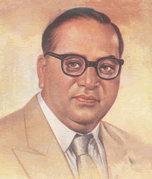
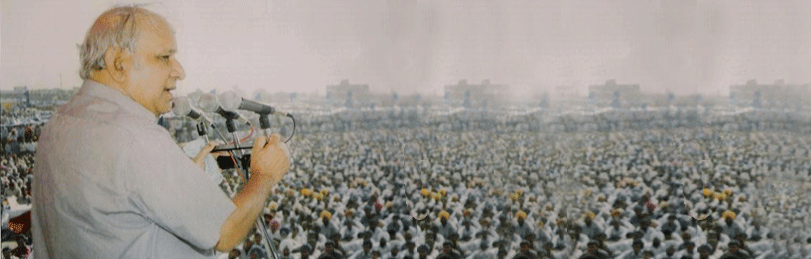
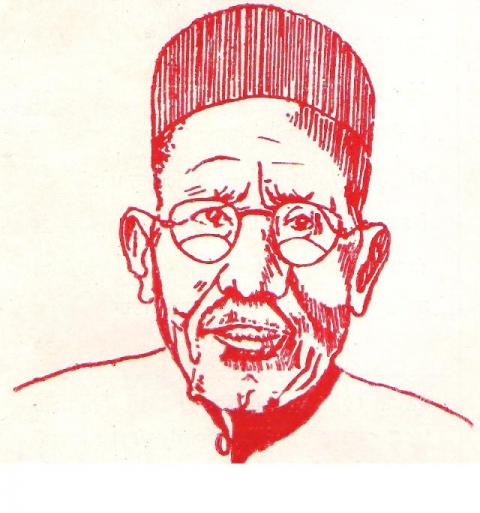
.JPG)