SHRI
GURU RAVI DASS SABHA PITTSBURG, CA. PAYS HOMAGE
TO GHADRI BABA BABU MANGU RAM JI MUGOWALIA |
 .
|
Report by Dashvinder Paul
Pittsburg(California):-
On Sunday January 24th, 2010 Sri Guru Ravi Dass Sabha Pittsburg
organized a function to celebrate 124th Birth Anniversary of
Ghadri Baba Babu Mangu Ram Ji Mugowalia a great freedom fighter
and the founder of Ad Dharm Movement in Punjab at the Temple.
Speaking on this occasion, Giani Harblas Singh Ji, Santokh Ralh,
Bhai Baldev Singh, Bibi Surjit Kaur, Gurnam Singh, Dashvinder
Paul and General Secretary Kamal Dev Pall urged Sangat to follow
the footsteps of Babu Mangu Ram Ji Mugowalia, who fought against
the mighty British rulers to get the freedom of India and made
his mind to liberate the downtrodden from the internal slavery
of Varnashramdharma and started organizing a unique battle against
the centuries old Hindu system of birth-based social exclusion.
He founded Ad Dharm movement for the emancipation and empowerment
of his people. He organized all the ex-untouchable castes falling
under the then category of the Depressed Classes in Punjab and
reminded them of their rich heritage when they used to be the
masters of this land. Babu Mangu Ram Ji was very clear in his
understanding that the real emancipation of the ex-untouchables
lies in their efforts to revive their own indigenous religion
(Ad Dharm). President Ram Parkash Raju and Chairman Satpaul
Surila thanked the entire Sangat for their participation in
this program. The “Ardaas" marked the end of the
program Guru Ka Parshad was distributed followed by the “Guru
ka Langar"
Posted
on January 31, 2010
|
|
GREAT
GHADRI BABA
BABU MANGU RAM MUGOWALIA Ji’s
124TH BIRTH ANNIVERSARY
CELEBRATION
|
Shri
Guru Ravi Dass Sabha Fresno (California), Shri Guru
Ravi Dass Sabha Pittsburg (California) and Shri
Guru Ravi Dass Sabha Sacramento (California) proudly
announce that we are going to celebrate the 124th
birth anniversary of our great freedom fighter &
the Founder of Ad Dharm Movement in Punjab, Baba
Babu Mangu Ram Mugowalia Ji on Sunday, January 24,
2010 at their Shri Guru Ravi Dass Temples. We are
requesting to all come join us on the 124th birthday
anniversary.
Posted
on January 17, 2010
|
|
HEARTIEST
CONGRATULATIONS TO ALL ON124TH BIRTH ANNIVERSARY OF THE
GREAT FREEDOM FIGHTER
& THE FOUNDER OF AD DHARM MOVEMENT IN PUNJAB GHADRI
BABA BABU MANGU RAM MUGOWALIA JI. |
| |
Jai
Gurudev!
Congratulation
to all the readers and writers of Ambedkartimes on the
124th birth anniversary of great revolutionary freedom
fighter
and founder of ad Dharm movement in Punjab Babu Mangu
Ram Mugowalia,
Des Raj Bangar (Journalist) Fresno (California)
USA
|
| |
Jai
Gurudev!
Heartiest
congratulations to all the readers and writers of pioneer
website “amberkartimes.com”, on the 124th birth
anniversary of Babu Mangu Ram Ji Muggowalia, who was “True
Devotee” of Ad-Guru, Shri Guru Ravi Dass Ji”.
On this day, it is very important to keep this in mind that
only person who, with the support of fellow Ad-Dharmis,
struggled for us to get distinct identity was Babu Mangu
Ram Ji Muggowalia, also to remember that we are “Ad-Dharmi”
and our religion is “Ad-Dharm”. “Ad”
means from the very beginning and “Dharm” mean
“religion”. We should all be proud of Ad-Dharm’s
accomplishments.
Regards
Proud Ad-Dharmi
Tejpal Gangar Burnaby, BC, Canada
|
| |
Jai
Gurudev!
On
the 124th birth anniversary day of Dalit’s Massiha,
broad-and-roared minded and a very great founder of AD DHARAM,
BABU MANGU RAM MUGGOWALIA. On this very special day I would
like to congratulate to all those who were/are attached
to him, especially Mr. C. L. Chumber and Dr. Ronki Ram by
this internet electronic Ambedkartimes News Paper- every
man, associations and Sabhas get vast and detailed knowledge
about our Adi Gurus, Dr. Ambedkar and Baba Babu Mangu Ram
Muggowalia Jee etc. Also, I would like to say all those
who are activated in the Ad Dharm Mission, attached with
any Sabha and associations; all should determine to follow
the teaching of Babu Mangu Ram Jee and these teaching we
forward to our next generations for reviving it. Please
come, we all together generate a powerful Ad-Dharm Mission’s
light among dalits by which all next generations will have
own AD-DHARMIDOM. I appreciate Ambedkartimes.com by which
we share our own views. Once again congratulation to all
Ad Dharmi on 124th birth anniversary day. Sohang! Jai Gurdev!!
Thanks
Balvir Singh Sandhu (Madhobalvira)
Italy
|
| |
|
REMARKABLE MISSION OF
BABU MANGOO RAM MUGOWALIA
100 Years ( 1909 – 2009 ) “FOUNDER OF AD-DHARM” |
Hari Paul Randhawa Chief Editor “Begumpura Times” UK "Voice of Ad-Dharm"
|
Mangoo Ram was born on January 14, 1886 , in village Mugowal, Hoshiarpur district, where this father,Harman Dass, had left the traditional Chamar caste occupation of training and preparing hides and attempting to sell tanned hides commercially1. Mangoo Ram’s mother, Atri, died when Mangoo Ram was three, so the father began to depend heavily on his sons – Mangoo and an older and a younger brother for assistance. Because the leather trade required some facility in English, Mangoo Ram’s father was forced to rely on literate members of upper castes to read sales orders and other instructions to him. In payment for their reading instructions for an hour, he would have to do a day of crude labour. For that reason, Mangoo Ram’s father was eager to have his son receive an early education.
When Mangoo Ram was seven, he was taught by a village Sadhu (Saint) and soon after attended a variety of schools in the Mugowal area (Tehsil Mahilpur of district Hoshiarpur). He also attended school in a village near Dehra Dun , where his older brother has settled. In most of the schools, Mangoo Ram was the only Scheduled Caste student. He sat at the back of the class, or even in a separate room, and listed through the open door. When he attended high school in Bajwara, he was forced to stay outside the building and listen to the classes through the windows. Once when he came inside during a heaving hailstorm, the Braham teacher beat him and put all the classroom furniture, which he had “polluted” by his presence, outside in the rain to be literally and ritually washed clean. Nonetheless, Mangoo Ram was a good student: he placed third in his class in primary school. But whereas the other good students were encouraged to become patwaris (village record-keeper) or to seek higher education, Mango Ram was encouraged to leave school and help his father at a more proper “Chamar task”. In 1905, he did quit school; he married, and for three years helped his father develop their leather trade into a thriving business.
In 1909 America as in the air. Scores of upper caste farmers from Mangoo Ram’s area of Hoshiarpur had gone to the United States , and those who had not gone were talking about it. Mangoo Ram decided to go also. He persuaded his father that it would be good for the business – he would send money back from America – and his father responded by giving him some savings from the family business. Amid assurances from some of the local Zamindars (“landowners”) and two Chamar friends set off for the new world.2
The friends turned back, but Mangoo Ram persevered and arrived in California late in 1909. For four years he picked fruit for the former Zamindars of his village who had settled in the San Joaquin valley of California . He was also employed in a sugar mill. Mangoo Ram lived first in Fresno , then in Stockton , Sacramento , EL Centro , Vacaville , Visalia , and again in Fresno.3. He did indeed make money and set his savings home.
In 1913 some of the Punjabi settlers in California were forming a militant nationalist organisation. Mangoo Ram joined this group, the Ghadar movement, as a full-time worker in San Francisco . He was struck by the fact that, as he was later to say, “it was a new society; we were treated as equal”4. There were not many Scheduled Caste persons in the Ghadar movement, however; Mangoo Ram recalls only one other Chamar besides himself.
Initially Mangoo Ram played only a minor role in the organisation,, but in 1915 he volunteered to be one of five Ghadrites to participate in a dangerous mission involving smuggled weapons shipped from California to the Punjab . He was chosen for the task by the main whom he identifies as the “leader of the Ghadar” party at that time.” Sohan Singh Bakhna5. The secretary of the Los Angeles where they boarded an intermediary boat after collecting all their personal identification. For the rest of the saga, Mangoo Ram would be known by a Muslim pseudonym, Nizamuddin.
According to Mangoo Ram, the intermediary boat took them to the Socorro (sic) islands to rendezvous with the weapons boat, but after thirteen days military shop from Sydney, the “Man of War”, discovered the timely intervention of an American warship were they spared. They went to Vera Cruz, Mexico , to receive rations.
There they finally connected with their weapons boat, the Maverick; they joined the crew, took on giant turtles for food, and headed for India.7 They were halted again in Hawaii , where Mangoo Ram witnessed the eruption of volcanoes. Free again, they advanced a bit further, perhaps to Java or New Caledonia.8. There the Japanese, on behalf of the British, imprisoned them for one year. Eventually, the British decided to hang them, but at midnight the night before they were to be hanged at dawn, fate intervened. The Germans spirited them away in the dark, and the five went their separate directions – Harmans Dass and Charan Dass to Bangkok ; the others, including Mangoo Ram, to Manila .
But again, according to Mangoo Ram’s memory, the intervention of fate altered their plans. A typhoon appeared, and the ship went to Singapore instead, where British spies, Bela Singh and Bhag Singh, turned Mangoo Ram over to British authorities, who promptly ordered him to be placed before a cannon and shot. Again, however, the Germans whisked Mangoo Ram away, and again he was placed on a ship bound for Manila.9. When Mangoo Ram arrived in the Philippines he read a news report in the Manila Times indicating that he had been executed for treason b the British in Singapore . Mangoo Ram assumes that one of his captured colleagues had taken on his name to protect him, and that that man had been shot in his place. The news of his alleged death preceded him to the Punjab , where his wife heard the report and promptly married his younger brother, as custom dictated. In the meantime, Mangoo Ram was sequestered in the Philippines in a series of hideouts on various islands. Members of the Ghadar party were his benefactors during this period, and Mangoo Ram remembers fondly their hospitality and friendship: he was no longer an Untouchable but a comrade in distress.10.
The war ended in 1918, the Ghadar party was no longer quite the threat its was earlier when it enraged the British by compounding separatism with sedition through its liaison with the Germans. But Mangoo Ram decided to stay in Manila nonetheless. He met an American, a Mr Johnson of Marshall Field and Company (a department store in Chicago ), who hired him to work in an
Early in 1925 he set sail, this time on a more pleasant and uninterrupted trip. He arrived in Ceylon in the company of a Christian missionary he had met on board, then travelled through the subcontinent to the Punjab , visiting Madurai , Madras , Bombay , Poona , Sitara, Nagpur , and Delhi . He observed the conditions of the Scheduled Castes en route and was dismayed “to se our people being treated to badly”.12. At the Minaksi Temple in Madurai , for instance, he was told to be careful not to touch the Achhut (Untouchables): people assumed from his dress that he was of decent caste. By the time Mangoo Ram reached the Punjab he was convinced that there was need for social change, and wrote to Ghadar Party headquarters in San Francisco about the difficult conditions of the Scheduled Castes in India , announcing that their freedom was more important to him than that of the nation itself. According to Mangoo Ram, leaders of the Ghadar party at that point designated him to work for the uplift of the Untouchables 13. Thus, in a new context, the old revolutionary from Fresno continued the Ghadar spirit.
Late in 1925, after his return to the Punjab , Mangoo Ram began teaching in a primary school in his home village of Mugowal , a school which Mangoo Ram claims he named the Ad Dharm School. It was in that school, on June 11 and 12 1926, that Mangoo Ram convened the meeting that formally launched the Ad Dharm movement. Mangoo Ram was elected its first president, a title he was retained for the duration of the movement. Om November 1926, when the Ad Dharm organisation opened an office in the city of Jullundhar , Mangoo Ram took up residence there, where he remained until he became active in politics in the 1940s, at which point he moved to the town of Hoshiarpur . Later, the newly independent government of India presented him with some land near Garhshankar, not for away, which developed into a small farm.
In 1977, after the Ad Dharm movement had been re-established, and Mangoo Ram had been again elevated to leadership of the movement, his supporter sent him on a triumphant tour of communities of expatriate lower caste Punjabis in Great Britain . It was Mangoo Ram’s first major voyage since returning from America , half a century before. For him the occasion was one of nostalgia, but also one of completeness, for it enabled him to mark the closing phase of his long public career with a trip abroad, just as he had opened it in a similar way many years before. It was to be the last great event before his death on April 22, 1980 , at the age of 94.
The pattern of expatriate experience leading to nationalism and political activism when the expatriates return home is replicated in the personal histories of other leaders: the lives of Gandhi, Sri Aurobindo Ghose, Dr. B.R Ambedkar, the Ghadar militants, and other Third world figures such as Kwame Nkrumah and Ho Chi Minh. Seldom, however has a personal history held such dramatic extremes- from leadership in a secular movement to leadership in a religious one, from an anti-British to a pro-British stance (and then back again), from being a banished Untouchable to being an imposing political figure. The sheer diversity of Mangoo Ram’s colourful life would invalidate any claims he might have wanted village culture of the lower castes, but experience forged him into a modern man. Ultimately, his characteristics were modern were those of the movement he led and of the proud new breed of ex-Untouchable he came to represent.
Posted on July 30, 2009
|
|
BABU MANGU RAM MUGOWALIA’S
BIRTH ANNIVERSARY WILL CELEBRATE AS SELF – INSPIRATION DAY
BY UNITED DALIT STUDENT’S FORUM |
"Those people are GREAT, who are awakened towards the duties in which they are born."...... Babasaheb Ambedkar the Great!
Dear Friends, Jai Bhim
The United Dalit Students' Forum UDSF is glad to inform that on the occassion of Babu Mangu Ram's Birth Anniversary, (14 Jan.), which is celebrated as Self-Inspiration Day, a well known personality, Gail Omvedt, will be there among us for a post-dinner talk at Chandrabhaga Hostel Mess by 9.00 pm on January 14 , 2009. All are requested to be present on time for the programme. Thanks
In Mission United Dalit Students' Forum (UDSF) Jawaharlal Nehru University , New Delhi . |
UNSUNG HEROES OF ADI-INDIA-(1)
Swami Achhuta Nand (Adi-Hindu of U.P.)
FOUNDER OF ADI-HINDU MOVEMENT, U.P. (INDIA)
(6.5.1879 -22.7.1933 AD)
By: C.L. CHUMBER Mobile: 91- 946 399 5087 <c.l.chumber@gmail.com>
|

C.L. CHUMBER
|
Sawami Achhutanand (6.5.1879 -22.7.1933 AD) was the founder of the Adi-Hindu socio-religious movement concentrated in most populated U.P. state in India. There were four other contemporary revolutionary Adi-Movements of untouchable aboriginals of India. A Gadhrite Baba Mangu Ram Muggowalia’s (Jan.14.1886 - April 22, 1980 AD) Adi-Dharm Mandal having H. Q. at Kishan Pura , Jalandhar city (Punjab) opened in November 1926 was active in greater Punjab ( present Pakistan’s and India’s Punjab , Himachal Pradesh, Chandigarh ( U.T. ), Haryana and Delhi states ), Uttarakhand ( first branch at Chuharpur-now Vikas Nagar District Dehradoon was founded in December 1927 as per the A.D.M. report 1931 AD ) , U.P.( first branch was founded at Varanasi City on April 19,1931 and others at Meerut, Lucknow, Allahabad, Saharanpur , Kanpur as per the A.D.M. Report 1931 AD ) , West Bengal ( first branch was founded at the bridge no.4 , Kolkata in 1928 AD as per the A.D.M. report 1931 AD ) , Rajasthan ( Adi-Dharmi is registered as SC in this state ) , J & K , , M. P. in India . The Adi-Dharm Mandal Report 1931 AD written by Baba Muggowalia and first ever translated from Urdu to Punjabi by myself published in the Bahujan Samaj Bulletin weekly’s Baba Muggowalia special issue of 12th Jan.1997. Shaheed-E-Azam Sahib Kanshi Ram was editor, printer and publisher and myself was the resident editor of this bulletin (released by Sahib Kanshi Ram on 16th Nov.1996 at a state level BSP rally at the Daresi Ground, Ludhiana and closed due to my plotted road accident at G.T. Road, Phagwara (District Kapurthala) Punjab in which my two lieutenants M/s Ashawni Kumar Shammi, Ali Puli Mohalla of Jalandhar City (Punjab) and Shusil Kumar Verma r/o Village Bohan Tehsil & Distt. Hoshiarpur were killed, six persons including myself, my wife Santosh Kumari, 11 year my son Jan Sangram Chumber were injured severely). The Adi-Dharm Mandal Report 1931 claimed their international network including in Malaya, U.S.A., Burma ( now Myanmar), New Zealand , Canada , Philippines , Africa , Fiji , Russia etc, The other Adi-Movements were Adi-Dravida of Madras state (now Tamilnadu) , Adi-Andhra of Andhra state and the Adi-Karnatka of Mysore state (now Karnatka) . These three revolutionary movements concentrated in the south India. These movements are ignored by the manuvadis as well as our manuvadi people. These revolutionary movements backed Dr. Ambawdekar (a brahmin teacher changed his name as Ambedkar) and confronted with Mr. Gandhi and Brahminism at national level. Dr. Ambedkar became a national leader with the active support of these non-Ambedkarite Dalit revolutionary movements. Dr. Ambawdekar `s party contested only in Bombay state in 1937 AD assembly election. I suggested Sahib Kanshi Ram to recognise the contribution of these revolutionary movements. I celebrated the Adi-Dharam Mandal’s platinum jubilee on 12th June, 2000 at the Desh Bhagat Yaadgar Hall , Jalandhar city by publishing in book shape first ever translation of Baba Muggowalia’s Adi-Dharm Mandal Report 1931 AD in Hindi and Punjabi languages .Then Sahib Kanshi Ram `s BSP celebrated Adi-Dharm Mandal’s platinum jubilee on 28th Feb.,2001 at the Roshan ground , Hoshiarpur. On my suggestion, he also celebrated the death centenary of Prof. Ditt Ram Gyani @ Prof. Ditt Singh Gyani (1850-1901 AD) of the Singh Sabha on 1st Sept.2001 at his ancestral village Kalaurh Nandpur District Fatehgarh Sahib ( Punjab). Sahib Kanshi Ram paid tributes to Baba Muggowalia in a Bahujan Samaj Day rally on his birthday on 15th March, 2003 at Shiva Ji park ground, Mumbai. He appreciated the contribution of Baba Muggowalia on producing more than 100 Adi-Dharmi I.A.S. / I.P.S. only in his Hoshiarpur District as compared to 64 of other castes! He also arranged public gathering in memory of revered Ayyan Kali of Kerala state
Now we come to Sawami Achhuta Nand Ji. His first ever name was Hira Lal. His guru and his relatives bestowed him with a new name Sawami Hariharanand. He was born on 6th May, 1879 at his maternal grandfather’s village Saurikh Tehsil Chhibramau District Farukhabad (U.P.) His father was Mr. Moti Ram and mother was Mrs. Ram Piari. His uncle Subedar Mathura Parsad helped him in education at Nasirabad, Ajmer (Rajasthan). His parents and uncle left the village due to some quarrel with the brahmins on caste basis before the mutiny of 1857 AD. They migrated to village Umari Tehsil Sirsaganj of District Mainpuri. Sawami ji’s father and uncle went to Dewali and joined the army. He was very brilliant in education. He left the school at 14. He was well versed with 8 Indian languages- Hindi, Sanskrit, Persian, Marathi, Bangla and Punjabi etc. He was married with Smt. Hira Bai. He had four daughters -! (Late) Sushila Bai married to (late) Mangal Singh Jatav, Tikonia, Murar District Gwalior (MP). Mr. Jatav was parliamentary secretary in MP govt. I met him on 19-20 August, 1989 in the Dalit Sahitya Akademy function at the Ravindra Bhawan, Bhopal. (2) (Late) Vidyawati married to (Late) Mr. Kalyan Chand Jatia r/o Farukhabad (UP) 3. (Late) Shanti Bai married to Dr. Thakur Chand Kain r/o Moh.Gulabwarhi , Jaswant Nagar, Etawah (UP) 4 . I could not get information. Swami Ji was a true feminist. His life is entirely dedicated to the untouchables. He dedicated his name also to the untouchables. But the thankless literate and illiterate, poor and rich untouchables forget him. Why? We talk of the honesty but we regard the corrupt due to our manuwadi thinking.
He first worked with the Arya Samajists for the annihilation of untouchability as well as caste. But he was disillusioned soon .He started his revolutionary work separately. He went village to village and town to town to propagate education, he preached against dowry, child marriage and un-necessary expenses on death ceremonies. In 1917 AD, Sawami Ji went to Delhi and he jointly worked with the untouchable `s leader Vir Rattan Devi Dass Jatia, Jagat Ram Jatia. They founded the Achhut Maha Sabha. They also published a vernacular periodical. In 1922 AD, he met the Prince of Wales in Delhi. Swami Ji organised an untouchables` function, the Prince of Wales participated. Swami Ji presented a memorandum of 17 demands as below: - The Adi-Hindus must be given separate electorate and separate representations (.2.) For the progress of the untouchables, government must open schools and colleges. (3) There must be a strict law to annihilate the untouchability. (4) The educated untouchables must be absorbed in the govt jobs. (5) There should be nomination of untouchables in the municipal committees. District boards, village Panchayats, own areas, notified areas etc.( 6) The untouchables should be granted liberty to do business and shop keeping.( 7 ) There must be ban on forced labour.(8) There must be equal rights for untouchables as compared to the swarn Hindus.( 9 ) There must be untouchables` representation in government and non-government committees proportionate to their population..(10) There must be stipends for the untouchable students. (11) There must be colleges for the untouchables where theirs population is density. (12) There must be recruitment for untouchables in the police and army. (13) There should be increase in the labour rate. (14) The Chowkidars of the villages should be untouchables. (15) The untouchables must be allotted land on lease. (16) There should be representation of untouchables in the state assemblies. (17) The above demands should be implemented in the princely states also.
He participated in the Jatav Sammelan in 1922 AD at Delhi and gave some revolutionary suggestions. In 1925 AD, he settled at Benajhabar, Idgah and Kanpur (UP). Mr. Girdhari Bhagat donated him residential plot. He launched the Adi-Hindu in Hindi paper. In 1927 AD at Kanpur, he said in a public conference," We dalits also demand a complete Independence as the Hindus and the Muslims demand. We are the rightful owner of the independence.” Sawami Achhutanand met the Simon Commission on 30th Nov.1930 at Lucknow with his comrades M/s Tilak Chander Kuril, Girdhari Bhagat, Laxman Parsad, Karorhi Mall Khatik etc.Dr. Ambawdekar was a member of the Simon Commission. Sri 108 Sawami Achhuta Nand Smark Smiti (UP) published the Photostat copy of hand written Dr.Ambawdekar`s letter dated 3rd Feb.1932 to Swami Ji in which Dr. Ambawdekar accepted him as his Guru. They first of all met in 1928 AD in the Adi-Hindu conference. Sawami Ji also met the Lothian committee in 1928 AD at Lucknow. In 1930 AD, he telegrammed in support of Dr. Ambawdekar and Rao Bahadur Sranivasin, the two untouchables at the Round Table conferences at London (UK). Swami Ji also raised voice for the “Achhutstan" Swami Ji was a signatory of the Puna Pact signed on 24th September1932.
The Hindus wrote a book against Sawami Ji under the title "SAWAMI JUTANAND ".The writer of this book later was nominated as president of the Congress of UP state.. Mr. Hira Lal s/o Mr. Mohan Dass Karam Chand Gandhi, the rasharpita of the Hindu-Rashtar came to allure Sawami Achhutanand but Sawami Ji showed a stale piece of loaf from his pocket .Sawami Ji asked Hira Lal how he dared to test his devotion towards his people.
He wrote six books in Hindi—(1) Shabuk Balidan (Drama) in this book Sawami Ji exposed Hindu Bhagwan Rama for killing innocent pious Saint Shambuk! ( 2 ) Mayanand Balidan ( biography ) ( 3 ) Achhut Pukar ( Voice of the untouchables )-Religious songs ( 4 ) Pakhand Khandani ( Heterodoxy refuted ). (5) Adi-vansh ka danka (drum of the aborigional people)-poetry (6) Ram rajya nyay (justice in the reign of king Rama)-drama. Swami Ji worked hard day and night. He was sick for 23 days and died on 22nd 1933 at Kanpur. He was buried in opposite PS Nazirabad, Nai Zamin, Lajpat Nagar, Kanpur (UP).
I (C. L. Chumber c.l.chumber@gmail.com , cl_chumber@yahoo.com ) was the main speaker of `Sawami Achhutanand` s ( 6.5.1879 -22.7.1933 AD ) 129th Birthday Function on 6th May, 2008 on the ground of Sawami Achhutanand Samadhi Sathal opposite PS Nazirabad , Nai Zamin , Lajpat Nagar, Kanpur. Mr. Ravinder Patani, Mayor, Kanpur Municipal Corporation(Chief guest), Mr. Partap Singh, Judge.( Retd.) presided over , S. Sukhwinder Singh Bhalla (Ladi) ex member ,the Minorities Commission of UP state performed opening ceremony, Mr. Anil Sharma ex Mayor and Mr. Shiv Kumar Beria M.L.A. were Special guests of honor.. M/s Rajinder Kuril, president, Ramesh Chander Kuril Councillor / General Secretary Mr. P. Lal, Mr. Jai Narain Kuril, J. P. Sonkar, Dr. Hira Lal, Kailash Dhiman, Sowaran Singh were main organisers of this function.
I delivered my speech on this socio-religious revolutionary Sawami Achhutanand who founded the Adi-Hindu Movement to achieve equality, liberty, fraternity and justice for the under privilege untouchable Indian citizens. On 17th September 1922 at Delhi and the Indian government recognized it in 1923 AD. He proclaimed 7 main commands of the Adi-Hindu Movement. (1) I have faith in the oneness of God. God is immaculate, sinless, eternal, infinite, amorphous, unborn, timeless, omnipresent, peerless and true! God has neither religious book nor ever incarnated on earth .God has no statue; God is omnipresent in the universe. And God’s flash is luminance within me and God’s perception and my actions accordingly is my religion. (2) I believe that I am Adi-Hindu being aboriginal Indian and that is why I am not the owner of the Indian country! Our duty is to develop our primitive land now called as India and it is my foremost duty to establish here the rule of the truthfulness and justice. (3 ) I have faith that the religion of the ( medieval period Bhakti Movement `s) Saints are India’s Adi-Dharm and being full with humanism, is the really blissful religion ! (4) I have faith in that all are equal and have brotherhood. The thinking of gradation and degradation on the basis of clans, sects and varnas is deluding. A person is graded by his/her virtues and degraded by his/her misdeeds. God lives in a person’s true heart. And that is why the behaviour of equality with each person is the prime religion. (5) I have faith in that to abstain from sexual instinct, anger, greed, attachment, pomposity and postulate thoughts is the religion of mind! To abstain from falsehood, bitter, backbiting, denunciation and useless talk is the religion of voice! And to abstain from violence, prostitution, gambling and intoxication is the religion of the body! That is why I will try my best to follow this universal blissful religion by thoughts, speech and actions for my salvation. (6) I have faith in the grate Saint Kabir`s teachings that all the Brahmin-scriptures are based on selfishness, falsehood and injustice! And theirs laws of religious scriptures etc. are the causes of the downfall of Hindus! That is why, I make commitment to denounce completely the Brahmin devtas, incarnations and brahminized religious discourses treating false and decadent! And I will never neither perform birth, tonsure, marriage and death brahminized ceremonies nor by brahmins! (7) I will highlight my forefathers `high character and the glory of the Adi-Vansh (aboriginal-clan) by efforts continuously. I will encourage our intellectuals to write books on our forefathers. I will be active to commemorate them by arranging public functions and for the educational, technical, economic, social, political, physical, and psychological development of our Adi-Hindu brothers continuously.
As I main speaker of the function advised the gathering not only make shoes but also beat unconstitutional elements with shoes as weapon because the governments had no time to annihilate caste system . I also suggested the gathering to arrange inter-caste and inter state mass marriages programme. The chief guest of this function also condemned "the Swami Achhutanand" book and writer. Later on , people added to my knowledge that the Utter Pradesh government published a book on silver jubilee of the so-called independence in which the writer wrote derogatory and unconstitutional remarks against Sawami Ji. The people resented. The local Hindi press covered this function with news and color photographs. WE ARE PROUD OF SAWAMI JI, HIS PHILOSOPHY AND HIS HIGH SPIRIT TEAM!!!!!
Posted on www.ambedkartimes.com (June 11, 2008 ) |
Jai Guru Dev, Dhan Dhan Guru Dev! |

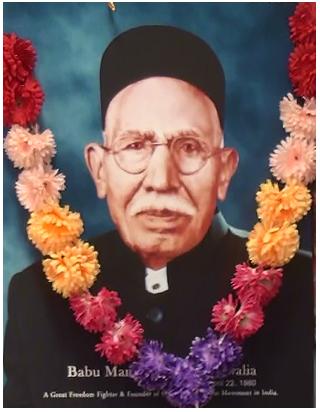
Babu Mangoo Ram Mugowalia
JAN. 14, 1886 - APRIL 22, 1980 |
AMBEDKARTIMES.COM
PAYS TRIBUTE TO MUGOWALIA
Ambedkartimes.com pays floral tribute to Ghadri Baba Babu Mangoo Ram Mugowalia, the founder of the Ad Dharm movement in Punjab , on his 28 th death anniversary.
Prem Kumar Chumber
(Editor:www.ambedkartimes.com) |
Babu Mangoo Ram Mugowalia (1886–1980), whose death anniversary falls on April 22, 2008 , was the pioneer of the anti-untouchability movement in colonial Punjab . A former Gadharite, who spent the formative years of his prime youth fighting against the mighty British imperialism in foreign lands, after reaching his native village made himself busy in organizing a unique battle against the centuries old Hindu system of birth-based social exclusion. He founded Ad Dharm movement for the emancipation and empowerment of his people. He organised all the ex-untouchable castes falling under the then category of the Depressed Classes in Punjab and reminded them of their rich heritage when they used to be the masters of this land. He told them how they were reduced into worse than slaves in their own land by the alien Brahmins who brought with them their sick social system called caste and started them whipping with the whip of untouchability. He told his people that for us the real battle is the battle against the Chaturvarna system of Brahminical Hinduism.
He openly declared that Scheduled Castes are neither Hindu nor Sikh. They are also neither Muslim nor Christian. They are the original inhabitants of this ancient land called Bharat. Their real religion (Ad Dharm) was much older than Hinduism, Christianity, Islam and Sikhism. All these religion born after Ad Dharm religion of the original inhabitants of India . He said that the Hindus did not only subjugate them but also made their religion oblivious; and thus made the ex-untouchables their slaves. He said that our real freedom will be to liberate ourselves not only from the British rulers but also from Brahmanism. He got special right from the Britishers by adding Ad Dharm to the Census list as a separate religion of the Depressed Classes in Punjab in 1931. A great victory of the Dalits indeed! Babu Ji also became the pioneer of seeking political power as a key to all the problems of the community. In 1937, his Ad Dharm won 7 out of all the 8 reserved seats in Punjab .
Babu Mangoo Ram Mugowalia's movement was not only confined to Punjab . He stood like a rock with Dr. Ambedkar. During Dr. Ambedkar's fight with Gandhi at the Roundtable Conferences in London (1930-32) Babu Ji sent telegrams in support of the former as the leader of the untouchables in India against the latter (Gandhi). In 1946, Babu Mangoo Ram Mugowalia was elected to the Punjab Legislative Assembly and remained in legislature till 1952.
He was very clear in his understanding that the real emancipation of the ex-untouchables lies in their efforts to revive their own indigenous religion (Ad Dharm), and in worshipping their own Gurus (Guru Namdev Ji, Guru Ravidass Ji Maharaj, Guru Valmiki Ji Maharaj, Guru Kabir Ji Maharaj). No other religion can liberate the Dalits from the quagmire in which they have been straddled for centuries except their own original religion "Ad Dharm".
< www.ambedkartimes.com> pays floral tribute to Babu Mangoo Ram Mugowalia, the founder of the Ad Dharm movement in Punjab, on his 28 th death anniversary.
Posted on www.ambedkartimes.com (April 22, 2008)
|
|
|
|