| Home | About Us | Contact Us | Community Activities | News | Photo Gallery | ArticlesCulture | Media | Literature |
| Dr. Ambedkar | Kanshi Ram | Babu Mangoo Ram | Ad-Dharm | The Gurus | Lord Buddha | Letter Box | Great Personalities |


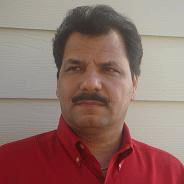
Raj Kumar Oshoraj

All of these articles by Raj Kumar Oshoraj
MY VISIT TO CALIFORNIA   Raj Kumar Oshoraj (Vice President Indian Buddhist Society) Toronto (Canada)


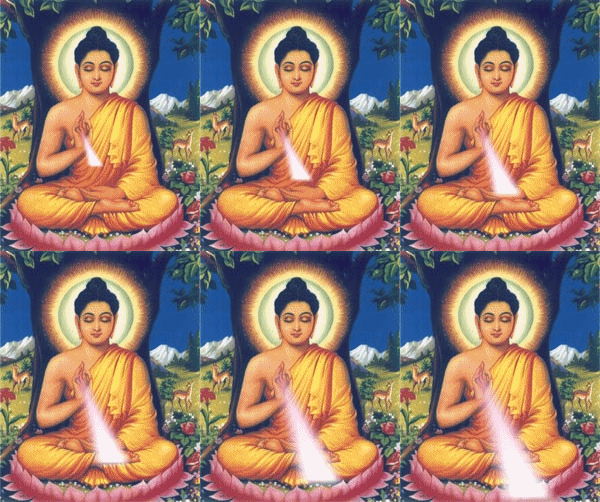
Lord Buddha:

The Greatest Son of India and World Peace Emblem

By: Raj Kumar Oshoraj

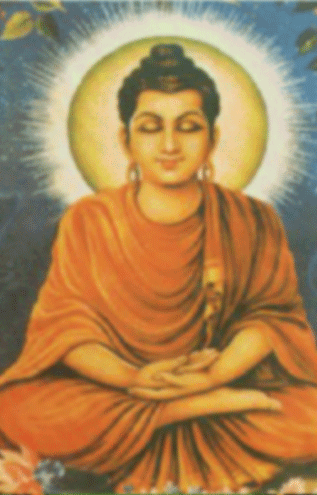
Buddhism is also known as Buddha Dhamma, which means ‘teachings of the Awakened One’ in Sanskrit and Pali: languages of ancient India . Buddhism began around the 5th century BCE in India with the teachings of Siddhartha Gautama, who is also known as ‘The Buddha’ which means the one who is awakened.

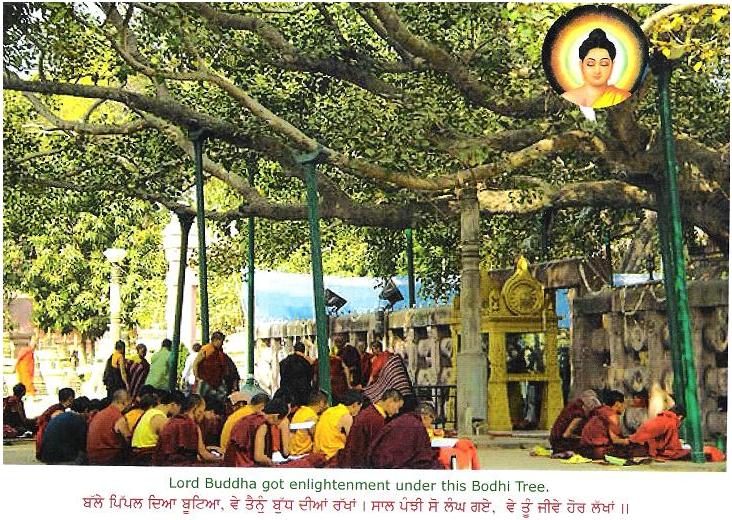
Siddhartha Gautama was his name before he left home in search of ultimate truth at the age of twenty eight and after seven years of continuous painful laborious search; he attained enlightenment and was called ‘The Buddha’ whom we also know today as ‘The Lord Buddha’. He is also referred with other names as Bhagwan Buddha, Gautama Buddha, Tathagata and Sakyamuni Buddha etc. Buddha died at the age of eighty and preached Dhamma daily for forty five years. Buddha: Siddhartha Gautama, the historical founder of Buddhism, was born in Lumbini - a place situated in modern Nepal .

The historical Buddha lived around the sixth century BCE. Emperor ‘Ashoka the Great’, who converted to Buddhism and made it a popular religion in India and beyond. It could be said here that he was the first revivalist of Buddhism. Today, Buddhism is the fourth largest religion of the world.

Full moon day of May is the most important day for practicing Buddhists all around the world. Three important events are related to this day: Visakha: Lord Buddha’s birth, enlightenment and passing away. Each year it is celebrated on full moon day of May and this year it’s on May 19, 2008 in Canada . It is called ‘Visakha’ in Pali language (Buddha preached in Pali) which is also known as Vaisakha in Sanskrit and Vesak in Sinhalese (Sri Lankan) language.

After attaining enlightenment; Buddha preached daily for forty five years for the welfare of the humanity. Here is what Buddha realized and preached after attaining enlightenment.

Four Noble Truths

  • There are sufferings in life (Though life itself is not a suffering)
  • The cause of suffering is craving (Endless desires)
  • By stopping the craving, suffering is stopped (End your desires to end suffering)
  • The way to ending craving is to follow the Eightfold Path (This path will tell you how to end desires and craving)

The Eightfold Path

The Buddha created The Eightfold Path as a way to end the suffering of humanity. These eight aspects help the seeker of truth to become aware about the reasons for these sufferings. As the seeker is becoming more and more aware about his consciousness it helps him to achieve the final goal of Nirvana (ultimate state of peace and happiness).

Eightfold Path:

  • Right Viewpoint - Realizing the Four Noble Truths
  • Right Values - Commitment to mental and ethical growth in moderation
  • Right Speech - One speaks in a non hurtful, truthful way
  • Right Actions - Avoiding actions that can harm others
  • Right Livelihood - One's job/work does not harm in any way: directly or indirectly
  • Right Effort - One makes an effort to improve in all aspects of life
  • Right Mindfulness - Mental ability to see things as they are with clear awareness
  • Right Concentration - A state of enlightenment where ego can disappear

Panchsheel

All religions of the world have fundamental teachings for their followers. Panchsheel in Buddhism is the basic teachings of The Buddha to help all to behave in the society such a way that no one harms anyone including themselves.

The Five Precepts:

  • No killing : Respect for life
  • No stealing : Respect for others’ property
  • No sexual misconduct : Respect for our pure nature
  • No lying : Respect for honesty
  • No intoxicants : Respect for a clear and normal mind

Tripitaka

Buddhism has religious scriptures like other religions of the world. It is formally called Tripitaka simply because it is divided into three categories. In the ancient days the writings of Tripitaka were memorized and recited orally by Buddha’s disciples. They are traditionally classified in three baskets ( tri-pi ak a ) in the following order:

  • Vinaya Pitaka : Code of Ethics for Monks and Nuns
  • Sutra Pitaka : Buddha’s teachings (contains more than 10000 sutras)
  • Abhidharma Pitaka : Contains Buddha’s higher teachings with philosophical and psychological discussion

Dhammapada (path of the dhamma) is part of Sutra Pitaka which contains 423 verses in 26 categories spoken by Buddha on various occasions.

Buddha’s India

India is proud of her great son ‘Lord Buddha’ and applauded by world community on international platform for Buddha’s contributions to the humanity. India has embraced his teachings and remembered Lord Buddha by having him on most important symbols of the nation: National Emblem of India and Dhamma Chakra in Indian Flag.

National Emblem of India

The national emblem of India is an adaptation of Buddhist Lion which is on Indian currency also. The original sandstone-sculpted Lion Capital of Ashoka preserved at Sarnath Museum which was originally erected around 250 BCE atop an Ashoka Pillar at Sarnath. The angle from which this picture has been taken, minus the inverted bell-shaped lotus flower, has been adopted as the National Emblem of India showing the Horse on the left and the Bull on the right of the Ashoka Chakra in the circular base on which the four Indian lions are standing back to back. On the far side there is an Elephant and a Lion instead. The wheel "Ashoka Chakra" from its base has been placed onto the centre of the National Flag of India . (www.wikipedia.org)

Dharma Chakra

This Dharma Chakra (Ashoka Chakra) depicted the "wheel of righteousness" in the Sarnath Lion Capital made by the 3rd-century BC Mauryan Emperor Ashoka (a Buddhist King). The ‘Ashoka Chakra’ in the centre of the white is the wheel of the law of dharma. Truth or dharma or virtue ought to be the controlling principle of those who work under this flag. Again, the wheel denotes motion. There is death in stagnation. There is life in movement. India should no more resist change, it must move and go forward. The wheel represents the dynamism of a peaceful change. (www.wikipedia.org)

Teachings of Lord Buddha

Buddha preached and taught based on logic and rational. His Kalama Sutta is staunch evidence of this. The Kalama Sutta ( Sanskrit: Kalama Sutra) is a Buddhist sutta in the Anguttara Nikaya of the Tipitaka. Kalama sutta is also called Buddha's charter of free inquiry. After observation and analysis, when it agrees with reason and is conducive to the good and benefit of one and all, then accept it and live up to it.

In this sutta, Gautama Buddha passes through the village of Kesaputta (in ancient Kurukshetra state and presently known as Haryana state in India) and is greeted by the people who live there: the Kalamas. The Kalamas greet the Buddha and ask for advice. According to the Kalamas, many wandering holy men and ascetics pass through the village, expounding their teachings and criticizing others'. The Kalamas ask the Buddha whose teachings they should follow. In response, he delivered a sutta that serves as an entry-point to Buddhist beliefs to those unconvinced by revelatory experiences.

The Buddha instructs the Kalama People on which basis one should decide which religious teaching to accept as true. The Buddha tells the Kalamas to not just believe religious teachings because they are claimed to be true by various sources or through the application of various methods and techniques. He urges that direct knowledge from one's own experience should be called upon. He notably does not, however, say (contrary to popular misconception) that his own teachings should not be accepted or not accorded trust: rather, he counsels that the words of the wise should be heeded and taken into account when deciding upon the value of a teaching.

Do not believe in traditions merely because they have been handed down for many generations and in many places; do not believe in anything because it is rumoured and spoken of by many; do not believe because the written statements of some old sage is produced; do not believe in what you have fancied, thinking that because it is extraordinary, it must have been implanted by a deva or a wonderful being.

Kalamas, when you yourselves know: "These things are good; these things are not blamable; these things are praised by the wise; undertaken and observed, these things lead to benefit and happiness," enter on and abide in them.' (www.wikipedia.org)

Buddhists are reminded to live in harmony with people of other faiths and to respect the beliefs of other people as the Buddha had taught. May all living beings be happy! These were the very last words Buddha spoke:

"Behold, O monks, this is my last advice to you. All component things in the world are changeable. They are not lasting. Work hard to gain your own salvation. Do your best. "

(Posted on www.ambedkartimes.com May 19, 2008 )


RETURNING TO BUDDHISM

Raj Kumar Oshoraj
Vice President
Indian Buddhist Society Toronto, Canada


October 14, 2007, Baba Sahib’s 51st Conversion Anniversary will be celebrated in India and around the globe. Last year alone, on the 50th anniversary of the conversion, worldwide notable mass conversions took place in India. Approximately 30 lakhs (3million) people returned to their original religion Buddhism. In my opinion, these conversions should be called ‘Returning to original religion’ instead.

As well, all participants have a moral duty to discharge their responsibility to follow Baba Sahib’s thoughts and not only follow his mission but also push forward his caravan to fulfill his dream to see India as a Buddhist nation.
Conversion Day (Diksha Diwas) celebrations are a tribute to the messiah of dalits. However, a real tribute is to give a serious thought to his decision as to why did he quit Hinduism and returned to his original religion Buddhism. At the same time it is a wakeup call for all those dalits who are flourishing other social and spiritual sects without actually enjoying the basic privileges of the religion in there.

Especially the dalits living abroad are knowledgeable and capable of understanding the need of a religion in today’s world either for mere religious reasons or to live a satisfied life from all aspects i.e. social, political and religious. One must be practical about these celebrations and continue fulfilling Baba Sahib’s mission on a daily basis, and then only, these celebrations can be considered a real tribute to Baba Sahib.

Baba Sahib himself quoted the following in one of his address in Poona on January 18, 1940.
“Addresses delivered on anniversaries of great men are generally occasional pieces. They do not have much permanent value.” ……B.R. Ambedkar.

Let’s be honest with ourselves and celebrate Baba Sahib’s 51st anniversary of his returning to his original religion: Buddhism.Such occasions must lead one and all to think about what is their religious status in the world.

One must be forced to ask the following questions:

Do I have a religion that I can call it my own?
Does my religion allow me to participate in, from the lowest to the highest order of my religious committees?
Does my religion treat all individuals same regardless of their caste, color and race?
Does my religion provide me self respect, equality, fraternity, justice and liberty?
And if one answers “YES” to any of these questions; he/she may not need to spend time to read the full attached article of Baba Sahib. But if the answer is “No” to any of these questions, one must read on the attached speech of Baba Sahib:“Why go for conversion?”


It’s my honest confession that I can’t meliorate Baba Sahib’s thoughts not only about this specific matter but also about the rest of the issues. Like some other writers may try to be better than Baba Sahib; I will make every diligent effort not to make this faux pas. I rather share Baba Sahib’s thoughts about the issue.

Posted on October 13, 2007

 
Indian Buddhist Society Toronto, Canada
Remembering Sahib Kanshi Ram

Exaggeration……..not at all if we call Babu Kanshi Ram Ji as one and the only successor of Baba Sahib Dr. B. R. Ambedkar to date.

Late Babu Kanshi Ram Ji not only followed Baba Sahib’s dream for his people to “EDUCATE, AGITATE AND ORGANIZE” he fulfilled this dream of Baba Sahib in the real sense too.

Babu Kanshi Ram Ji started fulfilling Baba Sahib’s dream from his childhood: he EDUCATED himself by achieving a professional degree from the university. He AGITATED throughout the country for human rights, justice and liberty. And finally Babu Kanshi Ram Ji ORGANIZED a National Political Party (BSP) to be the rulers of the society. As we all know; Bahujan Samaj Party is now ruling the biggest state of the biggest democratic country of the world.

He faced numerous challenges from our own people. People try to defame and discourage him by writing against his mission but it never stopped him from going forward. He kept his caravan moving and only moving to have success. He proved all his critics wrong and we all know that.

We all should learn a lesson from his life to deserve before we desire. He not only prepared himself to be where he was today but also prepared his whole community. Babu Kanshi Ram Ji was very practical about his mission. He took the lead role to work with his people and never expected miracles to happen.

Even though all his final rituals were performed in Buddhism but his last dream which he declared long ago to return to his original religion – BUDDHISM in 2006 is now a responsibility of all of us to fulfill as a tribute to him.

On his first death anniversary, for his great contribution to the Bahujan Society and Buddhism: We all salute him!!

Members: Indian Buddhist Society Toronto, Canada

Posted on October 09, 2007


MY VISIT TO CALIFORNIA

During my recent visit to California (USA) from August 16th -27th, 2007 I had the pleasure meeting with our organizations that are working actively for the upliftment of our community.

Among these organizations there were Shri Guru Ravidas Sabha Bay Area, Ambedkar Education Aid Society Fremont, IBO and Ambedkarite Buddhist gentlemen.

Firstly I met, an Ambedkarite and Buddhist who had spent a great deal of time serving our community in Toronto and now he is actively working for our community from Yuba City (California, USA) and he is very well known to the active workers of our community: he is Mr. Mohan Gill.

He shared his wealth of practical experience with me about how we can be released from the leprosy of castism that has been around us for thousands and thousands of years.

Mr. Gill commended Baba Sahib Dr. B.R. Ambedkar's contributions for our community and at the same time he felt sad for all those who claim to understand Baba Sahib's mission but do not follow his path to liberation from castism by embracing Buddhism. He also felt grief-stricken for people who are propagating Baba Sahib but don't spend enough time to understand his mission by themselves. But he was very optimistic about the future of Buddhism in India and abroad.

Secondly, Mr. Prem Kumar Chumber (Ambedkartimes.Com) was kind enough to lend his time to meet me. We had a great time discussing about the advantages of Electronic Media in 21st century and the role of Ambedkartimes.com. His website is the first of its kind that is bringing our people together to share their thoughts and also making them aware about the community activities around the globe. Mr. Chumber also shared his thoughts about facing and upgrading the website in near future. He seemed to me that he is very well up to date with the new technology and very keen to provide his services for the community. I was really impressed with his interest and dedication to continue this project without any personal financial benefit to him.

The credit goes to Mr. Prem Kumar Chumber for making arrangements for me to meet Shri Guru Ravidas Sabha Bay Area, California (USA) on Sunday. It was great opportunity for me to share my views with our brothers and sisters in this gathering which had blessing of Sant Shri 108 Sant Amar Dass Ji Dera Sherpur Dhakkon Near Mahil Pur Barian District Hoshiarpur (Punjab) I was able to share the common mission with the sangat to get social equality for our people from the times of Lord Buddha - Shri Guru Ravidas and all the way to the struggle of Baba Sahib Dr. B. R. Ambedkar. Sangat was very appreciative and they provided me their full co-operation to deliver my message.

After the Sunday Gurudwara at noon we had a meeting with some of the active community workers in the evening. They all felt the burning need of electronic media in today’s world. Mr. Prem Clumber’s services of his website were appreciated by all and also everyone assured him the ongoing support. Everyone also shared their practical experiences of social injustices here and in India. All were concerned to remove the social inequality based on castism and commended Baba Sahib's contribution for our community to show us social, economic, political and religious direction. The following gentlemen were present in the meeting...Vinod Kumar Chumber, Sucha Ram Bharta, Baldev Suman, Dharam Paul Jhamat, Prem Kumar Chumber.................................

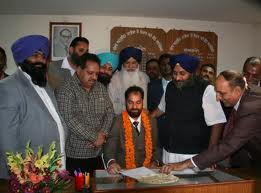
The following Saturday, Mr. Amrik Chand, a great personality, a great Ambedkarite and a great Buddhist also arranged another collective meeting with all representatives of the local organizations. The meeting was scheduled at Golden Peacock Banquet Hall in San Jose. Mr. Ram Murti Saroy, a well known personality in San Jose and the owner of the Banquet Hall also participated in the meeting. The meeting lasted for almost for five hours. The following gentlemen were present in the meeting: Amrik Chand, Kewal Bolina, Ram Murti Saroy, Ramesh Chander, Surinder Soni, Chander Mohan, Satnam Ram, Ram Lal, Surinder Saroy, Balbir Thind, Sonu Ambedkar, Bhupinder Singh, Major Kumar, Ram Gopal, Paramjit Rai, Randhir Suman.

A great extent of thoughts was exchanged in this meeting. I was given the opportunity to present my thoughts first and share my views with all present in the meeting which was followed by questions to me. All possible opportunities and challenges were discussed during this meeting by all participants. The main theme of the meeting was to find the best possible opportunities for all active workers to help promote the message of our Maha Purkhas and make every possible effort to achieve their dreams.

I was impressed by the questions raised by the participants since all those questions were very common for our community living in India and abroad except some questions. Issues were raised as to what we can do to improve the current condition of our community living in India and abroad. How can we get together and what could be done to bring our community at one platform. But the underlined concern of all participants was the same as all others living abroad that we must stand together for our community. All agreed to commend Guru Ravidas, Baba Sahib Dr. Ambedkar for their struggle to help our community to bring it where we are today. I felt a burning flame in their hearts to do something good for our community.

I enjoyed my trip with my family to California, USA even though I must admit the weather in California 35-40 Celsius was above normal for us as compared to our weather in Canada.

On behalf of INDIAN BUDDHIST SOCIETY TORONTO, CANADA .......I personally thank all of them who took their time to meet me during my trip to California and shared their thoughts with me. I assure them that their time is appreciated and all their thoughts will be considered and given a collective attention to help and support our community


| Home | About Us | Contact Us | Community Activities | News | Photo Gallery | ArticlesCulture | Media | Literature |
| Dr. Ambedkar | Kanshi Ram | Babu Mangoo Ram | Ad-Dharm | The Gurus | Lord Buddha | Letter Box | Great Personalities |