MAKING
US INCLUSIVE AND CARING SOCIETY
| FEDERAL
JOB GUARANTEE PROGRAMME |
Prof.
Autar Dhesi |
|
The
US persistently has been experiencing over 9 per cent
rate of unemployment for almost two and a half years.
However, the incidence of unemployment is much higher
among minorities and other vulnerable groups than the
national average. On top of it, national infrastructure
is considered to be in poor shape.Professor William Darity,
Jr of Duke University has proposed federal job guarantee
programme to address both the issuessimultaneously. To
pursue the matter seriously he made a presentation before
the Congressional Black Caucus Deficit Commission on January
28, 2011.
He contends that the opportunity to work for decent wage
is every citizen’s basic right. In addition to debilitating
human spirit, unemployment imposes heavy costs on individuals
andsociety and causes financial problems at all levels
of government- federal, state and local. The proposed
programme includes formation of a National Investment
Corps and Federal job Guarantee for all citizens. The
corps would perform the work required to maintain and
augment the US physical and human infrastructure. The
programme not only would meet the employment needs created
by the current financial crisis but also contribute to
national well-being. It is like taking a cake and eating
it too.
?Professor Darity, Jr. believes that his proposed plan
has an edge over stimulus measures, in terms of indirect
effects, in creating direct employment. Implementation
of the plan would make many other government programmes.
like antipoverty, unemployment compensation etc. redundant.
Similarly minimum wage laws, and financial regulation
would no longer be required. On balance cost-benefit analysis
favoursthe proposed programme.
The proposed Federal Job Guarantee Programme is logically
sound and workable. On balance it would not add to size
of the Government. It should enhance national well being
by creating conditions for social harmony and cohesion.
Happy, inclusive communities usually provide inbuilt mechanisms
to moderate wayward behaviour of vulnerable members. Further,
with improved infrastructure-physical and social, it would
be easy for policy makers to manage impact of cyclical
downsides and keep the society on an even keel. In such
a situation, financial 'predators' wo'nt find easy victims.
No doubt, the plan would face stiff opposition from certain
quarters. However, if the present administration is able
to muster sufficient courage to see this transformative
measure through,it would be credited for making the US
an inclusive and caring society. In any case, the plan
offers a rare opportunity for the US to redeem its lofty
ideals.
Somehow, if this sort of message reaches the right quarters,
theprogramme would be half way through.
Posted
on March 16, 2011
|
 |
POWER
SHIFT
BBC economics editor Stephanie Flanders writes on
China attaining
number 2 position in the world economy. BBC News,
Sunday, 13 February 2011 |
Summary
of Stephanie’s write up
With China overtaking Japan as number two economy in the
world, Stephanie reminds rest of the world why it is important
to keenly observe bahviour of the emerging economic super
power “Historically”, Steph laments that “the
birth of new economic superpowers has caused great instability
and conflict, more often than not.” Besides mentioning
the possibility of some geopolitical concerns, the two key
economic questions posed by Stephanie relate to possible
role of Chinese currency as a global currency and orientation
of economic policy towards domestic consumption. Both have
wider implications for the world to ponder over.
At 11:19am on 15 Feb 2011, Autar Dhesi wrote:
The middle kingdom has always considered itself as the centre
of civilisation. The sleeping giant has woken up after a
long slumber. It is trying hard to regain its earlier position
through absorption of modern technology. Its approach to
interaction with rest of the world is cautious and pragmatic.
It looks Chinese are quite astute players in the power game.
Their behaviour at times is quite enigmatic but it seems
to be driven primarily by relentless pursuit of national
interests. Ideology plays only a cosmetic role. Chinese
are too shrewd to risk their developmental goals by getting
involved in major conflicts, at least in the near future.
Nevertheless, they are likely to increasingly use their
economic muscle in pursuit of their national goals while
building their fire power. They would use aid and trade
to access secure sources of raw materials like developed
countries.
They
are unlikely to bring drastic changes in pattern of production
or foreign exchange regime as these would be too disruptive
and risky. In all probability, they would follow the middle
path and let economy evolve through institutional adjustments
over time. It does not mean that they will never use their
force against credible contenders in the global power game.
On may hope that they learn the art of 'live and let live'
as they become stronger by the day.
Post-script
The major credible contestant in Asia, as perceived by China,
is India. Of course, China, mindful of its historical experiences,
is equally wary of Japan that is closely aligned with the
U.S. However, China expects other countries to fall in line
once its superpower status in fully acknowledged.
Since independence India’s defence and foreign policy
in the region has been Pak-centric, especially till 1963
conflict with China. Besides a few recent major diplomatic
initiatives to reformulate its foreign policy in accordance
with emerging world balance of power, India has been trying
to fortify its defence along the Himalayan border. However,
in contrast to China’s proactive intrusive diplomacy
in the region, India remains primarily a cautious, if not
timid, non-interfering actor. China’s faith in potency
of flow of power from the barrel of a gun remains fully
intact. Harping on sacral “bow and arrow” strategy,
rooted in ancient anthroprological beliefs, by some Indians
seems to be a ‘baby play’ in contradistinction
with China's nuanced, modern, pragmatic approach. Amen!
Posted on February 19, 2011
|
EQUALITY:
IT’S NOT JUST A WORD, IT’S A SIGNIFICANT
WORD
Danielle Lund |
Man has been endowed with a sense
of worth. He has not only been created for a Purpose but
he has also been given a sense of worth in that he is unique
and has been given certain gifts and responsibilities. One
of the responsibilities that man has been given is to treat
his fellow neighbor(s) with respect and dignity—and
these concepts, when narrowed down, suggest something deeper,
that theoretically speaking, both parties involved, namely
“fellow- men” share a characteristic in common,
that characteristic being equality.
According to definition, equality is “The same degree
of dignity or claims; as the equality of men in the scale
of being; the equality of nobles of the same rank; an equality
of rights” (Webster, Noah). “Much of the misery
and poverty of the Depressed classes is due to the absence
of equality of opportunity which in its turn is due to Untouchability”
(Rodrigues, Valerian). The small word equality is an important
concept with great significance. It is a concept that has
not only been sought after in revolutions, but a concept,
which in its absence, millions of innocent people have been
made targets of both harassment and violence. Ambedkar in
his pursuit of helping to free India from her bondage of
prejudice and the inhumane practices of the caste system
recognized that all men are obligated to treat one another
with respect because they have been born in a state of parity
with one another. To be treated as an equal means to be
treated in an impartial manner; it carries with it the promise
of dignity and freedom.
Born an untouchable, Ambedkar later wrote: “The effect
of the caste on the ethics of the Hindus is simply deplorable.
Caste has killed public spirit. Caste has destroyed the
sense of public charity. Caste has made public opinion impossible.
A Hindu’s public is his caste. His responsibility
is only to his caste. His loyalty is restricted only to
his caste” (Rodrigues, Valerian)References:
Rodrigues, Valerian. (2002). The Essential
Writings of B.R. Ambedkar. Oxford University Press. New
Delhi. (362-363) & (275), Webster, Noah. (1967 &
1995). 2. American Dictionary of the English Language. Foundation
for American Christian Education. San Francisco Posted
on January 18, 2011 |
BBC
News Magazine 26 January, 2011
ARISTOTLE
ON MODERN ETHICAL DILEMMAS |
IS
SOCIAL MOBILITY GOOD? |
Summary
of BBC write up
Thinkers like Aristotle have pondered over such questions
for centuries. Most of the people to-day consider it a morally
desirable phenomena as a more socially mobile world is a more
just world. They have support for this view in Kantian approach
to ethics. But there are some ethical issues relating to impact
of social mobility on family and community, happiness (utilitarian
concern) and valuation of moral goods (concern of virtue ethics)
that need to be addressed.
Autar Dhesi’s response, partially published by BBC
A culturally enlightened, open society is less burdened by
debilitating, unequal social structures that often restrict
choices. But openness does not imply a situation free from
restraints. Only freedoms with responsibilities can make a
civilised society sustainable. And the aim of creating a level
playing field should not be confused with ensuring equal outcomes.
The latter would require some unethical social intervention.
Postscript
Social mobility is a precondition as well as consequence of
development. However, it is openness of a society that facilitates
mobility. The social conditions conducive to social mobility
are experienced by societies that have been deeply influenced
by egalitarian social ethos and historically lacked enduring
power structures. In addition, such societies put high value
on hard work, compassion and sharing. The Indian Punjab in
the subcontinent is the area that nearly fits such description.
In a study on urban Amritsar in 1980, Autar S. Dhesi and Surjit
Singh attempted to derive empirical estimates of intergenerational
mobility rates. The findings were later published in a paper,
“The Role of Social Mobility in Punjab’s Development”,
Anvesak (Journal of Sardar Patel Institute of Economic and
Social Research, Ahmedabad), Vol.12 (1):48-58, 1982.
The estimated rates of social mobility for Amritsar were comparable
to those for Chicago.
Obviously, openness seems to be associated with a flourishing
society. A lot more such studies are needed to confirm this
important link.
Posted
on January 30, 2011 |
BREATH
OF FRESH AIR: SGPC DECISION TO HONOR
NABI AND GANI KHANS IN PUNJAB, INDIA |
Dr.
Harmesh Kumar
Licensed Psychologist, President,
Therapeutic Residential Services, Inc. |
The
announcement by Dr. Gurmohan Singh Walia, Director of
Education, Shromani Gurudwara Parbhandak Committee (SGPC)
few days ago made me spiritually very excited. The news
in the Punjab Mail dated Dec. 24-31, 2010 that SGPC has
decided to open a school to honor two Muslim Humanitarians
i.e. Nabi and Gani Khans in Machiwara, Punjab. Most of
the readers would not know that Nabi and Gani Khans provided
shelter in Machiwara and saved Guru Gobind Singh Ji from
the Mughal army. I could not stop thinking about the timing
and relevance of this announcement in Punjab, India, Pakistan,
for other Muslim community in other parts of the world
and also for international community especially after
911 in United States.
It
is refreshing to mention that the foundation stone of
Golden Temple (Sri Harmandir Sahib) was laid by a Muslim
Saint, Sai Mia Meer in 1588 at the request of Sri Guru
Arjun Dev Ji (Fifth Guru). I was thinking that even though
it took SGPC almost 422 years after the foundation stone
of Sri Harmindar Sahib was laid by a Muslim Peer (Saint)
to publically acknowledge the contributions ofspiritual
leaders of Muslims faith to protect the Sikh Gurus. Most
of the spiritual leaders of Islam and Hinduism considered
Sikh Gurus as Saints and fighters for social justice and
they prevented exploitation of the poor and socially disadvantaged.
First
of all I want to acknowledge that this announcement made
me very proud and blessed of my spiritual heritage being
a Punjabi. The true Punjabi (whether s/he is a Hindu,
Sikh, Muslim or Christian) believes in One God and respects
all the faiths. It is because of the legacy of Sikh Gurus
who tried to abolish all the psychological barriers of
Caste, Creed, Religion, Rich or Poor and High & Low
Social Status and tried to create Begumpura (Egalitarian
society) based on true, hard labor and sharing the fruits
willingly and lovingly with others. When they do a true
worship or Seva, they feel the blissful state as described
in One of the quotes from Gurbani by Guru Arjun Dev Ji,
which says:
????? ?? ?? ???? ???? ?
bisar gee sabh thaath paraaee ||
????? ?? ?? ???? ???? ?
I have totally forgotten my jealousy of others,
?? ?? ???????? ???? ??? ??? ???? ?
jab thae saadhhasangath mohi paaee ||1|| rehaao ||
?? ?? ???????? ???? ??? ??? ???? ?
since I found the Saadh Sangat, the Company of the Holy.
||1||Pause||
?? ?? ???? ??? ?????? ??? ???? ?? ?? ??? ?? ???
naa ko bairee nehee bigaanaa sagal sang ham ko ban aaee
||1||
?? ?? ???? ??? ?????? ??? ???? ?? ?? ??? ?? ???
No one is my enemy, and no one is a stranger. I get along
with everyone. ||1||
14 ????? (?: ?) ???? ????? ????? : ??? ???? ??. ??
Raag Kaanrhaa Guru Arjan Dev
?? ???? ???? ?? ?? ????? ?? ????? ???? ?? ??? ???
jo prabh keeno so bhal maaniou eaeh sumath saadhhoo thae
paaee ||2||
?? ???? ???? ?? ?? ????? ?? ????? ???? ?? ??? ???
Whatever God does, I accept that as good. This is the
sublime wisdom I have obtained from the Holy. ||2||
?? ??? ??? ???? ????? ??? ???? ???? ???? ?????? ?????
sabh mehi rav rehiaa prabh eaekai paekh paekh naanak bigasaaee
||3||8||
?? ??? ??? ???? ????? ??? ???? ???? ???? ?????? ?????
The One God is pervading in all. Gazing upon Him, beholding
Him, Nanak blossoms forth in happiness. ||3||8||
???? ??? ???? ????? ?????? ?? ?? ???? ?
aval aleh noor oupaaeiaa kudharath kae sabh bandhae ||
???? ??? ???? ????? ?????? ?? ?? ???? ?
First, Allah created the Light; then, by His Creative
Power, He made all mortal beings.
19 ??????? (?. ????) ???? ????? ????? : ??? ???? ??. ??
Raag Parbhati Bhagat Kabir
?? ??? ?? ??? ??? ????? ??? ??? ?? ???? ???
eaek noor thae sabh jag oupajiaa koun bhalae ko mandhae
||1||
?? ??? ?? ??? ??? ????? ??? ??? ?? ???? ???
From the One Light, the entire universe welled up. So
who is good, and who is bad? ||1||
19 ??????? (?. ????) ???? ????? ????? : ??? ???? ??. ??
Raag Parbhati Bhagat Kabir
It has also given credibility to India that everyone is
accepted in India without paying attention to one’s
religion, faith, caste, creed and social status, thus
recognizing the secular nature of India. The Supreme Body
of Sikhs, SGPC’s recognition of the value of education
for the upliftment of the masses and spreading the message
of equality to humanity is very significant.
I have been discussing this in our Sikh community for
many years in USA and also in India that we have build
so many Gurudwaras wherever we are gone but we have not
build schools, colleges, universities and medical colleges
and hospitals. Many of my friends in the West have been
talking about the huge budget of SGPC and its lack of
desire for funding the educational institutions, now they
would not have that excuse.
This is also very important for the Muslim world at this
time to see that Punjabi (Sikhs) admire the positive contributions
of Muslims in their daily lives and by promoting educations
centers on the name of Muslim Humanitarians, it would
up lift the spirit of Muslim brothers and sisters as they
see their faith being negatively portrayed in the Media
especially in United States and European nations after
911. It is going to give a very good message to youth
and younger generations to remove the shadow of ignorance
in them so that they can accept all human beings as equal
without any biases of religion, caste, creed, nationality
and economic status. It is one’s good deed which
matters not one’s faith or status.
The true education which our Gurus gave us was based on
true universal principles of humanity where education
teaches students (Sikhs, seekers of truth) to respect
everyone no matter what their background is. However,
this message has been ignored by our current educational
institutions and political establishment. These educational
institutions are acting like business centers rather than
providing quality education to today’s students.
In the past parents would send their children to schools
so that they can become good human beings and can serve
the humanity with love and true (sewa) Service spirit.
Now days, parents told to send their kids to schools so
that they can earn high income to meet their daily needs
with special focus on economic well being while ignoring
all other aspects (emotional, social etc.) which help
an individual to live a productive and fulfilling life.
Therefore, to conclude it has been very good news that
SGPC has adopted a resolution to start a school on two
Muslim Humanitarians in Punjab. I congratulate the SGPC
and hope that it would start some other humanitarians’
projects or educational institutions named after different
Bhagats whose’ writings are enshrined in Sri Guru
Granth Sahib, our Gurus truly started the interfaith moment
during the times when it was a death penalty for those
who tried to correct the so called religious masters of
those times. Unfortunately it is still same in today’s
world. I pray and hope that we as a human race will grow
from this place to be higher spiritually aligned souls
to spread the message of love, peace to create harmony
within us, our families, our communities, nations and
in the world.
Posted on January 27, 2011
|
STEPHANOMICS:
FROM THE BBC’S ECONOMICS EDITOR STEPHANIE
FLANDERS
THE
FUTURE: EVEN MORE UNBALANCED
Tuesday, 21 December 2010
|
Comments
Commenting on Andy Haldane of Bank of England’s
thesis on increasing current account imbalances, Stephanie
seems to believe that nothing much can be done about them
except disrupting or reversing the process of globalization.
Ideally,
globalization implies relatively free flow not only of
goods and financial resources, warts and all but also
of manpower and knowledge. These flows are synergetically
interlinked and form a complete package. So, a country
either accepts it or completely opts out thus risking
a deep fall into dark abyss of fully integrated world,
The
key issue, Steph, is that these flows should remain smooth
and do not cause disruptions for countries individually
or collectively. This requires evolutionary institutional
adjustments at national and international level, as simple
as that.
So, please do not despair and look backward, Stephanie;
instead we should look forward to a better future of peace
and prosperity, a bliss point, an ever elusive goal but
increasingly coming within the realm of possibility.
The
main reason for Andy’s alarming conclusion is his
exclusive focus on investment-saving relationship, overlooking
other side of the equation, i.e. exports and imports.
At the risk of simplification, one may suggest that developed
countries’ earlier decision to shift manufacturing
alongwith environmental pollution to emerging countries
with low wages is prime cause of increasing current account
imbalances. Obviously, the objective of DCs has been to
enjoy cheaper imported goods in a cleaner environment.
It looks like killing two birds with one stone. But it
has had its own consequences, expected as well as unexpected.
In
this context, emerging countries’ tremendous capacity
to successfully absorb imported technologies put them
in a competitive position. Absorptive capacity can be
defined ability to access, learn, innovate and implement
new technologies. The greater trade openness, receptivity
to foreign direct investment in ‘conducive’
institutional environment and higher level of human capital
determine absorptive capacity and in turn productivity.
As
a graduate student at the University of Birmingham (England)
during early 1970s, I toyed with the idea of finding a
plausible theoretical explanation for changing trade pattern
in manufactured goods among countries at different levels
of development. The outcome was published in an article
and a book given below.
Autar
S, Dhesi (1977), “Theory of Comparative Costs and
the Level of Development”, Indian Journal of Economics,
Vol LVIII, No 229, PP. 171-181. The Journal was started
by Stanley Jevons.
Autar
S. Dhesi (1979), Human Capital Formation and its utilization,
Sterling, Chapter 10. The book got favourable reviews
in Economic Journal and Kyklos among other journals.
The
ideas contained in these publications have become even
more relevant to the contemporary situation.
As a consequence of emerging global economic geography,
DCs receive income from their invested capital in emerging
countries and cheaper imports. It permits emerging countries
in turn to become technologically sophisticated and to
accumulate massive reserves through exports, held in currencies
of some DCs, on which holders get negligible return. It
seems that it is inefficient / even inappropriate use
of this massive line of cheap credit at the disposal of
DCs that causes recurrent financial instability.
Given
a positive relationship between level of technology and
GDP per capita, as emerging countries catch up technologically,
GDP per capita , consumption pattern and associated behavioural
propensities should start converging among emerging and
developed countries. However, during transition, problem
of excess savings, facilitated by favourbale demographics,
cultural and other factors, in emerging countries would
remain a serious one.
So, DCs have to learn to live within means by moderating
excessive tendency to enjoy luxury on credit. Yet, as
Steph has rightly asserted in an earlier post, Britain's
excessive focus on reducing public debt, largely ignoring
private debt, might not only slow economic recovery but
also prove harmful to long term well being of Britain.
One should be particularly worried about adverse impact
of fiscal cuts on human capital formation and generation
of new ideas, two key two determinants of comparative
advantage. Please go on giving wakeup calls in the right
quarters, Stephani
|
Autar
Dhesi |
Note:
I could not post these comments on BBC economics
editor’s Blog in time as I was quite busy
with other pressing things.
Posted on January 07, 2011
|
|
BOOK
REVIEW
Prof Autar Dhesi's Book
Rural Development in Punjab: A Success Story Going
Astray
Edited by Dhesi Autar Singh and Gurmail Singh,
(London, New York and New Delhi, Routledge, 2008),
pp 533, INBN 987-0-415-45681-4, Rs. 795 (HB).
|
By:
Maninderdeep Cheema
Assistant
Professor, Eternal University, Baru Sahib, District Sirmor
(Himachal Pradesh)
Research
Journal Social Sciences, Vol.17, No.2, 2009, pp.149-155
The
introduction of Green Revolution technology in Punjab resulted
in a high rate of economic growth and structural changes.
The technology in Punjab proved to be very successful and
the state became the food bowl of India , incidence of poverty
declined to rapidly, per capita income has been the highest
in the country and Punjab became the fastest growing state
in the country. The state begins to be considered a role
model for agricultural modernization and rural development
for hitherto lagging regions in the developing world. This
impression generated by a success story of Punjab development
still dominates the mind of outsiders.
The
book brings out how this known success story is going astray.
The current state of economic affairs in general and rural
development in particular in Punjab is no longer consistent
with its impression of a vibrant growing economy for outsiders.
The era of rapid agricultural growth unleashed by the forces
of Green Revolution technology adopted in mid-sixties seems
to be almost over. Consequently growth decelerated to very
low level and state lost its star performer status and joined
the league of poor performing states in the country. The
crisis is not confined to agriculture alone but also haunts
other sectors as well. Productivity is stagnating, use of
natural resources has become unsustainable, industrial and
services sectors are not growing at a pace requires to reduce
the pressure on agricultural sector, incidents of suicides
by peasantry are on rise and debt-burden of the state is
increasing day-by-day, as almost one-third of the state
budget goes into repaying interest on accumulated debts.
This volume aims at encapsulating Punjab ’s development
experience, addresses to some of the key issues related
to crisis in the states rural economy and suggesting possible
solutions.
The
book begins with an introductory chapter on the role of
technology and institutions as key components in agriculture
transformation and overall economic development. In backdrop
of their role, authors discuss the evolution of centralized,
urban-biased and capital-intensive modern industry lead
development strategy in the country. However it continuously
changed overtime in line with international trends in development
thinking and changing economic scenario in the country.
Punjab model however was an exception to this framework.
The state pursued a development strategy with focus on rural
development and urban-based small scale industry. Unattended
ensuing changes in this model gradually culminated into
serious crisis in the state. Rest of the book is addressed
to some of the major issues related to this crisis in Punjab
’s rural economy. 27 papers following introduction
are divided into six sections; namely rural development-an
analytical framework, agricultural: development and challenges,
water resources: issues and responses, agro-industrial development,
human resources development and role of Punjabi Diaspora
in rural development in the state.
In
his chapter on rural development, Autar S Dhesi elucidate
the inherent limitation of the Punjab model of development
as a strategy for transition of Punjab economy to the next
stage of development. In backdrop of limited natural resources
and underutilized human resources, author suggests institutional
changes and heavy investment in modern infrastructure, and
R&D facilities and human resource development for promotion
of much needed focus on promotion of knowledge-based activities
in the state.
The
book first deals with broad-based and open-ended questions
of sustainable development, R& D activities related
to agriculture, contract farming, crop diversification,
diversification of allied activities and agro-forestry etc.
The major problems related to these areas, their growth
or development and the policy suggestions therein are discussed
in Section-II under the heading-Agriculture: Development
and Challenges. These two sections make a sound ground for
the reader to understand and get involved in the issues
going on in Punjab related to economy, society and institutions.
G.S.Kalkat
in his paper dwells on water depletion, soil degradation,
and viability of small farmers, slow down of technology,
neglect of education and sanitation, and rural indebtedness
as six major challenges faced by the rural economy in the
state. He emphasized the need of diversification of cropping
pattern, appropriate price policy and investment in rural
infrastructure and policy facilitating exist of unviable
small farmers to more rewarding professions as some of policy
suggestions to the agrarian crisis.
In
his paper, Ramesh Chand examines the changes in structural
and performance of agriculture in the state. In view of
the recent decline in domestic and international demand
of cereals, he suggests the reorientation of agricultural
production and diversification of area under wheat and paddy
to other crops that are globally competitive and have high
a future demand. The paper by Sidhu et al also recommends
the need for diversification of cropping pattern and public
investment in the state due to agrarian crisis resulted
form squeezed wheat-paddy profitability, depletion of natural
resources and stagnating farm incomes. The paper by Dhaliwal
and Bhullar suggests the need of diversification of The
paper by Gurmail Singh also examines the process of agrarian
transformation since 1950s and its contribution of agriculture
modernization and poverty alleviation. He brings out that
the achievements notwithstanding, rural development in Punjab
failed to bridge the rural-urban disparities in access to
health, education and civic amenities
The
paper by Sukhpal Singh highlights the role, types, problems
and prospects of contracting farming in light of the experiences
of farmers in realization of incremental gains from their
participation in contract farming. He recommends the need
of promoting group contracts, involvement of grass root
NGOs and CBOs and appropriate regulatory redressal mechanism
for better implantation of efficient contract farming in
the state.
Two
papers by Mathur et al and Chadha emphasizes the need to
renew R&D efforts to break the stagnation in agricultural
growth. Mathur et al recommend the investment in R&D
that promotes diversification of agriculture, conserve resources
and develop market. They suggest greater public-private
partnership model for the same. However Vikram Chadha in
his paper strongly argued for public funded R&D for
technological development in the state.
The
depletion of underground water is posing serious challenge
to the sustainability of agriculture in the state. Two papers
by H.S. Hira and Lakhwinder Singh examines this issue and
correlates the dwindling water table with dominance of wheat-paddy
crop cycle. To deal with the problem, both papers recommend
the need for immediate policy initiatives including recharging
of aquifer, diversification of cropping pattern and mobilization
of local communities in harvesting of rain water.
Two
papers by Rachpal Singh and Kashmir Singh, and Upinder Roy
elucidate the contribution of integrated watershed development
projects in the sub-mountainous and backward Kandi area
of Punjab in conservation of natural resources, control
of floods, improvement in living conditions of people, and
development of sustainable irrigated agriculture system
suitable to the local needs of the people in the region.
While the former authors emphasize the need to integrate
human resources development with the project objectives,
the later emphasize a decentralized approach for better
social outcomes of the projects.
Three
papers by Gurmail Singh, Gupta et al and Piare Lal emphasize
the development of strong agro-industrial linkages for better
realization of production gains to the farmers and overall
development of the state. While the paper by Gurmail Singh
identifies 15 broad group of agro-processing industries
for which the state enjoys comparative advantages and have
enough processable surplus raw materials. Piare Lal makes
strong case for integrated wood-based industries that have
enough future demand and producers can also benefit by tapping
carbon credits under Kyoto protocol. Gupta et.al. in their
paper makes a convincing case for tremendous potential for
biofuels production from available biomass for which cost
effective technology has already been tested successfully.
Authors find the scope for production of about 5500 megawatts
of eco-friendly renewable energy in the state from available
biomass in the state.
The
paper by S S Johl highlights the key role of education in
inclusive development. He emphasizes the need of correcting
to anti-rural bias in education policies to improve the
dismal affair of rural education in the state. The paper
by Jaswinder Brar reveals how the dwindling, inadequate
and unbalanced allocation to education and distorted priorities
during reform period in Punjab is a matter of serious concern.
Given its implications, he suggests the need for enhancing
public investment in education in the state. Not only education,
similar evidence of declining public expenditure on rural
health was also found in paper by Sukhwinder Singh and Sucha
Singh Gill. They also found that the poor plight of rural
health system in the state is pushing the poor population
to unmonitored, unregulated and quacks dominated private
health providers. Probably due to poor rural education and
health system in the state, state lagged much behind Kerala,
as brought out in paper by Sawarn Singh, in human resources
development. The poor health status of people in the state
is not compatible with high per capita income status enjoyed
by the Punjabi’s. Author recommends many policy suggestions.
Two
papers by Manjit singh and Balbir Singh and Janak Raj Gupta
examines the operation and effectiveness of the employment
generation and poverty alleviation programmes in the state.
Both papers notes the contribution of these programmes in
improving living conditions of the vulnerable groups in
the state. Collusion between village bureaucracy and village
leadership to certain extent is responsible of leakages
and poor implementation of programmes in the state. The
authors of these papers make suggestion for more effeteness
of such programmes.
The
unique feature of the book is its last section, which examines
the contribution of millions of Oversees Punjabi’s
to the development of Punjab ’s hinterland. This is
probably the first book putting five papers at a place on
the role of Punjabi Diaspora on economy way back home. In
first paper, Dhesi finds that their contribution to development
have been patchy, sporadic and episodic. He finds that lack
of appreciation of their potential to contribution alongwith
almost missing requisite institutional mechanism in Punjab
and abroad for channelising their contributions into a well-planned
social and economic investment. In second paper, Thandi
argues that recent the recent breakthroughs in communication
technology and the process of globalization strengthened
the Diaspora-homeland association, which facilitated canalization
of remittances. He emphasizes the need of creation of apolitical
wider network of emigrants’ alongwith development
of strong communication network and trust building measures
to strengthen their bonds with homeland. The third paper
by Tatla examines the extent and nature of Diaspora exchange
with homeland and contribution of Diaspora to agrarian transformation
and its manifestation social and cultural changes. The fourth
paper by Raghbir Bassi narrates his own experience in giving
practical shape to the bottom-up approach for rural development.
The successful transformation of his own village Kharaudi
through contribution by emigrants, with participation from
state and villagers in unique in its own way The success
story shows the way how to successfully mobilize and channelise
the financial resources of Diaspora for development of their
ancestral villages. The fifth paper by Gurdev Gill enlists
the practice solutions to the appalling subhuman conditions
of sanitation and hygiene in rural areas in most cost effective
manner.
This
volume is a welcome addition to the literature on rural
development in Punjab . Collection of papers successfully
highlights how a glorious achievement can be unsustainable
due to lack of intent and will to bring desirable structural
transformation of an agrarian economy. The book successfully
brings out the multidimensional nature of the current development
crisis in the state. Findings and suggestions of contributors
in the volume provide useful insights into challenges and
prospects of many problems encountered by rural development
of Punjab . It throws many useful lessons for other states
within India and abroad following the Punjab model of agricultural
and rural development. Many of these pitfalls are avoidable
by timely introduction of required policy initiatives. The
book is recommended for academia, policy makers, and national
and international development agencies.
The reviewer recommends that this book may be purchased,
read and preserved in the important libraries all over the
world. There is a not-too-bold price tag of Rs. 795/- for
sale in India . The quality of printing is excellent. My
praise for this wonderful, informative, and thought provoking
monograph presenting contributions from outstanding scholars
working on Punjab economy.
Posted
on www.ambedkartimes.com, December 01, 2010
|
Stephanomics-Economic
Insights From the BBC’s economics editor Stephanie
Flanders |
NEW
WORLD ORDER:
WHEN THE G20 STOPPED FEELING LIKE THE G8-PLUS |
At
11:47am on 15 Nov 2010, Autar
Dhesi wrote:
The
nagging problems of trade imbalances and instability in
financial markets reflect inadequacy of institutional framework
to cope with rapidly rebalancing international political
and economic power. But to consider issues in terms of Chinese
undervalued controlled exchange rate and easy US monetary
policy betrays lack of understanding of fundamental inadequacies
of the world system. There is dire need to institute stable
rules to ensure exchange rate flexibility and to co-ordinate
monetary and fiscal policies. Above all there is serious
need to think about viable alternatives to reserve currencies
to hold reserves. Both deficit and surplus countries have
responsibility to maintain stable,open international economic
environment in their long term self interest. However, the
new institutional framework would work only if rules of
the game are transparent and ensure equitable distribution
of costs and benefits of the system.
It
seems that the current issues and institutional aspirations
have a similar flavour as that of those during time of John
Maynard Keynes. But no person of his intelectual agility
is in sight to reinvent international institutions to cope
with rapidly rebalancing international economic environment.
Nevertheless, those at the helm of affairs may benefit from
his profound ideas to evolve the institutional framework
carrying his imprint,however faint, for ensuring more orderly,
balanced growth of the world economy. For example,his idea
of a Central Bank with Bancor as its monetary unit is still
relevant. In the absence a 'Keynes', even committed mediocrity
can deliver a lot in practical terms if it remains focused
on key issues,adopting a nuanced,flexible approach.
In
to-day's highly interdependent world, dialogue and diplomatic
engagement,underpinned by willingness to make mutual adjustments
and compromises is the prime instrument of resolving problems.
The mutually destructive,retaliatory actions and threatening
postures are past. The US Treasury Secretary,Tim Geither
missed the point by jumping guns and inadvertently contributed
to the diminution of significance of G-20 Seoul meeting.
The annoucement by Federal Reserve to print 6b dollars to
ease money supply,regardless of international consequences
had already put a damper on significant positive outcomes
at Seoul.
Paraphrasing Winston Churchill,jap,jap is any time a better
approach than bang.bang(even verbal) to reach agreements.
To-day,humanity is at the threshold of experiencing just,peaceful,prosperous
living, only seen in dreams so far.For realising this bliss
point, there is greater need for co-operation among countries
based on mutual understandings and appreciation for each
other's concerns.Then genuine differences may become source
of finding enduring solutions and institutional adjustments.
It
high time deficit developed countries realise that genesis
of problem of trade imbalances and debt crisis lies in their
earlier decision to shift high labour cost manufacturing
to developing countries like China to keep prices in check.
The outcomes of this action have been mutually beneficial.
While the developed countries enjoyed high level of properity,
the better organised developing countries experienced unprecedented,high
rates of growth and soon graduated to become world's dynamic
emerging economic power houses. Consequently, process of
rebalancing world economic power commenced. The centrally
controlled Chinese economy accumulated huge trade surpluses
by keeping value of Yen in check. But all the emerging economies
cannot be put in the same class. For example,China has been
following export-based growth strategy and has a controlled
foreign exchange regime. In contrast, India's growth strategy
is relatively more geared to meet huge domestic demand and
India maintains a market determined,flexible exchange rate.
While undervalued Yen hurts India's exports like those of
deficit countries,weakened dollar due to easy US monetary
policy strengthens Indian currency. Nevertheless, India
should play an active role in facilitating the institution
of stable rules for regulating international economic relations.
However,
it is not generally appreciated that emerging economies
with massive trade surpluses provide low-cost easy credit
to reserve currency countries that is not always used properly.More
often than not,greedy bankers and other speculators play
up with this easy source of credit to mess up financial
markets and asset values. While enjoying high living on
credit, these countries forget to leash the predatory actions
of speculators.Consequently, these countries quietly end
up with serious debt crisis.In panic response,instead of
looking at the underlying causes of their problems,they
search for scape goats and resort to domestic policies that
may prove to be detrimental to their long term economic
vitality. For example,UK's frontal attack on public debt,resulting
in indiscriminate cuts in public expenditure, might prove
damaging in the long run. A more balanced, sustainable fiscal
policy for the medium term might have been a better response
to debt crisis.
Nevertheless,
focus on increasing exports to remove deficits is desirable.
But here US and UK approaches differ in their preferences
for rates of recovery. US is relatively more ambitious and
optimistic than UK. However, because of domestic political
constraints due to politically divided Congress,US relies
more on monetary expansion, paying little attention to fiscal
measures. But its performance in reducing private debt is
better than that of UK. The latter remains excessively focused
on public debt.
As
Stephanie has pointed outed earlier that China is aware
of the need to restructure its economy and give greater
importance to domestic demand. But it is concerned with
social and political consequences of a rapid change in orientation.
So it is a question of pacing the change for China. However,
it would be in everybody's interest if China adopts a market
determined flexible exchange rate soon.
Germany,another trade surplus country, belongs to an entirely
class.Though its export surplus is significantly due to
its growth strategy,contribution of its efficiently managed
labour,product and financial markets cannot be overemphasized.Nevertheless,it
is in its long term self interest to facilitate smooth working
of the world economy.
Go
on prodding pedantics of the world (including me) to think
faster for a better world,Stephanie.
Posted on November 16, 2010 |
Dear Editor,
Though it is a matter of pride to hear
recognition names of 'Dalit' and Dr. Ambedkar from a leader
of super power, but I am sorry to hear President Obama's
elevation of MK Gandhi to a level of world leader and acclaiming
him as a role model for his presidency of the United States.
Clearly, Obama is encircled by caste conservative individuals,
who believe in perpetuating the same ideology as Gandhi
did. MK Gandhi may be a source of inspiration for President
Obama, may be a world leader or a symbol of non-violence,
but not for millions of downtrodden and oppressed classes
of India, still suffering at the hands of upper castes,
mainly because of Gandhi's hidden hatred towards them, his
denial to accept communal award, denunciation of caste system
and entering into a fast unto death to keep them segregated
at bottom of caste hierarchy of a Hindu religion. He often
undermined Ambedkar's intellectual capabilities at major
conferences and political occasions and rather succeeded
to establish an economical and political system based on
orthodox caste system, that as a matter of fact is still
prevalent in independent India even after 62 years of his
death. India can proclaim Gandhi as father of a nation,
particularly for his own clan whom he made a dominating
caste of India's economy and a ruling class as well, but
not for under privileged Dalits.
President Obama should have done an in
depth analysis of India's caste system, Gandhi's contribution
to the Untouchables of India prior to delivering his remarks
about Amberdkar at parliamentary speech. His brief remarks
clearly reveals that he is not well aware about Ambedkar,
his struggle and contribution to downtrodden and aboriginals
of India. Looks like he is completely over powered by Gandhi's
falsifying image as a Mahatma. Setting aside his economic
growth agenda, intellectuals and farsighted Dalits should
not take Obama's latest visit merely as a matter of pride.
Once again there may be another long term hidden conspiracy
behind it to elevate another young Gandhi to a national
level, after Manmohan Singh, just like he acknowledged MK
Gandhi a world hero, to maintain a Gandhi-Nehru hierarchy
in the nation. Dalit activists and/or organizations need
to move forward with consistent efforts for their own emancipation,
caution and being aware of national political environment.
Rakesh Chander
President, Sri Guru Ravidass Sabha Sacramento Posted
on November 11, 2010
|
UNDERSTANDING
COLLECTIVE WISDOM OF PEOPLE IN ELECTION 2010
By
Dr. Harmesh Kumar
|
I
could not stop thinking last week’s
election results through the prism of my Indian heritage
and collective wisdom of thousands of years. Pundits,
reflecting on democracies of India and America, predicted
results mostly based on a singular factor. They highlighted
the anti-incumbent wave in deciding the fate of the ruling
party in both the nations. However, we need to look into
these election results from the socio-political, economic,
racial, gender, national and local point of views. It
has been, it is, and it will be very difficult to predict
these results based on above factors. What lessons can
we learn as intellectuals and pundits from this election?
I want to share some thoughts from my understanding and
also from people’s point of view. Anti-incumbent
sentiments in the nation and in the state of California
dominated, according to some analysts. I will keep my
focus mainly on California election with some references
to the national election results. Many supporters of Meg
Whitman encouraged her invest $140 million of her own
fortune in the fray. She was convinced of the fact that
buying Governor’s office would make her most eligible
to serve people of California without any fear or pressures
from the outside. Maybe she would be the only governor
to keep herself free of lobbyists and special interest
groups. Meg
Whitman projected her success as CEO of a corporation
to be the yardstick for her future success. However, people
did not believe her agenda. People of California did not
believe that a person’s own financial fortune and
also being a CEO of a corporation was enough to be the
governor of the State of California and to be able to
do people’s business.
Her
opponents struck where her strength was most centered.
They tried to change people’s perception by stressing
that she did make millions of dollars in bonuses while
working as CEO of E-Bay and laid off thousands of workers
to make profit for her shareholders. Some humanists accused
her of following capitalistic policies for making few
people very rich while keeping the masses very poor.
Gender may also have played the role by projecting a woman
running against the man. Some negative comments in regards
to her gender during their debate at UC Davis last month
were noticed.
The
politicians and policy makers do need to think about the
“so called middle class that has been shrinking
in this country”. This has led to a lot of frustration
and anger in hard working men and women in this country
and especially in California. The policies of both the
major parties are focused on two extreme positions i.e.
one party (democratic) focusing on politics of minoritism
and tapping into anger of the poor while other one (Republican)
are focusing more on protecting the bottom-line of rich
corporations and so called small businesses. Both of these
major parties need to think about the middle class (and
common good) which is more and more being squeezed as
they are only generators of tax revenues for the country.
It is very clear that large corporations and some big
small businesses do not pay the taxes at all as they are
able to show more losses in their tax filings. The other
thing Republican Party representatives are talking about
the disbanding the health insurance improvements which
White House and Capitol Hill has made tremendous achievements
to bring some sanity to the prices of health insurance
plans and policies. I have been in this Country practicing
as a psychologist for the last 21 years, not even a single
time I have seen increase in my payment by the insurance
companies, rather than I have seen a decrease or cut in
my payments. Both the parties need to work on making sure
that everyone in USA gets an affordable health care. As
it happens in the family that parents has to take care
of all the children irrespective of their cognitive or
physical strengths. Some kids parents’ know cannot
compete in the open market due to their disability or
learning deficits, however, they need to be protected
to reduce resentment and anger and promote fairness among
siblings. The Government has the same role. For All the
people on disabilities, our Government at State and Federal
levels spends billions of dollars in providing the needed
services to the most needy population of our society,
i.e. disabled, seniors and victims of natural disasters.
Whereas private health and life insurance companies are
only catering to people who can afford to pay their high
premiums. Once those high premium paying individuals become
dysfunctional or laid off or disabled they also become
dependent on the Government and private insurance companies
refuse to participate in providing any benefit to those
once functional people.
The
tea party euphoria also did not help Whitman in California.
It bears some resemblance to India’s political system.
The Bhartya Janata Party (BJP) a right-wing party in India
reacts similarly as Tea Party here does. Whenever, the
Congress or other left-wing parties come to power in India,
BJP rakes up issues like the site of Babri Mosque and
building of a Hindu Temple. In the same manner, Tea Party
was the one to make Ground Zero controversy more distracting.
Most constituents of BJP in India and Republican Party
in the US control a major potion their country’s
wealth.
However, whenever, Congress Party was in power in India,
it had hard time controlling prices of the commodities.
People would cry from Mehghai (higher prices than their
income). During this election also Republican Party did
not let the President Obama create more jobs for the unemployed.
Even when he tried to give some respite to unemployed
by extending their unemployment benefits, Republican Party
vehemently opposed it and then they blamed his policies
for not creating the economic growth. They blamed everything
on the Government rather than seeing what their party
has created while continuing multiple wars which did lead
to too much deficits as no one wanted to cut the defense
budget in the name of the security. The regional results
of Eastern and Mid-Western States have a different meaning
as compared to election results in California. The lesson
is that people are fed-up with politics of extremism all
over the world. There is a recent movie (Live from Peepli)
by Indian Actor, producer and director, Amir Khan which
demonstrated very clearly what is more important to politicians
and media. It is not the common-good but how to protect
their political interest without any consideration for
the human suffering.
There
was another argument people did not buy in California,
it was age of Jerry Brown. They claimed that his ideas
are too old, stale and not innovative as compared to new
comers. One lesson is very clear that it is not the age
of the person what makes him or her win the election it
is social, economic and political context along with his
or her luck. However, it is very hard to predict the results
based on one or two factors. One thing is very clear that
Mr. Jerry Brown has been a very seasoned politician. I
happened to listen to him at various Indo-American forums
where he was heard making jokes that when he ran for Governor
in 1975, his mantra was “new ideas” and now
at the age of 72, his mantra was, “experience matters”.
The other things we need to consider that there were many
factors which did lead to Republicans taking over the
House and democrats losing their anchoring. It was very
sad that our president was making fun at one of the campaign
rallies of the man, “Rep. John Boehner (R-Ohio),
who wants to be the speaker of the house”. Nobody
knows the future including our president who was predicting
that Rep. John Boehner was not going to win the house
back which he did and he will be speaker of the house.
I
was very touched by the humaneness of Rep. John Boehner
when he was almost choking with emotions while talking
about his humble beginning when he worked as a waiter
in his family restaurant. It was his hard work which paid
off as he put it, “chasing his American Dream”.
The lesson from this story I see is that our president
should know better, especially with his higher cognitive
abilities as compared to his predecessor not to make fun
of his colleagues. The spiritual aspect in politics cannot
be ignored. The Supreme Soul or Higher Power can “make
a king a beggar and a beggar a king” in seconds
as this is very common saying in India I heard from my
elders while growing up. I am also reminded of the spiritual
Saloka (poetry) of a Sufi poet, Baba Farid, “Dushman
Mare Ta Khushi Na Manyaiye, Ke Sanjana Be Marjana”,
i.e. if our enemy dies we should not be as excited as
our friends will die too. I wish our politicians and pundits
will keep this in mind while serving people and hopefully
we will see some positive changes to alleviate human sufferings
not only in this country but all over the world.
Posted
on November 11, 2010
|
washingtonpost.com
> Politics > 44
Dalits get
their wish as Obama evokes story of their hero
By Emily Wax
New Delhi -- President Obama has spent
his three-day India trip praising Mahatma Gandhi, the father
of the Indian nation. During his speech at India's parliament
Monday, Obama had more accolades saying, "I am mindful
that I might not be standing before you today, as President
of the United States, had it not been for Gandhi."
But for weeks, India's lowest caste community has been lobbying
for Obama to evoke another hero of India's human rights
movement: B. R. Ambedkar, who hails from India's Dalit caste
once known as untouchables. Ambedkar was born in abject
poverty but earned a scholarship to study at Columbia University
and rose to write India's constitution. He is a hero for
India's poorest residents and is a symbol that they too
can be lifted out of poverty. Dalits number 2 million out
of India's 1.2 billion population. Dalit business leaders
wrote letters to the U.S. embassy, asking them to include
Ambedkar in the president's speeches. On the third and final
day of his trip, Obama granted their request. "We believe
that no matter who you are or where you come from, every
person can fulfill their God-given potential, just as a
Dalit like Dr. Ambedkar could lift himself up and pen the
words of the constitution that protects the rights of all
Indians," Obama said in his address to parliament.
"We believe that no matter where you live--whether
a village in Punjab or the bylanes of Chandni Chowk...an
old section of Kolkata or a new high-rise in Bangalore--every
person deserves the same chance to live in security and
dignity, to get an education, to find work, and to give
their children a better future."
Chandra
Bhan Prasad, a Dalit author and activist, said Obama's words
would be long remembered. Although Dalits have benefited
from affirmative action programs they continue to face violence
and discrimination, especially in rural India. "It's
wonderful, because by referring to the term Dalit and Dr.
Ambedkar Obama has given us recognition," Prasad said.
"In essence, Obama has expressed solidarity with India's
social underclass. Now the question is is the government
of India listening-- are they willing to bring Dalits along
within its splendid growth story."
By Emily Wax | November 8, 2010; 8:33 AM ET (Forwarded
by Arun Kumar & posted on November 10, 2010) |
|
With kind Regards,
Arun Kumar
posted on November 10, 2010 |
|
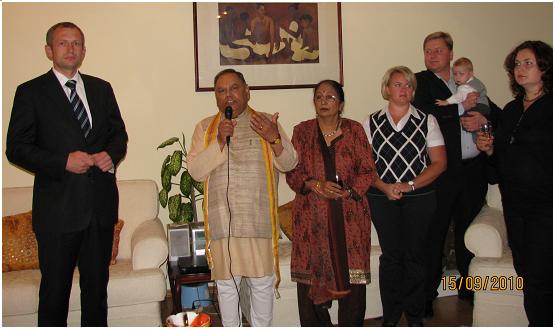
Photo
caption:
Ambassador
Mr.Ramesh Chander
speaking at the ITEC
Day Reception
at the India House
in Minsk (Belarus)
on September 15, 2010
Posted
on September 17, 2010
|
|
AMBEDKARTIMES.COM
TRIBUTE
TO THE GREAT SAHIB KANSHI RAM
(March15th,
1934 October 09th, 2006 ) |
Prem
Kumar Chumber
Editor: www.ambedkartimes.com
Sahib
Kanshi Ram was born on March 15, 1934, in Khawas
Pur village of Ropar District of Punjab. He belonged
to the Ramdassia community of the Scheduled Caste
group, which is the largest group in Punjab. He
was named Kanshi because after his birth the midwife
placed him in a tray made of kansa metal. His father
owned some land and his uncles were in the armed
forces. In Sahib Kanshi Ram's own words, "I
was born and brought up amongst those who sacrificed
themselves but never betrayed the country...
Despite his low caste background, he earned a bachelor’s
degree in science from the Government College at
Ropar ( Punjab). Soon after, he joined the research
staff of Kirki’s Explosive Research and Development
Laboratory (ERDL) in Pune 1957. While working in
Pune, he quit his job after becoming involved in
the famous Deena Bhan case. Deena Bhan, a Rajasthani
Scheduled Caste employee and senior colleague of
Kanshi Ram was suspended. His fault was that he
protested against the decision of ERDL management
for the cancellation of holidays for Ambedkar and
Buddha Jayantis and their replacement by the Tilak
Jayanti and one additional holiday for Diwali. Sahib
Kanshi Ram decided to fight against such a caste
ridden and dictatorial behaviour of the management.
The fighter in Kanshi Ram got the suspension orders
of Deena Bhan revoked and Ambedkar and Buddha Jayantis
holidays were restored.
This was the beginning of the long battle for the
emancipation of the Dalits in the country that Sahib
Kanshi Ram had to lead till his last breath. He
resigned from his job and totally dedicated his
entire life for the cause of the community. He never
married nor visited his home since then. His struggle
was not for the home and family. He devised a new
strategy to regain the lost glory of the original
(Adi) inhabitants of Bharat. He gave utmost importance
to the culture of work and democratic method of
struggle. He also expanded the circle of the Dalits
by incorporating other Backward Classes and Minorities
into it.
He
criticised the post-Ambedkar leadership of Dalits
in India. For that he declared Poona Pact as the
main reason. He said that “Poona Pact made
dalits helpless. By rejecting separate electorate,
dalits were deprived of their genuine representation
in legislatures. Several and various kind of chamchas
were born in the last fifty years. As and when India's
high caste Hindu rulers felt the need of chamchas
and when the authority of the upper castes got endangered
by real and genuine Dalit leaders, chamchas were
brought to the fore in all other fields".
In his "The Chamcha Age", a well argued
and polemical tirade against the pseudo Dalit leaders,
Sahib Kanshi Ram sharpen the contradiction for the
legitimate acquisition of political power by the
downtrodden in electoral democracy in India. In,
the Chamcha Age, "he focused very much on the
Poona Pact which was a point of a rather decisive
Gandhian victory over Dr. Ambedkar after a long
duel between the two at the Round Table Conference".
Ambedkartimes.com
pays tribute to The Great Sahib Kanshi Ram Ji on
his death anniversary.
Posted on October 9, 2010
|
|
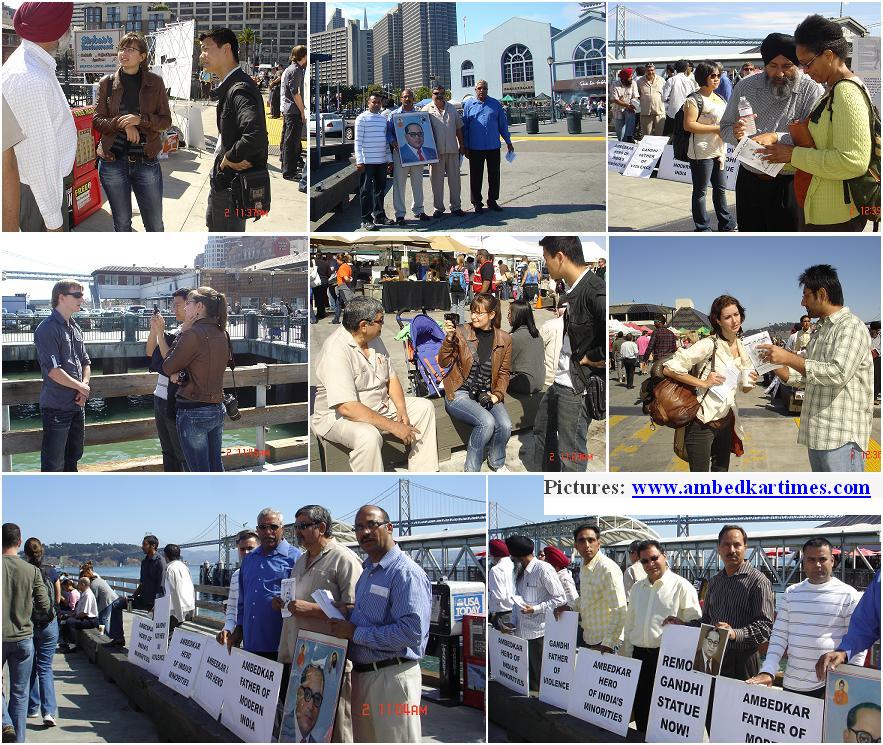
The
Organization for Minorities of India, Shri Guru
Ravidass Society/Ambedkarities/Sikh Community
and others at the Gandhi statue in San Fransico
(California) protest, on Ocotober 2, 2010.The
protesters demanded that M K Gandhi's statue in
San Francisco should be replaced with Dr. B R.
Ambedkar's who is the Father of Modern India.
Photos: www.ambedkartimes.com Posted on October
3, 2010 |
San Francisco: (Report
& Pictures: Ambedkartimes.com News Bureau)-On
141st anniversary of Mohandas Gandhi’s birthday,
the Organization of Minorities of India (California)
staged a unique protest in San Francisco on October
2, 2010. Protesters gathered at Ferry Building at 11
AM where a statue of M.K. Gandhi stands since 1988.
Demonstrators held banners and distributed flyers to
send the message that Gandhi’s non-violence was
merely a facade to practice covert violence, racist
ideology, and immoral and deviant sexual behavior. They
demanded that his statue should be removed, and replaced
with either that of Dr. Martin Luther King, Jr. or Dr.
B. R. Ambedkar who stood for human rights and freedom
of Untouchables from shackles of Hindu caste system.
An
excerpt from the inscription at the foot of the statue
reads that Gandhi’s life is his message. Protesters
said that Americans only know “egalitarian pacifist
myth” of his life.” To know the message,
people should know his real life.
One
of the organizers, Bhajan Singh said, “We want to
highlight how one political party of India is complicit
in fabricating Gandhi’s history and trying to fool
the whole world. Gandhi’s non-violence is entirely
a myth that demands a serious academic and historical
scrutiny. Such a deconstruction of Gandhi’s imaginary
life is significant to probe its correlation with “terrorism”
and “Genocide.” Violence increased 50 times
more where Gandhi’s involvement remained equivocal.
Gandhi directly monitored situation in Middle East, Kashmir,
Pakistan and Afghanistan that continue to be gripped in
violence ever since then.” Gandhi, an upper caste
Hindu considered himself superior to Africans who he said
were ‘Kaffirs’ living like animals, and sought
a preferential treatment in South Africa.
Mohan
Ram Paul, another organizer revealed that Gandhi defended
Hindus’ tyranny against Untouchables who were robbed
of their dreams of independence. He said that Gandhi collaborated
with the British and upper caste billionaires to torture
Untouchables physically and psychologically. Even the
leader of the Untouchables, B.R. Ambedkar, and a PhD from
Columbia University New York was not spared. Gandhi’s
true life has been documented in Ambedkar’s writings
spanning in 23 volumes. Mr. Paul said that Gandhi used
covert violence to get non-Hindu freedom fighters eliminated.
Dr
Amrik Singh who writes for www.examiner.com said that
Gandhi’s life is all rhetoric that has no basis
in reality. His much publicized ‘experiments with
truth’, in fact, embody his shifty, slippery and
quite often contradictory standpoints. His rejection for
Nobel Peace Prize five times was based on his suspicious
credentials.
Prem
Kumar Chumber, Chief Editor of www.ambedkartimes.com said
that Gandhi defrauded non-Hindu minorities and Untouchables.
He observed 21 fasts in his life, all were against the
interests of Untouchables and their leaders. He incited
Hindu mobs against Dr. B. R. Ambedkar when Poona Pact
was signed. Dr. Ambedkar recorded that Poona Pact was
signed against his will by shelving the Communal Award.
Mr.Vinod
Kumar Chumber & Kewal Singh from Shri Guru Ravidass
Sabha Bay Area, Mr. Mahi from Yuba City & many others
also participated. In view of the above, demonstrators
appealed to Americans to not allow the statue of an imposter
Mahatma who failed to practice what he falsely tried to
symbolize.
|
PRESIDENT
MR. OBAMA RECOGNIZES DR. AMBEDKAR
BUT OBAMA'S ELEVATION OF MK GANDHI........ |
Dear Editor,
Though it is a matter of pride to hear
recognition names of 'Dalit' and Dr. Ambedkar from a leader
of super power, but I am sorry to hear President Obama's
elevation of MK Gandhi to a level of world leader and acclaiming
him as a role model for his presidency of the United States.
Clearly, Obama is encircled by caste conservative individuals,
who believe in perpetuating the same ideology as Gandhi
did. MK Gandhi may be a source of inspiration for President
Obama, may be a world leader or a symbol of non-violence,
but not for millions of downtrodden and oppressed classes
of India, still suffering at the hands of upper castes,
mainly because of Gandhi's hidden hatred towards them, his
denial to accept communal award, denunciation of caste system
and entering into a fast unto death to keep them segregated
at bottom of caste hierarchy of a Hindu religion. He often
undermined Ambedkar's intellectual capabilities at major
conferences and political occasions and rather succeeded
to establish an economical and political system based on
orthodox caste system, that as a matter of fact is still
prevalent in independent India even after 62 years of his
death. India can proclaim Gandhi as father of a nation,
particularly for his own clan whom he made a dominating
caste of India's economy and a ruling class as well, but
not for under privileged Dalits.
President Obama should have done an in
depth analysis of India's caste system, Gandhi's contribution
to the Untouchables of India prior to delivering his remarks
about Amberdkar at parliamentary speech. His brief remarks
clearly reveals that he is not well aware about Ambedkar,
his struggle and contribution to downtrodden and aboriginals
of India. Looks like he is completely over powered by Gandhi's
falsifying image as a Mahatma. Setting aside his economic
growth agenda, intellectuals and farsighted Dalits should
not take Obama's latest visit merely as a matter of pride.
Once again there may be another long term hidden conspiracy
behind it to elevate another young Gandhi to a national
level, after Manmohan Singh, just like he acknowledged MK
Gandhi a world hero, to maintain a Gandhi-Nehru hierarchy
in the nation. Dalit activists and/or organizations need
to move forward with consistent efforts for their own emancipation,
caution and being aware of national political environment.
Rakesh Chander
President, Sri Guru Ravidass Sabha Sacramento
Posted
on November 11, 2010
|
SHELTER
IN A TIME OF STORMS: A CALL TO ACTION
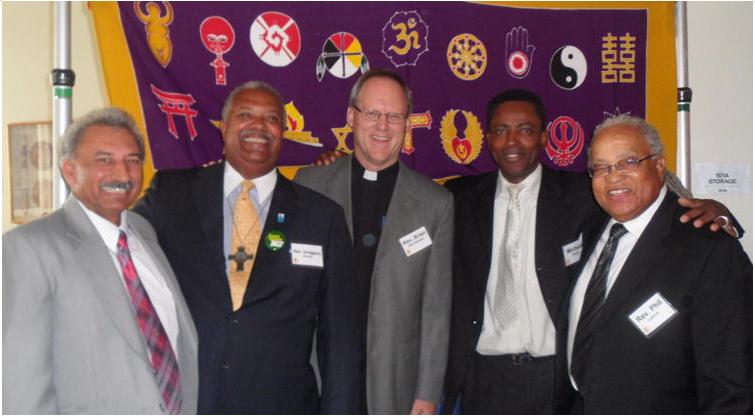
Dr. Harmesh Kumar (from
Left) with Rev. Greggory L. Brown, President Northern
California Interreligious Conference,
Rev. Brian Stein Webber, Executive Director Interfaith
Council of Contra Costa County, Rev. Phil Lawson
(right) with another EBHO member.
|
East
Bay Housing Organizations (EBHO) under the leadership of
Rev. Phil Lawson organized a 6th Annual Gathering at Stern
Hall, Temple Sinai , Oakland , California . The Interfaith
Council of Contra Costa County was represented by its Executive
Director, Rev. Brian Stein Webber. The interfaith blessings
were shared by Jewish, Christian, Muslim and Sikh faith
leaders. Dr. Harmesh Kumar of SABH Foundation Inc., who
is also serving on the Executive Board of the Interfaith
Council of Contra Costa County, participated in the gathering
to promote the mission of EBHO. He was one of the faith
leaders to give blessings from the Sikh tradition as he
represented Sri Guru Ravidass Temple, Pittsburg, California.
Dr. Kumar mentioned that like Jesus many of Sikh Gurus were
emotionally and physically tortured when they spoke the
truth and were not afraid to speak against exploitation
and protection of the downtrodden in India. In the same
way there are many seniors, veterans, low wage full time
workers and people with disabilities who cannot get an affordable
housing due to expensive real estate in the Bay Area and
they needed to be protected. A call for action was stressed
by all the participants due to large number of foreclosures
in the nation due to down turn in the economy. The following
messages were shared by various speakers:
That
all Bay Area residents, Californians, deserve a place to
call home, to provide for themselves and their families,
and to build opportunities for the future. The housing is
a universal human right, recognized by the United Nations
for over 60 years. Children deserve an opportunity to succeed
in school and life. A stable home can help them perform
better academically and socially. Working people, seniors,
veterans, and people with disabilities should be able to
afford housing and still have enough for food, health care,
and other basic necessities. It was stressed that investment
in housing is an investment in neighborhood improvement,
public safety, physical and mental health and civic engagement.
When people can afford to live near their jobs, they can
have shorter commutes, reducing traffic and air pollution
and gaining time with their families. The speakers remarked
that decent, affordable housing choices help families, generations,
and communities stay together.
In
the end of the gathering all the religious leaders agreed
to promote human welfare and work for affordable housing
for all people living in the Bay Area. Rev. Phil Lawson
thanked everyone for participating in the gathering and
for their willingness to serve the communities in a selfless
way.
Posted
on November 1, 2010 |
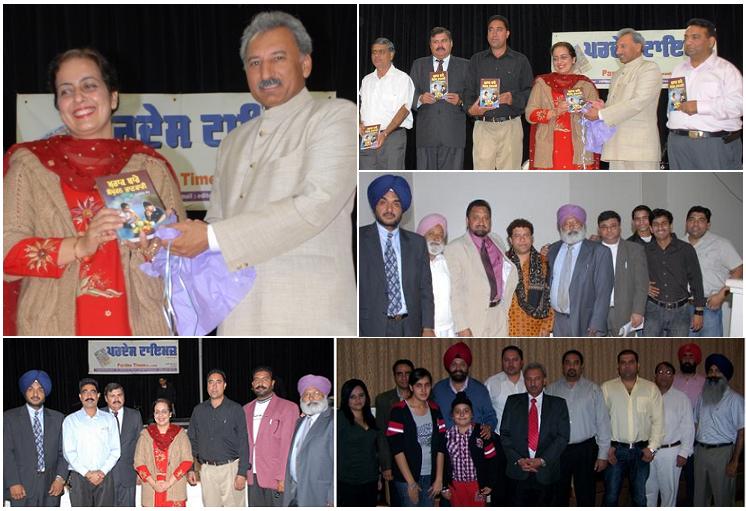
SABH
FOUNDATION HONORED RENOWNED SOCIAL WORKER
DR. HARSHINDAR KAUR IN FRESNO |
|
Dr.
Harmesh Kumar
with
Dr. Harshindar Kaur,
S.
Balbir Singh
Chief Editor
Pardes Times,
Mr. Raj Bhanot,
Jaspal Singh,
Om Parkash Kamal,
Dr. Shumaila Sultan,
Dr. Jasbir Lohan,
Sukhmani Kaur,
Nanak Singh,
Dr. Gurpal Singh,
Sukhi Hayer,
Taj Randhawa,
Vinney Vohra,
Dr. Paramjit Sandhu.
Mr. Sidhu,
Mr. Bagri,
Writer
Jagtar Singh Gill,
Singer star
Sukhdev Sahil
and more
|
|
Harmesh
Kumar, PhD Licensed Psychologist
President, Therapeutic Residential Services, Inc.
A
special awareness cum sensitization talk has been organized on
Female Feticide and Female Infanticide by non-profit organization
South Asian Behavioral Health and Training Foundation (SABH) Inc.
on 08th Oct.2010 in Fresno , California . Dr. Harshindar Kaur,
renowned social worker and crusader against female foeticide and
female infanticide was the Special Guest in this program. She
was welcomed by Dr. Harmesh Kumar, a renowned Clinical Psychologist
and President of SABH Foundation. During this occasion a number
of social activists of international repute, volunteers of SABH
Foundation, and other well known professionals from various fields
from Fresno who are really sensitive about social issues mainly
were present including Dr. Kuldeep Thusu, Taj Randhawa, Vinney
and Vikram Vohra, Dr. P. Sandhu, Dr. Jasbir Lohan, along with
well known Media Persons (Harpreet Singh, Kulvir and Sukhi Hayer,
Des Raj Banger. The SABH Foundation sponsored a walk to stop female
foeticide on international women’s day in San Francisco
earlier this year. Dr. Kaur has been honored for her unconditional
efforts towards Humanity by Dr. Harmesh Kumar on behalf of SABH
Foundation Family at this Special program.
It
is pertinent to mention here that Dr Kaur is a consultant pediatrician
at Rajindra Hospital , Patiala . She is the author of “Female
Foeticide - A Curse” (Bharoon Hatya – Ik Sarap). Dr.
Kaur has received several international and national awards, including
the United Nations Laadli Media Award and the Parliament of New
South Wales’ ‘Pride of Punjab’ award, for her
work for female foeticide prevention. Dr Kaur was selected as the
best woman writer of the country in the regional language category
in a contest organized by TATA Tea Company.
It
is also worth noting that Dr. Kaur is the grand daughter of Prof.
Sahib Singh, who did the first ever exposition of Guru Granth Sahib
and was awarded a D. Litt by Punjab University, the daughter of
Prof. Pritam Singh, renowned Punjabi writer and Honorary Professor
at San Jose University, California who was awarded D. Litt by Punjab
University, and sister of Dr. Jairup Singh, former Vice Chancellor
of Guru Nanak Dev University - Amritsar and present Vice Chancellor
of the Central University in Bathinda, Punjab.
Dr.Harshindar
kaurwas invited by S.BalbirSingh MA of Pardes Times in Sunnyvale
Hindu Temple as a chief guest on the fifth anniversary of his newspaper.
It is the only newspaper serving the Punjabi language in a objective
way. Her book on “Balanced Nutrition” was also released
on that occasion.
Dr.
Kaur spoke about the problem of female foeticide in India and especially
in Punjab . She narrated her earlier experience where female child
was thrown in the garbage dump outside the village, for dogs that
ate her to death. Her only fault- she was the fourth girl born in
a poor family. Dr Kaur recalling the first time she witnessed discrimination
against female infants in Punjab ’s rural side. “Over
a decade back I couldn't save that infant and ever since I try to
speak for the girls who never lived,” said Dr Kaur.
She
gave various horrific examples of young girls being sold for money
by their own parents, some fathers sold them for alcohol, some raped
their daughters under the influence of alcohol in Punjab , some
girls were killed due to fear of not being able to afford dowry
for them. She also spoke about the role of pills to prevent and
abort the female fetuses and how they are causing cancer and other
chronic diseases in women.
However,
it is very clear from the data that even higher educational level
has failed in bringing a change in the practice as children born
to mothers with Class 10 or higher education had a significantly
lower sex ratio at 683:1,000 than illiterate mothers at 869:1,000.
“My study on girl students of higher secondary schools in
urban areas revealed that 78.8 per cent did not want to give birth
to a girl child. I was shocked to find that educated girls from
urban areas can discriminate against their own kind. They cited
the deplorable condition of their own mothers and restriction imposed
on girls from family as the main reason,”. Dr Kaur added that
until the social status of women changed, the mind set will continue
the crime. Chandigarh , the city with the highest standards of living
in the country has a sex ratio of 777:1000 and Fatehgarh Sahib District
has the lowest ratio of 754:1000.
She
also clarified the illusion that among the privileged upper middle
and upper classes, where the resources for comfortable upbringing
are plenty, the second girl child is being aborted in nearly 20
per cent of the cases, and the third girl child in 80 per cent of
the pregnancies. She reported that examining the sex ratios at birth
of second child makes it clear that son preference is affecting
family-building strategies. The sex ratio of last births (number
of females born per 1000 males when the first child is a female
) ranges from a low of 504 in Punjab, to 540 in Haryana, and 572
in Himachal Pradesh indicating a regional spread. However Punjab's
sex ratio of the second child when the first child is a male, goes
up to a healthy 1,003:1,000, in other words, after one son families
are less inclined to go in for sex determination tests and female
foeticide.
Dr.
Kaur reported that unchecked technology combined with affordability
has made the practice a norm, high and middle income groups have
completely shifted to female foeticide as a more 'sanitary option'
and female infanticide too is practiced more in the form of abandoning
few days old infants in bushes, public toilets, parks or garbage
bins but the aim has not changed, no one wants to be son-less.
She
reminded that statutory laws such as the medical termination of
pregnancy act and the prenatal diagnostic techniques, regulation
and prevention of misuse act needs to be enforced strictly and the
doctors who are convicted should not be allowed to open their clinics
in other places. She reported that ineffective implementation of
laws by government agencies, religious leaders, politicians or NGOs
are somehow not able to sway people to abandon the practice but
we need to raise our voice against this practice in a persistent
manner.
She
said that at least 5 million female foeticide operations are conducted
every year in India as against an official assessment of 2 million
cases. PGD (Pre-Implantation Genetic Diagnosis) through in-vitro
fertilization technique is also exploited to avoid a female child.
Followed
by her talk, a question-answer session was held. The audience asked
lot of questions regarding current scenario of the problem in Punjab
. Dr. Kaur provided empirical evidence and data on the subject.
They assured their support in her efforts to stop this practice
in Punjab and India .
Dr.
Harmesh Kumar in his concluding thanksgiving remarks reminded the
audience that all technological advances can be used for and against
humanity. Whatever we have been seeing in USA , it is happening
in India because we are using the same ingredients of capitalistic
society. The pressures are becoming overwhelming on humans to surpass
each other to succeed in this materialistic race. We are unconsciously
chasing short term solutions to our long term survival as a human
race. He further mentioned that medical fraternity needs to be ethical
& objective so that doctors do not collude with parents seeking
sex-determination tests for the purposes of female foeticide. The
cultural and emotional programming needs to be dealt by applying
psychological and behavioral interventions & prevention and
by educating and making the masses aware of the decline in population
of girls in India . He also mentioned that keeping morality in mind,
let’s stop this practice by making people aware of this issue
while avoid creating guilt by not becoming punitive and judgmental.
On the other hand, if somebody practiced this we need to find out
the reason for that particular individual without finding fault
with him or her, otherwise we would create serious Psycho-physical
problems in them and for our community. Dr. Kumar launched slogans
like “SAVE GIRL CHILD-SAVE MOTHERS-SAVE FUTURE” &
“KILLING GIRL CHILD - KILLING YOURSELF”, “Today’s
Girl Child is Tomorrow’s Birth Giver- So Save Birth Givers”
on this occasion.
At
the end he thanked Dr. Harshindar Kaur for sharing her experiences
with the community and promised to support her endeavors to eradicate
the practice of female foeticide and female infanticide in India.
Posted
on October 11, 2010
|
TUMBI
DI TUNKAR
“USTAD LAL CHAND YAMLA JATT ANNUAL MEMORIAL FAIR” |
We
are commemorating the 10th annual Ustad Lal Chand Yamla Jatt Memorial
Fair. This fair is in memory of Ustad Lal Chand Yamla Jatt (inventor
of the Tumbi). You are cordially invited to attend this memorial
fair on your own, or with family members. Please come and pay tribute
to this great humanitarian and innovator of the Tumbi.
OPENING
CEREMONY: 12:00 PM, Saturday October 16, 2010, at 10178 S. DeWolf
Ave, Selma, CA 93662
PERFORMERS: Makhan Brar (from Canada), Balbir Dhillon, Micki Saran;
Pavanjot Yamla Jatt (from Canada); Sukhwinder Panchi; Kumar Khatkar;
Ashraf Gill, Ismeet Naroola; Palwinder Singh, Asha Sharma, Lachman
S Rathour; Sukhdev Sahil, Sohan S and Narinder K Meharu; Joginder
Shounki, Hardev Sandhu; Babboo Gurpal; Awtar Grewal, and other prominent
artists will also participate in this fair and Gidha & Bhangra
will also be performed.
Ustad
Lal Chand Yamla Jatt invented the “Tumbi”, an instrument
with one string. He composed and sang Punjabi Folk Songs throughout
his life and was the pioneer of Punjabi Folk Songs (Lok Geet). Yamla
Jatt wrote over 5 thousand songs about religion, nature, the environment,
historical melodies, and above all, the human condition.
Please plan to attend and bring your Tumbi. There will be music,
poetry reading, singing, and food.
COST:
Admission is FREE, however, due to the number of attendees expected
this year, donations are gratefully appreciated. You may contribute
on the day of the event, or before.
You may send your donation to ULCYJMF: Registered # C262246, 930
Palm Ave., Fowler, CA 93625.
DIRECTIONS:
99 Freeway Northbound: exit on Floral Ave. (go west, approximately
one mile), right on DeWolf Ave., just before Dinuba Ave. Mela on
right hand side
99 Freeway Southbound: exit on Manning (go west), left on Temperance,
left on Dinuba, right on DeWolf Ave, Mela on left hand side
PLEASE
RSVP TO: Raj Brar, Bansi Bangar, Asha Sharma, Harjinder Sekhon,
Gurbax Dhillon, Sarpanch Rajpal Kahlon, Balkar Bhathal, Gurdial
Randhawa, and Ajaib Brar of ULCYJMF.
Forwerded by Rajinder Brar Telephone
Contact: 559-834-2222, 559-312-3194, 559-824-9028, 559-285-2012,
714-943-3851, 408-859-7049.
Posted
on October 12. 201
|
Prof.
Dhesi on India-Pakistan Talks:
HAVE INDIA-PAKISTAN PEACE TALKS COLLAPSED? |
|
BBC News
At 12:07pm on 26 Jul 2010, Autar Dhesi wrote:
The talks have to really get going before they can collapse. There
have been numerous get to-gethers for one reason or the other but
no serious dialogues. The basic problem is lack of trust in one
another's intentions.
Hope the two sister states would be able to remove the hidden roadblocks
one day for the good of poor people on both sides
The road blockers to peace have been flourishing on both sides under
the cover of ever thickening, mysterious, misty clouds hovering
on the horizon of the subcontinent since the dawn of independence
days. The common,desperate objective of twice born elites has been
to snatch power and perpetuate their autocratic, vice like grip
over its levers by fair or not so fair means, meticulously camouflagedas
sacred pursuit of respective national interests (read nation building
projects). As a consequence, hapless, gullible 'common man' has
been on a costly, bumpy, endless ride.The emaciated invisible or
not so invisible agencies, handy tools of dirty tricks, often more
successful against fellow citizens than others, are always dutifully
there to accept any blame silently. Such mindless, misdemeanour
of civilians or non-civilians is nothing short of heinous crime
against humanity.
High time for some respite
Alas! no deliverance in sight
Gamesters ever shine bright
Facetious pride , citizen’s plight
While they merrily bray
Wait in silent pray
On an optimistic note, demeaning, farcical, political
dramatists are likely to go into obilivian with a worst of floodlights
of knowledge. They would find themselves out of place in a knowledge
society. The wise and noble are likely to prevail (a pious hope)
bymarginalising modern day Neros and charlatans. This should give
relief to ever suffering common man and some consolation for lost
souls of lesser beings. What a democracy! But it is only for the
chosen ones.
Some cynical citizens may lament that invisible (cross border) norms
of reciprocity seem to havebeen internalised by elites to come to
each other’s rescue at critical moments. The collusive game
play, however, should come to an end sooner or later as the play
field is becoming visibly open by the day. Till that time, one act
plays on ‘peace’ would be considered smoke screens for
some hidden,unethical aims by many on both sides. Somehow, by quirk
of fatethe progeny of manylong forgotten selfless liberators stands
besmirched due to doingsofpolitical knaves.
It is certainly a self-righteous, kinky approach
tolay downfoundations forbuilding modernnations. Equality is a normative
ideal goal that is difficult to achieve under the best of circumstances.
But in a democratic society, none should be perceived excessively
more equal than others. A society characterised by dissonance between
stated principles of governance and social practices sin ever need
of security threats (real or orchestrated ones, even at the cost
of some fellow citizens) to maintain some functional national unity.
History teaches us that a blinkered social vision based on selective
amnesia about honest contributions of beings of lesser gods often
proves self-defeating in the long run.
An ungrateful society is hardly sustainable. Yet, a mature, confident,
caring, civilised society is ever ready to recognise such aberrations
and make necessary amends. It considers no time bar for positive
actions.
Side Notes on Contemporary Political History
Sometimes poetic graffiti is more meaningful than long winded essays.
It gives readers freedom to interpret simple verses through their
respective prisms. There is no offence if verses get torn apart.
That is the essence of democratic living.
Supple conscience in game
Delivers a kinky dame
Flexible morals capricious mind
Modern to anthropological kind
Vain mistrust begets guile
Mirthed in narcissistic bile
Make debased scamps knight
Maligning valiant considered right
Once on self-willed trail
System sure gets derailed
Disgrace for mighty tall
Self-willed future actuated fall
Pliant underlings sans name
Fossilised ideas yield shame
Honourable norms should prevail
Making none to wail
New times reticent dame
Secret exchanges nuanced game
Foxy call anointed wise
Creating suspense for ‘sunrise’
Pretensions not-withstanding, there is no such
thing as honesty or integrity in public affairs.
They constitute the most debased currency for the naive and uninitiated
to lap up so that the twice born may carry on, regardless. Those
who know the value of honesty or priceless soul shun barter exchange..
Posted on July 27, 2010 |
MEDIA
HYPE AND THE REALITY OF “NEW” INDIA
Hasan Suroor
http://www.hindu.com/2010/07/20/stories/2010072055881100.htm |
Poverty
in at least eight States —
Bihar, Uttar Pradesh, Rajasthan, West Bengal, Orissa, Madhya
Pradesh, Chhattisgarh and Jharkhand
— was worse than in some of the poorest countries of sub-Saharan
Africa.
In a week when Delhi's new “world-class” airport
opened for business and the Indian Space Research Organisation
celebrated the successful launch of five new satellites, we
had a stark reminder of another India that, increasingly, many
Indians feel embarrassed to talk about. A United Nations-backed
study by Oxford University revealed that poverty in at least
eight Indian States — Bihar, Uttar Pradesh, Rajasthan,
West Bengal, Orissa, Madhya Pradesh, Chhattisgarh and Jharkhand
— was worse than in some of the poorest countries of sub-Saharan
Africa.
The findings are based on a global poverty index, the Multidimensional
Poverty Index or MPI, developed by Oxford University. It takes
into account a range of social factors not hitherto considered
while measuring poverty and will replace the Human Poverty Index
(HPI) which, until now, has formed the basis for the annual
U.N. Human Development Reports.
How's the new index significantly different from the traditional
ways of measuring poverty and how will it make a difference
on the ground? Here, Dr. Sabina Alkire , Director of the Oxford
Poverty and Human Development Initiative (OPHI), who has travelled
extensively in India, speaks to Hasan Suroor :
Were you surprised by the finding that there are more poor people
in eight Indian States than in the 26 poorest African states
combined?
No, I wasn't really surprised, as the scale of Indian poverty
is well known within the academic world —whether measured
in income terms or multi-dimensionally. But the recent focus
on India's phenomenal growth in the media has given the impression
that the largest numbers of very poor people are in Sub-Saharan
Africa rather than South Asia (where there are nearly twice
as many MPI poor than in Africa). We wanted to test that impression.
To get this comparison, what we did was to set a more extreme
poverty cut-off, which identified the Indian States and the
African countries whose Multidimensional Poverty Index (MPI)
was equal or greater than 0.32 (the MPIs we calculated for 104
countries range from 0 to .64). Eight Indian States and 26 African
countries fall below that cutoff. That's where this figure comes
from.
To give an idea of what this means, the least poor entry is
West Bengal (MPI = 0.32), in which 58 per cent of people are
MPI poor, and they are on average deprived in 54 per cent of
the dimensions or weighted indicators; in Niger 93 per cent
of people are MPI poor.
Actually, the intensity of poverty in Africa is still higher
— the population-weighted MPI for the 26 African countries
is 0.43, whereas for the Indian States it is 0.39.
How is the new Multidimensional Poverty Index or MPI significantly
different from the Human Poverty Index (HPI) that the U.N. uses
for its Human Development Report? Doesn't that also take social
indicators as the basis for measuring poverty?
The indices share the same motivation, but are totally different.
The MPI starts with each person, and looks at their lives and
that of their household members, and identifies a person as
poor only if they have multiple deprivations. The MPI reflects
the intensity of deprivation each person experiences as well
as the percentage of people who are poor.
The HPI aggregates percentages of people who are deprived in
different things. So it cannot see if all of the HPI indicators
affect the same person simultaneously, or if each person only
has one deprivation.
This is understandable, because in 1997 when the HPI was developed
we did not have the data that is required to construct the MPI.
Only recently has it become possible to focus first on each
person's life, and build a multidimensional poverty measure
from that.
Critics might say that studies such as yours simply end up producing
sensational headlines without anything actually changing on
the ground? Is there any evidence, for instance, that the Human
Poverty Index has helped fight poverty better than the previous
measures of poverty?
Our aim is to strengthen the work of many others who are working
passionately to stand alongside and empower those who live with
suffering and poverty to shape their own destinies. We welcome
specific suggestions from others about how better to do this,
but it seems that sharing a measure which can show the simultaneous
deprivations people face should be a useful tool to others.
Doesn't, ultimately, the good old definition of poverty based
on household income and purchasing still remain valid?
Yes. Our measure complements the income and consumption data,
and focuses only on very acute indications of poverty. These
data come from different surveys, in most cases. It is a matter
of enriching the information field. If both measures coincide
perfectly, of course, there would be no need for both poverty
measures. However from preliminary analysis it seems that they
differ quite a bit, even at the level of individual. We need
to understand how and why. If a household has a disabled person
it may not be income poor but clearly experiences multiple deprivations
for example. Or a family may have enough money to be nourished,
but actually the children are malnourished. Also, the MPI checks
access to certain services directly, whereas income data includes
these in a different way. Finally, data in both cases are imperfect,
so comparing two different measures can give us a clearer picture.
In the course of your study, did you come across any other surprising
trends about India?
We did note that the MPI for different caste groups varies a
great deal. The Scheduled Tribes have the highest MPI (0.482),
almost the same as Mozambique, and a headcount (the percentage
of people who are MPI poor) of 81 per cent. The Scheduled Castes
have a headcount of 66 per cent (the percentage of people who
are MPI poor) and their MPI is a bit better than Nigeria. Fifty-eight
per cent of other Backward Castes are MPI poor. About one in
three of the remaining Indian households are multi-dimensionally
poor, and their MPI is just below that of Honduras. While this
is not a surprise, it is yet another clear indication of the
need for interventions that address these social aspects of
poverty in India, alongside the direct deprivations.
Forwerded
by Paramjit Saroy & Posted on July 27, 2010
|
INDIAN
INSTITUTE OF ADVANCED STUDY, SHIMLA
DALIT CHALLENGES AND DISCIPLINARY PRACTICES
|
CONCEPT NOTE
Dalit Challenges and Disciplinary Practices Dalit
Studies Week (19-25 July, 2010) at Indian Institute of Advanced
Study, Shimla
The interface between dalit activism and academia in the last
two decades has given way to a growing body of work on Dalit
Studies. It is essentially inter/multi-disciplinary in character
and explores new questions, methods, and paradigms. The political
and cultural overtones of the term and concept of ‘dalit’
have opened up new possibilities of critical engagement with
conceptual categories of exclusion and marginality for disciplinary
practices. Posing a challenge to the existing disciplines,
it propels the initiative for the creation of an alternative
paradigm as well as reconfiguring the contours of everyday
life in Indian society in general and academia in particular.
Caste, religion and land as determinants of relations of power
and subordination, as sources of oppression and humiliation
are central to the understanding of dalit life-worlds.
Long
waves of egalitarian challenges posed by bhakti and sufi movements
to the hierarchical ideology of Brahmanism in the pre-colonial
times were fractured by the pro-Brahmanical colonial intervention
that left the task of building India ‘modern’
for the self-proclaimed ‘modernists’ highly complex
and difficult. It is best exemplified in the fall of the Hindu
Code Bill in 1951 that Dr Ambedkar had introduced as Law Minister
to empower women of India as equal citizens. Nehru as archetypal
‘modernist’ failed miserably to exert his weight
as the Prime Minister of India to carry along the conservatives
with the reformist agenda for a free India. Quite ironically
even Sarojini Naidu had threatened to go on a hunger strike
if the Bill was not dropped. While the orthodox majority basked
in their triumphal sun the real modernist Ambedkar resigned
from the Cabinet in utter disgust. The nation is still struggling
to wriggle out of the stranglehold of brahmanical ideology
and the colonial legacy of the British. Dalits have been trying
from time to time to escape this suffocation by converting
to egalitarian religions such as Islam, Christianity and Buddhism
with varying degree of success and satisfaction. The strategy
of ‘conversion’ was also stamped by Ambedkar and
it needs to be seen how far it has helped dalits improve their
life conditions.
Over
the last few decades the debate around ‘who speaks for
the subaltern?’ has raised questions of ‘representation’
and ‘authenticity’. Suspicions have been expressed
by internal voices against non-Dalits’ writings; not
even sparing the genuine and sympathetic thinkers. There has
also been the conventional mode of patronage and an attitude
of condescension on the part of the ‘other side’.
Even though serious academic work has been undertaken in the
past, however, there has also been a spurt in the production
of knowledge for the sake of promotions as also for the market.
A balanced approach demands an open-minded/ended and inclusive
reception and participation for a progressive onward journey.
The ‘exclusions’ cannot be countered by ‘exclusions’;
organic dalit intellectuals should be more aware of the dangers
of exclusionary practices. Dalit studies cannot but consciously
address the unconscious of not only the ‘oppressed’
but the ‘oppressor’ as well.
The
establishment of Dr. Ambedkar Chairs and UGC sponsored ‘Centres
for Social Exclusion and Inclusive Policy’ in different
universities and educational institutions have played its
role in sensitising the academics toward Dalit Studies. But
even after two decades of Dalit Studies’ existence in
the academia, it is still in an amorphous state, and is at
cross-roads. The ‘rethinking’ and ‘reimagining’
seem already in place and a week’s meeting-of-minds
is bound to trigger new ideas for charting this new road.
It is important that stocktaking be done, reviews made and
a roadmap sketched for the future of Dalit Studies. A week
of intensive presentations, discussions, and reflections by
a small group of 20 dedicated scholars is called for that
purpose. The invited participants cover a broad range of scholars
from different disciplines including public intellectuals
who have already contributed in the field of Dalit Studies.
Each day of the Study Week would take up not more than 4 papers
with ample time for presentation and discussion to finally
lead the scholars toward publication of its proceedings by
the Institute.
Themes:
· Dalit
activism, dalit studies and academia: impact of dalit consciousness
and assertion
· ‘Who
speaks for the Subaltern?’: The questions of ‘representation’
and ‘authenticity’
· Pragmatics
of knowledge production
· Dialectics
of the ‘oppressed’ and ‘oppressor’:
relationship between dalits and swarnas
· Dalits
in literary and historiographical praxis
· Dalits
and modernity project: religion, caste and state through colonial
and postcolonial times |
Studies
Week (19-25 July, 2010)
Programme Schedule:
Monday: 19 July 2010
10—11.00 Inaugural Session
Welcome: Ghanshyam Shah
Introduction: Raj Kumar Hans
11.00 Tea Break
11.30-13.30 Chair: Ghansyham Shah
Joel Lee: A Critical Review of the Anthropology of Caste
13.30-14.30 Lunch
15.00-17.00 Chair: Anand Teltumbde
P. Sanal Mohan: Social Science Practice and Cultures of Resistance:
Situating Dalit Studies
======================================================================================================
Tuesday: 20 July 2010
9.00—11.00 Chair: Sanal Mohan
Priyadarshini Vijaisri: Beyond the History of Pathos
11.00 Tea Break
11.30-13.30 Chair: Priyadarshini Vijaisri
Masood Alam Falahi: Dalit Oppression: an Analysis of Islamic Literary
and Historiographical Practice
13.30-14.30 Lunch
15.00-17.00 Chair: Joel Lee
Suresh Babu: Dalit Rationality and Post-colonial Trajectory of Modernity
in India
======================================================================================================
Wednesday: 21 July 2010
9.00—11.00 Chair: P. G. Jogdand
Anand Teltumbde: Dalit, Modernity and Metamorphosis of Castes 11.00
Tea Break 11.30-13.30 Chair: Ravikumar Neerav Patel: Who Speaks
for Dalits?
13.30-14.30 Lunch
15.00-17.00 Chair: Shura Darapuri
S Anand: Presentation of a Documentary Bhagwan Das: In Pursuit of
Ambedkar
=====================================================================================================
Thursday: 22 July 2010
9.00—11.00 Chair: S Anand
Ravikumar: The Untouched Sacrifice: Dalits and Third Mozhipor
11.00 Tea Break
11.30-13.30 Chair: Neerav Patel
Om Prakash Valmiki: Hindi Sahitya ke Antravirodh: Vishisath Sandarbh
aur Dalit Chetna
13.30-14.30 Lunch
15.00-17.00 Chair:
Manmohan: Dalit Questions in Contemporary Punjabi Literature
======================================================================================================
Friday: 23 July 2010
9.00—11.00 Chair: Ronki Ram
Nandu Ram: ‘Exclusion’ and ‘Inclusion’ in
the Context of Dalits
11.00 Tea Break
11.30-13.30 Chair: Raj Kumar Hans
Ronki Ram: Cultures of Social Protest in the Periphery: Guru Ravidass,
Bhakti and the Rise of Dalit Deras in Punjab
13.30-14.30 Lunch
15.00-17.00 Chair: Om Prakash Valmiki
Vijaya Singh: To Eat or Not to Eat: Hunger and Humiliation in Dalit
Stories
======================================================================================================
Saturday: 24 July 2010
9.00—11.00 Chair: Gopal Guru
Raj Kumar Hans: Dalit Saint Poets of Punjab and their Exclusion
from Histories
11.00 Tea Break
11.30-13.30 Chair: Nandu Ram
Jasvir Singh: Dalits, Constitutional Promises of Socio-Economic
Justice and the State in India with special reference to Agricultural
Wage Workers
13.30-14.30 Lunch
15.00-17.00 Chair: Gopal Guru: Challenges in Theorizing Dalit Questions
======================================================================================================
Sunday: 25 July 2010
9.00—11.00 Chair: Jasvir Singh
Shura Darapuri: Caste-based Exclusion and its Impact on Health:
A Study with specific reference to Dalit Women
11.00 Tea Break
11.30—13.30 Chair: P. G. Jogdand: Dalit Studies in Maharashtra:
Emerging Trends and Needed Research
13.30-14.30 Lunch
15.00-17.00 Reflections as chaired by Gopal Guru
Posted
on July 16, 2010 |
PROFESSOR
AUTAR DHESI ON INDIA-PAKISTAN PEACE TALKS
Have
India-Pakistan Peace Talks Collapsed?
BBC News at 3:10pm on 16 Jul 2010,
|
|
Autar
Dhesi wrote:
The talks have to really get going before they can collapse.
There have been numerous get to-gathers for one reason or
the other but no serious dialogues. The basic problem is
lack of trust in one another's intentions.
Hope the two sister states would be able to remove the hidden
roadblocks one day for the good of poor people on both sides.
At 09:59am on 19 Jul 2010, Autar Dhesi wrote:
The road blockers to peace have been flourishing on both
sides under the cover of ever thickening, mysterious, misty
clouds hovering on the horizon of the subcontinent since
the dawn of independence days. The common objective of twice
born elites has been to snatch power and perpetuate their
vice like grip over its levers by fair or not so fair means,
meticulously camouflaged as sacred pursuit of respective
national interests. As a consequence, hapless, gullible
'common man' has been on a costly, bumpy, endless ride.
The emaciated invisible or not so invisible agencies, handy
tools of dirty tricks, often more successful against fellow
citizens than others, are always there to accept any blame
silently. Such mindless, misdemeanour of civilians or non-civilians
is nothing short of heinous crime against humanity.
High time for some respite
Alas! no deliverance in sight
Gamesters ever shine bright
Faceticious pride, citizen’s plight
Postscript: On an optimistic note,
demeaning, farcical, political dramatists are likely to
go into obilivian with a worst of floodlights of knowledge.
They would find themselves out of place in a knowledge society.
The wise and noble are likely to prevail.
Posted on July 20, 2010
|
|
MAYA’S
CULTURAL JAAL
*By
Kancha Ilaiah
|
|
|
|
When
the Uttar Pradesh Chief Minister, Ms Mayawati, changed her ideological
position from Bahujan Samaj formulated by her mentor Kanshi
Ram to Sarvajan Samaj there was elation among the upper caste
intellectuals and sadness among the dalit-bahujan intellectuals.
Delhi-based
intellectuals, who usually hate Ms Mayawati, started praising
her for her accommodative approach and for leaving behind the
confrontational approach of Kanshi Ram. In fact, many were surprised
how a militant anti-manuwadi woman leader could compromise with
the Uttar Pradesh brahmins against whom she had been fighting
so virulently.
When she
worked out a formula for roping the Uttar Pradesh brahmins into
the fold of her votebank by repositioning her party’s
slogan itself, from Bahujan Samaj to Sarvajan Samaj, several
dalit-bahujan scholars thought that this would be the end of
Ambedkarism in Uttar Pradesh, even north India. Kanshi
Ram’s death had led to depression in the dalit-bahujan
political circles of the nation. Kanshi Ram was an inspiring
and uncompromising political and intellectual leader and Ms
Mayawati was not seen as a leader in her own right then. I too
was very sceptical of her abilities to lead the Bahujan Samaj
Party in a manner that could help it survive — leave alone
coming to power as it did later.
Once she
came to power there was also speculation that she would serve
the brahminical interests — leaving Kanshi Ram’s
legacy behind. However, it has now become evident that in the
cultural realm she is simply dalitising the whole state. This
was something unexpected. Not only are districts being renamed
after dalit-bahujan icons, but the very ethos of Uttar Pradesh
is undergoing a revolutionary change now. Ms Mayawati has built
many monuments on the Navayana Buddhist theme (navayana is Pali
for new vehicle). Navayana Buddhist refers to the idea that
a Buddhist movement may represent a new yana. Dr Babasaheb Ambedkar:
“I will accept and follow the teachings of Buddha. I will
keep my people away from the different opinions of Hinyan and
Mahayan, two religious orders. Our Bouddha Dhamma is a new Bouddha
Dhamma, Navayan”. The Buddhist and Ambedkar parks that
Ms Mayawati is building will inevitably reduce the spiritual
significance of Ayodhya, Kashi-Benares, Mathura and so on.
By renaming
districts after Ambedkar, Phule, Sahuji Maharaj, Rama Bai (the
illiterate first wife of Ambedkar), the dalit-bahujan icons
of Maharashtra and the birthplace of Navayana Buddhism, she
has changed Uttar Pradesh’s cultural atmosphere itself.
Of course, Kanshi Ram and Ms Mayawati herself have been elevated
as icons in the process. In Uttar Pradesh, they are not only
names of districts but their statues are being worshipped in
Ambedkar parks.
Ms Mayawati’s
decision to transform the cultural realm of Uttar Pradesh would
certainly have all-India implications. I do not think that the
brahmins of Uttar Pradesh are in a position to resist this transformation.
She has put it on an irreversible course. The Congress cannot
stall this course either. Wherever the Congress is in power,
they have named institutions after Nehru, Indira Gandhi and
Rajiv Gandhi. But they do not have any culturally transformative
implications. Buddha, Ambedkar, Phule, Sahuji Maharaj, Periyar,
Kanshi Ram and so on are not like that. They have serious anti-Hindu
cultural implications. The Bharatiya Janata Party (BJP) knows
this but is not in a position to do anything because it burnt
its hands in Ayodhya and Gujarat. Further, the BJP cannot say
that these are anti-national icons.
Likewise,
the Samajwadi Party (SP) leader Mulayam Singh Yadav cannot reverse
or stop the trend because he has no alternative of his own to
offer. His party is now competing for power for the sake of
power, without constructing any socio-cultural agenda of its
own. Its icons, Ram Manohar Lohia and Charan Singh, do not have
much impact in the cultural realm, unlike Ambedkar. The fact
is that unless icons are associated with alternative spiritual
culture they do not create a following that lasts long. In the
modern period only Ambedkar did that and Kanshi Ram brought
that icon into unbelievable achievability. And Ms Mayawati’s
dalit common sense captured that imagination very well.
Even if
the Congress, the SP or the BJP come to power they will not
be able to dismantle the Ambedkar parks or rename the districts.
Earlier, Ms Mayawati was in power only for six months each time
— that too with the BJP’s support. But now she will
be there for full five years and the chances of her getting
re-elected are very high. If she is in power for 10 years, Uttar
Pradesh’s cultural history will change beyond recognition.
Not many know that Kanshi Ram had a vision of constructing the
biggest Ambedkarite Buddha Vihara in Uttar Pradesh along with
a massive international airport in Lucknow. His plan was that
Uttar Pradesh should become a big Ambedkarite Buddhist international
tourist centre so that it could generate a competitive tourist
capital.
Ms Mayawati
seems to think that she has to fulfil her mentor’s dream.
She seems to understand that cultural capital will be more long-lasting
than political and economic capital.
*Courtesy:* Prof. Kancha Ilaiah's article, already published
in Deccan Chronicle.
(Posted on July 14, 2010, www.ambedkartimes.com)
BODHI-Centre for Adivasi Dalit Bahujan Initiatives
|
WHO’S
AFRAID OF CASTE CENSUS?
|
|
Ever
since the Centre announced that it would collect data on various
castes during the ongoing Census, the media has created a hue and
cry saying that this would harm the nation and open a Pandora’s
Box of caste conflicts. On the other hand, those who seek caste
enumeration are of the view that this would clear the cobwebs and
deliver proper data on other backward classes (OBCs) that will help
implement reservation policies and welfare schemes better.
The
collection of caste data was not a decision taken by the government
on its own. The OBC leadership across the country has demanded it
and the Supreme Court advised the Centre to go for such a Census
to ensure that an accurate population database was made available.
Let
us not forget the fact that even at the time of the 2001 Census
there was a strong demand for caste census. The then deputy Prime
Minister L.K Advani, in fact, went on record to say that caste data
would be collected. But Right-wing academic forces — particularly
a group of sociologists and anthropologists — advised the
Bharatiya Janata Party-led National Democratic Alliance government
not to go for such an enumeration as it would go against the interests
of the ruling upper castes and communities.
It
should be noted that the opposition to caste data has been coming
from upper castes that still control the levers of power. The lower
castes have never opposed such a proposal.
It
is fallacious to argue that society would get further divided if
the population of each caste is known to the policymakers and to
the public.
Caste
culture is all around us. In the dalit-bahujan discourse, the upper
castes are being shown as constituting less than 15 per cent. This
could be totally wrong. Even within the lower castes there are several
false claims about numbers. Every caste claims that it is numerically
the strongest and keeps asking for its “rightful” share.
How
to tell them that their claims are wrong? When caste has become
such an important category of day-to-day reckoning it is important
to have proper data at hand to tell communities that they constitute
this much and cannot ask for more than their share.
It
is true that we cannot distribute everything based on caste. But
caste census is the right basis for statistics such as literacy
rate and issues like the proportion of representation. Once we cite
the Census data there cannot be any authentic opposition to that
evidence.
The
upper caste intelligentsia is afraid that once detailed data on
number of people in lower castes is available it would become a
major ground for asking for accurate proportional representation
in certain sectors, such as education and employment.
For
example, once the caste data is available, the 50 per cent limit
on reservations imposed by the Supreme Court could be questioned
on the basis of numbers. This would in turn help in sustaining the
overall system of liberal democracy. The system of democracy would
only get deeper with the discourse of numbers.
Democracy
is in effect a system of numbers unlike communism, which does not
deal with numbers while institutionalising a government. In a democracy,
the governing system is institutionalised through an electoral process
and in such a system the people must be counted from all angles
— sex, race, religion, caste and so on. In a democracy based
on numbers, any section of society can come to power.
Based
on the counting on the basis of religion, Hindus have realised that
they are the majority. And because of that understanding they have
claimed power. When Mahatma Gandhi suggested that Muhammed Ali Jinnah
should be made the first Prime Minister in order to avoid Partition,
Jawaharlal Nehru and Sardar Patel put forth the argument that India
was a Hindu-majority nation and would not accept a Muslim as its
first Prime Minister. Where did the notion of Hindu majoritarianism
come from? It came from numbers.
With
the same logic what is wrong if women, cutting across religious
divides, count themselves, and organise themselves to come to power?
They constitute about 50 per cent of the population and if they
want to fight for gender democracy, they too can come to power.
So should there be a demand for abolition of gender enumeration,
too?
If
caste census is done, the India democracy would thrive on the firm
support of the lower castes who keep hoping of getting their share
based on their numbers. The upper castes may feel desolate with
the system of democracy itself, if this shift begins to take place.
They might call such a shift “castocracy”. But would
they call a state or a nation being ruled by women “womenocracy”?
Cognitive
social psychology says all such theories are constructed on a convenience
known as “comfort zone”. If brown upper castes live
in white societies they see brown bashing but black bashing remains
hidden in their blind spots. In white societies the browns are not
in their comfort zone but in India they are and do not want to see
the other’s “discomfort zone”.
Many
upper caste intellectuals say that caste was a construction of the
colonial census system. They talk as if caste never existed before
the British started an enumerative process. By their logic we should
come to the conclusion that before the British enumerated people
based on religion, there were no religions in India. There are many
such blind spots in India and that is why we still remain backward
in theories of knowledge.
Let
all castes — not just OBCs — be counted for strengthening
our democratic system. I know that even mine is a blind-spot theory
but it may have the effect of an antidote.
Published
in Deccan Chronicle Forwarded by: PARAMJIT SAROY Posted on July
09, 2010
|
Caste
Census: Opening a Pandora’s Box?
BBC News London At 07:25am on 25 May 2010, Autar Dhesi wrote:
PROF.
AUTAR DHESI ON CASTE IN INDIA |
|
|
Post-script
Man
sans learning tends to submerge in the animal kingdom(see Dhesi,1979).It
is educational processes, formal a swell formal, that facilitate
His becoming human. The idea has been expressed in verse (Dhesi,
1997, op.cit) as below.
Animal inert albeit nothing
Is a person without learning
The educational process is transformative that enhances human capability
in its different dimensions. Education is a potent instrument of
achieving equality and liberation from man-made shackles. Therefore,
a doctrine or policy that impinges on equality of access to educational
processes can be considered inhuman. The sources of inequities are
distorted social processes ,especially the educational one. The
crusted remanants of ‘varnashram’ ideology deeply embedded
in the Indian social psyche still militates against members of certain
groups trying to break the invisible roadblocks. Only the victims
can feel the illeffects of invidious caste-based game play. Worse
still, the insidious design ,inspired by ancient Indian anthropological
precepts, of modern Indian leaders is to stop the aspiring ‘lesser
beings’ in their tracks well before the stage of blooming.
The carefully fine tuned modus operandi is to discredit them by
deploying all ways and means. The thoroughly emasculated administrative
set up is there not to protect victims of illconceived design but
to serve the purposes of self-centred leaders without commitment
to social goals. For them, people are just numbers put into different
categories. Nevertheless, Indians enjoy the accolade of being the
biggest democracy of some sort. Some consolation for the hapless
who should remain happy, regardless. After all, everyone cannot
be in the special category.
It is simply a question of controlling access to society’s
stock of honey. Therefore, a just and correct policy approach should
attack inequities at the source rather than taking an insidious
recourse later on to a highly questionable policy of reservations,
caste-based or otherwise.
For details see:
Dhesi Autar S.(1979),Human Capital Formation and its Utilisation
New Delhi:Sterling.
----------------(1998),”Caste,Caste Synergies and Discrimination
in India,”
International Journal of Social Economics,
Vol.28(8):1030-48. ----------------(2006),”Unequal Opportunities
in Education and Employment”,
In Samuel L Myers,Jr. and Bruce P. Corrie (eds.), Racial and Ethnic
Economic Inequality: An International Perspective, chapter 10.
New York:Peter Lain
(Revised) Posted
on July 03, 2010 |
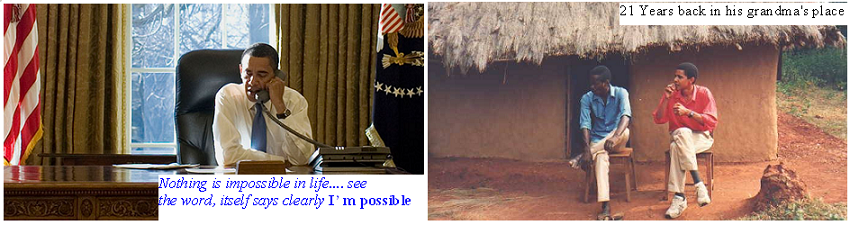
Forwarded byDushyant
Kumar |
LET
US JOIN THE JULY 4 AND VETERANS’ DAY PARADES |
Dr. Onkar Singh Bindra
America
is the country of birth of a lot of Sikh children and even many
adults. For those of us who were born in India, or another country,
America is the country of our choice. Having a Green Card or Citizenship
is a great privilege. With this privilege, go some duties, namely,
hoisting the American Flag and participating in the Independence
Day parades and other programs organized by the City governments
and Communities. Most cities in Greater Sacramento have a day-long
celebration on 4th of July, culminating in a fireworks display.
In Sacramento this year, these will include: Cal Expo State Fair
fireworks at 9:30 p.m.; Carmichael parade at 10 a.m.; Fireworks
at La Sierra Community Center at 9 p.m.; Citrus Heights fireworks
at Sunrise Mall at 9:40 pm. Elk Grove, Salute to the flag at Elk
Grove Regional Park at 9:45 pm.; Folsom, fireworks at Pro Rodeo
City. Rancho Cordova will celebrate at Hagan Park, 3 days of fun
& fireworks. We Sikhs have been in California since 1890s, but
we have lived in our small cultural islands. We have made little
effort to mix with the local Americans. They do not know who Sikhs
are. They mistake us for who we are not. Many Sikhs have been called
Osama. We have been called “rag-heads” and our turban
has been called a “Diaper”. Despite a lot of legal and
educational activity by national Sikh organizations (SALDEF, United
Sikhs, The Sikh Coalition) most Americans lack correct information
about the Sikhs. This has led to increased stereotyping, bullying,
oral and physical attacks, discrimination, and hate crimes including
arson and murders, in the wake of 9/11. Our mixing with the local
population in the Independence Day parades and Veterans Day Parades
will have a very positive effect. They will learn about us. Their
prejudice, fear and hatred for us will get replaced with understanding,
friendship and respect. Participation of the Sunday school of the
West Sacramento Gurdwara in the annual Neighborhood Parade is very
much appreciated by the West - Sacramentans. I urge the leaders
of various social, cultural, literary, political and religious organizations
of the Sikhs in Greater Sacramento toseriously consider organizing
Sikh participation in the July 4 and Veterans’ Day parades.
Please remember, non-participation in these national events is likely
to be considered un-American.
Posted
on July 01, 2010
|
|
ON
MULTICULTURALISM & CULTURAL FREEDOM
Professor
Autar Dhesi
|
The
cultural traditions and symbols need to adjust to a changed situation
otherwise they become a source of misunderstanding and lose utility
to their adherents. In any case, they can continue to persist
for long time at the place of origin but not necessarily elsewhere.
I understand
fully that British are very tolerant to other cultures. But it
should not imply that people of other cultures, who plan to settle
in Britain permanently, can do whatever they like, regardless
of sensibilities of indigenous population. However, there is need
for defining multiculturalism before taking any legislative measure.
The
relevance of cultural traditions and its symbols is context specific.
With change in context, they lose their significance and may rather
become source of misunderstanding. The origin of face-veil is traced
to the Christian-ruled Byzantine Empire. It was considered a device
to protect women in the absence of their male protectors engaged
in battles away from home. Later,the veil became part of Muslim
culture during conquest of Byzantine empire by Arabs. At present
it is prevalent among Muslim women only. However, there are more
than half a dozen different forms of veil that are popular across
the world. Some of them look quite graceful. In liberal Muslim countries,
Hijab, Al-mira, Shalya and Chador are the most popular forms of
veil. The western countries find only Burqua and probably Niqab
quite out of place.
It
is suggested that the Muslim communities in these countries should
debate this issue among themselves objectively and suggest an acceptable
solution in their long term interest.
Postscript
Before 1947, it was a common practice among married women across
castes, and religions, especially in rural North India to cover
their faces in the presence of male elders as a mark of modesty.
With mass migration of Muslims to Pakistan at the time of independence,
this outdated cultural symbol soon disappeared in the changed social
context, at least, in Punjab. It signaled emancipation of women
and not any disrespect to elders. In any case, the vitality of a
culture is contingent on its capacity to adjust to evolving socio-economic
conditions. The Punjabi culture is rich because of its inherent
flexibility..
Posted on May 19, 2010
|
|
SITUATION
IN SOUTH AFRICA
Autar
Dhesi wrote:
At 3:53pm on 07 Apr 2010,
|
It is easy to remove physical
walls and build bridges. But removing mental blocks and building
social bridges is entirely a different cup of tea. The removal of
dross from crevices of a society requires a lot of patience and
sustained efforts for long time. Besides enlightened strong political
leadership, building moral fabric of a society requires the involvement
of a large number of morally driven individuals across its different
segments. However, the former ruling elite should be quite clear
that the possibility of reverse discrimination can be avoided only
by their careful adjustment to the changed environment. However,
it is easier said than done. But one must try. The peaceful coexistence
respecting each others' sentiments and concerns is the only solution.
Post- script
The disagreement between an employer and his two employees, on fair
compensation for work, would have not resulted in loss of a valuable
human life, under conditions of healthy human relations based on
trust and respect for each other’s rights. The difference
could be resolved without acrimony. Therefore, the real issue that
needs to be addressed is much deeper.
It seems that the former ruling elites in South Africa have not
fully adjusted to the changed situation. The blacks, who are in
majority, have not fully shed their psychological burden of past
unpleasant experiences yet. As new rulers they should be more relaxed
and tolerant to-wards former rulers. However, a lot of work needs
to be done by government, and social entrepreneurs to facilitate
reconciliation between different groups. This time round, President
Jacob Duma’s political and diplomatic acumen is on critical
test at home ground. Hope he sets his priorities right.
|
SOCIO-ECONOMIC
CONDITION OF SCS IN STATE DEPRESSING:
Buta Singh
http://www.hindu.com/2010/04/29/stories/2010042957770100.htm
Special Correspondent
‘Injustice
has been done to them in recruitment, implementation of
schemes'
|
Bangalore:
The National Commission for Scheduled Castes (SCs) on Wednesday
termed “depressing” the overall socio-economic condition
of the Scheduled Castes in the State and said “grave injustice”
had been done to them in recruitment, promotions, allocation of
funds and implementation of various centrally sponsored schemes.
Commission
Chairman Buta Singh, who reviewed the progress achieved in the
implementation of schemes for the welfare of SCs in the State,
said they constituted 16.2 per cent of the State's population,
but reservation had been fixed at 15 per cent, which was against
the Constitution.
Denial
“Denial
of 1.2 per cent reservation for SCs is gross injustice and violation
of the fundamental right. We cannot digest this,” he added.
The Government allocates 15 per cent of funds in the budget and
reserves 15 per cent of seats in educational institutions for
SCs. Of the State's population of 5.28 crore, SCs account for
85, 53,920, he said. The Government has not maintained data on
the percentage of SC employees in Class I, Class II and Class
III categories. There is no data on the release of matching grants
by the State to implement centrally sponsored schemes. The commission
has given a two-day deadline to the Government to provide details
on various issues related to SCs, Mr. Singh said. The Government
has not followed the roster system in recruitment to its departments,
public undertakings and autonomous bodies. No action has been
taken against 4,200 candidates who obtained jobs by producing
fake caste certificates.
Several backlog
vacancies have not been filled over the years. “Unless the
roster system is followed, we cannot decide the number of vacant
backlog posts,” the Chairman said. Only in Group D category,
24.4 per cent of SCs had been employed, he said. Sources said
nearly 3,000 backlog vacancies exist.
No
liaison officer
There is no liaison officer at the State and district levels for
monitoring the implementation of welfare schemes, Mr. Singh said.
A high-level committee on the Scheduled Castes and the Scheduled
Tribes (Prevention of Atrocities Act) headed by the Chief Minister
has not met for the past three years. It held a meeting when H.D.
Kumaraswamy was Chief Minister, in 2006.
The
State ranks at the bottom of the table in conviction rates for
atrocities on SCs and STs. According to the National Crime Bureau,
in 2008 the conviction rate percentage in the State was 2.8 against
17.5 in Bihar, 13.3 in Andhra Pradesh, 26.9 in Assam, 34.2 in
Chhattisgarh, 3.5 in Gujarat, 10.6 in Haryana and 16 in Jharkhand,
he said. Referring to funds allocated for the Special Component
Plan and centrally sponsored schemes, Mr. Singh said that the
State did not release its share, and implementation of such schemes
had been dismal. Funds released by the Centre had also been not
utilised, Mr. Singh said.
Education
The Chairman said that the Government had not taken steps to improve
the quality of education of SCs. Nearly 65 per cent of students
did not pass 10th standard, and their admission to postgraduate
courses “is negligible in 11 State-run universities”.
Vice-Chairman of the commission N.M. Kamble, Social Welfare Minister
D. Sudhakar and Chief Secretary S.V. Ranganath were among those
present.
Forwarded
by Paramjit Saroy (Posted on May 08, 2010)
|
INDO-AUSTRALIAN
FRIENDSHIP
Some Reminiscences |
|
Autar
Dhesi |
My
interaction with Australians has been very limited but meaningful
I found them to be very friendly, direct and agreeable persons.
The recent bad press Aussies got due to a few unfortunate incidents
in their country has no effect on my view of them. Such incidents
occur occasionally almost in all societies.
One of my class fellows at University of Surrey was Daniel Breen.
He was already a senior lecturer in economics at one of the Australian
institutions. He came to London to do an M.Sc in international economics
in September, 1967. Breen and I opted for a course in Diplomacy
of International Economic Relations. Dr. Otto Pick, course in charge,
gave topics to each of us to prepare seminar essays for discussion.
We decided to exchange the essays prepared by us. One of us would
present the essay and the other was expected to put critical questions.
Dr. Otto Pick would act as a moderator and sum up the discussion
at the end of the seminar that often exceeded the allotted time.
Then we would go for coffee and continue informal exchange of ideas.
We soon became good friends. Dr. Otto considered Breen a hard working,
serious student and dismissed me as a casual, easy going person
but quite original (his words). He often said a student like me
either gets first or fails.
A minor incident in the department brought out the fine qualities
of Daniel Breen to the fore. Some undergraduate students had complained
to the head of the department against a teacher regarding her teaching.
Some of her colleagues planned to manipulate support of graduate
students by insulating that someone from our class might have complained.
We were quick to see through the game and unanimously decided to
depute Daniel Breen and another person of his choice to meet the
head of department, Mr. Lord. We felt relieved when Breen came back
and informed us that graduate students had nothing to do with the
complaint. Chance Meeting with Sir Robert Gordon Menzies
(Former Prime Minister of Australia)
After getting my degree from University of Surrey, one of the oldest
University of London College upgraded in 1960’s, I decided
to take a year off academic life for free lance writing. I had been
writing bits and pieces as a member of Indian Journalists’
Association, London since early 1960s. I also had been a founder
executive member of Campaign against Racial Discrimination since
its inception in 1964. All this made it easy to interact with the
right kind of persons. Some writing assignments came my way, especially
to write on socio-economic issue relating to immigrants for Race-Today,
a monthly of Institute of Race Relations, London and some other
publications. After handing over my article to Peter Watson, editor
of Race–Today, I decided to walk on a pleasant, sunny day
to London School of Economics. When I was near BBC House, I saw
a tall, well-built gentleman coming out of Australia House, next
to the BBC building. I instantly recognized him as his pictures
were everywhere in the morning papers. He was Sir Robert Gorden
Menzies. He was enjoying sun while waiting for someone. I decided
to greet him and try to get an appointment with a view to write
a story. He responded to my greetings warmly and wanted to know
about me. After listening to me for a few minutes, he said I could
go to Australia to study or to settle. Even he suggested that I
would do well in public life there. I was simply bowled over when
he said that. I should contact him if ever I decided to settle there.
I thanked him for his kindness. How can one forget such a wonderful
informal meeting with a great man?
I still remember, with nostalgia, those wonderful days of relaxed
social environment in London. Please permit me a little digression
to make my point clear. Just a few days earlier, I had gone to London
airport with a friend, who was doing his Ph.D. at School of Oriental
and African Studies, to receive his wife. As we entered the area
for incoming passengers, I noticed Reginald Maudling, former Chancellor
of Exchequer under P.M. Harold Macmillan. I had met him at an Indian
Journalists Association Republic day dinner. My friend could not
believe that a person of Maudling’s stature should be standing
among the commoners. So, I walked up to Reginald Maudling and reminded
him where we had met. Then I told him about my friend’s dilemma.
He told me that he was there to receive his son. The gentleman politician
gestured in his inimitable style, “Your friend better believe
you”.
An Australian in the World Bank
I was invited to work as a consultant in the Department of Economic
Analysis and Projection of the World Bank, Washington, D.C. during
summer months in 1982. Professor Hollis .Chenery was Vice-President,
Development Economics Research, and the above said department was
headed by an Australian, Dr. Helen Hughes. I made a courtesy call
on her on the first day of my joining the bank. After exchanging
pleasantries, she gave me friendly advice to publish only in international
journals if I wanted to reach somewhere. After a brief pause, she
said that she considered herself an Asian. At a social, she had
no hesitation in telling me that she worked as a bartender at some
stage of her life.
The Bank had rented an apartment for me in Watergate Towers near
Potomic River. I thought it was a bit away from the bank. So, I
found another apartment of similar quality in a hotel near the Bank
at half the rent. But I wanted to inform Helen before shifting there.
She was more than pleased by my proposed move as this would reduce
department’s expenses on my stay by half. Without wasting
a moment, she picked up the phone and told the person at the other
end to put her future consultants in this hotel near the Bank. At
the end, she thanked me.
I
found her as a friendly, direct person with no-nonsense, practical
approach.
Later, I learned that the only person among her permanent staff,
she got along well, was an Indian, Dr Shamsher Singh, Advisor (Project)
Professor Clem Tisdell Proessor Clem Tisdell, Emeritus Professor
of Economics, University of Queensland, Brisbane, is an acknowledged
academician of international standing. We have been friends, more
accurately pen pals since 1984, when I took over as Chairman, Punjab
School of Economics, Guru Nanak Dev University, Amritsar. At the
time it was a small department with good potential. My objective
was to make it one of the best in the country. There was no shortage
of funds. But I had to overcome locational disadvantage due to its
close proximity to sensitive international border with Pakistan.
There was no problem in getting additional academic positions sanctioned.
But the problem was to find well qualified candidates with good
potential. So, I decided to recruit young persons with potential
to grow and send them to advanced centres within the country and
abroad for training.
Professor Tisdell was one of the persons I contacted for this; His
response was positive and enthusiastic. However, I decided to put
this programme at the back burner due to serious social turmoil,
Punjab was going through at the time.
So I decided to work on the next item on my agenda. This was to
bring out a journal of international standing. I had full support
of senior professors at major centers of economics in the country.
Similarly, there was no problem in persuading a few well known economists
in North America and Europe to extend support. I invited Professor
Tisdell to become regional editor of the journal for Australia,
New Zealand and South East Asia. His response was very prompt and
positive. His contribution to the Indian Journal of Quantitative
Economics in its initial years will always be remembered with gratitude
by Punjab School of Economics. As an acknowledgement of his contribution,
journal’s first issue of 1996 was dedicated to him.
He is always prompt and courteous whenever I write to him. I still
regret my inability to avail his offer to spend a year in his department
as a visiting professor.
A Brief Encounter with an Australian in Minneapolis.
I was invited to speak at a plenary session of First World Conference
on Racial and Ethnic Economic Inequality, organized by Humphrey
Institute, University of Minnesota in May, 1996. At the end of the
session in which I presented my paper, “Unequal opportunities
in Education and labour Market in India”, a gentleman walked
up to me, addressing me by first name, invited me to present a paper
at next year’s World Conference on the topic, to be organized
by him in Australia. He was Colin Bourke, heading an upcoming university
for the indigenous people of Australia, as I was winding up my work
at Amritsar, I could not avail his kind offer. Nevertheless, his
gesture confirmed my earlier opinion about Australians as people
with direct, friendly and no-nonsense approach to life.
Proverbial Icing on the Cake
In Jane Stevenson’s well received novel, London Bridges, Dilip
Dhesi, an Indian lawyer and his Australian sweet heart Jeanene Malone,
a student of classical Greek in London, are depicted as honest,
rational and forthright characters. Many among the Asians living
in Britain, who remember me from my days (17 years or so) in London,
consider the protagonist, Dilip Dhesi as more or less Autar Dhesi’s
alter ego. The only missing link is that Autar never got an opportunity
to befriend an Australian lady in real life.
Posted
on April 27, 2010 |
DR.
B.R.AMBEDKAR- A HUMBLE TRIBUTE
|
O.P.Balley Martinez, (California)
This
year we will commemorate 119th Birthday anniversary of the great
leader of India, father of the Indian constitution, the very conscience
of the socially oppressed, who dedicated his entire life for their
emancipation and uplift, Bharat Rattan Dr.B.R.Ambedkar. Before
paying my humble tributes to the memory of the most luminous stars
in the galaxy of human intelligentsia I extend my hearty congratulations
to millions of his followers all over the world on this auspicious
occasion.
Some of the glimpses of his unrelenting struggle and sacrifices
to fight against social injustice which speak for themselves are
shared as under: Dr. Ambedkar, born on April 14, 1891 in a Mahar
family hailing from the state of Maharashtra, grew up in the midst
of harsh and severe social disabilities which the untouchables,
also known as dalits and later as scheduled castes, suffered at
that time. He acquired the first hand knowledge of the inequalities
and in-built inadequacies in the entire social spectrum of Indian
society. He created awareness among the exploited and derelicted
members of society to raise their voice against the unjust social
order.
EDUCATIONIST:- Baba Sahib as he was
lovingly and affectionately known firmly believed that education
is the light to the mind as eyes to the blind. His birth in a
family of so called “untouchables” exploded the false
myth that education is the birth right of only the selected segments
of society. His intellect, vision, creativity and farsightedness
reinforced the reality that it is the worth and not the birth
which is the real source of one’s recognition in any society.
In the philosophy of Baba Sahib the place of self- respect and
human pride was the greatest and most important. He, through education
wanted to develop the qualities of justice, equality, freedom
and fearlessness. After completing his academic pursuits in U.S.A
and England he returned to India in 1920 to grapple with the problems
of social degeneration and Hindu antagonism created by “Manuwad”
based on inequality and injustice, which had been eating like
a cancer for centuries into the very vitals of Indian society.
NATIONALIST
:- Dr. Ambedkar was a fervent nationalist who transcended
all political differences with other national leaders of the time
with regard to his love and patriotism for his motherland. He
supported the prosecution of war against the Nazis and fascists
while appointed as labor member to Viceroy’s executive council
,as witnessed by late Lord Mountbatten the then British Commander-In
–Chief of Allied forces in South East Asia during world
war II in his expositions on the personality of this illustrious
Indian leader.
CONSTITUTIONALIST:- He was a seasoned
statesman, politician and a nation builder who welded the entire
nation into one unified entity through his charismatic skills
and wisdom in drafting the constitution of free India. It was
his exceptional knowledge of constitutional law which earned him
the distinct honor to tackle justly and fairly the diverse and
complex intricacies of Indian social order. As chairman of the
drafting committee Dr. Ambedkar had to tackle almost single- handedly
the gigantic task of drafting and presenting the constitution
of free India within a very limited period of time. He stood like
a tower of strength, guiding, explaining and clarifying the intricate
provisions of the constitution. The man who publicly burnt Manusmiriti
in 1927 presented another Smiriti or living law ( i.e. The Indian
constitution) which granted the people of India ,justice, liberty,
Equality and Fraternity instead of inequality, discrimination
and social fragmentations.
According to Dr.Bannerjee, a profound scholar and an eminent author,
“ The speeches delivered by Dr.Ambedkar in the constituent
assembly as the chairman of the drafting committee shows his profound
scholarship, admirable capacity for lucid exposition, penetrating
intellect and his courageous statesmanship. Indeed he may very
rightly be regarded as the chief architect of the present constitutional
structure.”
WHY EMBRACED BUDHISM?:- After his personal experiences
and carping humiliations of Hinduism plagued with caste discriminations
Baba Saheb once seriously considered conversion to Sikhism as
a viable means to escape from the shackles of Hinduism but he
soon found out that caste system is very much alive among the
Sikhs too. This made him change his mind and embraced Budhism.
While paying his tributes to Dr. Ambedkar, late Pt.Jawahar Lal
Nehru,the first prime minister of India, in his speech in the
Indian Parliament said, “ Dr.Ambedkar will be remembered
mostly as a symbol of revolt against all the oppressive features
of Hindu society. His virulent opposition to those oppressive
features had kept people’s mind awake. Although he was a
highly controversial figure he played a very constructive and
important role in making of the constitution of India and Hindu
Law Reforms. He revolted against something which everybody should
revolt against.”
STATUS OF WOMEN:-His painstaking
and pioneering work as the first law minister of free India in
the enactment of Hindu Code Bill for which he faced lot of opposition
from many quarters was an outstanding piece of legislation and
contribution in the uplift of the status of women in India.
PERSONAL MEETINGS:- It was the most thrilling
and rewarding experience of my life when I was blessed to meet
Baba Sahib in person for the first time at his residence on Alipore
Road, Delhi in January,1956 with the help of Mr.Nanak Chand Rattu,
private secretary of Baba Sahib. Thereafter , I had many opportunities
to see, talk and listen to him in person which are deeply embedded
in my memories and will carry them as a holy relic for the rest
of my life.
FUNERAL PROCESSION ( Dec. 6,1956)-
On December
6,1956 while on way to my office located right in front of Baba
Sahib’s residence I heard on All India Radio the sad news
of his sudden demise. I was among the very few who arrived first
at his residence in the early morning where I had the rare opportunity
along with five other persons to carry Baba Sahib’s mortal
body from his bed room to the main lobby for public view. A vast
sea of mourners ,thereafter, gathered at his residence to participate
in a miles-long funeral procession to the Palam airport before
flying his body to Bombay for cremation. In the end I must mention
that though the lamp which guided the destiny and showed the path
to millions groping in darkness was suddenly extinguished by the
cruel clutches of his untimely death but his contributions and
sacrifices for the unprivileged in particular and the entire Indian
society in general will live forever, adorning the pages of the
history of India and the world like a precious jewel. His crusade
for social justice will be cherished as a perpetual source of
inspiration and encouragement to fight against the forces of tyranny
and injustice for generations to come.
SOME
FAMOUS QUOTATIONS OF BABA SAHIB:-
1. “
Glory to those who would keep on their struggle for the liberation
of the enslaved in spite of heavy odds, carping humiliations,
storms and dangers till the down trodden secure their rights.”
2.
“ Whatever I have done I have been able to do after passing
through crushing miseries and endless troubles all my life in
fighting with my opponents. With difficulties I have brought this
caravan where it is seen today. Let the caravan march on despite
the hurdles that may come in its way. If my lieutenants are not
able to take the caravan ahead they should leave it there but
in no circumstances should they allow the caravan to go back.
This is the message to my people”.
3. “ Turn in any direction you like ,caste is the monster
that crosses your path. You cannot have political reform, you
cannot have economic reform unless you kill this monster”.
|
|
PASH
MARTYRDOM
DAY
REMEMBRANCE CEREMONY
(Top
left)
Dr. Amolak Singh speaking ,
(Top right)
Dr. Ronki Ram
speaking ,
(Middle)
Prof T.C. Ghai's Book Release Cermony, standing:
(left to right):
Dr. Ronki Ram,
Prof. K.K. Pathak,
Prof. T.C. Ghai,
Dr. Amolak Singh and Prof Tarsem Sagar, (Bottom left)
Dr. Ronki Ram
with Prof. T.C Ghai
author of Pash's poems
translation into English at Talwandi Salem
village (Bottom right)
Prof. T.C. Ghai with
Sant Sandhu, a friend
of Pash at their
native village
on March 23, 2010 |
Report
& Images Ambedkartimes.com Bureau
(Talwandi
Salem):- Ambedkartimes.com congratulates Prof. T.C.
Ghai for his great efforts in translating entire poetry of Avtar
Pash, one of the pioneer revolutionary Punjabi poets who in his
very young age became a house-hold name not only in his home state
but also in the entire India. In addition, he is equally popular
among the wide Punjabi Diasporas. Prof. Ghai’s translation
(Pash: A Poet of Impossible Dreams) was released at the Martyrdom
day remembrance ceremony at Pash’s native village (Talwandi
Salem). At the ceremony, Prof. Ghai dedicated his book to Bha Ji
Gursharn, a noted revolutionary activist in the domain of theatre
art in the region. Among other recipients of the book at the ceremony
were Prof. K.K. Pathak, Dr. Ronki Ram, Prof Tarsem Sagar, Sh. Sant
Sandhu and Dr. Amolak Singh. The book is published by Pash Memorial
International Trust. Prof. T.C. Ghai (Born 1937) retired from Delhi
University as an Associate Professor of English in 2002. He has
published two short novels and a Hindi translation of his short
stories, Adamboo, originally written in English. He has translated
a Punjabi poet, late Dr. Puran Singh Kanwar’s collection of
poems, Rattan Di Rut (1984), into Hindi in 2000 and English in 2006.
While
speaking at Martyrdom day remembrance ceremony at Pash’ village,
Prof Ghai said that “in the premature violent death of Pash
the Punjabi poetry has perhaps missed its own Pablo Neruda, or may
be someone even greater”. Dr. Ronki Ram said that in contemporary
times, the poetry of Pash has become rather more relevant and crucial
in dealing with general myopia of free market economy led consumerism,
and electronic media’s persistent campaign for festivities
and glamour! Dr. Amolak reiterated on the need for pro-people policies
which he lamented are nowhere to be seen in the present regime at
the state and centre level. On the occasion different theater groups
staged revolutionary plays including the famous play Aeh Lahoo Kis
da Hai by Bha Ji Gursharn theater group.
Posted on March 24, 2010 |
THINKING
PEACE IN MIDDLE EAST WITH PRESIDENT OBAMA
|
|
Prof. Autar Dhesi’s Comments On Recent
US Peace Initiatives
Published by BBC News London
Iran
Friday,2 April,2010
In an increasingly interdependent world President Barack Obama's
effort to take China on board to restrain Iran is a rational, workable
approach. The other major countries in the region like Russia, Pakistan
and India should also be involved. In case the situation becomes
very serious all of them would be adversely affected. The US has
already set a precedent in collective diplomatic approach to handle
volatile Israel-Palestine issue. The US, Russia, EEC and UN joined
hands for the first time to restrain Israel's unacceptable attitude
in the changed situation. I am sure collective approach would also
have the desired impact on Iranian public.
Afghinstan
Tuesday,12 January,2010
Tuesday, 12 January, 2010, 13:39 GMT 13:39 UK
The long suffering Afghan people deserve co-operation and sustained
support of all well meaning people to have an enduring, open, democratic
dispensation. It is not surprising to find that they are becoming
confident by the day This should also contribute to securing peace
in the region. My only fear is that President Obama may not leave
the task unfinished due to domestic pressure just before the next
presidential elections.
The valiant Afghans can take care of their problems with experience.
Wednesday, 17 February, 2010, 13:34 GMT 13:34 UK
The situation in Afganistan is certainly very complex.The military
action can be expected to lead to meaningful ,sustainable results
only if it is accompanied by actions to ensure social and economic
development in cooperation with major countries of the region. However,successful
military action is a necessary condtion for other policies to succeed.
In the final analysis it is only the capacity of Afgans to manage
their affairs in an open democratic set up would ensure peace.and
prosperity. .
Monday, 29 Mar 2010
President Obama's surprise visit to Afghanistan is indication of
his firm commitment to secure enduring peace in the region. What
is more interesting is his forthright message to Afghan President
Hamid Karzai to root out corruption in the system and break the
nexus between drug trade and militancy. His visit should also boost
the morale of forces fighting against militants.
His initiative to get the stalled negotiations between Israel and
Palestine going also shows his earnestness to secure permanent peace
in entire region. His heart and head are at the right place. All
the well meaning people of the world should support his efforts.
Postscript
I am sure President Hamid Karzai fully understands the gravity of
the situation .Sooner he gets on with very difficult task of cleansing
the system better it is for him personally as well as the society.
No diversionary rhetoric would serve any purpose. I wish him good
luck that he needs most at present.
Israel
Tuesday,09March,2010
Given the will, nothing is impossible . Many historical complex
situations have been sorted out over the years. The most recent
example is the case of Northern Ireland. However, it requires a
lot of patience to sort out the intricate issues. The US is the
only country that can steer negotiations for some acceptable solution
. This would help in securing peace not only in the Middle East
but also in Afghanistan.
The US initiative would have explicit or implicit support of world’s
all well meaning people including those in Israel and Palestine.
Let us not forget that they have a lot of things in common. A lasting
solution will benefit both. Good luck
Thurday,18 March,2010
Israeli provocation could have been avoided in the interest of reaching
a lasting agreement on the vexed historical issue. Now it is time
for other countries, especially European Union, to back the US initiative.
Israel is too closely allied with the US to overlook the latter's
concerns for peace in the region. As I wrote in my previous comments,
US is the only country that can steer negotiations to some acceptable
lasting solution. I am sure Israel fully understands it.
Postscript
I was in Israel during summer of 1966 for six weeks as a member
of Student Group from Universities of Cambridge, Oxford, London
and Leeds. The study tour was partially financed by an educational
trust in London, headed by Labour leader Anthony Greenwood. I joined
University of Surrey later in the year. We were taken around all
over the country in two coaches and were given ample opportunities
to interact with different sections of the society. The driver of
the coach, I was in, was an air force pilot. He gave us informally
a good briefing about the security environment. It was not difficult
for us to anticipate some sort of conflict between Israel and the
neighboring Arab countries except Lebanon in the near future. At
Surrey, I shared my assessment of the situation and of the likely
outcome of conflict if it took place with others. To my utter surprise,
my assessment turned out to be more accurate than I expected, when
conflict actually took place in 1967. After that our teacher of
international relations, Dr Otto Pick, encouraged me to share my
assessment of some other similar situations in the class. A lot
of water has flowed since then. The field for interplay of nations
has changed, so have rules of the game. Israel's earlier approach
in the changed circumstances is untenable. The world Jewish fraternity
is too sophisticated and intelligent to overlook implications of
emerging multipolar world. However, a lot of water has flowed under
the London Bridge since then. The field for interplay of nations
has undergone drastic changes.
Consequently, rules of the game have also changed. For the first
time, the US, Russia, EEC and the United Nations collectively tried
restrain Israel's cavalier approach to Palestine issue on The world
Jewish fraternity is far too intelligent and sophisticated to ignore
its implications.
Posted on April 4, 2010 |
CRISIS
OF GOVERNANCE:
NEED FOR CITIZEN-CENTRIC POLITICS |
Dr.
Pramod Kumar
Director Institute for Development
and Communication, (IDC) |
Ambedkartimes.com
is pleased to publish an article entitled “CRISIS OF
GOVERNANCE” written by Dr. Pramod Kumar (Director Institute
for Development and Communication, (IDC). Dr.
Pramod Kumar was introduced to Ambedkartimes.com by
Dr. Ronki Ram (Chairperson Department of Political Science
Punjab University, Chandigarh , India ). Wethank him for introducing
us with this well known personality from Punjab (India). Ambedkartimes.com
welcomes Dr. Pramod Kumar.
Prem Chumber
Editor: Ambedkartimes.com |
| |
Governments
do not seek participation of the citizens in decision-making,
but claim to provide for the welfare of population. This made
governance less a matter of politics and more of administrative
policy. The main element of this has been the government’s
lack of trust in the common person, who has to submit affidavits
at every step. |
There is
a crisis of governance. This crisis is not because debts are mounting
especially when the states have abdicated most of their development
functions? It is also not that one-third of the world poor are surviving
in India. It is also not that corruption has become institutionalized.
It is also not that the prices are skyrocketing. It is all this,
but above all, what is really worrisome is the manner in which these
crises are being resolved.
These are liberating times – after a struggle
of 60 years, the governance models have been unleashed, the states
have abdicated their responsibility to provide the citizens a dignified
living. Under the banner of Private-Public Partnership (PPP), public
resources are leveraged in favour of private profit. People are
asked to mind their own health and subsidies are given to private
hospitals. And, they are asked to pay for life-saving services even
if they do not have the opportunities to earn a livelihood. The
message is that the people should mind their own health as the task
of nation-building is being outsourced to the private initiatives.
There is also a strong desire in the government
to liberate itself from the burden of providing social security
and subsidies to the people. However, doles have become a currency
to buy votes of the misery-stricken electorates. Number of dole-oriented
programmes are being implemented to integrate poverty-stricken people
into economic development which is euphemistically called inclusive
growth. This inclusive growth, may have drawn its inspiration from
the well-known economist Joan Robinson’s incisive observation
that ‘There is only one thing that is worse than being exploited
by capitalists. And that is not being exploited by capitalists.’
Here comes the flagship programme NREGA providing employment to
the rural poor for 100 days in a year. Is it not this kind of integration
of the poor into the capitalist development has has legitimised
‘dole giving and dole receiving mindset’ thereby reinforcing
the existing non-performing system of justice delivery. These policies
no doubt, have ensured safe passage for “plundering rotating
governments”.
And, the civil society has also liberated itself
from the burden of launching protest movements to transform or reform
the system. That is notwithstanding their media-driven ad-hoc noises
to bring to justice the individual violators.
2
There is a need is to rejuvenate governance. Because some of the
rules have become either redundant or inappropriate or violative
of the rights of the common people. Or, there may be asymmetry of
information, perverse incentives and high transaction costs.
The governments do not seek participation of the
citizens in decision-making, but claim to provide for the welfare
of population. This made governance less a matter of politics and
more of administrative policy. The main element of this has been
mistrust in the common person. It can be exemplified in a number
of ways, but the most visible is the filing of affidavits for almost
every interaction with the government.
These affidavits are required in support of the
facts given by the applicants for availing various services provided
by the government. In other words, these are affirmations by the
applicants supported by third parties in some cases. These affidavits
in most of the cases are given on legal papers sworn before a Magistrate
or the public notary. For instance, affidavits are even required
for public utilities such as new connections for electricity, sewerage
and water supply. This has added to the citizen’s harassment
and corruption.
It is, therefore, urgent to discontinue the practice
and replace it with self-declaration, a step towards bestowing full
citizenship on the colonial subjects. And, similar approach needs
to be adopted by discontinuing verification from the public officials.
There is a need to bring about a change in the processes, procedures,
rules, regulations and policies relating to affidavits, residence,
birth and death, marriage, SC and BC income certificates and urban
civic services such as construction, water and sewerage connections,
revenue etc.
A major casualty of this is the citizen-centric
democratic governance. Recently, a system of tracking the pregnant
women for prohibiting them from seeking sex selection tests to abort
a female foetus has been introduced. As this is violative of the
privacy of the citizen, can provide license to those who treat women
as commodities. It will be more prudent to enforce law on the supply
side i.e. on private and public sector medical practitioners and,
on the demand side, attempts be made to enhance the value of the
girl child, launch awareness campaigns, activise civil society organisations
and ensure tracking of the girl child through her life cycle from
birth to death and interweave incentive-oriented schemes with a
view to checking not only female foeticide, but also emphasise the
cultural neglect.
Interestingly, governance having become a prisoner
of the administrative structure, any political statement is seen
as interference. This political interference which has become an
accepted part of the political culture (not only in Punjab, but
in many other states also) has produced glaring distortions in the
practice of governance, particularly, in administrative recruitments,
postings, transfers, allocation and allotment of works, service
delivery etc., leading to the dilution of hierarchy, dysfunctional
internal accountability mechanisms and patronage-centric governance.
To illustrate, the average tenure in 2009 of SHO is around six months,
which was about seven months in 2004. In the case of Deputy Superintendent,
the same is ten months and one year for the District Police Chief.
The tenure of the police personnel have to be fixed as per the Police
Act and a performance audit report may be considered as the basis
for effecting transfers and postings. This alongwith other institutionalised
changes in the police practices like registration of crime, fair
investigation, transparent performance audit, complaint system against
the police functionaries for
3 ensuring accountable policing, shall help to mitigate harassment
and corruption in the police delivery system. The bigger challenge
is to break the nexus between the police and politics as both have
risen above law.
GOVERNANCE REFORMS: GOVERNANCE FIX AND NOT FISCAL
FIX
The governance crisis is holistic. A fragmented
diagnosis produces a tunnel vision. Consequently, remedies to social
problems are provided in a segmented and ad-hoc manner. Since administration
is compartmentalized in the departments and each department has
its own priority, if a particular department’s priorities
take precedence over the other that is likely to lead to dissonance
within the system. There is no dearth of examples to drive home
this point. In 2004-05, the then Punjab Department of Finance in
its overactive commitment to impose fiscal management came out with
a scheme to contract untrained ‘teachers’ from the same
village to cut government expenditure. As a result, the quality
of teaching further deteriorated and, later, all the contractual
‘teachers’ launched protest and demanded to be trained
as teachers and their services regularised. This scheme was spearheaded
by fiscal management framework rather than providing access to equity
concern in quality education.
No doubt, most of the states including the central
government are facing a fiscal crisis. In other words, the expenditure
of the governments is more than the revenue generated. Within increased
deficit, public expenditure on social development, needed most by
the poor, has been declining in the last 25 years in Punjab. A perusal
of the state expenditure pattern on social development makes this
point crystal clear. The expenditure on social development in Punjab
including health declined from 66 per cent in the early eighties
to 40 per cent. And, livelihood needs do not find any reference
in the public finance management drive. Why is it then that the
expenditure is multiplying while the governments have abdicated
their function to provide employment, public education and health
facilities to the people. The need is to reprioritise the expenditure
pattern to respond to the requirements of the people who do not
have the means. Further, the trends in the last 25 years have shown
that the expenditure on the salaries of the public sector employees
has declined. At least it would not be fair to blame the government
staff for the state’s bad fiscal health. They can, however,
be charged for inefficiency and corruption, but for that you do
not require fiscal fix, but governance fix. Similarly, to improve
tax collection in Punjab which is perhaps the lowest amongst the
other developed states, the need is to rejuvenate governance. There
is also an urgent need to rationalise subsidies. Most of the subsidies
to the poor are given as doles. To illustrate, the social security
programmes like Pensions and Shagun are given as doles to a large
section of the ineligible population. This has become a practice
with successive governments. Consequently, it leads to wastage.
Not only this, the doles given to protect profits (industrial interests)
are presented as rescue packages.
In fact, there is an emergent need to evolve disaggregate
deprivation-based schemes for groups and individual beneficiaries.
There are groups or individuals who may be high on education, but
low on health and income, or, alternatively, high on income but
low on education and health etc. No doubt, subsidies are essential
for enhancing productivity as
4 also equity being an integral component of the capitalist development.
But subsidies must not be given as doles.
Another distortion in governance is that each institution,
be it civil administration, police or judiciary, is overactive in
correcting the manifest distortions in other institutions rather
than performing its own assigned role. (To illustrate, in Punjab,
in the eighties, when the political process produced crisis, an
overactive administration armed itself with TADA. In view of the
failure of administration , the police was unleashed). When the
police produced a bigger crisis, the judiciary was unleashed. These
overactive institutions produced distortions similar or even worse
and also prevented the forces and factors behind these distortions
from coming to surface. As such, it should be understood that if
the civil administration becomes non-functional, the remedy is not
to unleash the police. The remedy must be sought to make the same
functional. For example, if there is a leakage in the revenue collection,
the chemists are trading in illegal drugs and the functionaries
are indulging in corruption, the remedy should not be seen in resorting
to policing. It is possible that the revenues may increase, and
so will the extortions. But the damage caused to the system shall
be irreparable. The tendency to empower the institutions with ad
hoc license has a clear message i.e. killing poison with poison
and letting the patient die. This has made governance less a matter
of politics, more of an administrative policy and the discretionary
political interference.
It is high time that the civil society was closely
engaged in governance and the people on the margins were granted
a dignified livelihood, harassment-free and non-discriminatory services
by enhancing the role of the public sector in social development.
Posted on Febuary 08, 2010
|
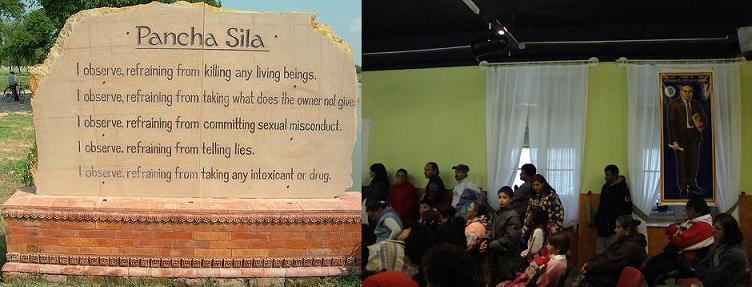
Celebrating
Dhamma Chakka Parivartan Diwas in Hungary
By Pardeep Singh Attri
|
When a senior Indian embassy official in Hungary
is invited in a programme celebrating one of the historic national
event of 20th century India, he speaks on every thing under the
sun except on the event and fails to utter a single word on the
most important figure involved with that particular event and his
life and struggles.
“I tell you, religion is for man and not
man for religion. If you want to organize, consolidate and successful
in this world, change this (Hindu) religion” – Dr. B.
R. Ambedkar
Dhamma Chakka Parivartan means ’setting in
motion the wheel of Dhamma’ andDiwas means ‘Day’.
This is the day to refresh our memories of the very first sermon
given by Buddha to his five disciples at Sarnath. Also on 14th October,
1956, Babasaheb Ambedkar took diksha in Buddhism along with more
than half a million people leaving behind the caste-virus of Hinduism.
Traces of Buddhism in Hungary can be found since 15th century (it’s
around the same time when gypsies/romas migrated from Balkan regions
of India, so it can be possible Buddhism here in Hungary may have
been brought by these gypsies/romas). There are few scholars in
Hungary who believe that name of the capital Budapest is derived
from the word Buddha. As in 19th century there were two cities Buda
and Pest, on both sides (east and west) of River Duna. The city
of Buda being somewhat hilly, scholars believe there may have stood
a lama monastery, Stupa or Buddha statue from which the name “Buda”
is derived. “Past or “Pest” is a Persian word
meaning “low”. It expresses the topographical relation
between Buda and Pest. “Lower-of-Buda, Lower-of-Gompa1”
= Budapest. 2
In Hungary, contemporary Buddhism is new to Romas. Total Buddhist
population of Hungary is about 15,000. Romas of village Sajokaza
(population around 3300) came to know about Babasaheb Ambedkar and
Buddha due to the efforts of Jai Bhim Network, that is working here
from last 3 years. It was decided by Derdak Tibor, Janos and others
of the Network that this time they’ll celebrate “Dhamma
Chakka Parivartan Diwas” on 14th October to commemorate Dr.
Ambedkar’s conversion to Buddhism. Earlier, the Network had
also organised an event on Poona Pact on 24 September, 2007.
The preparations for the celebration of Dhamma Chakka Parivartan
Diwas started from 1st October, 2009 onwards and there was lot of
excitement in local Roma community, especially among the students
about the event. So as to fulfill the curiosity of students of school
I visited “Ozd School” twice and talked with the students
about Buddhism, Dr Ambedkar, what all five colors of Buddhist flag
means (Blue- Faith, Yellow- Holiness, Red- Wisdom, White- Purity
and Orange- No Desire) and Diskhabhoomi, Nagpur etc.
Together with Janos, Tibor, Benu, Bharat, Katlin, we prepared the
schedule of the events to take place during the celebration to be
held on 14th October. We then decided to invite people from Indian
Embassy as well as from Hungarian Education Ministry for the programme.
In this regard on 5th October, Bharat and Janos went and met Mr.
V. V. Mohan, Second Secretary of Indian Embassy and personally hand
over the invitation.
Apart from various speeches by the network activists on Buddhism,
we also planned for Buddha Vandana, a Buddhist play by Lazi Monika,
Benu and Anna. I was also asked to deliver a lecture on ‘Buddhism
and Dr Ambedkar in India’. We decided to end the celebration
by a cultural programme followed by the movie on Babasaheb Ambedkar.
For this whole event, we booked the ‘cultural house’
of Sajókaza.
Finally the much awaited day came, Mr. V.V. Mohan along with one
of his colleague arrived at around 11am. At that time, all of us
were busy in cooking food for 150 people. However, some of us welcomed
Mr. Mohan and discussed about Jai Bhim Network’s activities
and later took him to various Roma settlements of nearby areas.
In the afternoon, around 2 pm, we started our program with around
150 people in attendance. The other dignitaries that graced the
function were Soltesz Lojosne (vice-mayor of Sajókaza) and
Belik Istvan (member, local governing council). Five of us inaugurated
the function by reciting Buddha Vandana on the stage followed by
the welcome speech delivered by the senior activist Janos.
Then Mr V.V. Mohan was invited to speak and share
his views, which he did by talking about India and the activities
of Jai Bhim Network. However, what surprised me the most in his
speech was that Mr. Mohan, speaking in the event on Dr. Ambedkar’s
historic conversion to Buddhism, failed to utter a single word about
Buddhism and Babasaheb Ambedkar. I am amazed at the audacity and
stubbornness of caste-Indian psyche on maintaining a silence at
all cost on Babasaheb Ambedkar and Buddhism. After that Derdak Tibor
spoke about the importance of Buddhism and Dr Ambedkar, how he converted
to Buddhism, necessity of Buddhism in present life etc. Then, women
congregation took place and they sang Roma songs. Then came my turn
to speak on importance of Buddhism and Babasaheb in Indian context.
Initially, I was bit nervous due to my stage fear as this was only
the second such opportunity for me, to speak before the gathering,
the first being in Nagpur last year. But then, Derdak Tibor being
my interpreter brought me some relief and I was able to talk about
the life and struggle of Babasaheb, about untouchability in India,
importance of Buddhism and the role of Buddhism in empowering the
whole Dalit community in the country. I also told the audience about
a study that found out that people embracing Buddhism doing much
better than those Dalits who have not yet converted.
At the end of the programme one of the Network activists Benu thanked
everyone and distributed gifts to children among the audience. We
also handed over Babasaheb Ambedkar’s pictures, Jai Bhim bands,
Buddhist bracelets, books etc to Jai Bhim Network that we brought
from India. It was around 5pm and the programme was concluded after
serving delicious food to all participants.
After two hours we again gathered at the same venue for showing
the movie on Dr Ambedkar but before that we gave a brief introduction
to the movie, being translated by another Roma activist Katlin.
We also featured a short movie ‘Pay Back to Society’
directed by our friend Saurav Arya and ended the programme by reciting
22 vows of Dr Ambedkar, being translated in Hungarian language and
suited to Hungarian context by Derdak Tibor. The response to the
event was very warm and welcoming by the whole Roma community.
Posted on December 18,
2009
|
|
Ambedkar and the Post-Ambedkar Dalit Intellectuals
Harish K. Puri
Ambedkartimes.com is pleased to publish an article entitled “Ambedkar and the Post-Ambedkar Dalit Intellectuals” written by Dr. Harish K. Puri. Professor Puri was introduced to Ambedkartimes.com by Dr. Ronki Ram (Chairperson Department of Political Science Punjab University, Chandigarh , India ). We thank him for introducing us with this well known personality from Punjab ( India ). Ambedkartimes.com welcomes Professor Harish K. Puri.
Editor: Ambedkartimes.com |
Desperate beatings on the drums of an imagined upper-caste past will produce no long-lasting victories. Gail Omvedt (Dalit Visions 1995:103)
The Dalit’s dogmatism about Ambedkar and his thoughts and philosophy may bring some immediate gains but may prove to be fatal in the long run for both the expansion of his ideas and philosophy and their own interests to be pursued through that.
Nandu Ram (Beyond Ambedkar 1995:80-81)
Are Brahmins still our Shatrus? . . . I very deeply felt that the thinking Dalit has somehow become a prisoner of the past, and for any successful battle of emancipation, the emancipators themselves must emancipate first
Chandra Bhan Prasad (The Pioneer 20.7.2003)
The consciousness and attitude of Dalit movements appears to have been frozen at its birth. It needs to recognise that the post independence reality presents a far more intricate complexity than in colonial times.
Anand Teltumbde (“Theorising the Dalit Movement”: 2000:27)
Dr Ambedkar is misunderstood on two crucial counts. One that he was merely a leader of Dalits, and two that he was anti- communist.
If others look down on me in their belief that my caste is low, it is their problem, not mine. I certainly don’t need to torment myself over it. I pity them, for they are the victims of their own obsolete prejudices. . . . Dignity, after all rests in the mind and heart . . . and soul. I have to reclaim it not from outside, but from within. And for that I must cut off the albatross of the caste system from my soul, once and for all.
Narendra Jadhav (Outcaste, 214)
The truth is that there are too many so- called leaders of Dalits who have actually betrayed Dalit interests.
Gopal Guru
The observations cited above point to the ferment among the Dalit intellectuals – the growing children of Ambedkar--- who were apparently dissatisfied with the course of Post-Ambedkar Dalit movement and searched for a clear direction of Dalit struggle for their emancipation. They looked up to Ambedkar for wisdom and direction. The challenges in the present context were different from those that Ambedkar had grappled with. His assessments and priorities changed, sometimes radically. Anand Teltumbde, in his book Ambedkar In and For the Post-Ambedkar Dalit Movement, for example, recalled Professor Upendra Baxi’s question, which he raised 14 years ago at the Ambedkar Birth Centenary celebration. There were many Ambedkars, wrote Baxi, and asked as to “which Ambedkar do we commemorate”? Teltumbde referred to the ambivalence reflected in Ambedkar’s sayings and doings. This, according to him, provided to the Dalit activists the scope to construct a variety of icons of Ambedkar and to interpret his teachings in a manner suitable to their own political agendas. There are among the Dalit intellectuals today clear signs of a critical review of their earlier positions in the light of the changed social and political reality. A call to move “from the abstract to the concrete” was, for example, raised strongly by Chandra Bhan Prasad. “The Issue for an intellectual”, as he argued, “is to balance the abstract by the force of the concrete”.( ) The participation of many in the Durban Conference and the World Social Summit seems to have made a considerable difference to the thinking of India ’s Dalit intellectuals. Their exposure to different kinds of struggles being waged by the oppressed people around the world and to the new kinds of challenges emerging in the wake of globalisation and liberalisation encouraged new thinking.
One such evidence comes from the ‘Bhopal Dalit Document’ of 2002 that emerged from the long discussions among a galaxy of Dalit intellectuals and activists representing diverse shades of opinion. On the agenda was Dalit response to the new openings and the challenges posed by the forces of international capitalism on the one hand and by the sectarian and revivalist agenda of the protagonists of Hindutva, on the other. This document makes a resolve to liberate the Dalit imagination from the stranglehold of some of the major and passionately held ideas about objectives and strategy of Dalit emancipation. It called for a serious review of the developments during the last 50 years. There was almost a consensus on the fact that Dalit bureaucrats and political leaders failed to make themselves into a social capital unlike those of the upper castes. One of the significant developments was the resolve not to remain tied to the discourse of “job–reservations”. The document asked for state intervention to ensure the de-casteisation of the economy, so that Dalits could become active players in the market. It was pleaded that private sector corporations in India should introduce “diversity principle” on the “American Model” to reserve a share of jobs for Dalits. There are problems with the impulse underlying the Bhopal Declaration and some of its assumptions, which we would discuss shortly. But one thing is prominent. There is serious effort to explore new ways of safeguarding and promoting Dalit interests. The new churning among the Dalit intellectuals also brought up the differences in their assessment of the past struggles of Dalits and about the vision and the strategy of action for the future. And these differences were sometimes sharp. That is a measure of the maturing of the thinking children of Ambedkar. Pride in Ambedkar’s legacy and gratitude towards his contribution became in this exercise a legitimate ground for “redefining Ambedkar”, understanding his core impulses and ideas, and for going beyond Ambedkar.
Babasaheb Ambedkar enjoyed an exceptional honour and love, as a liberator, among the Dalits. As Prasad put it, he was for the Dalit multitude a Prophet or “Christ plus”. No single leader, in the recent history of India , cared and did for them so much with love as he did to the transformation of the world of Dalits -–- in their perception of their self-worth and their destiny. Thanks to his vigorous and multi-dimensional efforts, the Dalits are today far more confident of themselves; they are far more politically conscious and assertive about their rights and about the need for struggle against oppression and exploitation than ever before. In fact, Ambedkar is perhaps the only one amongst the national leaders of India who seems to have grown immensely in his stature after his death, even among the non- Dalits.
The political priorities of Ambedkar and the interventions he made were, however, the responses to the problems he faced and the opportunities available to him in the specific historical conditions of his times. He launched a number of different kinds of struggles and established a variety of organisations. He was no less involved in working out an ideal philosophy of life. He grew with times and changed programmes and tactics accordingly. His prolific writings covered a wide range. But his primary concerns during the last years of his life were two. One was the project of establishing such institutions, rules and norms as would end untouchability and exploitation of his people and enable them to claim their rights to liberty, equality and human dignity. The second was the creation of a sensitive and civilised society in which there is a climate of fraternity. One of the most significant of his contributions for that purpose was the framing of the Constitutional Law of India. He had great faith in the rule of law. Given the clearly laid down objectives of the Constitution and the Directive Principals of the state policy, he had hoped (despite apprehensions to the contrary) that the state would be able to create the conditions necessary for social justice. Unfortunately, the apprehensions came to be true. The Indian state largely failed in fulfilling its constitutional obligations of social justice and the Indian people together failed in creating a civilised or caring society, where fraternity is possible.
Regarding how the intellectuals assessed the overall thrust of the state’s developmental and affirmative actions and its impact on the Dalits there were sharp differences among them. Some of them thought that such intervention by the state had, instead of empowering the Dalits, contributed to their subordination to a patronizing system. That point of view has been well articulated by S. P. Punalekar, himself a non-dalit. While there is a recognition of the improvement made in the conditions of life of the Dalits it was viewed as a process which had, by giving to the small upwardly mobile section a few opportunities of personal advancement and a nominal share in political power divided the dalits. They distanced themselves from the vast section of their fellows. For the mass of dalits it created a situation of relative deprivation, making them to aspire for what the elites gained and tying them to a system of looking for benefits from above. ( ) Gopal Guru moved beyond this by looking at it as a negative process. According to him, the advancement of some sections, which facilitated their co-option and which trapped the Dalits in a “mobility syndrome”, contributed to a negative consciousness of looking for incremental improvement. The reduction of “absolute deprivation into relative deprivation” had the consequence of atomisation of an individual which “denies any community a collectively critical subversive consciousness”. (EPW April 3, 1993)
Anand Teltumbde largely agreed with Guru’s perception that such consciousness ‘emasculated’ the Dalits and denuded them of the revolutionary consciousness. Incremental change and improvement seemed to them to be counter-productive and harmful to their liberation. In a fundamental sense, the changes that occurred during the last fifty years of development and change had, according to them, further harmed and weakened them. In fact they tended to give the impression that absolute deprivation of the Dalits might have been better because that would have prepared them for bringing about a revolutionary transformation of society. One could recall how some of our Leninist or communist activists used to look for signs of the sharpening of class contradictions for the revolution to happen. Kancha Ilaiah, on the other hand, did not think much of “relative deprivation”. He believed that “Post-independent India has not given the Dalit-Bahujans anything except a saga of atrocities”. (The Pioneer January 30, 2000 )
Many intellectuals and perhaps a vast majority of Dalits, on the other hand, appeared to appreciate, howsoever grudgingly, the difference made in their lives, and were grateful to Babasaheb Ambedkar for making that possible through the Constitution. That was in spite of the sense of betrayal and anger over the state’s failure. In fact, most of today’s Dalit intellectuals are the product largely of state interventions --- ‘reservations’, education, and schemes designed for welfare of the Scheduled Castes and Scheduled Tribes etc. The respect the Dalits had for ‘Babasaheb Ambedkar’s Constitution’ was evident when the NDA government initiated a review of the Constitution. No other section of society felt so incensed and angry, as the Dalits did, over the suspected “design to mutilate” the Constitution made by Ambedkar.
The overall changes in the country’s economy and society also made an impact on Dalit life. The end of jajmani relations, for example, helped in their liberation in the rural areas. A large section of Dalits moved away from the traditional caste-based occupations. It is correct that the Dalits still constitute the main strata below the poverty line and that caste discrimination and oppression of Dalits is very widely prevalent. Practices, such as those of the ‘two glasses’ system or separate cremation grounds persist in many parts of India, in violation of the law. The Dalits as a community continued to be more vulnerable to atrocities than others. The oppressors and criminals, both upper caste and OBCs, routinely succeeded in securing greater protection of the law and the civil society against the victims. But the practice of ‘untouchability’ has become an evil which could be referred to only in the past-tense. No social or political platform in India can today advocates or defends the injunctions of Manusmriti or the Varnashram, and still remains respectable or goes unchallenged. Over four million were employed in government or other public sector jobs. Chandra Bhan Prasad, for instance, argued in a article,
Now there are one million dalits with pucca houses, electricity, water supply, clean jobs, Television, fridge, scooter/car better colonies against only a few hundred of that kind in 1950. . . Can we not aspire to make the number 10 million and focus on education and self –employment for Dalits?
It was no small change that for the first time in history it was possible for a Dalit to be the President of India and another to be the Chief Minister of the biggest state in India . The Dalits have come to recognise their importance and stake in the electoral democracy. Each political party would like to woo them . None of these dare to take a position on public issues that was inimical to the interests of Dalits. Though their representation is still rather meagre, we can find some presence of Dalits in practically all public institutions and occupations. What is more significant, the Dalits would not, any more, take insults without resistance or retaliation. And in their struggle against oppression they were no more friendless.
There were other changes in the overall environment which effected the options available to them at present. It is a long time, for example, since the Indians turned their backs on Gandhian Ram Rajya, which Ambedkar ridiculed as conservative and obscurantist. The modernist Ambedkar and his advocacy of a social and political order, based on liberty, equality, fraternity, and human dignity, has today a much wider constituency of supporters across barriers of caste, religion and even nationality. On the other hand, the faith in Nehru’s “socialist pattern of society or Ambedkar’s “state socialism” seems to be loosing out to the call for privatisation and free market. There is a crisis of welfare state and the state is fast withdrawing from its basic obligations of providing education, drinking water and medical facilities, or of prevention of disease and multiple kinds of pollution. The declining ability of the state to provide good governance hits the weakest and the poorest i.e. the Dalits, the most. The Dalit intellectuals are faced with a new context and new kind of challenges. That required critical rethinking on the worth of the achievements in the past, the vision for the future and strategy for the present
A number of questions have been raised during the last decade or so by a fairly large number of Dalit intellectuals such as Narinder Jadhav, Nandu Ram, Anand Teltumbde, Chandra Bhan Prasad, S P Punalekar, Gopal Guru, Gail Omvedt and Kancha Ilaiah. Besides the theoretical and other academic contributions made by scholars in publications and in presentations at conferences and seminars, there was evidence of wide participation in debates on a rich variety of relevant issues in popular magazines like the Dalit Voice, Pal Pratipal, Yuddhrat Aam Aadmi, and web magzines like www.ambedkar.org and www.dalitstan.org.
One of the major issues related to the Dalit response to the ideology and forces of liberalisation and globalisation. There was an urge to understand what course of action and priorities would Ambedkar have followed in the present conditions of liberalisation. Many of Ambedkar’s followers were shocked when Narendra Jadhav observed that Ambedkar would have supported liberalisation; that he was in favour of material prosperity, private property and an open economy. Jadhav saw in globalisation and liberalisation new kinds of openings for Dalit emancipation. As the Principal Economic Advisor on Analysis and Policy in the Reserve Bank of India , he was one of the trained economists and one of the highest officers among Dalits. His credentials as a neo-Buddhist Ambedkarite were impeccable. His published biographical family history, Outcaste, created waves in many parts of the world, as an outstanding contribution to literature on Dalits. His observations could not be ignored lightly; not by Dalit intellectuals. No less important was the view of Gail Omvedt in this regard, even though she was shocked when Jadhav stated 15 years ago that Ambedkar would have favoured devaluation of the rupee. (1999: 275) On the other hand, some of the other well-known Dalit economists such as S K Thorat and Anand Teltumbde, disagreed with such an interpretation of Ambedkar and regarded liberalisation as a grave threat which may harm the Dalits the most. In fact, as Omvedt discovered, there was great confusion about Ambedkar’s economic theory. Part of the reason lay in his strongly propagated idea of “Brahminism and Capitalism” being the two enemies of Dalits. His advocacy of “state socialism”, including nationalisation of land and industry, has been a part of Dalit imagination of Ambedkar’s radical agenda. It was believed that Ambedkar was opposed to private agricultural property. In a recent issue of the Ambedkarite weekly paper Bheem Patrika, for example, a saying of Ambedkar about private property was published prominently as under.
If a murderer can be killed because he has killed a citizen, if a soldier can be killed in war because he belongs to a hostile nation; why cannot a property owner be killed if his ownership leads to misery for the rest of humanity. There is no reason to make an exception in favour of the property owner, why one should regard property as sacrosanct. (No.45 November 2004 (1) p. 2)
To deal with the confusion, Gail Omvedt tried to look closely at Ambedkar’s economic theory. She discovered a distinct shift in Ambedkar’s thinking during the last few years of his life. In his Buddha or Karl Marx, Ambedkar had articulated a distinctly new perspective, wherein he “rejects” state socialism, and nationalisation and turned to Buddhism as the “solution” to “economic exploitation”. He called it a “moral economy” solution. The distinct superiority of Buddhism over Christianity, as he argued, lay “precisely” in its rejection of Christian values of poverty and other-worldliness: “There is no Sermon on the Mount to be found in Buddha’s teachings. His teaching is to acquire wealth”.
Ambedkar cited Buddha’s sermon to his disciple Ananthapindika.
The disciple asked, “ will the Enlightened One tell what things are welcome, pleasant, agreeable to the householder but which are hard to gain?
The Enlightened One having heard the question put to him said ,
“ Of such things the first is to acquire wealth lawfully’.
“ The second is to see that your relations also get their wealth lawfully”.
“ The third is to live long and reach great age” . . .
Ambedkar, accordingly argued that,
“to acquire wealth legitimately and justly, earned by great industry, amassed by strength of the arm and gained by the sweat of the brow is a great blessing”. (text in Rodrigues 2002: 188, also Omvedt, op.cit.)
He stopped talking of socialism and instead talked in terms of an ideal of “abundance and wealth accumulation”. Ambedkar’s faith in Western liberalism and perhaps the Fabian influence contained in the word “lawfully” speaks of an innocence. After all the British colonial expropriation was followed according to their laws as much the practice of apartheid in south Africa; and the Morgans, the Fords and MNCs of today like Wall-Mart operated lawfully. Omvedt, however, thought that the above mentioned shift in Ambedkar thinking “presents some alternatives that will make both market and state work for the good of the people”. But she was not sure whether Ambedkar would have opposed privatisation or supported liberalisation. Most likely, as she believed, he “would have been pragmatic, looking for a combination of state, market and community”. (1999 : 284) She apparently looked for greater hope and opportunities for Dalits in the age of liberalisation. Many of the Dalit intellectuals who apparently felt more concerned about the Dalit poor, however, chose to ignore the later Ambedkar’s economic ideas. Or may be they were not well aware of the shift in his position? In any case, they preferred to rally the pre–1948 state-socialist Ambedkar to the support of their arguments and agenda. Ambedkar, therefore, served as the guiding prophet for the two opposing positions on liberalisation. The effort of enlisting his support for the new ideology of lawful freedom for money-making, as the route to good future for Dalits, is however, more likely than not, going to be an illusion.
Closely connected to the above was the issue of the character of the state in general and the Indian state in particular and the capacity of the Indian state to regulate, if not control, the operation of the market in favour of social justice. As the maker of the Constitution and during his days as Law Minister he appeared to have reposed great faith in the role and capacity of the state as an agency of social and economic transformation. His apparently well thought ideas formed part of the Memorandum of March 1947 which he submitted to the Constituent Assembly, on behalf of the Scheduled Caste Federation. In that Memorandum, which was published as The States and Minorities, he observed that basic industries shall be owned by the State and that
Insurance shall be a monopoly of the State. Agriculture shall be a State industry. Land will belong to the State and shall be let out to villagers without distinction of caste or creed and in such a manner that there will be no landlord, no tenant and no landless labourer
(Cited from Keer: 1995:391)
Teltumbde believed that even though Ambedkar’s thinking about state reflected some amount of autonomy from the hegemony of the ruling class, “his conception of the state is largely idealist”. The idea of class character of the state and the limits of state action vis a vis the ruling class-caste interests and the ruling custom and morality did not seem to be intrinsic to Ambedkar’s thinking. If things went wrong and the state failed in its obligations, it would only be so because “man was vile”, not because of the character of the state system or the structure of community power.
The consensus among the Dalit intellectuals and activists at the Bhopal Conference was, in the manner of the socialist Ambedkar of 1947-50, in favour of high expectations from the state and its command over the economy. The conference recognised that the reluctantly agreed social consensus at the time of independence had “by and large broken down”. There was agreement on the point that the system of discrimination and exclusion remained deeply entrenched in the civil society. However, they were evidently inclined to hope that the state may be forced to pursue a more proactive agenda for “redeeming the pledges of the founding fathers of the Republic to do justice to the Dalits”. Accordingly, practically each one of the “21-Point Action Agenda For the 21 st Century” spelled out concretely what the state must do. Interestingly, as Aditya Nigam points out, the relevant chapter of the draft of “Bhopal Document” contained a passionate call that
Every walk of life in India should be subjected to rigid state control till society attains civility and social democracy matures.
Nigam correctly observed that it was “contrary to all social scientific sense”, that the state may be regarded as the embodiment of social reform and as the guarantor against the discriminatory practices of the economic forces and the ‘civil society’. (EPW March 30, 2002 : 1192) And that too, at a time when the state appeared to be all set to go into the service of the free market and prepared to wash its hands off its basic social obligations.
The present time is distinctly different from that of the early post-independence period of “consensus” regarding the transformational and social welfare role of the state. Even at that time, however, Ambedkar’s frustration came within one year of the Republic, when he talked of burning the Constitution. That was, followed by his resignation from the cabinet over the Hindu Code Bill. It seemed, in retrospect, that the feeling of betrayal was perhaps no less attributable to the illusions about the State being a neutral or a benign agency and about the working of representative governments. The constitution and the State worked to the good of the ruling interests, as in the case of land reforms; and of the ruling caste, as in the case of Hindu social reform legislation. Given a semblance of understanding of the structure of community power or the class character of the state, one wondered whether the expected social transformation did not amount to erring on the side of illusion. That is to say, in spite of the commitment of a Jawaharlal Nehru and the presence of the alluded “consensus”.
One can, understand the pragmatism of Dalit intellectuals at Bhopal . Chandra Bhan Prasad, who played the most crucial role at the conference and who is presently the only Dalit activist who makes his presence felt in India’s predominantly upper caste media, and his colleagues. had their reasons. Prasad’s appreciation for what the Indian state had been able to do for the Dalits carried sense in the pervading repertoire of relentless denial. However, while moving on to a positive agenda, the final resolution tended to give the impression of placing inordinate faith in the role of the Indian state and government, particularly in the context of the ruling market rationality. Secondly, the above mentioned focus on the benefit to a section of Dalits also tended to ignore the consequences of the widening differentials even among the Dalits. It also refused to grapple with the problem of the fast decline in the ability of the state to deliver the goods, even in terms of routine governance. There is considerable weight in S. P. Punalekar’s assessment that in the age of liberalisation, Dalits would need more, and not less support and protection from the State. But we need to be cautious and remember that the State is under far stronger hold of the propertied interests today than earlier. It is turning into more of a security state primarily meant to safeguard the property and investments of the big corporations, particularly MNCs. The faith which the Bhopal Consensus reposed in rigid state control was more likely, than not, to go against the Dalits and the other poor. Unless the struggle is directed to, what Randhir Singh described as “transformation of the nature of political power itself”.
The role of religion and conversion to Buddhism, which Ambedkar emphasised on, was another issue that has been a subject of debate among the Dalit intellectuals. It is well known that Ambedkar had great faith in religion, particularly during the later period of his life. “My philosophy has roots in religion and not in political science”, he stated. He also stated that he derived the fundamentals of “liberty, equality and fraternity”, from the teachings of Buddha, not from the French Revolution. According to Dhanajay Keer, Ambedkar was unhappy that the men of his party were interested more in politics than in religion, while he himself was interested more in religion than in politics. (1995: 502). Conversion of half a million followers to Buddhism was his last major enterprise and he thought of devoting the rest of his life to propagation of Buddhism. His hopes of radical social change seemed to be focussed on making India a Buddhist country within ten to fifteen years. To quote again from Keer’s biography of Ambedkar, “he thought that he would achieve now for Buddhism what Shankracharya had done for Hinduism’. (Keer: 509) Economic interpretation of history was not Ambedkar’s forte. Not many of his followers considered it crucial to understanding how politics happens. To many of them as teltumbde commented “Buddhism was the culmination of ambedkar’s mission and hence the true Ambedkarite not only had to be a Buddhist but also had to work for the spread of Buddhism’ ( 1997: 18) It is no wonder that some of them, including leaders like Udit Raj, considered conversion to Buddhism as the key to the emancipation of Dalits.
Several other intellectuals, such as Prasad and Teltumbde, for example, however, correctly regarded it as a useless distraction. Perhaps it was little more than thumbing one’s nose against Hinduism. Prasad ridiculed the choice of Ambedkar’s Buddhist radicals: “why this mad euphoria about conversion to Buddhism? It is no help’. The key thing, according to him, was the change in occupation. Teltumbde , who is a votary of revolution, was amazed that his followers projected Ambedkar as the Bodhisatva that inspires Nirvana – the state of total detachment from worldly matters. He believed it was a serious mistake that Ambedkar made Buddhism a substitute for Marxism. His excessive religiosity towards the last years of his life seemed to him to be a manifestation of “ frustration” of his efforts in the political domain. (1997: 64). “It is paradoxical that a person who is rational enough not to bind the posterity with his vision, volitionally binds himself with what is said 25 centuries before”, he said. The Buddhist orientation towards inwardness, according to him, “dis-oriented the Dalits” from the material world where their real problems are located. “Without the ideology of class struggle, the Dalit movement could never come to grips with the real problem of Dalits or comprehend the means to solve them”.
There was appreciation for the absence of irrationality in Buddhism and also for the value of moral force in social life. It was also felt that Ambedkar’s turn to Buddhism was meant not only to provide a new religion to his people but also a new cultural identity in place of the discarded Hindu identity. It is different point, however, to examine why do issues of social transformation sometimes end up as issues of identity. In the event, Mahars in Maharshtra were the only major section of Dalits who converted to Buddhism. Further, the growing emphasis on ritualism, mythology, or the controversial Vipasana, the pechant for more Buddhist temples, statues, religious congregations --- known aberrations in any organised religion --- made it no different from other religions in practice. A Buddhist Dalit remained as much a Dalit as a Hindu, Christian or Muslim Dalit. Mandelsohn and Vicziany referred to another negative dimension. According to them, the emphasis on Buddhist identity itself became a divide, between the Buddhist Dalits and the Hindu poor and oppressed communities. ( 2000: 217) In fact it also walled out other Dalit communities. To the Mangs in Maharashtra , for instance, it became the religion of the Mahars ; just as for the Bamikis in U P and Punjab that of a section of the Chamar. No wonder that most of the Dalit activists, including Kanshi Ram and Mayawati were not attracted to it.
That ideology free penchant for acquiring political power has been another subject of rethinking among Dalits intellectuals. Ambedkar’s followers were perhaps the most inspired by his call for “making Dalits the ruling race”. No one has as skillfully utilised that slogan to the advantage of his movement as Kanshi Ram did. Most of the other kinds of statements and observations of Ambedkar were not relevant. Teltumbde thought that Kanshi Ram ignored Ambedkar’s vision and instead propagated an image of Ambedkar as a master strategist, for whom electoral victory and acquiring seat of power was in itself the key to Dalit liberation. The focus of BSP and factions of RPI on somehow winning the largest number of seats in an election made the ideological thrust of Dalit struggle less relevant. It was alleged that instead of empowering the Dalits, such no holds-barred pursuit of political power robbed them of their little self-esteem and their potential optimism of will to change the social and political system. Questions were therefore raised whether such power was for Dalits an end in itself or means to a radical social transformation?
Closely connected to this issue, for the Dalit intellectuals, were the questions of adequacy of caste identity and Bahujan solidarity. Mere caste identity, as Teltumbde argued was bound to be dysfunctional. The question of Jati identity obstructed even Dalit solidarity. The fact that the benefit of reservations and other affirmative measures went more to a few advantaged Scheduled Castes favoured what Gopal Guru described as “politicisation of relative deprivation” among the others caste groups. The Mangs, for instance, positioned themselves against the Mahars. Educated Dalits like Jagannath Pani insisted that “‘jati identity’ can not be sacrificed for the sake of ‘Dalit unity’ “. ( Dalit Voice, April 16-30, 1999) The Balmikis insisted on their separate identity against the Chamars. Interestingly, some of the latter publicly declared their objective to be achievement of a “Chamar Raj“.
The question of Dalit unity with the OBCs and the religious minorities in the broad based struggle for social justice has been another issue of interest to the Dalit intellectuals and activists. Organisations such as Bahujan Samaj Party and BAMCEF were founded on that principle. Of late a certain rethinking has started on whether the interests of the Dalits Dalits and OBC are common or conflicting and contradictory. Chandrabhan Prasad has pleaded that the concrete reality pointed to a fundamental conflict of interest between the two. In his weekly column in The PIoneer and his book Dalit Diary he argued that after independence the Brahmins had been gradually replaced by the shudra or the OBC castes as the immediate and ”real tormentors of the Dalits”. The shudra castes (OBCs), according to him benefited the most from land reforms and became the landowning castes. Following Mandalisation and the strengthening of their clout in electoral politics they emerged as the most violent caste-class enemy of the Dalits. Instead of abstract ideas of broader class unity, the concrete reality, according to him, demanded a complete rethinking on the issue. In fact, writing under the title “Are Brahmins still our Shatrus? he argued that in the changed context, “Dalits and dwijas are destined to form common political coalition against marauding shudras”. (The Pioneer, July 20,2003 )
The differing perceptions and agendas among the Dalit intellectuals, pointed to the dichotomy between the selective directions from the ”Ambedkar of faith” and the “essential Ambedkar”. In terms of essentials, his vision was that of creating a social and political order pervaded by values of liberty, equality and fraternity. For that purpose, the Constitution of India included besides the apparatuses and procedures of governance, a rather conspicuous text , what Upendra Baxi described as “Justice text”. Ambedkar had no doubt in his mind that it was not possible to conceptualize Dalit emancipation without the state committed to “a redistribution of resources and “redirection of the market”. No less important to him was the creation of a sensitive and caring civil society? He saw the civil society as the “conscience-keeper of the political sphere” which determined the course of governance. Perhaps that was part of the reason why he devoted all his energy during the last days of his life to explore and articulate the importance of Buddhism to the creation of a sensitive and responsible civil society.
The task before the Dalits in this age of liberalisation, privatisation and globalisation, is far more difficult and challenging. One of the problems, it seems, lies in the thinking of what K. P. Singh termed as “Dalit Bourgeoisie”. It was amazing that those who drafted the Bhopal Dalit Document waved the flag of “American Model” for seeking space for Dalits in Business corporations. It stated , for example, that the “ American society has undergone a sea change in its attitude”; that “The U S has evolved into a thriving democracy”, which is ”now an enthusiastic advocate and practitioner of equality of opportunity, affirmative action and diversity policies in every sphere of life “.(p.67, cited from Nigam, op.cit.) Sure enough, the blacks have been, following a dogged and hard struggle for decades, able to secure space in the big companies. But does that mean that this appearance social justice should be allowed to blind us to the general thrust of the ruling market rationality?
Liberalisation and globalisation tend to yoke the state and community to the service of the market. Market operates for profit. Chomsky explains the logic of international capitalism under an eloquent title of his book -- Profit over People. The lesson which economists like J K Galbriath drew from their own experience of the working of the said combination in USA is important. During the 1940s and 1950s, as Galbraith argued, the big business was used to lobbying to pressurise the agencies of state for such policies and legislation as would be favourable to their business interests. Now, as he finds, the big business are directly a part of the government.
There is another logical consequence. The small section of the rich and prosperous get disconnected from the society. A Harvard scholar Robert Reich described it as “Secession of the Successful”. It is no surprise that even the Dalit intellectuals “ in search of a Dalit Bourgeiosie” appeared to be getting disconnected from their less fortunate kinsmen. One has to take into account another related and serious problem liberalisation has posed, that is, the general disabling of governments. Political scientists have observed that in the present context, even when the people may be able to elect the representatives and the party which they liked, it was not sure that such an elected government would be free and able to make and implement decisions which it promised or even liked to make and implement. There is a tremendous global pressure for rolling back the welfare state and for limiting the intervention of the state in the social sector. On the other hand, consumerism and obsession with individual self-gratification, which is the hall-mark of liberalisation, tends to ridicule compassion and social morality. It is pertinent to remember that possessive individualism of the market strikes at the root of community feelings or “fraternity”, which was so central to Ambedkar’s and Mahatma Gandhi’s concerns.
It is necessary to understand that it is not possible in today’s context to conceive of Dalit emancipation outside or independent of the vast masses of the poor and the oppressed of diverse castes and religious affiliations. Ambedkar’s politics was not ethnic politics, but politics for the whole of Indian society. His politics was not of caste but for end of caste. Nagesh Chaudhry’s lament must make the intellectuals sit up. He said,
“ All are followers of Babasaheb Ambedkar, but divided, They hate each other more than the upper castes. . . Our numerous organisations are like the tribes, organisations for each caste” ( Dalit Voice Aug.16.2000)
How could the intellectual refuse to take note of I. P. Desai’s empirical observation that there existed a phenomenon of “untouchability amongst untouchables”. The comment by Dipankar Gupta made sense that instead of thumbing their nose at Hinduism by conversion to Buddhisn, they would do better “if they thought a little more deeply about combating caste among Dalits instead of wanting to be priests in a new religious order”. (Dipankar Gupta 2003)
Further, it is time to examine whether continuing to bewail the setback of Poona Pact or the fad of bashing of Gandhi served the causes in the context of the problems that face us in the 21 st century. Let the primary focus be Babasaheb Ambedkar’s larger vision. That can never be realised in an order of politics and economy driven by lust, greed and profit – by polution of the enviroment and of minds. There is no alternative short of the one directed to negation of Capitalism. The fate of centralised party-state bureaucratic route to socialism provides a lesson. The hope for an order of social justice and human dignity in an environment of fraternity can be realised only if the people secure real power, not the mask of power; when such politics, not market mystification, is in command. The task is far too big and complex. Dalits have to be part of the bigger struggle. The present ferment among Dalit intellectuals --- the readiness for ruthless criticism of old beliefs and ideas ---- may be viewed as a sign of confidence and hope. Appo Deepo Bhava .
References
Ambedkar, B. R., “ Buddha or Karl Marx “ text from Valarian Rodrigues, (Ed.) The Essential Writings of B.R.Ambedkar. Delhi: Oxford University Press
Bheem Patrika, No.45 November 2004 (1) p. 2)
Dalit Voice, April 16-30, 1999 ; August 16, 2000 ;
Gupta, Dipankar , “ Killing Caste by Conversion”, The Hindu, November 13, 2003
Guru, Gopal , “Mobility Sydrome”, in S.M. Michael ed.Dalits in Modern India : Vision and values, New Delhi : Vistaar Publications,1999.
_______________1993. Comment. Dalit Movement in Mainstream Sociology, Economic and Political Weekly, Vol.XXVIII, No.14, April 3, !993.
Jadhav, Narendra 2003, Outcaste: A Memoire, Delhi ; Viking.
Keer, Dhananjay 1995. Dr. Ambedkar; Life and Mission . Bombay : Popular Prakashan.
Mandlesohn and Vicziany 2000. The Untouchables, Cambridge University Press.
Muthalaly, Shonali 2003. “An Emerging Voice”, Interview with Narendra Jadhav , The Hindu, Nov. 10, 2003 .
Nigam, Aditya, “ In Search of a Bourgeoisie : Dalit Politics Enters a New Phase’, Economic and Political Weekly, March 30, 2002 .
Omvedt, Gail 1999. “ Dalits and Economic Policy: Contributions of Dr. B.R. Ambedkar”, in S.M. Michael (ed) Dalits in Modern India : Vision and values, New Delhi : Vistaar Publications,1999.
Prasad, Chandra Bhan2003. “ Are Brahmins Still Our Shatrus?” The Pioneer, July 20.
------------------------2004. “ Posers for Intellectuals”,The Pioneer May29.
---------------------------- Diversity Directorate, Letter to the Prime minister, Manmohan Singh from website ambedkar.org
Punalekar, S. P.1999. “ Development Against Empowerment of the Poor” in S.M. Michael (ed).Dalits in Modern India : Vision and values, New Delhi : Vistaar Publications.
Ram . Nandu. 1995. Beyond Ambedkar: Essays on Dalits in India , New delhi : Har Anand Publications.
Teltumbde, Ananad 1997. Ambedkar in and For the Post- Ambedkar Movement, Pune: Sugawa Prakashan,
________________ 2000. “ Theorising Dalit Movement: A Viewpoint”, Dalit e-Forum, www.ambedkar.org”
Posted on August 21, 2009
|
|
“Ambedkar and the Post-Ambedkar Dalit Intellectuals” |
Dr. Harish K. Puri (Retired Professor, Dr. B. R. Ambedkar Chair, Department of Political Science, Guru Nanak Dev University, Amritsar (Punjab, India) is visiting Sacramento on August 22 nd, 2009 at Gadar Memorial Foundation of America, Sacramento. Other known scholars accompanying him include Dr. Jaspal Singh (Vice Chancellor Punjabi University Patiala), Dr. Surinder Mand ( India ), Dr. J.S. Neki, and Dr. Atamjit from India (Playwright and Director). Dr. Gurdev Singh Khush of University of California would also be part in the galaxy of scholars converging at Gadar Memorial Foundation.
Ambedkartimes.com is pleased to publish an article entitled “Ambedkar and the Post-Ambedkar Dalit Intellectuals” written by Dr. Harish K. Puri. Professor Puri was introduced to ambedkartimes.com by Dr. Ronki Ram (Chairperson Department of Political Science Punjab University, Chandigarh ,India ). We thank him for introducing us with this well known personality from Punjab ( India ). Ambedkartimes.com welcomes Professor Harish K. Puri.
Editor (Ambedkartimes.com) |
UNDERSTANDING
THE ANGER AND RIOTS IN PUNJAB , INDIA
By Dr. Harmesh Kumar, (Clinical Psychologist) |
|
We are really shocked at the attack of our Gurus in Austria by some misguided and misinformed so called upper castes Sikhs. It seems they did not understand the meaning of “Sikh” i.e. seeker of Truth. The Sikh religion was founded to give fair hearing and justice to the miseries of Kashmiri Pundits who were being converted by force to Islam by then Muslim Dictator, Aurangzeb and also to the lower castes that were not being treated with respect. It was promoted to remove discrimination of upper castes against lower castes Hindus, so called untouchables. The Sikh religion became very entrenched in Punjab where most of the people especially from lower castes joined the in masses because they were promised to be treated equally in social hierarchy and with respect.
Unfortunately, after the death of the Tenth Guru Gobind Singh Ji, Who founded the Khalsa, the religion fell into the hands of the upper castes. Even though lower castes Sikhs started practicing the religion more sincerely and with more devotion. Some of the spiritual leaders from various Dera (Sects) started their own preaching based on the Holy Guru Granth Sahib. Dera Sach Khand was one of the sects which was promoting equality not only in social, financial and religious matters but went into supporting Congress Party openly in the current Lok Sahba election. It seems there are many vested interests that do not want to see the positive changes in the society and are not happy with the financial and vertical social mobility by lower castes, they want to create unrest and anger in the lower castes, which seems like a bank votes for the Congress Party. Rahul Gandhi’s going to untouchable’s homes and kissing the babies of those untouchable and spending times with them and eating food with them did not set well with some of the people who did this heinous act of attacking the spiritual leaders of a very progressive sect in Punjab. Most the followers of this sect (Dera Sach Khand) are in the western world and made significant financial and social gains and want to contribute in India to uplift their communities by sending millions of dollars for educational, health, social and religious institutions led by Swami Naranjan Dass Ji and Rama Nand Ji. These attacks were designed to hinder momentum of social, financial and political gains these so called lower castes spiritual leaders have made especially during last decade or two.
On the one hand, Sikh religion as Prime Minister, Dr. Manmohan Singh reported in the News media, was created to spread universal message of love, tolerance and respecting the human rights of all irrespective of their castes, creed, religion, race, origin of nationality etc. but some vested interests with social myopia and ignorance still try to create that wedge between different sections of the society based on their narrow interpretation of the tenets of Sikhism. Being a practicing psychologist in United States,
I am observing that many Sikhs have sued the mainstream businesses, private and governmental organizations that they are being discriminated by the mainstream. However, when I see them in my daily interactions it appears that they are having a hard time shedding the same programming of discrimination they brought with them from India. They are not only hurting themselves but their children are having hard time to respect them and assimilate better in the mainstream. This duality sometimes causes cognitive dissonance and mental and emotional turmoil in younger generations. This in turn leads to anger and violence. The world has become very complicated and the news moves with super-sonic speed with the invent to TV and internet, therefore, any thing happening in US or India or Austria could trigger events positive or negative in other parts of the world. Some groups and agencies specialize in creating misperception based on their narrow belief systems to create division for political gains as they function on Machiavellian model of Power which is based on divide and rule principal, whereas regular and genuine people or spiritual beings like Swami Naranjan Dass and late Rama Nand Ji tried to spread the message of true love and devotion to make positive changes in humanity are being eliminated by the same consciousness who eliminated Fifth Guru Arjun Dev Ji and Jesus Christ.
It is up to all of us as ordinary human beings whether to align ourselves as Gurumukh (One who operates on the basis of love for all and serve all philosophy) like Swami Naranjan Dass and Rama Nand Ji or align ourselves as Manmukh (One who operates on the basis of selfishness and Homeon, inflated ego or Machiavellian model of Power) to preach and force our way of thinking to preach division, hatred and duality and create psychological boundaries based on caste, creed, religion, nationality, race or ethnicity. Thus leading to suffering not only for us but for others. I wish and hope sincerely that we as a human race promote more tolerance and not react to things immediately rather try to understand them more thoroughly. |
KHUSHBOO
PUNJAB DI, MEHFIL-E-SARTAAJ
Due
to unavoidable circumstances, the promoter has postponed the concert
on Saturday, April 3, 2010 until further notice.
You are entitled to a full refund at your point of purchase.Management
(Posted onApril 01, 2010)
|
|
|
MESSAGE
FOR DR. HARMESH KUMAR
SOUTH ASIAN BEHAVIORAL HEALTH (SABH)
Dr. Ronki Ram, Chairperson,
Dept. of Political Science, Panjab University, Chandigarh
(India) |
|
I
convey my felicitations to South Asian Behavioral Health and Training
(SABH) Foundation for the occasion of organizing Khushboo Punjab
Di, Mehfil-A-Sartaj, Saturday, April 3, 2010, and express my immense
pleasure for its efforts to bring out a Souvenir on this very day.
I sincerely appreciate the
spirit behind this exciting event. SABHF would be remembered for
its noble initiative toward raising a Seniors” Home for South
Asians. We should not forget out civilizational moral duty towards
our seniors in the family as well as our society. Any civilization
which ignores its senior citizens can neither grow nor survive.
Seniors are not merely elderly persons they are, in fact, the custodian
of wisdom and store-house of immense experiences of numerous ups
and downs they have passed through their daily struggle in lives.
In today’s highly fragmented
social and consumerized world, it is high time that we inculcate
in ourselves the noble duty of looking after the well-being of our
seniors. The efforts being made by SABHF are laudable. I congratulate
the organizers of the SABHF and wish them all success
Posted on March
20, 2010 |
|
|
"DO GOOD, GET GOOD, DO EVIL, GET EVIL." LORD BUDDHA
AMBEDKAR TIMES’S SPECIAL ISSUE
ON BHARAT RATTAN BABA SAHIB
DR. B. R. AMBEDKAR |
Ambedkartimes
has started its own first newspaper named “Ambedkar
Times” and if anyone would like to send us any
kind of community news, matters, ads and more please feel free to
e-mail us on premchumber@yahoo.com
. We would be more than happy to publish then in the newspaper.
We are going to have our next issue of “Ambedkar Times”
in the first week of April 2009 especially on Bharat
Rattan Baba Sahib Dr. B. R. Ambedkar’s birth anniversary.
We would like all of your help in publishing your valuable articles
on Dr. B. R. Ambedkar. Please send us your articles on or before
March 30 th, 2009. Once again thanks for all your support.
With warm regards,
Prem Chumber (Editor)
March 24, 2009 |
|