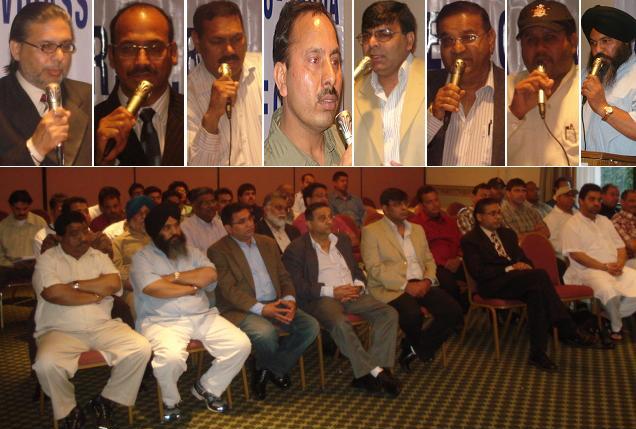
AMBEDKAR JAYANTI CELEBRATED
AT INDIA HOUSE IN LONDON ON APRIL14 |
By C. Gautam
April 14, 2008, India House, London: Dr Ambedkar Jayanti was celebrated at the Indian High Commission , London on a grand scale with a participation of over 400 to 500 people from all walks of life, different religions, cultures and faiths.
The celebration was organised by Federation of Amedkarite and Buddhist Organisations (FABO) in co-operation with different Ambedkarite organisations and individuals in U.K working for Dr Ambedkar's mission.
The chief guest for this year’s celebration was the former Chief Justice of India and present Chairman of National Human Rights Commission, (NHRC) India - Dr Rajendra Babu. The other distinguished guests were Cllr Faizullah Khan, Hon. Speaker of Hackney, London Borough of Hackney, and Cllr Harshadbhai Patel, The Worshipful Mayor of London Borough of Brent.
The programme commenced with a Buddhist prayer administered by Ven. Bhikkhu Tejwant, followed by a daily Buddhist recitation by Sanchi compiled by the late most Ven. Dhammananda, Sanghanayaka Thera. She recited - Morning and evening Buddhist prayer -
At the start of the day.
Cheer up your mind to be positive and energetic.
Lift your heart with good and loving thoughts for the rest of the day.
In the evening.
Reflect on your day’s actions.
Rejoice over your good actions.
But learn from your mistakes by not repeating them.
Impress upon your mind to be stronger wiser and happier.
Invite the Buddha, Dhamma and Sangha into your life for guidance and protection.
Take the Buddha, the ideal of love and compassion, wisdom and purity,
as your spiritual ideal in your thoughts and action.
Follow the Dhamma everyday and in every way to fulfil your aspirations.
Follow the example of the noble Sangha who liberated themselves through diligence.
Floral tributes were paid to Dr Ambedkar by the acting High Commissioner of India Asoke Mukherji and Dr Rajendra Babu, followed by Dr Srinivasan, Vice- President of Federation of Ambedkarites and Buddhists Organisations, Mr. Yograj Ahir, President, Shri Guru Ravidass Sabha, Southall, Mr. Chaman Lal Madhahar, President, Shri Guru Ravidass Human Rights International Organisation, and Dhammacharini Vajrapushpa Chair of KARUNA Trust, Dhammachari Lokabandhu.
Gira Chakraborty representing FABO UK , in her welcome address, said that “to honour Babasaheb, is to honour the largest democracy on Earth, because it was through his genius that the constitution of India was born. To honour Babasaheb, is to honour the importance and dignity of each human life for it was he who fought for equality for the under-privileged, for the poor and the forgotten. To honour Babasaheb, is to honour individual achievement, for his life from being born disadvantaged to scholar and statesman, stands as an example to all future generations. “
She also stressed that “perhaps it would be rare to find any other contemporary of Dr. Ambedkar who has worked to build, re-construct and regenerate the Indian society in such a short span of time. To honour Babasaheb, is to honour all that is best in human life, for he gave his life in service to others, to bring hope where there had been despair and where there had been poverty”.
Chief Justice Dr Rajendra Babu spoke about Dr Ambedkar's contribution in different ways to strengthen, build and unite India . In his speech he said,
‘Dr.Ambedkar is widely respected as the father of the Indian constitution. Our constitution was unique for it’s time. At the time countries were low to recognise the discrimination faced by citizens belonging to the marginalised groups. Worst, laws even sanctioned discrimination such as the southern states of US, where the black people were segregated in education, transportation, housing and other public goods. Today the talk of multiculturalism and accommodation by the governments to the needs of minority groups is common place in developed countries including the UK . But even in late 80’s, in many communist countries cultural, linguistic and religious differences amongst the citizens were overlooked and a policy of stabilization was the norm. Our constitution, on the other hand, promotes minority rights. The revolutionary character of our constitution is no small measure due to the social philosophy of Dr. Ambedkar. Today as we celebrate his birth anniversary, I would like to deliberate on his social philosophy and its relevance in today’s times. Dr. Ambedkar’s belief in social justice and his concern about ameliorating the situation of the so called untouchables was moulded by his experience. Right from his childhood when he was not allowed to sit with his class mates or open the school tab to drink water. In such situations a person would try to enhance his individual situation and such opportunities were available to Dr. Ambedkar when he completed his foreign education. It is indeed the testimony of his greatness that he chose to come back to India to live a life long struggle against the caste based oppression. During the course of the independence movement Dr.Ambedkar found that the political struggle for independence from British rule existed largely independent from the social reform. He pointed that the campaigners for reform on child marriage, widow remarriage belong to the so called upper caste groups and pointed out that they did not feel the necessity for agitating for abolition of caste or had not the courage to agitate it. According to him the campaigners worked for reforms of the so called upper caste Hindu family overlooking the social structure of the Hindu society which was highly unequal. He brought out a contradiction between political leaders who repeated the dogma of Mill that one country is not fit to rule another country, and the existence of the caste system which creates a hierarchical relationship between the different castes. He expressed his concerns in the constitutional assembly on Nov 25 th 1949 , stating the following, I quote ‘on 26 th of January 1950, we are going to enter into a life of contradictions. In politics we will have equality and in social and economic life we will have inequality. In politics we will be recognising the principle of one man one vote and one vote one value. In our social and economic life, we shall, by reason of our social and economic structure, continue to deny the principle of one man one value. How long shall we continue to live this life of contradictions? How long shall we continue to deny equality in our social and economic life? If we continue to deny it for long, we will do so only by putting our political democracy in peril. We must remove this contradiction at the earliest possible moment or else those who suffer from inequality will blow up the structure of political democracy which this assembly has so laboriously built up ’
Political democracy is not only about participation in the elections. Dr. Ambedkar recognised that in an unequal society several barriers such as lack of education, illiteracy, and poverty prevent people from participation in the political process and holding their leaders accountable. Towards the aim of removing these social barriers, the constitution envisages a number of measures including the prohibition of untouchability and affirmative action programmes. In a speech made in October 1954 Dr. Ambedkar Stated ‘Positively my social philosophy may be set to be enshrined in three words Liberty , Equality and Fraternity. Let no one however say that I have borrowed my philosophy from French Revolution. I have not. My philosophy has roots in religion and not in political science. I have derived them from the teaching of my master the Buddha. In his philosophy liberty and equality had a place.
But he added that unlimited liberty destroys equality and absolute equality leave no room for liberty. In his philosophy law had a place only as a safeguard against the breaches of liberty and equality. But he did not believe that law could be a guarantee for breaches of liberty and equality. He gave the highest place to fraternity as only real safeguard against the denial of liberty and equality’.
That Dr. Ambedkar emphasised on liberty equality and fraternity and Fraternity among the human beings must be accorded primacy is hardly surprising. Fraternity between human beings is very anti-thesis of unequal treatment. How far has India realised Ambedkar’s ideals?
I would say that the record is mixed. On the one hand we have remarkable examples like late Mr. K.R.Narayanan the former President of India, Justice K.G.Balkrishnan, the current Chief justice of India , Dr. Narendra Jadhav, Vice Chancellor of Pune University and head of the RBI’s Department of Economic Analysis and policy. All of them have struggled against the odds posed by the caste based oppression. On the other hand in 2006 in Khairlanji, Maharashtra , four member of a Scheduled Caste family were killed when they sought to resist the acquisition of their field belonging to another caste. I don’t want to go in literary of atrocities committed against the SC but suffice to say that these atrocities are a shameful reality in India today. It has been pointed out by some activists that atrocities against the S.Cs are highest in the states where armed by education and employment, they resist caste hierarchy. Dr. Ambedkar’s call to the so called untouchables to Educate, Unite and Agitate is as relevant today as it was when he thought of it. One of the consequences of the reservation programmes in education and employment is the development of a nascent, a small middle class intelligentsia. As Ambedkar before them, they have an important role. The tools of education and economic empowerment means that they were well placed to fight the stigma and prejudice, needless to say that they cannot replace the government machinery which however should continue its efforts to render Ambedkar’s ideals into reality .
However we can’t overlook their role either. The other aspect I would like to highlight is the need for a more proactive approach of the part of the government machinery. Instead of mechanically fitting the quotas we should also work towards ensuring the beneficiaries of reservation have the capability to compete. By capability to compete I am referring to skills which education- the high schools and universities levels freely imparted towards students. This failure combined with poverty and prejudice against the SC aspirants is a deadly combination severely affecting them in competing in the competitive examinations. In this regards I would like to refer to a training programme that we conducted for S.C applicants for posts in lower judiciary in Karnataka. As a result to the training programme several were chosen and I am proud to report that some of them have gone to become an excellent judicial officers. I believe that much remains to be done to realise Dr. Ambedkar’s ideals. A constant efforts by government, civil society, SC people and so called upper caste is required in this regard. This is my humble submission. Thank you’
The chair of Karuna Trust Dh. Vajrapushpa spoke of her experiences of working with ex-untouchable girl from Pune and how Karuna is helping communities to live a better life. She said - I feel very honoured to be talking to you all today. I bring you greetings from the Karuna Trust and will say a few words about Karuna’s work. For over 25 years the Karuna Trust has been funding and helping run social and Dhamma projects amongst some the most disadvantaged people in India . Karuna’s work is based on the Buddhist principles of Wisdom and Compassion and continues to draw inspiration from the work and example of Doctor Ambedkar.
Amongst the projects funded by Karuna are educational hostels – which have won recognition for the high quality of care they offer to their students – kindergartens, health education projects, micro saving schemes, help for runaway railway children, computer classes for children from poor backgrounds, radio programmes teaching English. Two areas of work have become of particularly important and prominent over the last few years: one is advocacy work - enabling people to gain access to services, in education, health and the legal system , that they are entitled to, and the other one is ‘women’s empowerment’.
I would also like draw your attention to a book that is being published today. It is called Broken Voices’ by Valerie Mason-John (also a member of the Western Buddhist Order, known as Vimalasara). The book brings together, in a unique way, life stories of numerous women from the Dalit communities in India . The book is moving, harrowing, informative, challenging and, above else, very inspiring. Many women, young, old, middle-aged, who have struggled against the restrictions, imposed upon them by the society and/or by their families, have had the good fortune to find the confidence and help from others to educate themselves, or simply improve the conditions in their lives.
One of the guiding principles of Karuna’s work is the importance of ‘mind change’: it is only as a result of the changes in people’s views, attitudes and ways of thinking , that real social and spiritual change can take place. Poverty doesn’t have to exist; oppression and discrimination don’t have to exist. This is where we see the significance of advocacy work and women’s empowerment projects. One woman, who grew up in one the largest slums of Maharashtra and was able to gain a good education with the help of her brother and later, join the Buddhist sangha, put it like this: ‘It is women who pass on culture, so it is important to educate them about Buddhism. In the slums they are still totally dependent on the worship of Hindu gods for the provision of food and good health. They believe that poverty and illness happen because of karma. This makes the Dalit woman passive. We need to teach her that the health of her children, and the money to provide food, can be created by her own hard work, and not by placing food and money at the feet of a god.’
A small project that has recently started in Pune, run by an Indian woman doctor, is an example of the kind of work we see as being increasingly valuable. The aim is to reach young girls and women giving them information and support and teach them ‘life skills’ including communication and negotiation skills. The hope is that they will be able to make better informed choices in their lives and, if necessary, resolve conflicts, when faced with family pressure, or any prejudice from others through communication.
There are many inspirational and strong women in India leading and managing large projects. There are also small projects run by groups of women pulling together their resources, learning new skills, providing opportunities and encouragement for others. What is common to all these women is their absolute commitment to the work they are doing, their desire to work for the benefit for their communities and their understanding of the need for further spiritual and social change in their society.
I will finish by quoting Meera Ambedkar, the daughter-in-law of Dr Ambedkar, who has enormous respect for his legacy: ‘Now that my children have left home, I can dedicate my whole life to the great work of my father-in-law. There are still many atrocities against my people. Caste Hindus still can’t cope when families from the Scheduled Castes manage to uplift themselves. My role as president of the Buddhist Society of India is to take Buddhism into every home of India , so that casteism can become something of the past, so that all Indian people can live a proper human life, with liberty, equality and fraternity.’
Thereafter, Dhammachari Lokbandhu spoke about the international relevance of Ambedkar’s ideology by giving the example of gypsies of Hungry who are taking inspiration from the life and struggle of Dr. Ambedkar and his people to live a dignified life. He also mentioned about the Jaibhim School established in Hungry for the gypsy students and highlighted the common link between the exploited and marginalised communities of different countries.
The other provoking speeches from young Ambedkarites, Ms Sulekha Gautam, studying medicine in Romania , Mr Saunvedan Aparanti - Studying Human rights in London . Sulekha Gautam in her speech said, “ Dr. Ambedkar was a product of unequal social order with stigmatised identity, extraordinary thinking great vision and above all a true Bodhisattva. It’s beyond doubt that he has been a victim of the process of ‘Reductionism’. Dr Ambedkar was not just a leader of one particular group or community but a national leader in its true sense.
If we evaluate his contribution in terms of statesmanship, political leadership and intellectual inputs in economic, social, educational and judicial realms, we would be forced to call him a ‘nation builder’.
His endeavour to deconstruct and reconstruct the Indian society on structural basis rather than by social reforms is testimony to this. He vehemently criticized the social reformers of his time for paying only lip service to the issue of caste or untouchability.
He showed the real image of Indian villages to the constituent assembly by stating that they were devoid of equality, liberty fraternity and in total of democracy.
Today, Indian democracy is the world’s largest democracy. The credit for making India a democratic state and creating an inclusive society with dignity to all the individual mainly goes to Dr.B.R.Ambedkar.
His slogan was ‘Be a ruling class’, only by this you can march ahead effectively towards formation of a casteless society, which is an ultimate solution to all our problems.
Now the question arises who should destroy the caste system? Well the answers lies in the history of sufferings and agony of insulting experiences of victims. So those who have suffered because of this will have to take the task of destroying it. Though discrimination of any kind has been abolished by the constitution, but it still exists in our day to day life.
To fulfil the vision of our forefathers to create an egalitarian society and making India a truly global power, we must destroy all discriminations including the caste hierarchy, which is mainly a mental phenomenon.
In my view, only the victims of the system have the strength and courage to come forward to destroy all sorts of discriminations.
I have so far talked at length about the ‘caste’ based discrimination, now I want to speak few words about our vision for the future –
Well as a famous saying goes – ‘ a person with a mentality of a beggar can not become a ruler, which clearly states that , the hands which are used to ask/beg have to strive to become the ones which will give.
And this is only possible when we will shed away our Victim/Dalit mentality. Dr. Ambedkar had greater expectations from the free citizens born in the democratic India and also from the educated class/ intellectual class which is the product of his lifelong struggle.
I feel very annoyed to state that so far we have not been successful in understanding the total vision of this great leader.
In public domain, due to political compulsions, these days’ politicians or leaders of all the political parties project him as their leader unfortunately, without even slightly following his ideology.
We failed to imbibe Ambedkar principles in our social, educational and personal life as well be it schooling or at higher education.
In my view the greater responsibility lies on the younger generation. We have to understand this great leader, his mission and
The young generation will have to bear this in mind, that lot of confusions are been created around his teachings, his words are being misinterpreted by the so called ‘intellectuals’. Don’t let anyone forcibly impose you but we must understand Ambedkar by reading the voluminous books and speeches delivered or written by him and understanding his mission in total.
I finally end my words by conveying you my only message that let us prove by our conduct that we have not only the man power but also wisdom to carry with us all section of the country with pride which is bound to lead us to unity.
Saunvedan Aparanti –
We are fortunate to be commemorating the birth of our great leader so close to Kingsway where he must have once walked. Just behind us lies the London School of Economics where Dr. Babasaheb Ambedkar obtained a DSC before reading Law at Gray’s Inn . Of the millions of our brothers and sisters that we have left behind in India , we are the privileged few to taste freedom and escape the barbaric discrimination under the caste system.
In this free environment, it is easy to lose memory of what we have been through and what millions of our brothers and sisters are going through every day. They look at us as a beacon of hope that some day we shall liberate them from the clutches of Hindu social order. Those of us that feel that voicing our grievances to the western world is the answer, I am sorry to say that it is simply not the Western world’s problem. One may derive comfort that our concerns are now internationally discussed but that alone cannot resolve our issues and liberate our people.
Confronted which such questions as an undergraduate student of sociology, I took sanctuary in Dr. Babasaheb Ambedkar’s vehement pursuit of academics as an answer to our problems. It is indeed the culmination of his efforts and vision that I stand before you today as a Master of Human Rights from University College London. I remember my first day at UCL which happened to fall on Monday the 2 nd of October, 2006 . It was Gandhi’s birth anniversary and I was passing through Tavistock Square to attend my lectures. In the middle of the square was a statue of Gandhi which was being garlanded and speeches being delivered by those gathered in the background. Gandhi being one of the more famous alumni of UCL where he studied law, I reflected on how far Dr. Ambedkar had brought us and empowered us in such a short span of time.
We have now reached a stage where we are living on an equal footing with the rest of Indian society. Our rights are guaranteed and we have a strong constitution protecting democratic principles in the country. Unfortunately, so is not the case of our uneducated brothers and sisters that are still unaware of their fundamental human rights and dignity. Trapped in the confines of the rural caste structure, millions are still victims of caste atrocities and the word of Babasaheb has still not reached their ears.
In the history of humanity, it has never so happened that one individual uplifted so many so rapidly in the backdrop of our struggle for independence. Dr. Babasaheb Ambedkar reversed 3000 years of inequality in the 65 years that he lived bringing us to where we are now. His biggest contribution was to give us the Buddha and his Dhamma which by doing has permanently freed us from abuse under the caste system. All that he left for us to do is to carry on the message of the Buddha and spread the word of Dhamma among our brothers and sisters back home. I must say that it is a relatively easy task as compared to what Dr. Babasaheb Ambedkar must have faced when he was the sole crusader for human rights for our community.
My message to this solemn gathering is first to stay united and come together under the teachings of the Buddha and second to keep fighting against inequality and submission. To quote Dr. Babasaheb Ambedkar would not be inappropriate at this point. He said: It is disgraceful to live at the cost of one's self-respect. Self-respect is the most vital factor in life. To live worthily with self-respect, one has to overcome difficulties. It is out of hard and ceaseless struggle alone that one derives strength, confidence and recognition. What I have learnt in my Human Rights education is that human dignity is indivisible from a human being. Just being born human automatically bestows human dignity upon the individual. Many argue that human rights are a western concept that has no relevance to eastern civilizations. I would argue back taking inspiration from Dr. Babasaheb Ambedkar that it doesn’t matter where human rights come from. What does matter is the fact that individuals have the right to discard their faith if they are abused in its name.
We must pay tribute to Dr. Babasaheb Ambedkar for not only uplifting the untouchables but also to give us our constitution which is what runs our nation today. In spite of being so diverse in terms of language and religion we are held together as a nation by our constitution. As its chief architect, Dr. Babasaheb Ambedkar incorporated the essence of western liberal democracies and set us on a path to becoming a modern nation. To extrapolate the essence of our constitution, I would like to present you with its Preamble which in my opinion gives us a taste of Dr. Babasaheb Ambedkar’s influences:
Bearing this in mind, I urge the most potent among us, our youth such as myself to come forward and carry the torch that Dr. Babasaheb Ambedkar has lit which is our only identity and our only source of dignity. Do not forget what our great leader did for us and what we ought to do in our lifetimes. Life is too short when we have more than 200 million of our brothers and sisters to liberate. Most of our work has already been done by the man whose birth anniversary we are celebrating today. The rest is not in the hands of fate or destiny but in the strong hands of Ambedkarite youth of which I am proud to say I am a part.”
A Punjabi p oem was recited by Mr. R M Summan – publicity secretary of FABO UK . The acting High Commissioner of India released a new Punjabi weekly Ranjit Times. Yograj Ahir, President, Shri Guru Ravidass Sabha, Southall highlighted the common link between the struggle of Dr Ambedkar and Guru Ravidass.
Shrey recited – Metta Bhavana – Loving kindness
May I be well, happy, peaceful and prosperous. May no harm to come to me.
May no difficulties come to me. May no problems come to me. May I always meet with success. May I also have patience, courage, understanding and determination to meet and overcome inevitable difficulties, problems and failures in life. May my parents be well, happy, peaceful and prosperous. May my family be well, happy, peaceful and prosperous. May my neighbours be well, happy, peaceful and prosperous. May my teachers be well, happy, peaceful and prosperous. May my friends be well, happy, peaceful and prosperous. May those unfriendly be well, happy, peaceful and prosperous. May all living beings be well, happy, peaceful and prosperous. May no harm to come to them. May no difficulties come to them. May no problems come to them. May they always meet with success. May they also have patience, courage, understanding and determination to meet and overcome inevitable difficulties, problems and failures in life.
May the suffering not suffer,The fearful not fear,The grieving not grieve,May all beings be well and happy.
Young talent was acknowledged and rewarded by Dr Babu. Heena Parmar, Sangini Aparanti, Sanchi and Shrey Chakraborty received awards for their outstanding performance in their respective fields.
People from Wales , Scotland , Midlands and also from European countries, U.S.A and India descended down for the celebration in London . People of young and old generation, representing different parts of India took part in the celebrations.
The vote of thanks was proposed by Gajendra Pantawane who said that “the annual event as this one is a great opportunity to meet and interact with people and rededicate one self to the mission of Dr. Ambedkar”.
The programme was concluded at 2100 hrs in the dining hall with the delicious vegetarian meal by the courtesy of Shehenshah Restaurant Southall and Mr. Balram Sampla and family.
(Revised report re-posted on www.ambedkartimes.com (June 27, 2008 )
========================================================================================
By C. Gautam
April 14, 2008, India House, London: Dr Ambedkar Jayanti was celebrated at the Indian High Commission , London on a grand scale with a participation of over 400 to 500 people from all walks of life, different religions, cultures and faiths.
The celebration was organised by Federation of Ambedkarite and Buddhist Organisations (FABO) in co-operation with different Ambedkarite organisations and individuals in U.K working for Dr Ambedkar's mission.
The chief guest for this year’s celebration was the former Chief Justice of India and present Chairman of National Human Rights Commission, (NHRC) India - Dr Rajendra Babu. The other distinguished guests were Cllr Faizullah Khan, Hon. Speaker of Hackney, London Borough of Hackney, and Cllr Harshadbhai Patel, The Worshipful Mayor of London Borough of Brent.
The programme commenced with a Buddhist prayer administered by Ven. Bhikkhu Tejwant, followed by a daily Buddhist recitation by Sanchi compiled by the late most Ven. Dhammananda, Sanghanayaka Thera. She recited - Morning and evening Buddhist prayer –
At the start of the day: Cheer up your mind to be positive and energetic. Lift your heart with good and loving thoughts for the rest of the day.
In the evening:Reflect on your day’s actions. Rejoice over your good actions. But learn from your mistakes by not repeating them. Impress upon your mind to be stronger wiser and happier. Invite the Buddha, Dhamma and Sangha into your life for guidance and protection. Take the Buddha, the ideal of love and compassion, wisdom and purity, as your spiritual ideal in your thoughts and action. Follow the Dhamma everyday and in every way to fulfil your aspirations. Follow the example of the noble Sangha who liberated themselves through diligence.
Floral tributes were paid to Dr Ambedkar by the acting High Commissioner of India Asoke Mukherji and Dr Rajendra Babu, followed by Dr. Srinivasan, Vice- President of Federation of Ambedkarites and Buddhists Organisations, Mr. Yograj Ahir, President, Shri Guru Ravidass Sabha, Southall, Mr. Chaman Lal Madhahar, President, Shri Guru Ravidass Human Rights International Organisation, and Dhammacharini Vajrapushpa Chair of KARUNA Trust, Dhammachari Lokabandhu.
Gira Chakraborty representing FABO UK , in her welcome address, said that “to honour Babasaheb, is to honour the largest democracy on Earth, because it was through his genius that the constitution of India was born. To honour Babasaheb, is to honour the importance and dignity of each human life for it was he who fought for equality for the under-privileged, for the poor and the forgotten. To honour Babasaheb, is to honour individual achievement, for his life from being born disadvantaged to scholar and statesman, stands as an example to all future generations. “
She also stressed that “perhaps it would be rare to find any other contemporary of Dr. Ambedkar who has worked to build, re-construct and regenerate the Indian society in such a short span of time. To honour Babasaheb, is to honour all that is best in human life, for he gave his life in service to others, to bring hope where there had been despair and where there had been poverty”.
Chief Justice Dr. Rajendra Babu spoke about Dr Ambedkar's contribution in different ways to strengthen, build and unite India . In his speech he said,
‘Dr. Ambedkar is widely respected as the father of the Indian constitution. Our constitution was unique for it’s time. At the time countries were low to recognise the discrimination faced by citizens belonging to the marginalised groups. Worst, laws even sanctioned discrimination such as the southern states of US, where the black people were segregated in education, transportation, housing and other public goods. Today the talk of multiculturalism and accommodation by the governments to the needs of minority groups is common place in developed countries including the UK . But even in late 80’s, in many communist countries cultural, linguistic and religious differences amongst the citizens were overlooked and a policy of stabilization was the norm. Our constitution, on the other hand, promotes minority rights. The revolutionary character of our constitution is no small measure due to the social philosophy of Dr. Ambedkar. Today as we celebrate his birth anniversary, I would like to deliberate on his social philosophy and its relevance in today’s times. Dr. Ambedkar’s belief in social justice and his concern about ameliorating the situation of the so called untouchables was moulded by his experience. Right from his childhood when he was not allowed to sit with his class mates or open the school tab to drink water. In such situations a person would try to enhance his individual situation and such opportunities were available to Dr. Ambedkar when he completed his foreign education. It is indeed the testimony of his greatness that he chose to come back to India to live a life long struggle against the caste based oppression. During the course of the independence movement Dr. Ambedkar found that the political struggle for independence from British rule existed largely independent from the social reform. He pointed that the campaigners for reform on child marriage, widow remarriage belong to the so called upper caste groups and pointed out that they did not feel the necessity for agitating for abolition of caste or had not the courage to agitate it. According to him the campaigners worked for reforms of the so called upper caste Hindu family overlooking the social structure of the Hindu society which was highly unequal. He brought out a contradiction between political leaders who repeated the dogma of Mill that one country is not fit to rule another country, and the existence of the caste system which creates a hierarchical relationship between the different castes. He expressed his concerns in the constitutional assembly on Nov 25 th 1949 , stating the following, I quote ‘on 26 th of January 1950, we are going to enter into a life of contradictions. In politics we will have equality and in social and economic life we will have inequality. In politics we will be recognising the principle of one man one vote and one vote one value. In our social and economic life, we shall, by reason of our social and economic structure, continue to deny the principle of one man one value. How long shall we continue to live this life of contradictions? How long shall we continue to deny equality in our social and economic life? If we continue to deny it for long, we will do so only by putting our political democracy in peril. We must remove this contradiction at the earliest possible moment or else those who suffer from inequality will blow up the structure of political democracy which this assembly has so laboriously built up’ Political democracy is not only about participation in the elections. Dr. Ambedkar recognised that in an unequal society several barriers such as lack of education, illiteracy, and poverty prevent people from participation in the political process and holding their leaders accountable. Towards the aim of removing these social barriers, the constitution envisages a number of measures including the prohibition of untouchability and affirmative action programmes. In a speech made in October 1954 Dr. Ambedkar Stated ‘Positively my social philosophy may be set to be enshrined in three words Liberty , Equality and Fraternity. Let no one however say that I have borrowed my philosophy from French Revolution. I have not. My philosophy has roots in religion and not in political science. I have derived them from the teaching of my master the Buddha. In his philosophy liberty and equality had a place.
But he added that unlimited liberty destroys equality and absolute equality leave no room for liberty. In his philosophy law had a place only as a safeguard against the breaches of liberty and equality. But he did not believe that law could be a guarantee for breaches of liberty and equality. He gave the highest place to fraternity as only real safeguard against the denial of liberty and equality’.
That Dr. Ambedkar emphasised on liberty equality and fraternity and Fraternity among the human beings must be accorded primacy is hardly surprising. Fraternity between human beings is very anti-thesis of unequal treatment. How far has India realised Ambedkar’s ideals?
I would say that the record is mixed. On the one hand we have remarkable examples like late Mr. K. R. Narayanan the former President of India, Justice K.G. Balkrishnan, the current Chief justice of India , Dr. Narendra Jadhav, Vice Chancellor of Pune University and head of the RBI’s Department of Economic Analysis and policy. All of them have struggled against the odds posed by the caste based oppression. On the other hand in 2006 in Khairlanji, Maharashtra , four member of a Scheduled Caste family were killed when they sought to resist the acquisition of their field belonging to another caste. I don’t want to go in literary of atrocities committed against the SC but suffice to say that these atrocities are a shameful reality in India today. It has been pointed out by some activists that atrocities against the SCs are highest in the states where armed by education and employment, they resist caste hierarchy. Dr. Ambedkar’s call to the so called untouchables to Educate, Unite and Agitate is as relevant today as it was when he thought of it. One of the consequences of the reservation programmes in education and employment is the development of a nascent, a small middle class intelligentsia. As Ambedkar before them, they have an important role. The tools of education and economic empowerment means that they were well placed to fight the stigma and prejudice, needless to say that they cannot replace the government machinery which however should continue its efforts to render Ambedkar’s ideals into reality .
However we can’t overlook their role either. The other aspect I would like to highlight is the need for a more proactive approach of the part of the government machinery. Instead of mechanically fitting the quotas we should also work towards ensuring the beneficiaries of reservation have the capability to compete. By capability to compete I am referring to skills which education- the high schools and universities levels freely imparted towards students. This failure combined with poverty and prejudice against the SC aspirants is a deadly combination severely affecting them in competing in the competitive examinations. In this regards I would like to refer to a training programme that we conducted for S.C applicants for posts in lower judiciary in Karnataka. As a result to the training programme several were chosen and I am proud to report that some of them have gone to become an excellent judicial officers. I believe that much remains to be done to realise Dr. Ambedkar’s ideals. A constant efforts by government, civil society, SC people and so called upper caste is required in this regard. This is my humble submission. Thank you’
The chair of Karuna Trust Dh. Vajrapushpa spoke of her experiences of working with ex-untouchable girl from Pune and how Karuna is helping communities to live a better life. She said - I feel very honoured to be talking to you all today. I bring you greetings from the Karuna Trust and will say a few words about Karuna’s work. For over 25 years the Karuna Trust has been funding and helping run social and Dhamma projects amongst some the most disadvantaged people in India . Karuna’s work is based on the Buddhist principles of Wisdom and Compassion and continues to draw inspiration from the work and example of Doctor Ambedkar.
Amongst the projects funded by Karuna are educational hostels – which have won recognition for the high quality of care they offer to their students – kindergartens, health education projects, micro saving schemes, help for runaway railway children, computer classes for children from poor backgrounds, radio programmes teaching English. Two areas of work have become of particularly important and prominent over the last few years: one is advocacy work - enabling people to gain access to services, in education, health and the legal system , that they are entitled to, and the other one is ‘women’s empowerment’.
I would also like draw your attention to a book that is being published today. It is called Broken Voices’ by Valerie Mason-John (also a member of the Western Buddhist Order, known as Vimalasara). The book brings together, in a unique way, life stories of numerous women from the Dalit communities in India . The book is moving, harrowing, informative, challenging and, above else, very inspiring. Many women, young, old, middle-aged, who have struggled against the restrictions, imposed upon them by the society and/or by their families, have had the good fortune to find the confidence and help from others to educate themselves, or simply improve the conditions in their lives.
One of the guiding principles of Karuna’s work is the importance of ‘mind change’: it is only as a result of the changes in people’s views, attitudes and ways of thinking , that real social and spiritual change can take place. Poverty doesn’t have to exist; oppression and discrimination don’t have to exist. This is where we see the significance of advocacy work and women’s empowerment projects. One woman, who grew up in one the largest slums of Maharashtra and was able to gain a good education with the help of her brother and later, join the Buddhist sangha, put it like this: ‘It is women who pass on culture, so it is important to educate them about Buddhism. In the slums they are still totally dependent on the worship of Hindu gods for the provision of food and good health. They believe that poverty and illness happen because of karma. This makes the Dalit woman passive. We need to teach her that the health of her children, and the money to provide food, can be created by her own hard work, and not by placing food and money at the feet of a god.’
A small project that has recently started in Pune, run by an Indian woman doctor, is an example of the kind of work we see as being increasingly valuable. The aim is to reach young girls and women giving them information and support and teach them ‘life skills’ including communication and negotiation skills. The hope is that they will be able to make better informed choices in their lives and, if necessary, resolve conflicts, when faced with family pressure, or any prejudice from others through communication.
There are many inspirational and strong women in India leading and managing large projects. There are also small projects run by groups of women pulling together their resources, learning new skills, providing opportunities and encouragement for others. What is common to all these women is their absolute commitment to the work they are doing, their desire to work for the benefit for their communities and their understanding of the need for further spiritual and social change in their society.
I will finish by quoting Meera Ambedkar, the daughter-in-law of Dr Ambedkar, who has enormous respect for his legacy: ‘Now that my children have left home, I can dedicate my whole life to the great work of my father-in-law. There are still many atrocities against my people. Caste Hindus still can’t cope when families from the Scheduled Castes manage to uplift themselves. My role as president of the Buddhist Society of India is to take Buddhism into every home of India , so that casteism can become something of the past, so that all Indian people can live a proper human life, with liberty, equality and fraternity.’
Thereafter, Dhammachari Lokbandhu spoke about the international relevance of Ambedkar’s ideology by giving the example of gypsies of Hungry who are taking inspiration from the life and struggle of Dr. Ambedkar and his people to live a dignified life. He also mentioned about the Jaibhim School established in Hungry for the gypsy students and highlighted the common link between the exploited and marginalised communities of different countries.
The other provoking speeches from young Ambedkarites, Ms Sulekha Gautam, studying medicine in Romania , Mr. Saunvedan Aparanti - Studying Human rights in London . Sulekha Gautam in her speech said, “Dr. Ambedkar was a product of unequal social order with stigmatised identity, extraordinary thinking great vision and above all a true Bodhisattva. It’s beyond doubt that he has been a victim of the process of ‘Reductionism’. Dr Ambedkar was not just a leader of one particular group or community but a national leader in its true sense.
If we evaluate his contribution in terms of statesmanship, political leadership and intellectual inputs in economic, social, educational and judicial realms, we would be forced to call him a ‘nation builder’.
His endeavour to deconstruct and reconstruct the Indian society on structural basis rather than by social reforms is testimony to this. He vehemently criticized the social reformers of his time for paying only lip service to the issue of caste or untouchability.
He showed the real image of Indian villages to the constituent assembly by stating that they were devoid of equality, liberty fraternity and in total of democracy.
Today, Indian democracy is the world’s largest democracy. The credit for making India a democratic state and creating an inclusive society with dignity to all the individual mainly goes to Dr. B.R. Ambedkar.
His slogan was ‘Be a ruling class’, only by this you can march ahead effectively towards formation of a casteless society, which is an ultimate solution to all our problems.
Now the question arises who should destroy the caste system? Well the answers lies in the history of sufferings and agony of insulting experiences of victims. So those who have suffered because of this will have to take the task of destroying it. Though discrimination of any kind has been abolished by the constitution, but it still exists in our day to day life.
To fulfil the vision of our forefathers to create an egalitarian society and making India a truly global power, we must destroy all discriminations including the caste hierarchy, which is mainly a mental phenomenon.
In my view, only the victims of the system have the strength and courage to come forward to destroy all sorts of discriminations.
I have so far talked at length about the ‘caste’ based discrimination, now I want to speak few words about our vision for the future –
Well as a famous saying goes – ‘ a person with a mentality of a beggar can not become a ruler, which clearly states that , the hands which are used to ask/beg have to strive to become the ones which will give.
And this is only possible when we will shed away our Victim/Dalit mentality. Dr. Ambedkar had greater expectations from the free citizens born in the democratic India and also from the educated class/ intellectual class which is the product of his lifelong struggle.
I feel very annoyed to state that so far we have not been successful in understanding the total vision of this great leader.
In public domain, due to political compulsions, these days’ politicians or leaders of all the political parties project him as their leader unfortunately, without even slightly following his ideology.
We failed to imbibe Ambedkar principles in our social, educational and personal life as well be it schooling or at higher education.
In my view the greater responsibility lies on the younger generation. We have to understand this great leader, his mission and
The young generation will have to bear this in mind, that lot of confusions are been created around his teachings, his words are being misinterpreted by the so called ‘intellectuals’. Don’t let anyone forcibly impose you but we must understand Ambedkar by reading the voluminous books and speeches delivered or written by him and understanding his mission in total.
I finally end my words by conveying you my only message that let us prove by our conduct that we have not only the man power but also wisdom to carry with us all section of the country with pride which is bound to lead us to unity.
Saunvedan Aparanti –
We are fortunate to be commemorating the birth of our great leader so close to Kingsway where he must have once walked. Just behind us lies the London School of Economics where Dr. Babasaheb Ambedkar obtained a DSC before reading Law at Gray’s Inn . Of the millions of our brothers and sisters that we have left behind in India , we are the privileged few to taste freedom and escape the barbaric discrimination under the caste system.
In this free environment, it is easy to lose memory of what we have been through and what millions of our brothers and sisters are going through every day. They look at us as a beacon of hope that some day we shall liberate them from the clutches of Hindu social order. Those of us that feel that voicing our grievances to the western world is the answer, I am sorry to say that it is simply not the Western world’s problem. One may derive comfort that our concerns are now internationally discussed but that alone cannot resolve our issues and liberate our people.
Confronted which such questions as an undergraduate student of sociology, I took sanctuary in Dr. Babasaheb Ambedkar’s vehement pursuit of academics as an answer to our problems. It is indeed the culmination of his efforts and vision that I stand before you today as a Master of Human Rights from University College London. I remember my first day at UCL which happened to fall on Monday the 2 nd of October, 2006 . It was Gandhi’s birth anniversary and I was passing through Tavistock Square to attend my lectures. In the middle of the square was a statue of Gandhi which was being garlanded and speeches being delivered by those gathered in the background. Gandhi being one of the more famous alumni of UCL where he studied law, I reflected on how far Dr. Ambedkar had brought us and empowered us in such a short span of time.
We have now reached a stage where we are living on an equal footing with the rest of Indian society. Our rights are guaranteed and we have a strong constitution protecting democratic principles in the country. Unfortunately, so is not the case of our uneducated brothers and sisters that are still unaware of their fundamental human rights and dignity. Trapped in the confines of the rural caste structure, millions are still victims of caste atrocities and the word of Babasaheb has still not reached their ears.
In the history of humanity, it has never so happened that one individual uplifted so many so rapidly in the backdrop of our struggle for independence. Dr. Babasaheb Ambedkar reversed 3000 years of inequality in the 65 years that he lived bringing us to where we are now. His biggest contribution was to give us the Buddha and his Dhamma which by doing has permanently freed us from abuse under the caste system. All that he left for us to do is to carry on the message of the Buddha and spread the word of Dhamma among our brothers and sisters back home. I must say that it is a relatively easy task as compared to what Dr. Babasaheb Ambedkar must have faced when he was the sole crusader for human rights for our community.
My message to this solemn gathering is first to stay united and come together under the teachings of the Buddha and second to keep fighting against inequality and submission. To quote Dr. Babasaheb Ambedkar would not be inappropriate at this point. He said: It is disgraceful to live at the cost of one's self-respect. Self-respect is the most vital factor in life. To live worthily with self-respect, one has to overcome difficulties. It is out of hard and ceaseless struggle alone that one derives strength, confidence and recognition. What I have learnt in my Human Rights education is that human dignity is indivisible from a human being. Just being born human automatically bestows human dignity upon the individual. Many argue that human rights are a western concept that has no relevance to eastern civilizations. I would argue back taking inspiration from Dr. Babasaheb Ambedkar that it doesn’t matter where human rights come from. What does matter is the fact that individuals have the right to discard their faith if they are abused in its name.
We must pay tribute to Dr. Babasaheb Ambedkar for not only uplifting the untouchables but also to give us our constitution which is what runs our nation today. In spite of being so diverse in terms of language and religion we are held together as a nation by our constitution. As its chief architect, Dr. Babasaheb Ambedkar incorporated the essence of western liberal democracies and set us on a path to becoming a modern nation. To extrapolate the essence of our constitution, I would like to present you with its Preamble which in my opinion gives us a taste of Dr. Babasaheb Ambedkar’s influences:
Bearing this in mind, I urge the most potent among us, our youth such as myself to come forward and carry the torch that Dr. Babasaheb Ambedkar has lit which is our only identity and our only source of dignity. Do not forget what our great leader did for us and what we ought to do in our lifetimes. Life is too short when we have more than 200 million of our brothers and sisters to liberate. Most of our work has already been done by the man whose birth anniversary we are celebrating today. The rest is not in the hands of fate or destiny but in the strong hands of Ambedkarite youth of which I am proud to say I am a part.”
A Punjabi p oem was recited by Mr. R M Summan – publicity secretary of FABO UK . The acting High Commissioner of India released a new Punjabi weekly Ranjit Times. Yograj Ahir, President, Shri Guru Ravidass Sabha, Southall highlighted the common link between the struggle of Dr Ambedkar and Guru Ravidass.
Shrey recited – Metta Bhavana – Loving kindness
May I be well, happy, peaceful and prosperous. May no harm to come to me. May no difficulties come to me. May no problems come to me. May I always meet with success. May I also have patience, courage, understanding and determination to meet and overcome inevitable difficulties, problems and failures in life. May my parents be well, happy, peaceful and prosperous. May my family be well, happy, peaceful and prosperous. May my neighbours be well, happy, peaceful and prosperous. May my teachers be well, happy, peaceful and prosperous. May my friends be well, happy, peaceful and prosperous. May those unfriendly be well, happy, peaceful and prosperous. May all living beings be well, happy, peaceful and prosperous. May no harm to come to them. May no difficulties come to them. May no problems come to them. May they always meet with success. May they also have patience, courage, understanding and determination to meet and overcome inevitable difficulties, problems and failures in life. May the suffering not suffer, the fearful not fear, the grieving not grieve, May all beings be well and happy.
Young talent was acknowledged and rewarded by Dr Babu. Heena Parmar, Sangini Aparanti, Sanchi and Shrey Chakraborty received awards for their outstanding performance in their respective fields.
People from Wales , Scotland , Midlands and also from European countries, U.S.A and India descended down for the celebration in London . People of young and old generation, representing different parts of India took part in the celebrations.
The vote of thanks was proposed by Gajendra Pantawane who said that “the annual event as this one is a great opportunity to meet and interact with people and rededicate one self to the mission of Dr. Ambedkar”.
The programme was concluded at 2100 hrs in the dining hall with the delicious vegetarian meal by the courtesy of Shehenshah Restaurant Southall and Mr. Balram Sampla and family.
(Posted on www.ambedkartimes.com (June 04, 2008 ) |
