|
The House of Dr. Babasaheb Ambedkar
The Indian government is taking care of other heritage places , but the House of Dr. Babasaheb Ambedkar is been neglected and no single minister or any government body is interested to take care till date.
Picture & comments:
Akash Kamble
|
Akash
Kamble
Vice President
Mumbai,
Republican Sena
(Maharashtra)
India |
Posted on December 25, 2013 www.ambedkartimes.com |
|
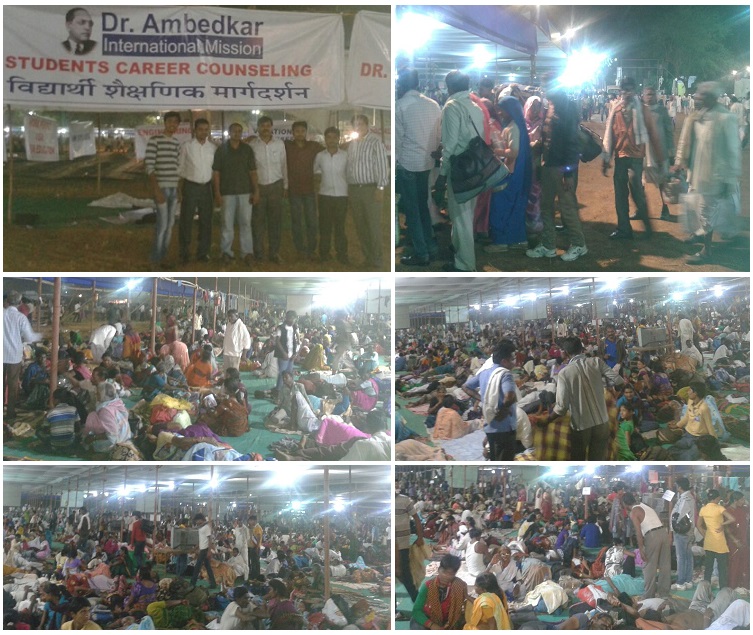
Educational Guidance Series in the year of 100th year of educational visit to USA
|
Dr. Ambedkar Student Federation
Venue: Shivaji Park,ChaityaBhoomi, Dada, December 6 2013
Dr. Ambedkar Student Federation believes Dr. Ambedkar brings inspiration and hope amongst the Dalit youth of the nation, who is otherwise in the desperate situation where the atrocities, humiliations, depression is the part and parcel of everyday life.
The year 2013 marks the 100th year of his visit to USA. It was in July 1913 that the young Bhimrao Ramji Ambedkar (14 April 1891 – 6 December 1956) went to Columbia University, New York, USA for pursuing his higher studies (MA and Ph.D.).It was this period that made a formidable impact in his intellectual journey. It was this period that prepared him not only to face courageously the onslaught of caste based oppression but also to attempt to transform Indian society in his own terms.
To rescue communities from age-old oppression Dr. Ambedkar gave the mantra of “Educate, Agitate, Organize”. Ambedkar Student Federation believes that “educate” played a crucial role in transforming the life very small section of population. Dr. Ambedkar also encouraged education with the Shila (ethics) to encourage pay back to society. Education with ideals played an integral role in grooming sensitive class (although very small) who can help other brethren in their struggle of upliftment. December 6th marks an important event in India, when millions of Dalits and other oppressed class population visit Chaitya Bhoomi, Dadar Mumbai.
In this 100th year of Dr. Ambedkar US study visit, on the occasion of death anniversary of Dr. Babasaheb Ambedkar, ASF along with other several students forums are organizing series of events to provide educational guidance for higher studies in India and abroad.
Education is the only hope for democratic progress of the nation, where majority of them are in despair.
Majority of politicians from across parties give their speeches, Chief Minister and other dignitaries give lot of promises on this day. They are widely covered by media however the crucial issues and work of young youths on Educational guidance program are ignored every year.
It is so crucial to report this event of hope and inspiration for youths, the guidance centre includes experts from USA, India and other countries, who will provide guidance and training to students who are coming from remote parts of India.
Posted on www.ambedkartimes.com December 7, 20132 |
|
|
AMBEDKAR B/DAY
CELEBRATION
|
REPORT:
BY
HARMESH LAL
SR. TRAFFIC SUPTT. AIR INDIA AMRITSAR
|
Amritsar:
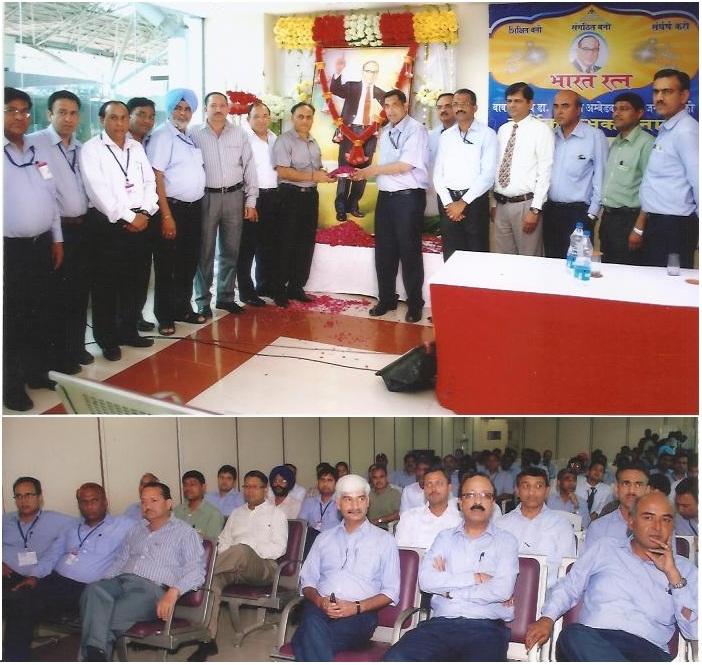
Bharat Rattan Baba Sahib Dr. Bhimrao Ramji Ambedkar’s
121st birthday celebrated at Shri Guru Ram Dass Ji International
Airport (Raja Sansi Airport Amritsar, Punjab) on 18th
April 2012; where Baba Sahib Dr. Ambedkar was landed in
October, 1951, by SC/ST Welfare, Association. In this
function, many departmental heads i.e. Mr. S. K. Kondal
(Station Manager Air India), sunil datt (airport director),
S. K. Sharma (Deputy Commandant C.I.S.F), Gagan Malik
(DGM Operations), M. K. Nagpal (DGM Accounts), Veenu Gopal
(Joint GM), Rakesh Malik (airport manager) paid homage
to Baba Sahib Ambedkar for his contribution in the development
of modern India. Mr. Kirpal Singh General Secretary of
the Association thanks to the audience and snacks were
distributed to all.
Posted on May 16, 2012
|
|
|
POONA
PACT-A MEAN DEAL
DR. B.R. AMBEDKAR |
To
end this - long and sad story, the Congress sucked
the juice out of the Poona Pact
and threw the rind in the face of the Untouchables.
DR. B.R. Ambedkar
|
In
the Government of India Act of 1919, there was a provision
which had imposed an obligation on His Majesty's Government
to appoint at the end, of ten years a Royal Commission to
investigate into the working of the Constitution and report
upon such changes as may be found necessary. Accordingly,
in 1928 a Royal Commission was appointed under the Chairmanship
of Sir John Simon. Indians expected that the Commission
would be mixed in its personnel. But Lord Birkenhead who
was then the Secretary of State for India was opposed to
the inclusion of Indians and insisted on making it a purely
Parliamentary Commission. At this, the Congress and
the Liberals took great offence and treated it as an insult.
They boycotted the Commission and carried on a great agitation
against it. To assuage this feeling of opposition it was
announced by His Majesty's Government that after the
work of the Commission was completed representative Indians
would be assembled for a discussion before the new
constitution for India is settled. In. accordance with this
announcement representative Indians were called to London
at a Round Table Conference with the Representatives of
Parliament and of His Majesty's Government.
On
the 12th November 1980 , His late Majesty King George V
formally inaugurated the -Indian. Round Table Conference.
|
|
From the point of view
of Indians the Round Table Conference was an event of great. Significance.
Its significance lay in the recognition by His Majesty's Government
of the right of Indians to be consulted in the matter of framing
a constitution for India . For the Untouchables it was a landmark
in their history. For, the Untouchable were for the first time allowed
to be represented separately by two delegates who happened to be
myself and Dewan Bahadur R. Srinivasan. This meant that the Untouchables
were regarded not merely a separate element from the Hindus but
also of such importance as to have the right to be consulted in
the framing of a constitution for India .
The work of the Conference was distributed among nine committees. One of these committees was called the Minorities Committee to which was assigned the most difficult work of finding a solution of the Communal question. Anticipating that this Committee was the most important committee the Prime Minister, the late Mr. Ramsay MacDonald, hithself assumed its chairmanship. The proceedings of the Minorities Committee are of the greatest importance to the Untouchables. For, much of what happened between the Congress and the Untouchables and which has led to bitterness between them will be found in the proceedings of that Committee.
When the Round Table Conference met the political demands of communities other than the Untouchables were quite well known. Indeed the constitution of 1919-had recognized them as statutory minorities and provisions relating to their safety and security were embodied in. it. In their case the question was of expanding those provisions or altering their shape. With regard to the Depressed Classes the position was different. The Montague-Chelmsford Report which preceded the Constitution of 1919 had said in quite unmistakable terms that provision must be made in the Constitution for their protection. But unfortunately when the details of the Constitution were framed, the Government of India found it difficult to devise any provisions for their protection except to give them token representation in the legislatures by nomination. The first thing that was required to be done was to formulate the safeguards deemed necessary by the Untouchables for their protection against the tyranny and oppression of the Hindus. This I did by submitting a Memorandum to the Minorities Committee of the Round Table -Conference. To give an idea of the safeguards that were formulated by me, I reproduce below the text of the Memorandum:-
A Scheme of Political Safeguards for, the Protection of the Depressed Classes in the Future Constitution of, a self-governing India , submitted to the Indian Round Table Conference.
The following are the terms and conditions on which the Depressed Classes will' consent to place themselves under a majority rule in a self-governing India .
Condition No. I
EQUAL GITIZENSHIP
The Depressed Classes cannot consent to subject themselves to majority rule ill their present state of hereditary bondsmen. Before majority rule is established then emancipation from the system of untouchability must be an accomplished fact. It must not be left to the will of the majority. The Depressed Classes must be made free citizens entitled to all the rights of citizenship in common with other citizens of the State.
(A) To secure the abolition of untouchability and to create the equality of citizenship, it is proposed that the following fundamental right shall be made part of the constitution of India .
FUNDAMENTAL RIGHT
“All subjects of the State in India are equal before the law and possess equal civic rights. Any existing enactment, regulation, order, custom or interpretation of law by which any penalty, disadvantage, dissolubility is imposed upon or any discrimination is made against any subject of the State on account of untouchability shall, as from the day on which this Constitution comes into operation, cease to have any effect in India.
(B) To abolish the immunities and exemptions now enjoyed by executive officers by virtue of Sections 110 and 111 of the Government of India Act 1919 and their with what it is in the case of a European British Subject.
Condition No. 11
FREE ENJOYMENT OF EQUAL RIGHTS'
It is no use for the Depressed Classes to have a declaration of equal rights... There can be no doubt that the Depressed Classes will have to face the whole force of orthodox society if they try to exercise the equal rights of citizenship. The Depressed Classes therefore feel that if these declarations of rights are not to be there pious pronouncements, but are to 'be realities of everyday life, then they should be protected by adequate pains and penalties from interference ill the enjoyment of these declared rights.
(A) The Depressed Classes therefore propose that the following section should be added to Part XI of the Government of India Act 1919, dealing with Offences, Procedure and Penalties:-
(i) Offence of Infringement of Citizenship.
"Whoever denies to any person except for reasons by law applicable to persons of all classes and regardless of any previous condition of untouchability the full enjoyment of any of the accommodations, advantages, facilities, privileges of inns, educational institutions, roads; paths, streets, tanks, wells and other watering Places, public conveyances on land, air or water, theatres or other Places of public amusement, resort or convenience whether they are dedicated to or maintained or licensed for the use of the public shall be punished with. Imprisonment of either description
for a term which may extend to five years and shall also be liable to fine."
(B) Obstruction by orthodox individuals is not the only menace to the Depressed Classes in the way of peaceful enjoyment of their rights. The commonest form of obstruction is the social boycott. It is the most formidable weapon in the hands of the orthodox classes with which they beat down any attempt on the part of the Depressed Classes to undertake any activity if it happens to be 'unpalatable to them. The way it works and the occasions on which it is brought into operation are well described in the Report of the Committee appointed by the Government of Bombay in 19~8. "to enquire into the educational, economic and social condition of the Depressed Classes (untouchables) and of the Aboriginal Tribes in the Presidency and to recommend measures for their uplift." The following is
an extract from the same :-
Depressed Classes and Social Boycott
"102. Although we have recommended various ,remedies to secure to the Depressed Classes their rights to all public utilities we fear that fare will be difficulties in the way their exercising them fare long time to come. ,The first difficulty is the tear of open violence against them by the orthodox classes. It must be noted that the Depressed Classes form a small minority in every village, opposed to which is' a great majority of the orthodox who are bent on protected their interests and dignity from any supposed invasion by 'the Depressed Classes at any cost. The danger of prosecution by the Police has put a limitation upon type use of violence by the orthodox classes and consequently such cases are rare.
“The second difficulty arises from the economic position in which the Depressed Classes are found to-day. The Depressed Classes have no economic independence in most parts of the Presidency. Some cultivate the lands of the orthodox classes as their tenants at will. Others live on their earnings as farm laborers employed by the orthodox classes and the rest subsist on the food 01' grain given to them by the orthodox classes in lieu of service rendered to them as village servants. We have heard of numerous instances where the orthodox classes have used their economic power as a weapon against those Depressed Classes in their villages, when the latter have dared to exercise their rights, and have evicted them froth their land, and stopped their employment and discontinued their remuneration as village servants. This boycott is often planned on such an extensive scale as to include the prevention of the Depressed Classes from using the commonly used paths and the stoppage of sale of the necessaries of life by the village Bania. According to the evidence sometimes small causes suffice for the proclamation of a social boycott against the Depressed Classes. Frequently it follows on the exercise by the Depressed Classes of their right to the use of the common-well, but cases have been by no means rare where a stringent boycott. has been proclaimed simply because a Depressed Class ,man has put on the sacred thread, has bought a piece of land, has put on good clothes or ornaments, or has carried a marriage procession with the bridegroom on the horse through the public street.
"We do not know of any weapon more effective than this social boycott which could -have been invented for the suppression of the Depressed Classes. The method of open violence pales away before it, for it has the most .far reaching and deadening effects. It is the more dangerous because it passes as a lawful method consistent with the theory of freedom of contact. We agree that this tyranny of the majority must be put down with a firm hand, if we are to guarantee the Depressed Classes the freedom of speech and action necessary for their uplift."
In the opinion of the Depressed Classes the only way to overcome this kind of menace to their rights and liberties is to make social.
Boycott an offence punishable by law. They are therefore bound to insist that the following sections should be added to those included in Part XI, of the Government of India Act 1919, dealing with Offences, Procedure and Penalties.
I. OFFENCE OF BOYCOTT DEFINED
(I) A person shall be deemed to boycott another who:-
(a) refuses to let or use or occupy any house or land, or to deal with, work for hire, or do business with another person, or to render to him or receive from him any service, or refuses to do any of the said things on the terms on which such things should commonly be done in the ordinary course of business, or
(b) abstains from such social, professional or business relations as he would, having regard to such existing customs in the community which are not inconsistent wit any fundamental right or other rights of citizenship declared in the Constitution ordinarily maintain with such person, or
(c) In any way injures, annoys or interferes with such other person in the exercise of his lawful rights.
II. PUNISHMENT FOR BOYCOTTING
Whoever, in consequence of any person having done any act which he was legally entitled to do or of his having omitted to do any act which he was legally entitled to omit to do, or with intent to cause any person to do any act which he is 1ot legally bound to do or to omit to do any act which he is legally entitled to do, or with intent to cause harm to such person in body, mind, reputation or property, or in his business or means of living, boycotts such person or any person in whom such person is interested, shall be punished with imprisonment of either description which may extend to seven years or with fine or with both. Provided that no offence shall be deemed to have been committed under this Section, if the Court is satisfied that the acts person has not acted at the instigation of or in collusion with any other person or in pursuance of any conspiracy or of any agreement or combination to boycott.
III. PUNISHMENT FOR INSTIGATING OR PROMOTING A BOYCOTT
Whoever:-
(a) Publicly makes or publishes or circulates a proposal for, or (b) makes, publishes. or circulates any statement, rum our or report with intent to, or which he has reason to believe to be likely to, cause or
(c) in any other way instigates or promotes the boycotting of any person or class of persons, shall be punished with imprisonment which may extend to five years, or with fine or with both.
Explanation.-An offence under this section shall be deemed to have been committed although the person affected or likely to be affected by any action of the nature referred to herein is not designated by name or class but only by his acting or abstaining
From acting in some specified manner.
IV. PUNISHMENT FOR THREATENING A BOYCOTT
Whoe1ler, in consequence of any person having done any act which he was legally entitled to do or of his having omitted to do any act which he was legally entitled to omit to do, or with intent to cause any person to do any act which he is not legally bound to do, or to omit to do any act which he is legally entitled to do, threatens to cause such person or any person in whom such person is interested, to be boycotted shall be punished with imprisonment of either description for a term which may extend to five years or with fine or with both.
Exception:-It is not boycott
(i) to do any act ,in furtherance of a bona fide labor dispute, (ii) to do any act in the ordinary course of business competition.
N.B.-All these offences shall be deemed to be cognizable offences.
Condition No. III.
PROTEOTION 'f1GAINST DISCRIMINATION
The Depressed Classes entertain grave fears of discrimination either by legislation or by executive order being made in the future. They cannot therefore consent to subject themselves to majority Nile unless it is rendered impossible in law for the legislature or the executive to make any invidious discrimination against the Depressed Classes.
, It is therefore proposed that 'the following statutory provision be made in the constitutional law of India :
''It shall not be competent for any Legislature or executive in India to pass a law or issue an order, rule or regulation so as- to 'violate the rights of the Soviets of the State, regardless of any previo1ts condition of untouchability, in all territories subject to the jurisdiction of the dominion of India,
(1) to make and enforce contracts, to sue, be parties, and give evidence, to inherit, purchase, lease, sell, hold and convey real and personal property,
(2) To be eligible for entry into the civil and military employ and to all educational i1tStituti01ts except for such. Conditions and UmitaUo1tS as may be necessary to provide for the due and adequate representati01t of all classes of the subjects of the State.
(3) to be entitled to the full and equal enjoyment of the accommodations, advantages, facilities, educational institutions, privileges of inns, rivers, streams, wells, tanks, roads, paths, streets, public conveyances on land, air and 1iJater, theatres, and other Places of public resort or amusement except for which conditions and limitations applicable alike to all subjects of every race, class, caste, color or creed,
(4) to be deemed fit for and capable of sharing without distinction the benefits of any religious or charitable trust dedicated to or created, maintained or licensed for the general public or for persons of the same faith and religion,
(5) To claim full and equal benefit of all laws and proceedings
for the sec1trity of person and property as is enjoyed by other subjects regardless of any previous condition of untouchability and be subject to like punishment pains and penalties and to none other.
Condition No. IV ADEQUATE REPRESENTATION IN THE LEGISLA TURES
The Depressed Classes must he given sufficient political power to influence legislative and executive action for the purpose of securing their welfare. In view of this they demand that the
Following provisions shall be made in the electoral law so as to give them
(1) Right to adequate representation in the Legislatures of the Country, Provincial and Central.
(2) Right to elect their own men as their representatives,
(a) By adult suffrage, and
(b) By separate electorates for the first ten years and thereafter by joint
electorates and reserved seats, it being understood that joint electorates shall not be forced 1tpOn the Depressed Classes against their will unless such joint electorates are accompanied by adult suffrage.
N: B.-Adequate Representation for the Depressed Classes cannot be defined in quantitative terms until the extent of representation allowed to other communities is known. But it must be understood that the Depressed Classes will not con
Sent to the representation of any other community being.
Settled on better terms than those allowed to them. They will not agree to being placed at a disadvantage in this matter. In any case the Depressed Classes of Bombay and Madras must have weight age over their population ratio of representation, irrespective of the extent of representation allowed to other minorities in the Provinces.
Condition No. V.
ADEQUATE, REPRESENTATION IN THE SERVICES
The Depressed Classes have suffered enormously at the hands of the high caste officers who have monopolized the Public Services by abusing the law or by misusing the discretion vested in them in administering it to the prejudice of the Depressed Classes and to the advantage of the caste Hindus without any regard to justice, equity or good conscience. This mischief can only be avoided by destroying the monopoly of, taste Hindus in the Public Services and by regulating the recruitment to them in such a manner that all communities including the Depressed will have an adequate share in them. For this purpose the Depressed Classes have to make the following proposals for statutory enactment as part of the constitutional law:
(1) There shall be established in India and in each Province in India a public Services Commission to undertake the recruitment and control of the Public Services.
(2) No member of the Public Service Commission shall be removed except by a resolution passed by the Legislature nor shall he be appointed to any office under the Crown after his retirement.
(3) It shall be the duty of the Public Service Commission, subject to the tests of efficiency as may be prescribed,
(a) To remit the Services in such a manner as will secure due and adequate representation of all communities, and (b) to regulate from time to time priority in employment, in accordance with the existing extent of the representati01J of the various comm14nities in any particular service concerned.
Condition No. V I
REDRESS AGAINST PREJUDICIAL ACTION OR NEGLECT OF INTERESTS
In view of the fact that the Majority Rule of the future will be the rule of the orthodox, the Depressed Classes fear that such a Majority Rule will not be sympathetic to them and that the probability of prejudice to their interests and neglect of their vital needs cannot be overlooked. It must be provided against particularly because, however adequately represented the Depressed Classes will be in a minority in all legislatures. The Depressed Classes think it very necessary that they should have the means of redress given to them in the constitution. It is therefore proposed that the following provision should be made in the constitution of India :
" In and for each Province and in and for India it shall be the British North Amer. duty and obligation of the Legislature and the icaAct, 1867, Sec.93 Executive or any other Authority estal; Jlished by Law to make adequate provision for the education, sanitation, recruitment in Public Services and other matters of social and political advancement of the Depressed Classes and to do nothing that will prejudicially affect them.
"(2) Where in any Province or in India the provisions of this section are violated an appeal shall lie to the Governor-General in Council from any act or decision of any Provincial Authority and to the Secretary of State from any act or decision of a Central Authority affecting the matter.
"(3) In every such case where it appears to the Governor-General in Councilor to the Secretary of State that the Provincial Authority or Central Authority does not take steps requisite for the' due execution of the provisions of this Section then and in every such case, and
as far only as the circumstances of each case require the Governor General in Councilor the Secretary of State acting as an appellate authority may prescribe, for stitch period as they may deem fit, take remedial measures for the due execution of the provisions of this Section and of any of its decisions under this Section and which shall be binding upon the authority appealed against.
Condition No. VII SPECIAL DEPARTMENTAL CARE
The helpless, hapless and sapless condition of the Depressed Classes must be entirely attributed to the dogged and determined opposition of the whole mass of the orthodox population which will not allow the Depressed Classes to have equality of status or equality of treatment. It is not enough to say of their economic condition that they are poverty-stricken Or that they are a class of landless laborers, although both these statements are statements of fact. It has to be noted that the poverty of the Depressed Classes is due largely to the social prejudices in consequence of which many an occupation for earning a living is closed to them. This is a fact which differentiates the position of the Depressed Classes from that of the ordinary caste laborer and is often a source of .trouble between the two. It has also to be borne in mind that the forms of tyranny and oppression practiced against the Depressed Classes are very various and the capacity of the Depressed Classes to protect themselves is extremely limited. The facts, which obtain in this connection and which are of common occurrence throughout India, are well described in the Abstracts of Proceedings of the Board of Revenue of the Government of Madras dated 5th Nov., 1892, No. 723, from which the following is an extract:
“134. There are forms of oppression only hitherto hinted at which must be at least cursorily mentioned. To punish disobedience of Pariahs, their masters
(a) Bring false cases in the village court or in the criminal courts.
(b) Obtain, on application, from Government waste lands lying all round the preacher, so as to impound the Pariahs’, cattle or obstruct the way to their temple.
(c) Have mirasi names fraudulently enter-red in. the Government account against the paracheri.
(d) Pull down the huts and destroy the growth in the backyards.
(e) Deny occupancy right in immemorial sub-tenancies.
(f) Forcibly cut the Pariahs' crops, and on being resisted, charge them with theft and rioting.
(g) Under misrepresentations, get them to execute documents by which they are afterwards ruined.
(h) Cut off the flow of water from their fields.
(I) Without legal notice, have the property of sub-tenants attached for the land-lords' arrears of revenue.
"135. It will be said there are civil and .criminal courts for the redress of any of these injuries. There are the courts indeed; but India does not breed village Hampdens. One must have courage to go to the courts; money to employ legal knowledge, and meet legal expenses; and means to live during the case and the appeals. Further most cases depend upon the decision of the first court; and these courts are presided over by officials who are sometimes corrupt and who generally, for other reasons, sympathize with the wealthy and landed classes to which they belong.
"136. The influence of these classes with the oftlcial world can hardly be exaggerated. It is extreme with natives and great even with Europeans. Every office, from the highest to the lowest, is stocked with their representatives, and there is no proposal affecting their interests but they can bring a score of influence to bear upon it in its course from inception to execution. "
There can be no doubt that in view of these circumstances the uplift of the Depressed Classes will remain a pious hope unless the task is placed in the forefront of all governmental activities and unless equalization of opportunities is realized in practice by a definite policy and determined effort on the part of Government. To secure this end the proposal of the Depressed Glasses is that the Constitutional Law should impose upon the Government of India a statutory obligation to maintain at all times a department to deal with their problems by the addition of a section in the Government of India Act to tke following effect ;
"-1. Simultaneously with the introduction of this Constitution
and as part thereof, there shall be created in the Government of India a Department to be in charge of a Minister for the purpose of watching the interest~ of the Depressed Classes and promoting their welfare.
"2. The Minister shall hold office so long as he retains the confidence' of the Central Legislature.
"3. It shall be the duty of the Minister in the exercise of any powers and duties conferred upon him or transferred to him by law, to take all such steps as may be desirable to secure the preparation, effective carrying out and co-ordination of measures preventative of acts of social injustice, tyranny or oppression against the Depressed Classes and conducive to their welfare through out India.
"4. It shall be lawful for the Governor-General
(a) -to transfer to the Minister all or any powers or duties in respect of the welfare of the Depressed Classes arising from any enactment relating to ,education, sanitation, etc.
(b) to appoint -Depressed Classes welfare bureaus in each province to work under the authority of and in co-operation with the Minister.
Condition No. VIII
DEPRESSED CLASSES AND THE CABINET
Just as it is necessary that the Depressed Classes should have the power to influence governmental action by seats in the Legislature so also it is desirable that the Depressed Classes should have the opportunity to frame the general policy' of the Government. This they can do only if they can find a seat in the Cabinet. The Depressed CI8.sses therefore claim that in comnion With other minorities, their moral rights to be represented in the Cabinet should be recognized. With this purpose in view the Depressed Classes propose:
That in the Instrument of Instrument an obligation shall be Placed upon the Governor and the Governor-General to Endeavour to secure the representation of the Depressed Classes in his Cabinet.
II
What happened to these demands of the Untouchables and how the members of the Minorities Committee reacted to them can be well understood by a perilsal of the Report made by the Minorities Committee to the Round Table Conference. I give below a few extracts from that Report:
"5. Claims were therefore advanced by various committees that arrangements should be made for communal representation and for fixed proportions of seats. It was also urged that the number of seats reserved for a minority community should in no case be less than its proportion in the population. The methods by which this could be secured were mainly three: (1) nomination, (2) electorates and (3) separate electorates.
"6. Nomination was unanimously deprecated.
"7. Joint electorates were proposed with the proviso that a proportion of seats should be reserved to the communities. Thus a more democratic form would be given to the elections whilst the purpose of the electorate system would be secured. Doubts were expressed that, whilst such a system of election might secure the representation of minorities, it provided no guarantee that the representation would be genuine, but that it might, in its working, mean the nomination or, in any event, the election of minority representatives by the majority communities.
It was pointed out that this was in fact only a form of community representation and had' in practice all the objections to the more direct form of community electorates.
"8. The discussion made it evident that the demand which remained as the
only one which would be generally acceptable was separate electorates. The general objection to this scheme has been subject to much previous discussion in India . It involves what is a very difficult problem for solution, viz., what should be the amount of communal representation in the various provinces and in the Centre; that, if the whole, or practically the whole, of the seats in a legislature are to be assigned to communities, there will be no room for the growth of independent political opinion or of true political parties, and this problem received a selious complication by the demand of the representative of the Depressed Classes that they should be deducted from the Hindu population and be regarded, for electoral purposes, as a separate community.
"9. It was suggested that, in order to meet the most obvious objection to the ear-marking of seats to communities, only a proportion should be so assigned-say 80 per cent. or 90 per cent.-and that the rest should be filled by open election. This, however, was not regarded by some of the communities as giving them the guarantees they required.
"10. The scheme proposed by Maulana Muhammad Ali, a member of the Sub-Committee, whose death we deplore, that, as far as possible 110 communal candidate should be elected unless he secured at least 40 per cent. according to arrangement, of the votes of the other community, was also considered. It was, however, pointed out that such a scheme necessarily involved the maintenance of communal registers and so was open to objections similar to those urged against separate electorates.
"11. No claim for separate electorate or for the reservation of seats in joint electorates was made on behalf of women who should continue to be eligible for election on the same footing as men. But, in order to familiarize the public mind with the idea of women taking an active part in political life and to secure their interim representation on the legislature, it was urged that 5 per cent. of the seats in the first three Cowlicks should be reserved for women and it was suggested that they should be filled by co-option by the elected members voting by proportional representation.
“12. There was general agreement with the recommendation of Sub-Committee No. II (Provincial Constitution) that the representation on the Provincial Executive of important minority communities was a matter of the greatest practical importance for the successful working of the new constitution, and it was also agreed that, on the same grounds, Muhammadans should be represented on the Federal Executive. On behalf of the smaller minorities a claim was put forward for their representation, either individually or collectively, on the Provincial and Federal Executives or that, if this should be found impossible, in each Cabinet there should be a Minister specially charged with the duty of protecting minority interests.
(Dr. Ambedkar and Sardar Ujjal Singh would add the words "and other important minorities" after the word Muhammadans in line 6).
The difficulty of working jointly responsible Executives under such a scheme as this was pointed out.
"13. As regards the administration, it was agreed that recruitment to both Provincial and Central Services should be entrusted to Public Service Commissions, with instructions to reconcile the claims of, the various communities to fair and adequate representation in the Public Services, whilst providing for the maintenance of a proper standard of efficiency.
* * *
"16. It has also been made clear that the British Government cannot, with any chance of agreement, impose upon the communities an electoral principle which, in some feature or other, would be met by their opposition. It was therefore plain that, failing an agreement, separate electorates, with all their drawbacks and difficulties, would have to be retained as the basis of the electoral arran!, "Cments under the new constitution. From this the question of proportions would arise. Under these circumstances, the claims of the Depressed Classes will have to be considered adequately.
* *
18. The Minorities and Depressed Classes were definite in their assertion that they could not consent to any self-governing constitution for India unless their demands were met in a reasonable manner."
*
The Federal Structure Committee, another Committee appointed by the Round Table Conference to discuss the form and functions of the Central Government, had also to consider the question of the Untouchables in connection with the composition of the Federal Legislatures. In the rep01.t it made to the Conference it said:
"Opinion was unanimous in the sub-committee that, subject to any report of the Minorities Sub-Committee, provision should be made for the representation, possibly in both Chambers and certainly in the Lower Chamber, of certain special interests, namely, the Depressed Classes, Indian Christians, European, Anglo-Indians, Landlords, Commerce (European and Indian) and Labour."
Before the first session of the Round Table conference was concluded the reports of both the committees were placed will be noticed that although agreement on details was lacking it was unanimously accepted the the Untouchables were entitled to recognition as a separate entity for political and constitutional purposes.
The only party in the country, whose attitude to this decision of the Round Table Conference was not known when the First Session of the Round Table Conference was closed, was the Congress. This was because the Congress had boycotted the Round Table Conference and was busy, in carrying on civil disobedience against the Government. By the time the Second session of the Round Table Conference became due, a compromise between His Majesty's Government and the Congress was reached as a result of which the Gentiles agreed to participate in, it and make its contribution to the solution of the many problems confronting the Conference. Everybody, who had witnessed the good temper, happy relationship and the
Spirit of give and take shown by the delegates at the first session. Of the Round Table Conference, hoped that the progress made would be maintained from session to. Session. Indeed the rate of progress in forging an agreement was expected. To be much more rapid as a result of the advent of the Congress. In fact, friends of Congress were alleging that if the session did not produce an agreement it was because of the absence of the Congress.
Everybody was therefore looking forward to the Congress to lead the Conference to success. Unfortunately, the Congress chose Mr. Gandhi as its representative. A worse person could not have been chosen to guide India 's destiny. As a unif1ng force he was a failure. Mr. Gandhi presents himself as a man full of humility. But his behavior at the Round Table Conference showed that in the flush of, victory Mr. Gandhi can be very petty-minded. As a result of his successful compromise with the Government just before he came, Mr. Gandhi treated the whole Non-Congress delegation with contempt. He insulted them whenever an occasion furnished him with an excuse by openly telling them that they were nobodies and that he alone, as the delegate of the Congress, represented the country. Instead of unifying the Indian delegation, Mr. Gandhi widened the breach. From the point of view of knowledge, Mr. Gandhi proved himself to be a very ill-equipped person. On the many constitutional and communal questions with which the Conference was confronted, Mr. Garidhi had many platitudes to utter but no views or suggestions of a constructive character to offer. He presented a curious complex of man who ill, some cases would threaten to resist in every possible way any compromise on what he regarded as a principle though others regarded it as a pure prejudice but in other cases would not mind making the worst compromises on issues which appeared to others as matters of fundamental principle on which no compromise should be made.
Mr. Gandhi's attitude to the demands of the Untouchables at the second session of the Round Table Conference furnishes the best illustration of this rather queer trait in his character. When the delegates assembled for the second session of the Round Table Conference the Federal Structure Committee met first. In the very first speech which he made in the Federal structure Committee on 15th September l931, Mr. Gandhi referred to the question of the Untouchables. Mr. Gandhi said:
"The Congress has, from its very commencement, taken up the cause of the so-called 'Untouchables.' There was a time when the Congress had at every annual session as its adjunct the Social Conference, to which the late Ranade dedicated his energies, among his many 'other activities. Headed by him you will find, in the programmer of the Social Conference, reform in connection with the' Untouchables' taking a prominent place. But, in 1920, the Congress took a large step and brought in the question of the removal of untouchability as a plank on the political platform, making it an important item of the political programmer. Just as the Congress considered the Hindu-Muslim unity-thereby meaning unity amongst aU the classes-to be indispensable for the attainment of Swaraj, so also did the Congress consider the removal of the curse of untouchability as an indispensable condition for the attainment of full freedom. The position the Congress took up in 1920 remains the same today; and so you will see the Congress has attempted from its very beginning to be what it described itself to be~ namely, national in every sense of the term."
Anyone, who has perused how the Congress failed to carry out the 1922 programmer for the uplift of the Untouchables which was included in the Bardoli programme and how it left it to the Hindu Maha Sabha, could have no hesitation in saying that what Mr. Gandhi said was untrue. The speech however gave no indication as to what line Mr. Gandhi was going to take on the demands presented by the Untouchables, although I could see the drift of it.1 but he did not leave people long in imagining what his position was going to be. The meeting of the Federal Structure Committee held on the 17th of September 1931 provided him the necessary occasion. The agenda for the meeting included the question of election of members of the Federal Legislatures. Expressing his views on the subject, Mr. Gandhi made the following statement:
"I come to sub-head (v)-representation by special constituencies of special interests. I here speak for the Congress. The Congress has reconciled itself to special treatment of the Hindu-Muslim-Sikh tangle. There are sound historical reasons for it 'but the Congress will not extend that doctrine in any shape or form. I listened to the list of special interests. So far as the Untouchables are concerned, I have not yet quite grasped what Dr. Ambedkar has to say: but of course the Congress will share the honour with Dr. Ambedkar of representing the interests of the Untouchables. They are as clear to the Congress as the interests of any other body or of any other individual throughout the length and breadth of India . Therefore I would most strongly resist any further special representation."
This was nothing but a declaration of War by Mr. Gandhi and the Congress against the Untouchables. In any case it resulted in a war between the two. With this declaration by Mr. Gandhi, I knew what Mr. Gandhi would do in the Minorities Committee which was the main forum for the discussion of this question.
Mr. Gandhi was making his plans to bypass the Untouchables and to close the communal problem by bringing about a settlement between the three parties, the Hindus, the Muslims and the Sikhs. He had been carrying on negotiations privately with the Muslims before the Minorities Committee met, but evidently they had not been concluded. C6nl§equently, when the Minorities Committee met on 28th September 1981, Sir Ali Imam representing the Nationalist Muslim point of view started the debate. He began by saying:
"I am personally not aware if there are any negotiations going on so far as the Muslim Delegation is concerned. I have had no opportunity of knowing that there are, any proposals at present that are under consideration. It may be, as I have heard generally, that some kind of understanding may be arrived at. I do not vouch for it; I know nothing about it. If you desire, Sir, that I should put before you the Muslim Nationalists; point of view, I shall be ready to do so; but of course, I must have your permission, because it may take a little time and economy of time in a meeting like this is one's principal aim.
"Chairman: The point is that this Committee's business is very strictly limited to a consolidation of the Minorities problem.
Sir Ali Imam.' It is from that point of view that I shall approach the subject.
Chairman: If there is no other official intervention shall I call on Sir Ali Imam?"
Then followed His Highness the Aga Khan who said:
"I believe that Mahatma Gandhi is going to see the Muslim Delegation to-night. We hope to-night to have a fril1ndly talk with our friend. That is all that I can tell you as far as any possible negotiation is concerned."
Pundit Madan Mohan Moldaviacx also suggested that a short adjournment may be fruitful of results. Knowing that this was a mischievous move I got spoke as follows:
"I should like to say one word before we adjourn. As regards your suggestion-that while these negotiations arc going on members of the other minority communities should prepare their case-I should like to say that so far as the Depressed Classes are concerned, we have already presented our case to the Minorities Sub-Committee last time.
"The only thing which remains for me to do is to put before this Committee a short statement1 suggesting the quantum of representation which we want in the different Legislatures. Beyond that I do not think I am called upon to do anything; hut the point I am anxious to make at the very outset is this. I have heard with great pleasure that further negotiations are going to take place for the settlement of the communal issue, but I would like to make our position clear at the very start. I do not wish any doubt should be left on this question. Those who are negotiating ought to understaI).d that they are not plenipotentiaries appointed by the Committee to negotiate a settlement; that whatever may be the representative character of Mr. Gandhi 01' of the other parties with whom he wishes to negotiate, they certainly are not in a position to bind us-certainly not. I say that most emphatically in this meeting.
"Another thing I want to say is this-that the claims put forward by the various minorities are claims put forward by them irrespective of the consideration as to whether the claims that they have put forward are consistent with the claims of the other minorities. Consequently, any settlement which takes place between one minority on the one hand and the Congress or any other party for the matter of that on the other hand, without taking into consideration the claims which have been put forward by other minorities, can have no binding force' as far as I am concerned. I have no quarrel with the question whether any particular community should get wcightagc or not, but I do want to say most emphatically that whoever claims weightage and whoever is willing to give that weightage he must not give it-he cannot give it-out of my share. I want to make that absolutely plain."
'What followed will be clear from the extract from the proceedings given below :
"Chairman: Do not let there be any misunderstanding.
This is the body before which the final settlement must come, and the suggestion is merely that if there are minorities or communities that hitherto have been in conflict with caeh other they should use a short time for the purpose of trying to overcome their difficulties. That will be a step and a very important and essential step, towards a general agreement, but the agreement is going to be a general one.
Dr. Ambedkar: I have made my position absolutely clear. "Chairman: Dr. Ambedkar's position has been made
absolutely elear ; in his usual splendid way he has left no doubt at all about it, and that will come up wlien this body resumes its discussion. What I would like to do is to get you all to feel that was are co-operating together for a general settlement; not for a settlement between any two 61' any three, but a complete settlement.
"Chairman: The position is this. We will adjourn now, I think, and later continue 'our meetings. Pending any negotiations that may be going on between any two or any three of you, we can take up the time in listening to a statement of the elaims of the other minorities. I think that would be very useful. It would save time, and it would not mar the possibility of any harmony that may be reached between, say, our Sikh friends-who, we know, can look after themselves with a great deal of persistence-Mr. Gandhi and his friends and the Aga Khan and his.
"Dr. Ambedkar: I should like to suggest whether it would not be possible for you to appoint a small Committee consisting of members drawn from the various minority communities, along with the Congress representatives, to sit in an informal nianner and discuss this problem during the period of the adjournment.
"Chairman: I was going to make this suggestion. Do not ask me to appoint that Committee; do it yourselves. I have invited you to get together. Could not you manage to hold an informal meeting amongst yourselves and talk the matter over, and then when you speak here you will speak with some sort of knowledge of the effect of what you are saying on others?
Could we leave it in that way?
"Dr. Ambedkar: As you like.
"Chairman: That would be far better."
No settlement was evidently arrived at between the three parties during the adjournment. Consequently when the Minorities Committee met again on 1st October 1931 , Mr. Gandhi said:
"Prime Minister, after consultation with His Highness the Aga Khan and other Muslim friends last night, we came to the conclusion that the purpose for which we meet here would be better served if a week's adjournment was asked for. I have not had the opportunity of consulting my other colleagues, but I have no doubt that they will also agree in the proposal I am making."
The proposal was seconded by the Aga Khan. I got up to oppose the motion. What I said will be clear from the following extract from the proceedings :
"Dr. Ambedkar: I do not wish to create any difficulty in our making every possible attempt to arrive at some solution of the problem with which this Committee has to deal, and if a solution can be arrived at by the means suggested by Mahatma Gandhi, I, for one, will have no objection to that proposal.
"But there is just this one difficulty with which I, as representing the Depressed Classes, am faced. I do not know what sort of committee Mahatma Gandhi proposes to appoint to consider this question during the period of adjournment, but I suppose that the Depressed Classes will be represented on this Committee.
"Mr. Gandhi: Without doubt.
"Dr. Ambedkar: Thank you. But I do not know whether in the position in which I am today it would be of any use for me to work on the proposed Committee. And for this reason. Mahatma Gandhi told us on the first day that he spoke in the Federal Structure Committee that as a representative of the Indian National Congress he was not prepared to give political recognition to any community other than the Muhammadans and the Sikhs. He was not prepared to recognize the AngloIndians, the Depressed Classes, and the Indian Christians.
I do not think that I am doing any violence to etiquette by stating in this Committee that when I had the pleasure of meeting Mahatma Gandhi a week ago and discussing the question of the Depressed Classes with him, and when we, as members of the other minorities, had the chance of talking with him yesterday in his office, he told us in quite plain tenus that the attitude that he had taken in the Federal Structure Committee was a finn and well considered attitude. What I would like to say is that unless at the outset I know that the Depressed Classes are going to be recognized as a community entitled to political recognition in the future Constitution of India, I do not know whether it will serve any purpose for me to join the committee that is proposed by Mahatma Gandhi to be constituted to go into this matter. Unless, therefore, I have an assurance that tins Committee will start with the assumption that all those communities which the Minorities Sub-Committee last year recommended as fit for recognition in the future constitution of India will be included, I do not know that I can whole-heartedly support the proposition for adjournment, or that I can wholeheartedly co-operate with the Committee that is going to be nominated. That is what I wish to be clear about.
* * *
"Dr. Ambedkar: I should like to make my position further clear. It seems that there has been a certain misunderstanding regarding what I said. It is not that I object to adjournment; it is not that I object to serving on any Committee that might be appointed to consider the question. What I would like to know before I enter upon this committee, if they give me the privilege of serving on it, is : What is the thing that this Committee is going to consider? Is it only going to consider the question of the Muhammadans vis-a-vis the Hindus? Is it going to consider the question of the Muhammadans vis-à-vis the Sikhs in the Punjab? Or is it going to consider the question of the Christians, the Anglo-Indians and the Depressed Classes?
"If we understand perfectly well before we start that this committee will not merely concern itself with the question of the Hindus and the Muhammadans, of the Hindus and the Sikhs, but, will also take upon itself the responsibility of considering the case of the Depressed Classes, the Anglo- Indians and the Christians, I am perfectly willing to allow this adjournment resolution to be passed without any objection. But I do want to say this, that if I am to be left out in the cold and, if this interval is going to be utilised for the purposes of solving the Hindu-Muslim question, I would press that the Minorities Committee should itself grapple with the question and consider it, rather than allow the question to be dealt with by some other informal Committee for arriving at a solution of the communal question in respect of some minorities only.
"Mr. Gandhi : Prime Minister and friends, I see that there is some kind of misunderstanding with reference to the scope of the work that some of us have set before ourselves. I fear that Dr. Ambedkar, Colonel Gidney and other friends are unnecessarily nervous about what is going to happen. Who am I to deny political status to any single interest or class or even individual in India? As a representative of the Congress I should be unworthy of the trust that has been reposed in me by the Congress if I were guilty of sacrificing a single national interest. I have undoubtedly given expression to my own views on these points. I must confess that I hold- to those views also. But there are ways and ways of guaranteeing protection to every single interest. It will be for those of us who will be putting our heads together to try to evolve a scheme. Nobody would be hampered in pressing his own views on the members of this very informal conference .or meeting.
." I do not think, therefore, that anybody need be afraid as to being able to express his opinion or carrying his opinion also. Mine will be there equal to that of every one of us; it will carry no greater weight; I have no authority behind me to carry my opinion against the opinion of anybody. I have simply given expression to my views in the national interest, and I shall give expression to these views whenever they are opportune. It will be for you, it is for you to reject or accept these opinions. Therefore please disburse your minds, to every one of us, of the idea that there is going to be any steamrolling in the Conference and the informal meetings that I have adumbrated. But if you think that this is one way of coming closer together than by sitting stiffly at this table, you will not carry. This adjournment motion but gives your whole-hearted co-operation to the proposal that I have made in connection with these informal meetings.
* * *
"Chairman: Then I shall proceed to put it. I put it on the clear understanding, my friends, that the time is not going to be wasted and that these conferences-as Mr. Gandhi has said,
Informal conferences, but nevertheless I hope very valuable and. fruitful conferences-will take place between now and. our next meeting. I hope you will all pledge yourselves to use the time in that way."
It is unnecessary for me to recite what happened at the informal meeting held after the adjournment. It was a complete failure if not a fiasco. The meeting was presided over by .Mr. Gandhi. Mr. Gandhi began with the most difficult part of the Communal question namely the dispute between the Sikhs and the Muslims in the Punjab. This problem at one stage appeared to be nearer solution when the parties agreed to abide by the decision, of an Arbitrator. The Sikhs, however, refused to proceed further in the matter until they knew who the Arbitrator was. As the Musalmans were not prepared to have the name of the Arbitrator disclosed the matter fell through. Mr. Gandhi was not interested in the problem of the other minorities, - such as the Untouchables although he enacted the farce of calling upon the representatives of the other minorities to present a catalogue of their demands. He heard them but took no notice of them much. Did he place them before the meeting for its consideration? As soon as the Sikh-Muslim settlement broke up, Mr. Gandhi dissolved the meeting. The Minorities Committee met on. 8th October 1931. The Prime Minister having called upon Mr. Gandhi to speak first, the latter said:-
"Prime Minister and friends, it is with deep sorrow and deeper humiliation that I have to announce utter failure on my part to secure an agreed solution of the communal question through informal conversations among and with the representatives of different groups. I apologies to you, Mr. Prime Minister, and the other colleagues for the waste of a precious week. My only consolation lies in the fact that when I accepted 'the burden of carrying on these talks I knew that there was much hope of success and still more in the fact that I am not aware of having spared any effort to reach it solution.
"But to say that the conversations have to our utter shame failed is not to say the whole truth. Causes of failure 'were inherent in the composition of the Indian Delegation. We are almost all not elected representatives of the parties .or groups whom we are presumed to represent; we are here by nomination of the Government. Nor are those whose presence was absolutely necessary for an agreed solution to be found here. Further, you will allow me to say that this was hardly the time to summon the Minorities Committee. It lacks the sense of reality in that we do not know what it is that. We are going to get. If we knew in a definite manner that we were going to get the thing we want, we should hesitate fifty times before we threw it away in a sinful wrangle as it would be if we are told that the getting of it would depend upon the ability of the present Delegation to produce an agreed solution of the communal tangle. The solution can be the crown of the Swaraj constitution, not its foundation-if only because our differences
have hardened, if they have not arisen, by reason of the foreign domination. I have not a shadow of a doubt that the ice bag of communal differences will melt under the warmth of the sun of freedom.
"I, therefore, venture to suggest that the Minorities Committee be adjourned sine die and that the fundamentals of the constitution be hammered into shape as quickly as may be. Meanwhile, the informal work of discovering a true solution of the communal problem will and must continue; only it must not baulk or be allowed to block the progress of constitution building. Attention must be diverted from it and concentrated on the main part of the structure.
Continue.......................................................................................................................................
Posted on September 24, 2008
|
Future of Parliamentary Democracy
This speech was delivered by Babasaheb Dr. Ambedkar at D.A.V. College, Jalandhar on 28th of October, 1951 |
I am indeed thankful to you for the great honour done to me of asking me to address the special session of your parliament. During my whole life I have been, so to say, a wanderer from subject to subject, from profession to profession. I began my career as a Professor of Political Economics in the Government Commerce College, Bombay after my return from England. But I soon felt that the Government Service was no good for a man who was bound by rules of discipline. He is hampered at every stage in his work of public service. I then went back to England and qualified for the Bar. After my return I rested for a short period and then accepted the post of the Principal of the Law College at Bombay. I came back to the profession of teaching. I worked as the Principal of the Law College for five years. Then the 1935 Government of India Act came into being which brought the popular legislatures into being for the first time. I then thought of taking a jump into politics and I left the service and took to politics. Since then I have alternatively been doing legal practice and serving the public. Legal practice and public service are thus the alternating currents in my life, and I do not know on which current my life will end, whether A.C. or D.C.
I am very fond of the teaching profession. I am also very fond of students. I have dealt with them. I have lectured them in my life. This is the first opportunity I have got to address students since my resignation from the Cabinet. I am very glad to talk to students. A great deal of the future of this country must necessarily depend on the students of this country. Students are an intelligent part of the community and they can shape public opinion. I, therefore, take special pleasure in addressing you the members of the Parliament and I am really thankful for the opportunity given me.
When your principal wrote to me requesting me to address you, he did not indicate any particular topic on which I shall speak to you this morning. But suddenly, as usually happens in my case, in the flash of a moment the subject became clear to me and I have decided to speak a few words to you on the subject of parliamentary government. The time at my disposal is very short and I will therefore be able to give only a brief analysis of the subject.
During the discussion in the Constituent Assembly there was a variety of opinion as regards the nature of the Constitution that we should have. Some preferred the British system; some the American system. There were others who did not want either of these two types of government. But after a long discussion, a large majority if members came to a conclusion that the system of the Parliamentary Government as it is in Britain is best suited to our country.
There are some sections of people who do not like Parliamentary Government. Communists want the Russian type of government. The socialists are also against the present Constitution of India. They are agitating against it. They have declared that if they come to power, they will modify it. Personally speaking, I am very attached to the Parliamentary system of Government. We must understand what it means and we must preserve it in constitution. What is meant by Parliamentary Government? There is a book on the English Constitution written by Walter Baggot; it is indeed a classic treatise. It was later expanded by other authorities on constitutional government like Laski and others. He has put the conception of the Parliamentary Government in one sentence. He says Parliamentary Government means government by discussion and not by fisticuffs. You will always find in the British system of Government that they hardly ever resort to fisticuffs when taking any decision. The decision is always taken after discussion. Nobody introduces the element of disturbance in the British parliament. Look at French Politics. Decisions are arrived at more than often by knocking knockout blows. You will find that this system is hardly adequate to those not born in that system. It is an alien institution to them. We must learn, understand and make it a success.
Parliamentary democracy is unknown to us ar present. But India, at one time, had Parliamentary institutions. India was far more advanced in ancient times. If you go throughout the Suktas of Mahaprinibbana, you will find ample evidence in support of my point. In these Suktas it is stated that while Bhagwan Buddha was dying at Kusinara (Kusinagara) a message to the effect was sent to the Mallas who were sitting in session at that time. They were decided that they should not close the session but would carry on with their work and would go to Kusinara after finishing the business of the Parliament. There are innumerable references in our literature to prove that the Parliamentary system of Government was not unknown to us. There are many rules about Parliamentary procedure. May’s parliamentary practice is generally followed. One rule that is invariably followed everywhere is that there can be no discussion without a motion. That is why there is no discussion on a question. The rule was also practiced in our land in ancient times. The system of secret ballot now in vogue is also not new to us; it was followed in Buddhist Sanghas. They had the ballot papers which they called Salapatraka Grahakas. Unfortunately, we have lost this entire past heritage that was good. Historians of India must tackle this question as to why these parliamentary institutions disappeared from our land. But I find that they cannot or do not want to find out the reasons for it. Ancient India was the master of the world. There was such intellectual freedom in ancient India as was nowhere else to be found. Then why was it that this ancient civilization went to the dogs? Why was India subject to autocratic monarchies? We were familiar with parliamentary institutions, we knew about votes, voting, committees and other things related to parliamentary institutions. Today the Parliamentary system of government is alien to us. If we go to a village, we will find that the villagers do not know what it is to vote, or what a party is. They find it something strange some thing alien. It is, therefore, a great problem as how to preserve this institution. We will have to educate the public; we will have to tell them the benefits of Parliamentary Democracy and of the Parliamentary system of Government. We know what Baggot means by Parliamentary government. But today his definition is of no use, it is utterly inadequate. There are three main things inherent in the Parliamentary system of Government. Parliamentary Government means negation of hereditary rule. No person can claim to be a hereditary ruler. Whoever wants to rule must be elected by the people from time to time. He must obtain the approval of the people. Hereditary rule has no sanction in the Parliamentary system of government.
Secondly, any law, any measure applicable to the public life of the people must be based on the advice of the people chosen by the people. No single individual can presume the authority that he knows everything, that he can make the laws and carry the government. The laws are to be made by representatives of the people in the Parliament. They are the people who can advise the men in whose name the law can be proclaimed. That is the difference between the monarchical system Government and the democratic system Government. In monarchy, the affairs of the people are carried on in the name of the monarch and under the authority of the monarch. In democracy the affairs of the public are carried on in the name of the head of state but the laws and the executive measures are the authority on which the government is carried on. The head of state is the titular head; he is merely a symbol. He is consecrated ‘Murti’. He can be worshipped but he is not allowed to carry out the government of the country. The government of the country is carried out, though in his name, by the elected representatives of the people.
Thirdly and lastly, the Parliamentary system of government means that at a stated period those who want to advise the head of state must have the confidence of the people in them renewed. In Britain, formerly, the Parliament were carried out every seven years. The Chartists agitated against this; they wanted annual elections. The motive behind this agitation was very praiseworthy indeed. It would have been best in the interests of the people if annual elections were held, had it been possible, of course. But Parliamentary elections are very costly affairs. So some sort of compromise was arrived at and a five year period was supposed to be the responsible period at which the legislators and the ministers were to go back to the people and obtain the fresh renewal of their confidence.
This is also not enough. The Parliamentary system of Government is much more than government by discussion. There are two pillars on which the Parliamentary system of Government rests. These are the fulcrums on which the mechanism works. Those two pillars are an opposition and free and fair elections.
For the last 20 or 30 years we acclimatized to one single political party. We have nearly forgotten the necessity and importance of opposition for the fair working of Parliamentary Democracy. We are continuously told that opposition is an evil. Here again we are forgetting what the past history has to tell us. You know that there were Nibandhnars to interpret the Vedas and Smrities. They used to begin their comments on Slokas and Sutras by stating firstly the Parva Pakshs, the one side of the question. They used to follow up by given the Uttar Paksha, the other side. By this they wanted to show us that the question raised was notan easy question, it is a question where there is dispute, discussion and doubt. Then they used to give what they termed as Adhikiran where they used to criticize both the Pakshas. Finally, they gave the Siddhant, their own decisions. From here we can find that all our ancient teachers believed in the two party system of Government.
One important thing in the Parliamentary Democracy is that people should know the other side, if there are two sides to a question. Hence a functional opposition is required. Opposition is the key to a free political life. No democracy can do without it. Britain and Canada, the two exponents of the Parliamentary system of Government, recognize this important fact and in both countries the Leader of the Opposition is paid a salary by the Government. They regard the opposition as an essential thing. People of these countries believe that the opposition should be as much alive as the Government. The Government may suppress the facts; the government may have only one-sided propaganda. The people have made provision against these eventualities in both these countries.
A free and fair election is the other pillar on which Parliamentary Democracy rests. Free and fair elections are necessary for the transfer of power from one section for the community to the other in a peaceful manner and without any bloodshed. In older times, if a king died, there was at least one murder in the palace. Revolution used to take place in the palace resulting in murders before the new king used to take the reign of his country into his authority. This has been the history of India. Elections must be completely free and fair. People must be left to themselves to choose those whom they want to send to the Legislatures.
Now the question arises as to whether there is any desire on the part of the party in power to permit any opposition to be created. Congress does not want any opposition. Congress is attempting to gather people of sundry views under one canopy. I ask you whether this is a desirable trend in the Political life of this country. What about free and fair elections? We must not lose sight of the fact that Big Business is trying to play a great part in the political life of this country. The amount that is being contributed to Congress on behalf of Big Business is a very dangerous thing. If moneyed people try to influence the elections by contributing to the election fund of any political party, what will be the result? If the party which they have supported financially comes into power, they will try to extract concessions for themselves either by modifying the present legislation or by influencing the party in power to legislate in such a manner as would be beneficial to their interests. I ask you, gentlemen, whether under these circumstances there is any hope left for the Parliamentary system of Government to do any good to the country. I would like to refer to the Mahabharat. During the battle between the Pandvas and the Kaurvas, Bhishma and Drona were on the side of the Kaurvas. The Pandvas were in the right and the Kaurvas were in the wrong. Bhishma admitted this.When some body asked Bhishma as to why he was supporting the Kaurvas if he found the Pandvas to be in the right. Bhishma replied in the memorable sentence. I must be loyal to the salt if I eat the food of the Kaurvas. I must take their side even if they might be in the wrong.
Today the same thing is happening. Congress is accepting the financial help of the Banias, Marwaries and other multimillionaires. Congress is eating their food and it follows therefore naturally that Congress will have to take the side of these Big Businesses at all crucial times. We also find that the government servants are influencing the elections in favour of the party which is feeding them and their dependents. No less a personality than Dr. Shyama Prasad Mukherjee, at the inaugural session for the Bhartiya Jan Sangh at Delhi recently, openly charged government servants of helping the Congress and thereby nullifying the elections from being free and fair. Under these circumstances, do you, gentlemen, think that there is any hope for Parliamentary Democracy to succeed?
If Parliamentary Democracy fails in this country, and is bound to fail for the reasons mentioned by me, the only result will be rebellion, anarchy and Communism. If the people in power do not realize that people will not tolerate hereditary authority, then this country is doomed. Either Communism will come, Russia having sovereignty over our country, destroying individual liberty and our independence, or the section of the people who are disgruntled at the failure of the party in power will start a rebellion and anarchy will prevail.
Gentlemen, I want you to take note of these eventual certainties and if you wish that the Parliamentary system of Government and Parliamentary Democracy prevail in this country If you are satisfied that we cherish the inherent right of individual liberty, then it is your duty as students, as the intelligent community of our country, to strive your utmost to cherish this Parliamentary system of Government in its true spirit and work for it. Gentlemen, I have done. I thank you for having given me this opportunity to address this august gathering.
|
Why go for conversion?
Speech by Dr. B.R. Ambedkar
In 1935 at Nasik district, Maharashtra, Dr.Babasaheb Ambedkar had declared his firm resolve to change his religion. He had declared that he was born as a Hindu but will not die as Hindu. About a year later, a massive Mahar conference was held on May 30 and 31, 1936, in Mumbai, to access the impact of that declaration on Mahar masses. In his address to the conference, Dr.Ambedkar expressed his views on conversion in an elaborate, well- prepared and written speech in Marathi. Here is an English translation of that speech by Mr.Vasant Moon, OSD to the committee of Govt. of Maharashtra for publication of Writings & speeches of Dr.B.R.Ambedkar
Conversion is not a game of children. It is not a subject of entertainment. It deals with how to make man’s life successful. Just as a boatman has to make all necessary preparations before he starts for voyage, so also we have to make preparations. Unless I get an idea as to how many persons are willing to leave the Hindu fold, I cannot start preparations for conversion.For a common man this subject of conversion is very important but also very difficult to understand.
Class Struggle
There are two aspects of conversion; social as well as religious; material as well as spiritual. Whatever may be the aspect, or line of thinking, it is necessary to understand the beginning, the nature of Untouchability and how it is practiced. Without this understanding, you will not be able to realize the real meaning underlying my declaration of conversion. In order to have a clear understanding of untouchability and its practice in real life, I want you to recall the stories of the atrocities perpetrated against you. But very few of you might have realized as to why all this happens! What is at the root cause of their tyranny? To me it is very necessary, that we understand it.
This is not a feud between rival men. The problem of untouchability is a matter of class struggle. It is the struggle between caste Hindus and the Untouchables. That is not a matter of doing injustice against one man. This is a matter of injustice being done by one class against another. This “class struggle” has a relation with the social status. This struggle indicates, how one class should keep its relation with another class. This struggle starts as soon as you start claiming equal treatment with others...
Conversion not for slaves
The reason for their anger is very simple. Your behaving on par with them insults them. The untouchability is not a short or temporary feature; it is a permanent one .To put it straight, it can be said that the struggle between the Hindus and the Untouchables is a permanent phenomena. It is eternal, because the religion which has placed you at the lowest level of the society is itself eternal, according to the belief of the Hindu caste people. No change, according to time and circumstances is possible. You are at the lowest rung of the ladder today. You shall remain lowest forever. This means the struggle between Hindus and Untouchables shall continue forever. How will you survive through this struggle is the main question. And unless you think over it, there is no way out. Those who desire to live in obedience to the dictates of the Hindus, those who wish to remain their slaves, they do not need to think over this problem. But those who wish to live a life of self-respect, and equality, will have to think over this. How should we survive through this struggle? For me, it is not difficult to answer this question. Those who have assembled here will have to agree that in any struggle one who holds strength becomes the victor. One, who has no strength, need not expect success. This has been proved by experience, and I do not need to cite illustration to prove it.
Three types of Strength
The question that follows, which you must now consider, is whether you have enough strength to survive through this struggle? Three types of strength are known to man: (i) Manpower, (ii) Finance and (iii) Mental Strength. Which of these, you think that you possess? So far as manpower is concerned, it is clear, that you are in a minority. In Mumbai Presidency, the untouchables are only one-eighth of the total population. That too unorganized. The castes within themselves do not allow them to organize. They are not even compact. They are scattered through the villages. Under these circumstances, this small population is of no use as a fighting force to the untouchables at their critical moments. Financial strength is also just the same. It is an undisputed fact that you at least have a little bit of manpower, but finances you have none. You have no trade, no business, no service, no land. The piece of bread thrown out by the higher castes, are your means of livelihood. You have no food, no clothes. What financial strength can you have? You have no capacity to get redress from the law courts. Thousands of untouchables tolerate insult, tyranny and oppression at the hands of Hindus without a sigh of complaint, because they have no capacity to bear the expenses of the courts. As regards mental strength, the condition is still worst. The tolerance of insults and tyranny without grudge and complaint has killed the sense of retort and revolt. Confidence, vigour and ambition have been completely vanished from you. All of you have been become helpless, unenergetic and pale. Everywhere, there is an atmosphere of defeatism and pessimism. Even the slight idea, that you can do something does not enter your mind.
If, whatever I have described above is correct then you will have to agree with the conclusion that follows. The conclusion is, if you depend only upon your own strength, you will never be able to face the tyranny of the Hindus. I have no doubt that you are oppressed because you have no strength. It is not that you alone are in minority. The Muslims are equally small in number. Like Mahar- Mangs, they too have few houses in the village. But no one dares to trouble the Muslims while you are always a victim of tyranny. Why is this so? Though there may be two houses of Muslims in the village, nobody dares to harm them, while the whole village practices tyranny against you though you have ten houses. Why does this happen? This is a very pertinent question and you will have to find out a suitable answer to this. In my opinion, there is only one answer to this question. The Hindus realize that the strength of the whole of the Muslim population in India stands behind those two houses of Muslims living in a village and, therefore, they do not dare to touch them. Those two houses also enjoy free and fearless life because they are aware that if any Hindu commits aggression against them, the whole Muslim community from Punjab to Madras will rush to their protection at any cost. On the other hand, the Hindus are sure that none will come to your rescue, nobody will help you, no financial help will reach you. Tahsildar and police belong to caste Hindus and in case of disputes between Hindus and Untouchables, they are more faithful to their caste than to their duty. The Hindus practice injustice and tyranny against you only because you are helpless.
Outside Support
From the above discussion, two facts are very clear. Firstly, you can not face tyranny without strength. And secondly, you do not possess enough strength to face the tyranny. With these two conclusions, a third one automatically follows. That is, the strength required to face this tyranny needs to be secured from outside. How are you to gain this strength is really an important question? And you will have to think over this with an unbiased mind.
From this, you will realize one thing, that unless you establish close relations with some other society, unless you join some other religion, you cannot get the strength from outside. It clearly means, you must leave your present religion and assimilate yourselves with some other society. Without that, you cannot gain the strength of that society. So long as you do not have strength, you and your future generations will have to lead your lives in the same pitiable condition.
Spiritual Aspect of Conversion
Uptil now, we have discussed why conversion is necessary for material gains. Now, I propose to put forth my thoughts as to why conversion is as much necessary for spiritual wellbeing. What is Religion? Why is it necessary? ... ‘That which govern people is religion’. That is the true definition of Religion. There is no place for an individual in Hindu society. The Hindu religion is constituted on a class-concept. Hindu religion does not teach how an individual should behave with another individual. A religion, which does not recognize the individual, is not personally acceptable to me. Three factors are required for the uplift of an individual. They are: Sympathy, Equality and Liberty. Can you say by experience that any of these factors exist for you in Hinduism?
No Equality in Hinduism
Such a living example of inequality is not to be found anywhere in the world. Not at anytime in the history of mankind can we find such inequality, which is more intense than untouchability... I think, you have been thrust into this condition because you have continued to be Hindus. Those of you who have become Muslims, are treated by the Hindus neither as Untouchables nor as unequals. The same can be said of those who have become Christians...
That God is all pervading is a principle of science and not of religion, because religion has a direct relation with the behaviour of man. Hindus can be ranked among those cruel people whose utterances and acts are two poles apart. They have this Ram on their tongues and a knife under their armpits. They speak like saints but act like butchers...
Thus we are not low in the eyes of the Hindus alone, but we are the lowest in the whole of India, because of the treatment given to us by the Hindus.
If you have to get rid of this same shameful condition, if you have to cleanse this filth and make use of this precious life; there is only one way and that is to throw off the shackles of Hindu religion and the Hindu society in which you are bound.
The taste of a thing can be changed. But the poison cannot be made amrit. To talk of annihilating castes is like talking of changing the poison into amrit. In short, so long as we remain in a religion, which teaches a man to treat another man like a leper, the sense of discrimination on account of caste, which is deeply rooted in our minds, can not go. For annihilating caste and untouchables, change of religion is the only antidote.
Untouchables are not Hindus
What is there in conversion, which can be called novel? Really speaking what sort of social relations have you with the caste Hindus at present? You are as separate from the Hindus as Muslims and Christians are. So is their relation with you. Your society and that of the Hindus are two distinct groups. By conversion, nobody can say or feel that one society has been split up. You will remain as separate from the Hindus as you are today. Nothing new will happen on account of this conversion. If this is true, then why should people be afraid of conversion? At least, I do not find any reason for such a fear...
Revolution - Not Reform
Changing a religion is like changing a name. Change of religion followed by the change of name will be more beneficial to you. To call oneself a Muslim, a Christian, a Buddhist or a Sikh is not merely a change of religion but also a change of name.. Since the beginning of this movement of conversion, various people have raised various objections to it. Let us now examine the truth, if any, in such objections...
A congenital idiot alone will say that one has to adhere to one’s religion because it is that of our ancestors. No sane man will accept such a proposition. Those who advocate such an argument, seem not to have read the history at all. The ancient Aryan religion was called Vedic religion. It has three distinct characteristic (features). Beef-eating, drinking and merry-making was part of the religion of the day. Thousands of people followed it in India and even now some people dream of going back to it. If the ancient religion alone is to be adhered to why did the people of India leave Hinduism and accept Buddhism? Why did they divorce themselves from the Vedic religion?... Thus this Hindu religion is not the religion of our ancestors, but it was a slavery forced upon them...
To reform the Hindu society is neither our aim nor our field of action. Our aim is to gain freedom. We have nothing to do with anything else.
If we can gain freedom by conversion, why should we shoulder the responsibility of reforming the Hindu religion?
And why should we sacrifice our strength and property for that? None should misunderstand the object of our movement as being Hindu social reform. The object of our movement is to achieve social freedom for the untouchables. It is equally true that this freedom cannot be secured without conversion.
Caste can’t be destroyed
I do accept that the untouchables need equality as well. And to secure equality is also one of our objectives. But nobody can say that this equality can be achieved only by remaining as Hindu and not otherwise. There are two ways of achieving equality. One, by remaining in the Hindu fold and another by leaving it by conversion. If equality is to be achieved by remaining in the Hindu fold, mere removal of the sense of being a touchable or an untouchable will not serve the purpose. Equality can be achieved only when inter-caste dinners and marriages take place. This means that the Chaturvarnya must be abolished and the Brahminic religion must be uprooted. Is it possible? And if not, will it be wise to expect equality of treatment by remaining in the Hindu religion? And can you be successful in your efforts to bring equality? Of course not. The path of conversion is far simpler than this. The Hindu society does not give equality of treatment, but the same is easily achieved by conversion. If this is true, then why should you not adopt this simple path of conversion?
Conversion is a simplest path
According to me, this conversion of religion will bring happiness to both the Untouchables as well as the Hindus. So long as you remain Hindus, you will have to struggle for social intercourse, for food and water, and for inter-caste marriages. And so long as this quarrel continues, relations between you and the Hindus will be of perpetual enemies. By conversion, the roots of all the quarrels will vanish... thus by conversion, if equality of treatment can be achieved and the affinity between the Hindus and the Untouchables can be brought about then why should the Untouchables not adopt the simple and happy path of securing equality? Looking at this problem through this angle, it will be seen that this path of conversion is the only right path of freedom, which ultimately leads to equality. It is neither cowardice nor escapism.
Sanctified Racism
Although the castes exist in Muslims and the Christians alike, it will be meanness to liken it to that of the Hindus. Thereis a great distinction between the caste-system of the Hindus and that of the Muslims and Christians. Firstly, it must be noted that though the castes exist amongst the Christians and the Muslims, it is not the chief characteristic of their body social.
There is one more difference between the caste system of the Hindus and that of the Muslims and Christians. The caste system in the Hindus has the foundation of religion. The castes in other religions have no sanction in their religion ... Hindus cannot destroy their castes without destroying their religion. Muslims and Christians need not destroy their religions for eradication of their castes. Rather their religion will support such movements to a great extent.
Conversion alone liberates us
I am simply surprised by the question, which some Hindus ask us as to what can be achieved by conversion alone? Most of the present day Sikhs, Muslims and Christians were formerly Hindus, majority of them being from the Shudras and Untouchables. Do these critics mean to say that those, who left the Hindu fold and embraced Sikhism or Christianity, have made no progress at all? And if this is not true, and if it is admitted that the conversion has brought a distinct improvement in their condition, then to say that the untouchables will not be benefited by conversion, carries no meaning...
After giving deep thought to the problem, everybody will have to admit that conversion is necessary to the Untouchables as self-government is to India. The ultimate object of both is the same. There is not the slightest difference in their ultimate goal. This ultimate aim is to attain freedom. And if the freedom is necessary for the life of mankind, conversion of Untouchables which brings them complete freedom cannot be called worthless by any stretch of imagination...
Economic Progress or Social Changes?
I think it necessary here to discuss the question as to what should be initiated first, whether economic progress or conversion? I do not agree with the view that economic progress should precede...
Untouchability is a permanent handicap on your path of progress. And unless you remove it, your path cannot be safe. Without conversion, this hurdle cannot be removed...
So, if you sincerely desire that your qualifications should be valued, your education should be of some use to you, you must throw away the shackles of untouchability, which means that you must change your religion...
However, for those who need this Mahar Watan, I can assure them that their Mahar Watan will not be jeopardized by their conversion. In this regard, the Act of 1850 can be referred. Under the provisions of this Act, no rights of person or his successors with respect to his property are affected by virtue of his conversion...
Poona Pact
A second doubt is about political rights. Some people express fear as to what will happen to our political safeguards if we convert...
But I feel, it is not proper to depend solely on political rights. These political safeguards are not granted on the condition that they shall be ever lasting. They are bound to cease sometime.
According to the communal Award of the British Government, our political safeguards were limited for 20 years. Although no such limitation has been fixed by the Poona Pact, nobody can say that they are everlasting. Those, who depend upon the political safeguards, must think as to what will happen after these safeguards are withdrawn on the day on which our rights cease to exist. We will have to depend on our social strength. I have already told you that this social strength is wanting in us. So also I have proved in the beginning that this strength cannot be achieved without conversion...
Political Rights
Under these circumstances, one must think of what is permanently beneficial.
In my opinion, conversion is the only way to eternal bliss. Nobody should hesitate even if the political rights are required to be sacrificed for this purpose.
Conversion brings no harm to the political safeguards. I do not understand why the political safeguards should at all be jeopardized by conversion. Wherever you may go, your political rights and safeguards will accompany you. I have no doubt about it.
If you become Muslims, you will get the political rights as Muslims. If you become Christians, you will get the political rights as Christians, if you become Sikhs, you will have your political rights as Sikhs. In short, our political rights will accompany us.
So nobody should be afraid of it. On the other hand, if we remain Hindus and do not convert, will our rights be safe? You must think carefully on this. Suppose the Hindus pass a law whereby the untouchability is prohibited and its practice is made punishable, then they may ask you, ‘We have abolished untouchability by law and you are no longer untouchables...
Looking through this perspective, conversion becomes a path for strengthening the political safeguards rather than becoming a hindrance. If you remain Hindus, you are sure to lose your political safeguards. If you want to save them, leave this religion. The political safeguards will be permanent only by conversion.
The Hindu religion does not appeal to my conscience. It does not appeal to my self-respect. However, your conversion will be for material as well as for spiritual gains. Some persons mock and laugh at the idea of conversion for material gains. I do not feel hesitant in calling such persons as stupid.
Conversion brings Happiness
I tell you all very specifically, religion is for man and not man for religion. To get human treatment, convert yourselves.
CONVERT -For getting organized.
CONVERT -For becoming strong.
CONVERT -For securing equality.
CONVERT -For getting liberty.
CONVERT -For that your domestic life may be happy.
I consider him as leader who without fear or favour tells the people what is good and what is bad for them. It is my duty to tell you, what is good for you, even if you don’t like it, I must do my duty. And now I have done it.
It is now for you to decide and discharge your responsibility.
Reference: “Bhim Chakra 1996” published by Oil & Natural Gas Corp. Ltd. Tripura project, Agartala.
Buddhism free
from Hindu practices – 22 Vows
Buddhism was indeed the religion of the majority of the people in India for over a millennium. But after this, Buddhism declined in India. In fact it is the rivalry which was responsible for the downfall of Buddhism in India. Different strategies were adopted to destroy Buddhism in India. One of it was the forced assimilation of Buddhism into Hinduism and also the infiltration by Brahmins into Buddhism. As a result of this numerous illogical religious practices were inserted into Buddhism, merely for the sake of creating confusion.
Dr. Ambedkar wanted all this to be sorted out, separated before it is given to the people to follow as Buddhism. To do this Dr. Ambedkar administered the following 22 vows on the conversion day:
1. I shall have no faith in Brahma, Vishnu and Mahesh nor shall I worship them.
2. I shall have no faith in Rama and Krishna who are believed to be incarnation of God nor shall I worship them.
3. I shall have no faith in ‘Gauri’, Ganapati and other gods and goddesses of Hindus nor shall I worship them.
4. I do not believe in the incarnation of God.
5. I do not and shall not believe that Lord Buddha was the incarnation of Vishnu. I believe this to be sheer madness and false propaganda.
6. I shall not perform ‘Shraddha’ nor shall I give ‘pind-dan’.
7. I shall not act in a manner violating the principles and teachings of the Buddha.
8. I shall not allow any ceremonies to be performed by Brahmins.
9. I shall believe in the equality of man.
10. I shall endeavour to establish equality.
11. I shall follow the ‘noble eightfold path’ of the Buddha.
12. I shall follow the ‘paramitas’ prescribed by the Buddha.
13. I shall have compassion and loving kindness for all living beings and protect them.
14. I shall not steal.
15. I shall not tell lies.
16. I shall not commit carnal sins.
17. I shall not take intoxicants like liquor, drugs etc.
18. I shall endeavour to follow the noble eightfold path and practise compassion and loving kindness in every day life.
19. I renounce Hinduism which is harmful for humanity and impedes the advancement and development of humanity because it is based on inequality, and adopt Buddhism as my religion.
20. I firmly believe the Dhamma of the Buddha is the only true religion.
21. I believe that I am having a re-birth.
22. I solemnly declare and affirm that I shall hereafter lead my life according to the principles and teachings of the Buddha and his Dhamma.
22 vows given by Dr. Ambedkar have given a clear-cut direction to his followers to understand what is Buddhism and what is Hinduism. Thus Dr. Ambedkar took great care in providing a religion, which is fulllproof, a time tasted religion, which can easily pass the tests of today’s scientific temperament.
Dhamma Chakka Pravartana
Dr.Ambedkar’s revival of Buddhism had a parallel to the initiation of Buddhism by Gautam Buddha. Gautama Buddha’s first sermon has been documented the scripture, called “Dhamma Chakka pavattana Sutta”. It is also called as the “Turning of the wheel of Dhamma”. Dr.Ambedkar also turned the wheel of Dhamma in India after a lapse of a long gap. Hence 14th October is also termed as ‘Dhamma Chakkapavattana Day.
BABA SAHIB DR. B.R.AMBEDKAR’S
LAST MESSAGE
“Tell my people,Nanak Chand,that whatever i have been able to achieve for them, i have done it single-handed,passing through crushing miseries & endless troubles, in the midst of abuses hurled at me from all sides, more so from the Hindu press , fighting with my opponents, all my life, as also with a handful of my own people who deceived me for their selfish ends. But i will continue to serve the country & my down-trodden people till my end. With great difficulty, i have brought the Caravan where it is seen today. Let the Caravan march on & further on, despite the hardles, pitfalls & difficultes that may come its way. They must rise to the occasion, if they want to live an honourable & respectable life. If my people, my lieutenants are not able to take the Caravan ahead, they should leave it where it seen today, but must not, under any cicumstances allow the Caravan to go back. This is my message, probably the last message in all my seriousness, which i am sure will not go unheeded. Go & tell them; go & tell them; go & tell them,” he repeated thrice.
|

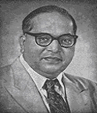
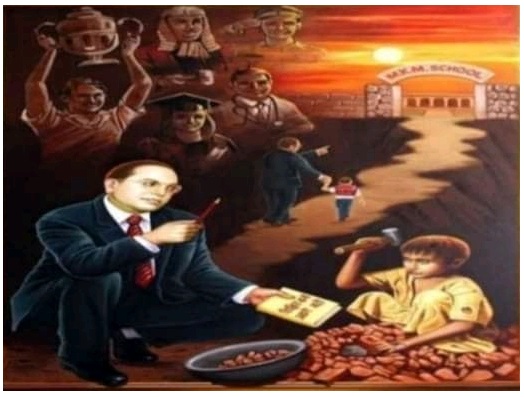

.jpg)