|
|

Report on the Seminar
Dr. B. R. Ambedkar, Dalits and Globalization
organised by GSVS
and NCDHR
Babu Mangoo Ram Mugowalia, who was also an NRI at
one point of time and was in the forefront of the Ghaddar movement and later on
became the founder father of the famous Ad Dharm movement in Punjab, started his
struggle for the emancipation of the Dalits by establishing his own school where
Dalit children were provided free education in a caste free environment at
his own village itself. Dr. Ronki Ram
Chandigarh (Ambedkartimes.com News
Bureau):- Gramin Shikshan Vikas Sanghathan (GSVS) and National Campaign
on Dalit Human Rights (NCDHR) organized seminar on Bharat Rattan Baba Sahib Dr.
B. R. Ambedkar, Dalits and Globalization at Muktsar (Punjab), Sunday December 9,
2007. In the morning session of the seminar issues relating to the problems of
rural education, especially among the Dalits, and how to solve them
constructively were taken up seriously. Mr. Vishwanath Meshram of Calgary
(Canada) initiated the discussion with his opening detailed inaugural note on
the current state of affairs of Dalit/rural education in the state and in
general. He also related his experiences of the rural education in Maharashtra
and the present situation over there. He asked the participants, mostly from the
school and college education field, to pinpoint the main causes of neglect and
how they can be covered up. What has gone wrong with the rural education system
and how that can be rectified? The inaugural address was followed by a long
discussion. Mr. Basant Singh Raju, former teacher, touched upon various crucial
aspects of the problem. He said that the govt. is often remains indifferent to
the rural education. Students belonging to the upper castes complete their
syllabus much in time, whereas Dalit students’ study starts two to four months
after the actual session begins. It was so because that won’t get books (to be
supplied by the govt welfare department) at the beginning of the academic
session. He also underlined that most of the teachers in village schools
belonged to the Dalit community. They were also an exploited lot. Vacant posts
are not filled for years. It is suggested to fill these posts on ad hock basis.
Mr. R. Bharti another schoolteacher also touched upon various similar issues. He
said though books from the welfare dept. would be available in time, but it is
the teachers who deliberately delayed in to bring them. Master Harbans Singh
Dish held parents and teachers also responsible for the sorry state of affairs
in rural education. He said 25% students dropped from first to fifth class.
Those who reached up to 8th standard majority of them pass the examination by
cheating because there is pressure to pass every one who sits for 5th class
examination. Principal Jagroop Singh Roop told that is lack of assertion, which
is the main reason behind the poor performance of the Dalit community students.
Mr. Surinder Singh talked about the stereotyped teaching techniques. Mr. Sham
Lal, Principal of a senior secondary school in the region, suggested to adopt
poor students as a way to improve the lot of the students belonging to Dalit
community. Principal Mool Chand discussed in detail many more aspects of the
deteriorating rural education. He emphasised on the need of making Dalits
self-sufficient in order to provide good education to the children. Mr. Sukhdev
Ram exhorted the NRI Dalit brothers to come forward to help their community
build their own education system independent of the prevailing one that would
also facilitate in building the self-esteem of the community. He also talked
about establishing village level Dalit committees to look after the education of
the children of the community. Other prominent speakers were Mr. Mohan Lal
Phillauria, Mr. Rajesh Kumar and Mr. Ram Prasad Bhoriwal.
The second session started after the community lunch. This
session was devoted to summing up and formulating suggestions as what is to be
done to improve the state-of-affair of the rural education. Mr. Roshan Chumber
of Calgary, who was also one of the organisers of the seminar, laid stress on
confining to the main focus of the meet and to be specific on what we want to
do. He said NRI’s help would definitely be there, but more in terms of time and
manpower we have to depend our community fellow back home in Punjab. Mr.
Meshram, the main brain behind the seminar spoke at length summarising the
discussion and elaborating on what to be done. At this level many other
participants also gave the opinions: infrastructures need to be provided at the
village schools, enough recruitments are to made, parents should spare more
time, since majority of the Dalit students come from poor families they do not
find right type of environment to study at home, so there should be some
community centres in each locality in the villages to provide them conducive
environment for the study etc. etc. Prof. Gurnam Singh Muktsar assured his full
support and praised the efforts of the organisers.
Dr. Ronki Ram, the chief guest on the occasion, gave his
concluding remarks. He congratulated the organisers for their efforts to
highlight the problems of the rural education how it affects the Dalit students
the most. He stressed upon the need of effective networking among the various
Dalit organisations and activists to revive the already much deteriorated system
by taking up the matter with the right authorities and also at the community
level. He said that it is a very positive trend that Dalit NRI brothers have
started showing concern towards education. No community can rise without
receiving education. He also reiterated on the fact that we do not need
education as such; we need right type of education to become conscious of our
rights and to stand on our feet. He reminded how Babu Mangoo Ram Mugowalia, who
was also an NRI at one point of time and was in the forefront of the Ghaddar
movement and later on became the founder father of the famous Ad Dharm movement
in Punjab, started his struggle for the emancipation of the Dalits by
establishing his own school where Dalit children were provided free education in
a caste free environment at his own village itself.
Mr. Sushil Bharti coordinator conducted the discussion and Mr.
Raresh Kumar, Secretary NCDHR; Punjab gave the vote of thanks.
Posted on www.ambedkartimes.com (December 20,
2007) |
Buddhamarga in Wolverhampton
By
Ven. S.M. Sujano
On 2nd September 2007, Punjab Buddhist Society UK has organized dhamma talk programme on ‘How to apply Buddhist meditation in daily life’. This is a part of ‘Buddhamarga’
regular dhamma discussion session at the centre. This talk was given by
Ven. Sayadaw Jnanapurnik Mahasthavir, Aggamahasaddhamma jotikadhaja
vipassanachariya from Nepal.
The programme was started by the lighting the candles in front of
the Buddha by Cllr. D. D. Ahir, society’s senior adviser. All the
participants observed five precepts from ven. Sayadaw. Ven. Sujan, a
resident monk on behalf of society welcomed all the participants and
give short background of the buddhamarga session and hand over ven.
Sayadaw to deliver his massage to all.
The talk was started with the importance and value of being born
as human being in this world. Having such precious life, one should not
forget owns’ target to achieve ultimate happiness by training mind not
to associating with harming other, adulteries, intoxication etc. one
who established in morality, could develop mental peace and clam. In
daily life we are facing many different difficulties and tangled with
it. The more we try to release, tangled more due lack of understanding
of mental condition.
Ven. Sayadaw gave clear vision of over coming from these
difficulties by understanding the nature of mind by observing and
developing awareness. Awareness on each and every object that one is
getting from senses. Just observing as they truly are and letting it
go. Further, to develop this awareness, one has to fully understand the
concept of Eight Fold Noble Path and try to establish on it. Shortly,
Eight Noble Path is known as ‘the Middle Path’, which is Right
understanding, Right Thought, Right Speech, Right Action, Right
livelihood, Right effort, Right mindfulness and Right concentration.
The eight Fold Noble path can be categorised into three principles;
morality, concentration and wisdom. Clear understanding on these three
principles is the guidance for developing or applying the dhamma in
daily life.
Ven sayadaw has discussed more on Sila or precepts, which is the
foundation for developing concentration or meditation. Meditation is
the practice of awareness or process of paying attention and focusing
your awareness. Awareness will help you to gain or recovery your
energy. It will help you to relax, understand the nature of changing
phenomenan and understand the life as they truly are. However, he
pointed out strongly that with our strong dedication and commitment,
meditation won’t help and won’t work at all. Practice and practice will
help to deal with daily life difficulties.
One hour’s talk was greatly appreciated and responded by the
audience. Audience were eagerly joined the question & answer
session. Audience were multi-nationals; British, Indian British,
Indian, Nepalese, Bangladesi etc. After the Q/A session ven. Sujan
invited everyone to participate ‘buddhamarga’ dhamma
discussion programme on every third Sunday of the month in evening time
and thanked to all the participants. At the end of the programme ven.
Chander Bodhi, a chief monk of the centre and patron/president of
Punjab Buddhist Society UK gave a vote of thanks to all for
participating at the function and inviting all the members to join next
programme and ven. Sangha gave blessings. The programme was ended by
light refreshment. Every participants were enjoyed the talk and full of
joy and happy in the taste of dhamma. They also gave wonderful feed
back for organizing such activity every month. Further, members have
suggested publishing this talk on CD or as a booklet. If anyone would
like to voluntarily join on this project or would like to support
please contact to ven. Chander Bodhi at the centre.
Short biography of Ven. Sayadaw Jnanapurnik Mahasthavir
Ven. Sayadaw Jnanapurnik was born in Nepal on Nov 21, 1939, and
renounced at the early age of 16. At the age of 23, he obtained a
degree in Buddhist teaching in Burma and has been teaching the Buddha
dhamma ever since.
A gifted linguist Ven. Sayadaw is reputed to know seven major
languages of the world. Thus, it was no surprise when he became Ven.
Mahasi Sayadaw, one of the famous Buddhist meditation teacher’s
interpreter in the early 70’s and in the course of his duty, he
traveled widely in the west teaching the dhamma and vipassana
meditation. Ven. Sayadaw is currently the chief abbot of Vishwa Shanti Vihara in Kathmandu.
p.s. special thanks to Ven. U Nagasena for bringing Ven. Sayadaw to
the centre and thanks to ven. Tejwant and Mr. Martin for the
preparation.
May all beings be happy and peace….
Posted on September, 07, 2007
--------------------------------------------------------------------------------------------------
THIRTEENTH PUNJABI
AMERICAN LITERATURE CONFERENCE ORGANIZED BY
PUNJABI SAHIT SABHA CALIFORNIA
U.S.A. (Regd.)
Sacramento:- The Punjabi Sahit Sabha California, USA (Regd.) is inviting
to all lovers of Punjabi Literature to attend 13th Punjabi
Literature Conference on Sunday, September 9th, 2007 at Lakshmi Narayana
Mandir’s community hall: 7495 Elder Creek Road Sacramento, California 95824 from 9:00
am to 6:00 pm. Dr. Jaspal Singh former literary columnist of The Tribune will
deliver a key note address on Postmodern Diaspora Punjabi American Literature
and a lively discussion shall follow thereafter. Your participation will be a
great contribution to the historic event. If you have any concerns, please feel
free to contact me anytime.
Dr. Amrik Singh
(916) 212-8550
President,
Punjabi Sahit Sabha California, USA (Regd.)
POSTED ON SEPTEMBER 5, 2007 : 06:52 PM
============================================================================
AJAY
SHRI CHANDRA A
Dalit PhD student was Harrassed & pushed to commit Suicide by Faculties
Dr.Ajit Kumar & Dr.Raghavendra Gadkar at the Indian Institute of Science!?
A Brilliant and outstanding PhD Student committed suicide in the Biological science division of Indian Institute of Science???Bangalore, India they call this is the most prestigious and premiere institute for science and
basic research in India. If one has to do the due diligence to look at it and
analyze the status and quality of this institute, a shocking truth will emerge
that this is not true at all?. There is not much accomplished in this science
institute in decades, nor there is any world renowned scientist like C.V. Raman
or Raman jam came out of this institute in centuries now. It is rather a Brahmin Institute instead.
Brahmins will go to any extent ever if they have to kill people to keep
this national and public institute as their backyard playground, so do
other several
educational institutions in India.
We have not seen any useful research work done in
this institute for decades, where is the discovery of drug that helped
thousands or millions of patients in India? Where is the invention that emerged from IISc to
show the world that Indian science is top of the line? Where is the noble prize from this institute or any
other Indian institute to show the world that Indian's have done a great
science? Where is one outstanding output of this Institute
or any other Institute that proclaims as the top science university.......
...there would not be a single answer for any of these questions?
While such is the case, the amount of discrimination,
favoritism, skewed ness and manipulation by the brahmins in these institution
is beyond any words can describe, in one of the very recent incident, a
doctorate (PhD) student of a Dalit community by name AJAY
SHRI CHANDRA
CV IN
EXCELLENCE
SSLC: 88.83 per cent from Hyderabad
PUC: 94.14 per cent from a
Nalgonda college
BSc: 83 per cent from Nizam
college, Osmania varsity
IISc Entrance 2006: Among the
top 12 and was selected for the biology division
brilliant, brilliant and hardworking scholar was harassed
by his Mentor Dr. Ajit Kumar and one Dr. Raghavendra Gadkar (both from the Dept
of Biological Sciences, IISc, Bangalore), the young PhD scholar was humiliated and degraded
to an extent, the mental torture was beyond this boy's control to commit
suicide. This young man was literally robbed of his youth and talents by the
casteistic bastards of IISc, a emerging scholar is no more as has committed
suicide on August 27, 2007 in his hostel/dorm room.
IISc student commits suicide
A PhD student of the Indian Institute of Science (IISc) in Bangalore
committed suicide due to "depression" by hanging himself in his
hostel room, a senior police official said on Monday.
Rediff, India, August 27, 2007
IISc student commits suicide
A suicide note addressed to Ajay's father was found in his room. "I am
sorry dad. The world is not for me. It is too much for me to take," stated
the note.
Pressure drives IISc student to suicide
DH News Service, Bangalore: Aug 28, 2007 Wilting under academic pressure, a 21-year-old IISc student allegedly committed
suicide by hanging himself from a ceiling fan at the students hostel in the
campus here in the wee hours of Monday.
Read
the full story from Atrocity news:
-That his guide, Dr. Ajit Kumar and Co-Guide, Dr. Raghavendra Gadkar
used to insult, abuse, humiliate and discriminate on the basis of caste. In one
course, Dr. Raghavendra awarded only a “D” grade which was undervalued
purposely to demoralise him.
-That he suffered depression and mental trauma of the treatment he was
prearranged. He was isolated and was completely ignored by fellow students and
professors.
-That the media reported his guide had asked some student to inquire regarding
Ajay’s whereabouts. When that student went to his room, the door was locked
from the inside. When he did not respond to several people’s attempt to wake
him up, the door was broken open with the help of security guards only to find him
hanging.
-That there was a 7 page suicide note found at the room he was hanging in which
had mysteriously disappeared police records.
-That the police had taken custody of the body to conduct post-mortem.
-That his parents were informed only after two days of the incident.
-That police had handed over the body along with only a two page suicide note.
-That Mr.Govind Raj, a non-teaching staff in the college (mobile no.
09945346077) and Prof.Jay Bhaskaran know all these facts.

Labels: Balarkrishnan,
Bangalore,
CJI, CJI
India, Dalit PhD student, dalits, Harraser Dr.Ajit Kumar, Humiliator Dr.Raghavendra Gadkar, IISc, IITs, Indian Institute of Science, suicide
http://upliftthem.blogspot.com/
Posted by Saint
at
9/03/2007 12:08:00 PM
http://ambedkartimes.com/ POSTED ON SEPTEMBER 04, 2007 08: 40 PM
------------------------------------------------------------------------------------------------------------------
Entering Temple,
Boiling Dal Poured on Dalits
On 31st August at Shahpu, near Patna
in Bihar a group of Dalit boys were beaten up
mercilessly for playing in the temple premises by the upper caste people
calling it sacrilege.
The Upper Caste people later followed the
children into their huts and started assaulting their mothers. In the clash,
the Upper Caste people poured boiling Dal on two Dalit women and babies who
suffered burn injuries and are now in the hospital.
Dalit Sarpanches barred from
unfurling
The Tricolor Flag on Independence
Day
A Panchayat chief of Kaimur district was barred
from unfurling the Tricolor on Independence Day this year on15th August.
The incident reportedly took place in the
parliamentary constituency of none other than Union Minister for social justice
and empowerment Mira Kumar, Daughter of Babu Jagjiwan Ram.
Dimari Panchayat chief Sinhas Ram was assaulted
and chased by some members of the upper caste on August 15 when he and
Panchayat secretary also a Dalit, reached the Panchayat Bhavan to unfurl the
National Flag.
In another shocking incident of
"Untouchability" arising out of Caste factor, a Dalit woman, Lali
Devi, was prevented from cooking mid-day meal for school children at Rahtas.
When Lali went ahead for cooking, school
secretary Umashankar Tiwary, who represents upper caste and his associates,
reportedly dragged her out of the kitchen and assaulted her husband publicly.
POSTED ON SEPTEMBER 2,
2007
---------------------------------------------------------
Tension in Haryana town over youth's
murder
August 28, 2007
12:37
IST
Tension prevailed in Gohana Town of District Sonipat (Haryana) on Tuesday
after a large number of Balmikies took to the streets and clashed with police
to protest the murder of a youth belonging to their community.
The Balmikies set ablaze a police check-post and damaged several Haryana
Roadways buses at the Gohana bus stand last night.
Police had to resort to mild baton-charge to disperse Balmikies, who in turn
pelted stones at the police personnel leaving some of them injured.
Rakesh alias Lara was shot dead by three unidentified motorcycle-borne
youths when he along with another youth Vikki was going to meet one of their
friends in the town on Monday.
Vikki told police that the assailants after shooting down Rakesh also fired
some shots in the air to scare away the people who tried to give them a chase.
Keeping in view the situation, District Magistrate D P S Nagpal has enforced
prohibitory orders and banned carrying of firearms within the town.
Sonipat's police chief, Navdeep Singh Virk told reporters here today that so
far three youths had been arrested in connection with last night's incident.
Virk said the situation in Gohana town was tense, but under control as
additional forces had been deployed to control the situation.
Rakesh was acquitted in the murder of Baljit Siwach, a financer of Garhwal
village. Siwach, who belonged to the pre-dominant Jat community, was murdered
on August 27, 2005.
After his murder, several Dalit houses in the Balmiki Colony of Gohana town
had been torched on August 31, 2005.
Gohana to Saalwan
Dalits faced with burning
issues
WHEN it comes to Dalits, history repeats itself
with a minor difference being in the detail but not in the fact that they
continue to be targets of castist oppression. The only difference in the
violence that was unleashed against Dalits at Gohana in Sonipat on August 31, 2005, and on March 1 at
Saalwan in Karnal district is the caste of their tormentors. At Saalwan, the
hordes that razed the houses and wrecked the belongings of Dalits were Rajputs,
whereas 19 months ago, at Gohana, the perpetrators of arson were Jats. That
such atrocities driven by a feudal mindset, which has only contempt for the
law, should occur with alarming frequency in Haryana exposes the prevalence of
a despicable social order, which ought to have been rooted out long ago.
The mob that forced its way into the houses of
Dalits to destroy and burn their belongings was said to have set out to avenge
the murder of a farmer who was reportedly killed by two Dalits. Doubtless,
murder is a heinous crime and the guilty, regardless of their caste, should be
brought to book. Historical injustice and centuries of oppression do not
justify Dalits — or members of any community, for that matter — taking the law
into their own hands. By the same token, there can be no recourse to mob rule
to avenge a crime.
The mobs, in retaliating against a murder, vented
their wrath against over 50 Dalit families only because they were Dalits. This
is an atrocity that should and could have been foreseen and prevented by the
administration, especially when it is known that such attacks are not uncommon
in Haryana. The state also boasts of caste panchayats “dispensing justice” in
blatant violation of the constitutional scheme and in defiance of all law.
Clearly, both the rule of law and the civil rights are endangered and the
administration is able to do little to safeguard the lives and property of
Dalits. In 2002, five Dalits were lynched in Jhajjar merely because of rumours
that they had killed and skinned cows. The government should get rid of these
castist black holes that are a blot on the country.
By Virender Singh Gill
POSTED ON SEPTEMBER 2, 2007
|
GOHANA BURNING AGAIN!
MURDER OF A DALIT LEADER IN GOHANA
POLICE LATHI CHARGED OVER PROTESTING DALITS
S. L. Virdi Advocate
On Monday evening, a large number of
angry Dalits clashed with the police, set ablaze a police chownki, damaged
Haryana Roadways buses and jammed the link road traffic in Gohana Town of District
Sonipat (Haryana). 20 people were hurt in the action including 8 police men.
Trouble started when a Dalit youth
Rakesh Alias Lara was shot dead here last night by three men came on a motor
cycle.
The violence this morning was again
sparked when the police brought the body of a murdered Dalit youth in a truck
from the Rohtak PGIMS. A large number of Dalits protesters came out in streets
in Gohana.
It is pertinent to mention here that
Rakesh was acquitted in the murder of Baljit Siwach a Jat Financer of nearby
Garhwal village on August 27, 2005
near the Balmiki Basti in Gohana, on misbehaving a Dalit woman.
How dared the Dalits? In retaliation
against the Baljit's murder, a mob of twelve villagers, gathered for Maha
Panchayat at Gohana on August 31, 2005,
first looted the houses and set on fire the Balmiki Basti in which 50 houses of
the Dalits were damaged and ruined.
Under the pressure, the State
government ordered a CBI inquiry into the murder and torching of Dalit houses
in Gohana Balmiki Basti.
The police arrested Ramesh with six other Dalit youths
following the murder of Baljit Siwach, Rakesh and other three youths were,
however, acquitted by the CBI special court on November 26, 2006 due to the lack of evidence. The
incident took place due to revenge and for teaching a lesson to the Dalits.
Dalit organizations staged strong
protests, demonstrations, rallies in Rohtak, Bhiwani, Karnal, Jamna Nagar,
Panch Koola, Ludhiana, Phagwara
TownsPunjab. of Haryana and
Posted on August 29, 2007
|
HOMAGE TO PUNJABI POET LAL SINGH DIL
BRINGS OUT THE
POWER OF LITERATURE
TO EXPOSE DISCRIMINATION AND OPPRESSION
By
INDIRA PRAHST,
Instructor of Race and Ethnic Relations,
Department of Sociology, Langara College, Vancouver
The University of British Columbia last week hosted the 14th
International Triennial Commonwealth Literature Conference with the
theme "Literature of
Our Times." Academics from all over the world attended. In conjunction,
the Chetna Association at the Dr. Ambedkar Library in the Guru Ravi
Dass Community Centre organized a seminar dedicated to renowned Punjabi
poet, Lal Singh Dil, last Sunday evening.
Mr.
Dil was scheduled to speak at the event, but due to an illness, he died
on August 14. Therefore, the program was changed to commemorate his
achievements in the literature of the oppressed. Several prominent
writers, journalists, local artists and social activists attended and
engaged in knowledge translation. The unveiling of Mr. Dil's portrait
was done by a local artist Shital Anmol and a candle lighting in his
memory preceded the presentations.
The
loss of Dil, according to many at the event, will "leave a large void
in the field of the literature of the oppressed." However, his memory
and powerful words live on. The new words and idioms he introduced made
him a distinguished Punjabi poet. Despite being a well-known and
progressive writer, he died in poverty and, as members of the Chetna
Associoation pointed out, "a few days earlier, the poet was found
unconscious in his dingy room at Balmiki Mohalla when a team of TV
journalists arrived to film a documentary on his contribution to the
revolutionist poetry in Punjab."
Being
a Dalit left a deep scar on Dil's identity, and because of his caste he
also suffered spiritually, abandoned his Hindu religion and did not die
a Hindu. At the event, one way to pay tribute to the passion that led
him to change the condition of the landless was through a visual clip.
Indeed, his words were powerful when he spoke about the lived
experience of being Dalit. "This shows our people's slavery and mental
slavery," he said. His
words to explain the oppression and to encourage activism were
expressed thus:
"Those who do not know how to fight and those who wish not to fight are
enslaved; slavery is a terrible scar. We do not know how to speak up,
that is the issue - we keep silent. People must realize this is our
land and it belongs to us."
The
words are very much at the heart of Karl Marx's ideas about
mobilization of the masses to produce social change. A necessary
strategy is for a leader to form and to help get the oppressed out of
"false consciousness."
This involves questioning and debunking the ideologies employed to
oppress them. What people need to realize is that they occupied the
land first. In this context, a "Conflict Perspective," would argue that
the caste system
is an "ancient prejudice" to rationalize the unequal distribution of
resources. Franz Fanon pointed out a similar argument for change in his
well-known book "The Wretched of the Earth," where he wrote about the
need to educate
the masses as a means of liberation from oppression in the context of
the Algerian war and terrorism. It is this theme of mobilization and
education that the guest speakers touched on.
Keynote
speakers at the UBC conference also spoke at the event. They included
Sivakami Palanimuthu, a writer and social activist who is described as
a "champion of Dalit and women rights." Her most recent work is
the novel "The Grip of Change" in which she shows "Dalit life in the
raw,
what is done to them, and what they do themselves," (The Hindu, 2006).
When
I asked her about the strategies she employed to expand the Dalit Land
Rights Movement in the context of government, she was not shy to talk
about her interactions with government officials and her interactions
with members of the Tamil Panther Movement, as well as the hospitality
of Dalit Panther leader, Thirumavalar. She spoke about "being a tool of
the movement to organize meetings and raise awareness of the plight of
the Dalits and their landlessness and the need for the creation of land
policy.
Some
key issues raised were: 1) government has a "modern"
responsibility; 2) how Dalits can turn to the government and ask for
land; 3) uprooting of Dalits who dwell on high cost land (in the urban
centers); 4) provisions of basics amenities in urban settings; and 5)
amendments to "The Land Ceiling
Act."
She
also stated that the issues of the Dalits are not only economical in
accessing land, but "much more, it is the dignity." Although she
herself is successful and has elevated herself economically; she spoke
about still being tagged as a "Dalit." Inspired by her words, Ajmer
Rode, (regarded
as the "founder of Punjabi theater in Canada" who wrote the first
Punjabi play Dooja Passa on racism experienced by minorities and is
known for his recent play Rebirth Of Gandhi, which was inspired by Ms.
Palanimuthu's work), said: "Her writing indeed is what a writer should
be, getting involved at the grass roots level -the writing that comes
out of that - is real writing."
Another speaker from the conference was Arun Prabha Mukherjee, a professor of English at Toronto's York
University,
specializing in South
Asian and minority literatures. Mukherjee has authored many books,
including her much acclaimed "Towards an Aesthetic of Opposition and is
currently translating
Marathi Dalit writer Sharan Kumar Limbale's novel "Hindu." She
pointed out how Mr. Dil's poetry inspired her: "Poets like Lal Singh
Dil leave words behind that will inspire in different phases of peoples
lives. They are the spark and the light to keep the fire burning."
As
an educator, she said, "It is sad that this great literature is not
taught in schools and universities. These words have a great effect on
the younger generation because of the eye-opening realities of life of India
that was hidden from them. People forget social injustice and different work needs to be done to keep memories alive.
"Prominent
activist from Nawan Shaher, Mr. Om Parkash Lakha (General Secretary of
Dr. Ambedkar Mission Society and Trust), also spoke and said he that he
was hopeful to tell the Dalits upon his return to India, that Dr.
Amdedkar societies are doing well in Canada, and "in a globalized
world, emancipation is easier."
As the evening came to a close, local Punjabi singer, Kamlesh Ahir sang
with passion and asked: "Why did Lal Singh Dil never marry? He chose
not to because he loved a woman from a different caste and he loved her
all his life." Indeed, Mr. Dil lived for self-respect and died for
self-respect
even in matters of the heart.
Also present at the event, as the only non-South Asian, was conference participant Dr. Karin Doerr, professor from Concordia
University, Montreal.
She was called upon to be part of the award presentation. Her work as researcher
and educator is connected to injustice, revolving around the issues of
extreme discrimination and genocide as they occurred during World War
II in Germany
and examines its manifestations in language and literature.
Of special concern to her is the plight of women in struggles and
conflicts because it often gets neglected. She said her visit and
interactions within the South Asian community and its literature was a
learning experience as she enhanced her knowledge about the injustice
experienced by the Dalits and the widows in the Delhi colonies
following the Sikh massacre of 1984. This, she feels, needs to be shared and exposed more to promote general awareness.
This article forwarded by Mr. Jai Birdi.
*VOICEONLINE.COM*
Posted on August 29, 2007============================================================================
ATROCITIES AND SOCIAL BOYCOTT OF DALITS IN PUNJAB S. L. Virdi Advocate
There are discriminated people all over the world but
no any where on this earth the natives now known as Dalits, the sons of their own
soil, have been treated as animals
continuously for thousands years under the social system called Varna
System. The system is now popularly known as caste system.
In India,
350 millions of people officially termed and called Scheduled Castes and
Scheduled Tribes now called Dalits are being treated inhumanly, discriminated
against and oppressed relentlessly by various modes and methods.
If Dalits
try to enjoy the constitutional rights to improve their life, they are brutally
killed, their women are raped, children are slaughtered, wells are poisoned,
and their dwellings are burned collectively. One Lakh cases of atrocities are
reported in the police stations every year and almost equal number of
atrocities is not reported and recorded. During last 60 years about One Lakh
people have been killed by the upper caste people due to castism.
Punjab
is not very much behind in committing atrocities and following the practice of
untouchability. In Tur village of the Tarn Taran District, the Dalits are
facing social boycott by the Landlords for the past ten days. Trouble started
when a Dalit woman Charanjit Kaur with her relative (Kurmani) Swarn Kaur had
gone to the fields for answering the call of nature (excreta). A Landlord's son
misbehaved them. The matter was reported to Police, which booked the boy, in
retaliation, the Landlord imposed the social boycott on Dalits. Situation in
the village is tense, but the Police is strictly watching.
On 19th
August in village Faridpur of District Fatehgarh Sahib in Punjab,
four Dalit girls were forced to pick up their own nature soil (excreta) with
their hands and were victimized by the landlords.
DALIT STUDENT LOST HIS VISION
FOR DEMANDING MORE FOOD IN BIHAR
A Dalit
Navin Kumar Paswan, student of fourth class, Government
School, Aujapauchha
of District Purnea in Bihar,
lost his one eye after headmaster and master beating him up mercilessly for simply
demanding more food during Mid-Day Meal Scheme run by the WHO, Agency of the
UNO. POSTED ON AUGUST 27, 2007
=============================================================
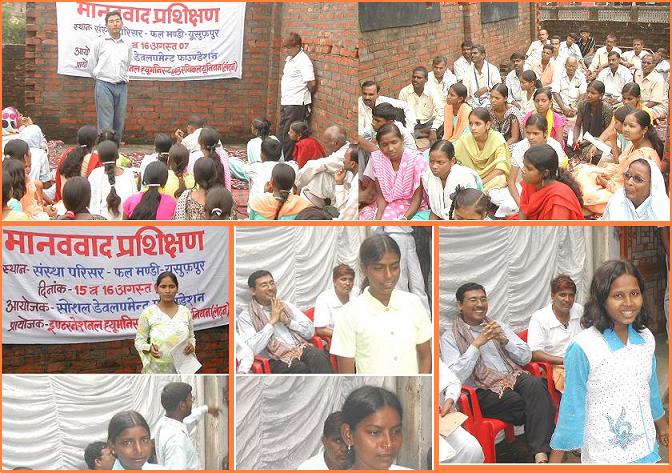
We are sharing some of the photographs taken during these days at Mohammadabad.
V. B. RAWAT
I have just returned
from a long trip from Eastern Uttar-Pradesh. On 15th of August, this
year, at Mohammdabad, we honored the two young girls from scavenger
community who stood first in their board examinations of 10th and 12th.
We had promised to give them a bicycle each if they score good marks.
The two of them worked hard. To instigate the other girls and boys in
the community to work harder, a meeting was organized with the parents
of the girls and other elders from the community.
Social Development
Foundation's local centre in Mohammdabad has become ray of hope for not
only the scavenger and Dalit girls but also for the Muslims girls who
come and learn sewing. A two days workshop in developing humanist leadership among Dalit youth was also organized in Mohammdabad.
We would like to thank
each one of our individual donors who supported the cause of the Dalit
girls and hope they would continue do so. I will be sending a detailed
note to our friends soon on the outcome of our scholarship scheme. We
are happy to inform you that apart from sewing, we have decided to
start a computer learning programme at our centre and are in the
process of getting another computer so that the girls can learn
computer skills. Apart from that we also intend to start designing,
jardoi work also.
The
process has been difficult as this is really a constructing work and
the community is appreciating it but individual donations are tough
thing to collect. We will be releasing the list of individuals who
donated last year and our expense sheet for the same.
This
year we plan to provide scholarship to 15 girls & already 40 girls
are learning sewing free of cost. Now as our computer centre will start
functioning in next two months, we expect more enrollments for the same.
POSTED ON AUGUST 24, 2007
DALITS AFTER 60 YEARS OF INDEPENDENCE OF INDIA
Dalit girls forced to pick up their own excreta in Punjab
Phagwara:-
On 19th August in village Faridpur, 30 km. from Patiala District in
Punjab, four dalit girls were forced to pick up their own excreta with
their hands and were victimised by the landlords. The girls had gone to
the nature soil in the fields. The owner of the field not only insulted
them but forced them to pick up the excreta.
The Local Dalits protested against the inhuman behaviour but police failed to take action against the land lords accused.
The Constitution of India in its article
46 casts a duty on the state to protect Scheduled Castes and Scheduled
Tribes from social injustice and all forms of exploitation. How far has
the state been able to protect them?. The state government failed to
check atrocities on Dalits in Punjab. Atrocities on Dalits are due to
Casteism. There have been innumerable and persistent atrocities on
Dalits even after the 60 years of Independence of India.
S. L. Virdi, Advocate, (Phagwara, Punjab.)
POSTED ON AUGUST 22, 2007
============================================================================
SPECIAL THANKS TO
SHRI GURU RAVI DASS SABHA OF
NEW YORK
Our special thanks to Shri Guru Ravidas Sabha New York and
to all Punjabis who took first historic step to highlight Baba Sahib Dr. B.R.
Ambedkar in India 's 60th Independence Day Parade in New York .
NRI Punjabis have played a lead role in spreading and
promoting Baba Sahib Dr. B.R. Ambedkar's mission around the world for over fifty
years. They have always offered their services and finances voluntarily for the
community support.
I must mention here that the main organizers and financers
of Baba Sahib's float were our Punjabi brothers and sisters of New York along
with other Indians. We extend our support from around the world to encourage
them to do more such historic events.
We are proud of our community members who dedicate their
time and money to spread Baba Sahib's Mission of Liberty, Equality and
Fraternity. Today, we are proud of all who organized Baba Sahib's float for the
parade. Our special thanks to Shri Guru Ravidas Sabha and all Punjabi brothers
and sisters for their support and financial help that made it happen.
Also, we appreciate AMBEDKARTIMES.COM for posting beautiful
pictures of the float.
Yours, in mission,
Raj Kumar
Oshoraj
Indian Buddhist Society Toronto, Canada
POSTED ON AUGUST 24, 2007 =====================================================
AMBEDKAR FLOAT ON INDIA DAY PARADE IN NEW YORK RAJU KAMBLE
This is first time in New
York, Ambedkar float is being put in the India Day
Parade in New York. The India Day
parade is on Sunday, the 19 August
2007. This is a good occasion for all of us around New
York City to show solidarity and show of our strength.
The Parade will start at 9.00 A.M. Our
float is something like 45 ft. Our friends in New York
are working very hard on getting real big size portraits of Babasaheb.
The idea was muted quite late and then to get the permission
to be part of the procession was not all that easy. Hence it took lot of time
to fix all these things. The entry fee into the procession is US$ 3500; which
is already been paid of by the Ambedkarites in New York.
So, please join us one and all. I guess our people right up
to Virginia in the south and up to Boston in the North/East should make an
attempt to be part of this parade with their families.
Our Punjabi friends are hiring a
bus to facilitate participation of our people from Queens’s
area in New York. The parade
starts at 41st street in Madison
Square and goes up to 23rd
Street. This
is a first time ever for all of us and hence i too, cannot resist from not
participating in it and hence will definitely show up in New
York.
Quite a few of us are working on putting together the
posters, banners and the handouts for distribution. So, see you all in New York
on Sunday, 19 August 2007.
For more in-details, please contact: Raju kamble (Canada) 403-615-4590 Posted on August 13, 2007
============================================================================
SOME NIHANGS ATTACKED ON DALIT WOMAN
IN PUNJAB
&
A CONFRONTATION BETWEEN AMBEDKARITES & SHIV SENA WORKERS
L. R. BALLEY Jalandhar:-Doaba region of
Punjab ( India ) is in grip of some agitations. In village Jalbhe Thana Adampur District Jalandhar ( Punjab ) India
there was a Scheduled Caste lady namely Sarbjit Kaur alias Suraj Devi
who used to treat people by her divine powers. Some NIHANGS attacked
her, now in a serious condition she is laying in a hospital. After the
Nihangs ransacked her building, the Police came drunkard and furious.
The police attacked whosoever came before it. It did not spare the
pregnant, aged women and even children. There is great resent on the
brutalities committed by the people. Not only had the police filed
baseless FIRs against them, presently nine men and three women
belonging to Scheduled Caste they are in jail. Besides them two others
(man and woman) are also in jail along with her. A deputation led by Mr. Lahori Ram Balley met the Deputy Commissioner Jalandhar on 9th
August, 2007, gave him an memorandum urging upon the Govt. to release
the detained persons. Mr. Balley also presented to the D C Jalandhar a
CD which depict how the police had been attacking unarmed indent poor
Scheduled Castes on 19th August, a big public conference is being organized at Adampur to chalk out and declare further action. A CONFRONTATION BETWEEN AMBEDKARITES & SHIV SENA WORKERS In
Hoshiarpur city there has occurred a confrontation between the
Ambedkarites and so called Shiv Sena workers. The bone of contention
that a Goona in the garb of a Sadhu has captured with helps of Hindu
communalists a Dera namely ‘Dera Fattu Shah’. This
Dera is in area surrounded by the Scheduled Caste people. The Shiv Sena
has lastly attacked the Scheduled Castes and they said Sadhu is a
potential danger to the honor of the Scheduled Castes. On account of
pressure from the Scheduled Castes they said Sadhu had to flee but the
Shiv Sena communalists have against put him in charge of the Dera. The
police has issued warrants against the SC youth whereas the District
Administration has a soft corner for the Shiv Serna. Now 20th August, 2007 has been fixed to stage a huge demonstration in Hoshiarpur. Mr. Balley has been met the youths on 8th August 2007 and inspired them for waging struggle. Posted on August 13, 2007 ========================================================================= SANT SHIROMANI SATGURU KABIR SAHIB
COMMEMORATED IN TORONTO
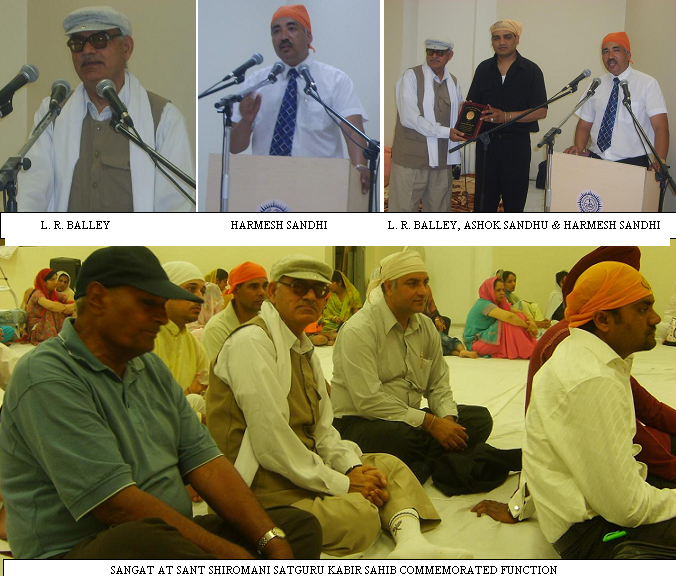
Reported by
Harmesh Sandhi
President, Shri Guru Ravi Sabha Ontario (Canada)
In order
to commemorate the cultural contribution by Sant Shromani Satguru Kabir
Sahib Ji, a public function was organized by Shri Guru Ravidass Sabha Ontario, the function was held in the premises of the Temple.
Mr. Harmesh Sandhi presided over the function. He introduced Mr. L. R
.Balley by saying that for the last more then 50yrs. He has been
struggling for public causes. He has authored more than one hundred
Books in different languages. He is editing Bheem Patrika since 1958.
The Sabha greatly appreciated the services of Mr. Balley and presented
him a purse of $500.
Mr. L. R. Balley an Ambedkarite Scholar, author, and journalist from India
was the chief guest. Mr. Balley in his very scholarly and impressive
speech said, “Sat Guru Kabir Sahib was a true, upright and penetrating
poet of ‘Shraman Sanskriti,’ the revolutionary culture. He condemned
orthodoxy, caste system, social disparities and contradictory conduct
of Indians at large.
Satguru Kabir Sahib was externed from kashi by emperor Khilgi. A nefarious effort was made to kill him by drowning him in the Ganga River.
Such atrocities he has to undergo. Mr. Balley said that we should
follow rationalistic and moralist teachings of Sat Guru Kabir Saheb.
Mr.
Ashok Sandhu president Bhagwan Balmik Sabha along with other office
bearer honored Mr. Balley with a memento. Finally, Mr. Balley advised
that Temple should serve as community centre and become source of knowledge. Prominent members from Ambedkar Mission Toronto were present in the function in good number. Mr.Harmesh Sandhi delivered a speech and thanked the audience.
POSTED ON JUNE 27, 2007 =============================================================================
FOLLOWING PHULE, AMBEDKAR AND MUGOWALIA’S
STEPS WILL ALWAYS LEAD US TO THE SUCCESS -HARVINDER KAUR
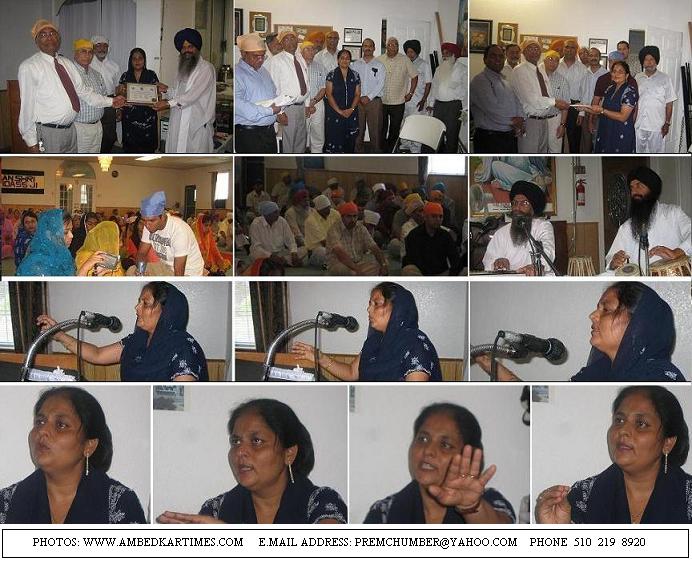
Above pictures were taken at Shri Guru Ravi Dass Temple, Rio Linda (Califormia) on June 10, 2007
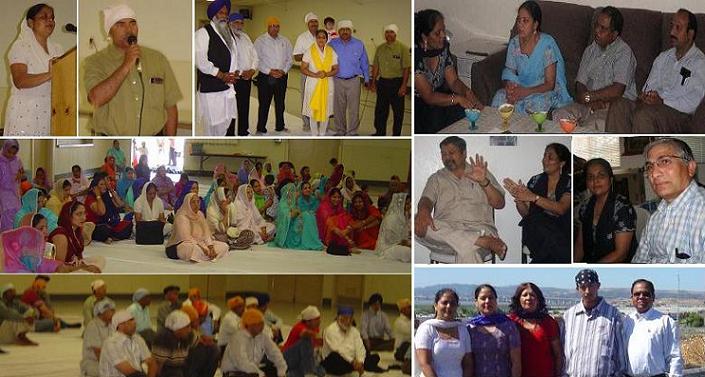
Above
left side pictures were taken at Newark on June 24, 2007 & an other
at Ambedkartimes Office, Shri Guru Ravi Dass Temple, Rio Linda,
Sacramento (California) etc.
Mrs. Harvinder Kaur, President of BAMCEF, ladies wing of India, came to California on June 8th; she visited Shri Guru Ravidass Temple Rio Linda in California before she went to Ambedkartimes office. On June 10, 2007
she went to the temple again for her special welcome, where she made
the congregation aware of the BAMCEF and its objectives, goals and
strategic planning to achieve those goals. It is a non-political
organization that stands for Backward (SC/ST/OBC) and Minority
Communities Employees Federation, established in India in 1978 by late Mr. Kanshi Ram Ji. As
the name states, it is an organization of working class and is chiefly
responsible to pay back to the society they came from. Every one in
this world deserves self-respect and self-respect comes through
education and self-awareness. Therefore, it is one of the important
action plans of BAMCEF to bring social awareness among masses of
downtrodden communities.
No
doubt the structure of Hindu Indian Society stands on a rigid caste
system – Brahmin, Khatri, Vaishaya & Shudra. This caste system is
like a cancer for which there is permanent cures so far. History tells
us that it can be controlled to some extent but can’t be eliminated far
ever. In India,
the shudra communities are known or recognized by the various names,
e.g., Low-Caste, S/C, S/T, OBC, Dalits and numerous other names that
differ from one state to another. To further widen the gap between
these communities, the Hindu Holy Scriptures divided it into more 6000
sub-caste. According to Indian Census these communities constitutes
almost 85% of the total current population. Equally true, on the other
hands these 85% population is more than 85% lagging behind in every
sphere of the socio-economical and even political activities than the
other 15% population, also known as the high caste population. For
numerical purposes, all are considered a part of the Hinduism, even
though not cherishing the same benefits as by he higher caste Hindus.
Following
the footprints of Great Gurus and social reformers, from past 30 years
BAMCEF is attempting to bring all these Oppressed Communities on a
common stage to create social awareness and made them realize the
leitmotif of this human race. Mahatma Jyoti Rao Phule, Dr. Ambedkar,
Babu Mangu Ram Mugowalia and our other great forefather struggled their
whole life for a humanitarian cause. Their path of struggle was no
different than those of Guru Sahibans showed us. Today, therefore, is a
need to know the history of our great ancestors and their sacrifices.
In this fast changing era of modernization, try to understand and
recognize our true reformers of Ambedkar-Phule-Mugowalia ideology.
Beware of traitors or puppets of government in power, whose motive is
to accomplish their own selfish interest in the name of community.
Mrs.
Harvinder Kaur Ji also visited Shri Guru Ravidass Sabha in Yuba City on
June 17, and Shri Guru Ravidass Sabha of Bay Area (Newark) on June 24,
2007. Speaking on the occasion of the Martyrdom Day of Shri Guru Arjun
Dev Ji Maharaj, she urged the audience to follow the true path
described by our great gurus in Guru Granth Sahib Ji and implement the
holy teachings in life. We need to understand the philosophy of life
for which Guru Ji struggled and sacrificed their life for a
humanitarian cause. Guru Gobind Singh Ji sacrificed his whole families
to fight against injustice, inequalities and make the downtrodden of
the times a community of braveness of today. It is hard to find a parallel example of these kinds of sacrifices in the beautiful history of the pages.
The
mission of Baba Sahib Dr. Ambedkar, Mahatma Phule Ji, Babu Mangu Ram
Mugowalia Ji and other great social reformers’ movement was in steps
with the ideology & teachings of great gurus, though in different
shape. She encouraged the ladies wing to get educated to better educate
our succeeding generations to come. A great deal of our progress
depends on educated women in the communities who play a significant
role in the social improvements. As Dr. Ambedkar said, our struggle is
not for power or wealth but it is for liberation. The liberation comes
through human personality. And to develop a sound human personality an
education is the first right step in that direction. If we are
educated, we can understand what is good or not good rather than merely
depending on others for directions. Follow a path of truthfulness for
success and achievements in life. A man who finds truth, like Baba
Sahib Dr. Ambedkar, lights a torch that can never be extinguished.
Therefore, it is our moral duty, especially of the educated community
on which BAMCEF is established, to keep this torch of truthfulness
burning.
Mr.
Randhir Suman ex general secretary Shri Guru Ravi Dass Sabha Bay area
(California) welcomed Harvinder Kaur and appreciated her work for the
community.
POSTED ON JUNE 27, 2007 ==================================================================================================
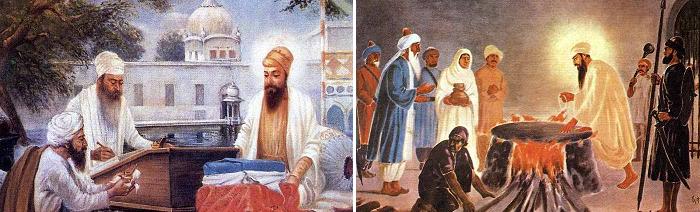
SHRI GURU ARJUN DEV'S MARTYRDOM DAY CELEBRATED BY
SHRI GURU RAVI DASS SABHA SACRAMENTO
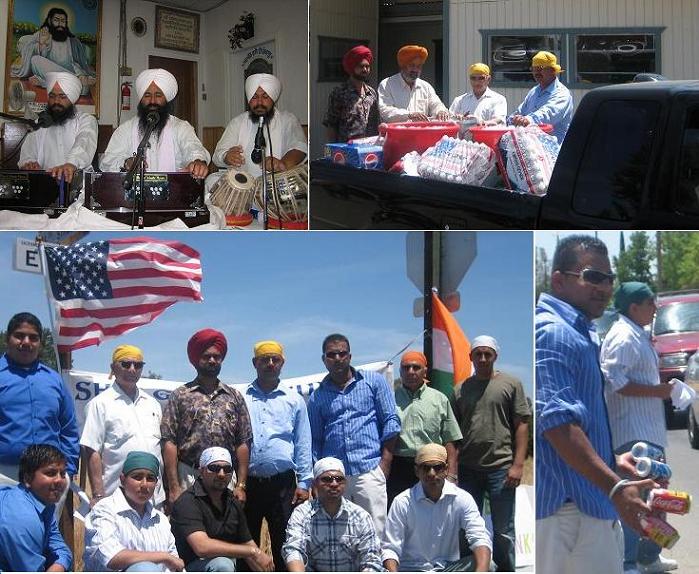
SOME PICTURES FROM SHRI GURU RAVI DASS TEMPLE RIO LINDA (CA.) (Photos: ambedkartimes.com)
Saceamento:-
Shri Guru Ravi Dass Sabha Sacramento (California) celebrated the
martyrdom day of great guru in humankind Shri Guru Arjan Dev Ji at Shri Guru RaviDass Temple, Rio Linda (California) on June 17, 2007 (Sunday). There was large number of people gathered at Shri Guru Ravi Dass temple
to celebrate the martyrdom day, which has taken important place in the
Sikh History. The Raghi Jathas recited hymns from the Shri Guru Garanth
Sahib & speakers enlightened the teachings of Sahib Shri Guru Arjun
Dev Ji.
This
Martyrdom day comes in June (Very high temperature), so people serve
free cold drinks, water, etc to the sangat in the Gurdwaras, offices,
fictories, on the roads & streets etc. Today the langar was
prepared and served by three families:. Jaswinder Banga (Ex Chairman
Shri Guru Ravi Dass Sabha Sacramento & well known businessman),
Subash Banga and Avtar Singh Jassal.
POSTED ON JUNE 17, 2007 ============================================================================
BHAGWAN VALMIKI JAYANTI CELEBRATED IN CALIFORNIA ( USA )
Sacramento:-Last
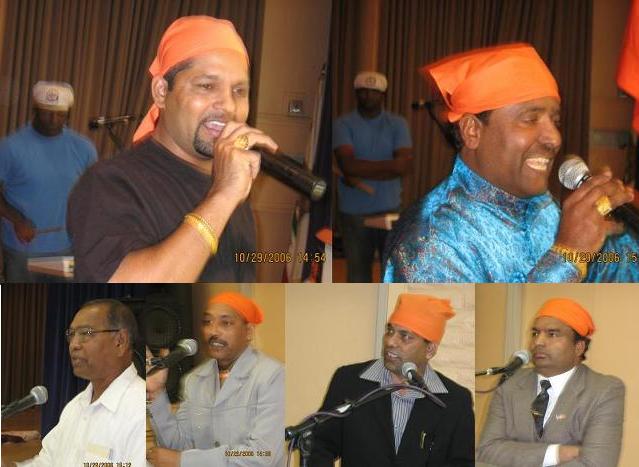
days a large number of people celebrated Bhagwan Valmiki Jayanti with
great dedication & spirit.The Jayanti was arranged by the Maharishi
Valmiki Sabha USA at Dan Foley Park,Valejo (California) USA on October
29,2006.The people gathered from different 2 parts of California to
celebrate jayanti.All men, women & children met eachother with
greetings Jai Valmiki...... .& they shared their joys.
The
jayanti ceremony was started aroundabout 10.00am with Valmiki
Ramayana's katha & after that well known singers like Bhupinder
Bhinda,J.S.Chandan,Sultan Akhtar & Shivtar Sidhu took over the
stage.The stage & hall were both decorated colour garlands &
some pictures of Bhagwan Valmiki Ji,Baba Sahib Dr.B.R.Ambedkar, Kaumi
Kavi Gurdass Ram,Sant Ram Udassi, & also one book stall was installed by K.K.Saroya.
All
singers did very well on stage with fully respect to Bhawan Valmiki Ji
& they were all dedicated to mission.They sang all religious songs
related to Satgur Valmiki Ji & every singer sang 2-3 songs on his
turn.A young talanted & famous singer J.S.Chandan also sang one song related to Maharishi Shambooka (Written by journlist/lyric P.K.Chumber )& that song he has already been sung in
great style on Bhagwan Valmiki Jayanti at Yuba City (California) this
year.That song's wording is very good/strong & fully linked to
MULNIVASI HISTORY & in future that song may be the best song of
MULNIVASI IDIA.An other top singer Sultan Akhtar did show very good
performence in his singing.The people enjoyed & welcomed all
singers's singing. Befor them in starting arising star singer Bhupinder
Bhinda gave very good start to stage & in the last Shivtar Sidhu
also put his poet.
An
other side inbetween singing programme some speakers like Dr.Santokh
Gill, Ambedkrite Mohan Gill, Journalist Prem Kumar Chumber, Mr.Ashwani
Parwana etc delivered their valuable speaches about Satguru Valmiki
Ji,Dr.Ambedkar & Babu Kanshi Ram etc.On this occation one DVD MOCHI DA PUT presented by K.K.Saroya & also free distributed.
Mr.Gurjit Singh served very good his duty as stage secretary.The tea,coffe.milk,sweets,samosaes,pakoras & chhole bhature served all day.
=========================================== 
FUNDS DELIVERED TO PUNJAB'S
DALIT HERO S. BANT SINGH
Dear donors and friends,
I am
extremely happy to let you know that we have handed over funds
collected to help a Punjab Dalit Hero, Br. Bant Singh of Mansa, who
fought heroically with landlords to get justice and lost his limbs in
the process.
First
of all, I apologize for the delay in completing this task. Originally,
it was planned to be completed in Mar 2006. Due to logistic reasons, it
got delayed this long. I hold myself responsible for this delay.
I
thank all donors for their generous donations and patience to wait this
long to complete it. I hope, your confidence in me and in our project
is still in good standing.
I
feel relieved and my happiness is unbounded. It is far greater than the
most memorable Will Smith's happiness in "Pursuit of Happiness" (one of
a few movies that I can remember as long as I live) movie when he got
the stock broker job after all the pains he had gone through in his
life. If not seen, I advice you all, to see without fail this wonderful
movie of a real life story.
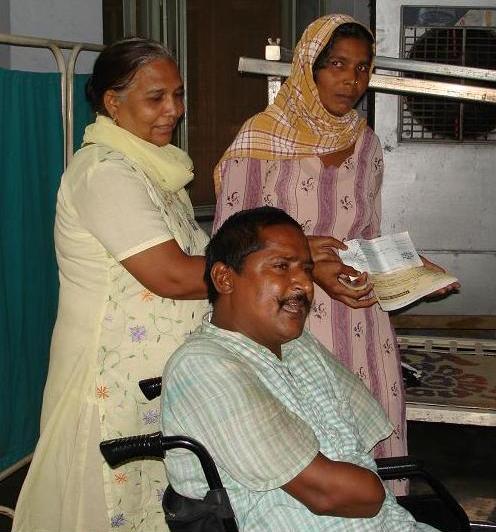
Another thing that made me happy is that the funds are delivered from the hands of KP's mother instead of some sundry politician.
Finally,
I thank Dr. K. P. Singh for completing the task. My special thanks go
to Prof Shiva Shankar, a great soul and a supporter of mine who stands
firmly behind me whenever I take up a work of this nature. He is not
only my best friend in this work but also a moral supporter in my times
of disappointment and discouragement. My Special Thanks to Rama Krishna Bhupathi for completing the task as per schedule.
Due to some technical difficulties, I could not post the information on our website www.ambedkarscholarship.org . I will do so and let you all know immediately when it is fixed. For now, I am sending the docs as attachments.
May
I expect your continued support to Ambedkar Scholarships in future? We
are venturing into several areas successfully. The need is so great but
the help is too less. Without your support it is not possible for us do
continue this work.
With best regardsBenjamin Paul KailaPlease write to me if any questions."Benjamin Kaila" <benjamin_kaila@yahoo.comPlease visit www.ambedkarscholarship.org
POSTED ON JUNE 22, 2007 www.ambedkartimes.com
|
|
HISTORIC RESOLUTION ON UNTOUCHABILITY
THIS IS THE FIRST TIME IN HISTORY THE US HAS OFFICIALLY SPOKEN OUT AGAINST UNTOUCHABILITY:
US
US House of Representatives Passe Historic Resolution on Untouchability
- July 23, 2007 House Concurrent Resolution 139 is the First Official
Statement on Untouchability by US Congress. Dr. Joseph D'souza, President of the Dalit Freedom Network, praised the leadership of Congressman Franks and the many others whose active support of the Dalit cause made HCR 139 possible:
"without the leadership of Members of Congress like Congressmen Franks,
Wolf, Smith, Sali, Tancredo, Pitts, and Congresswoman Kilpatrick in
sponsoring Dalit events, film screenings, and hearings and directing
their staff to advocate on this issue with vigilance, this historic
moment would have never happened. They
and the many others who have worked to make this resolution a reality
have earned the gratitude of millions of Dalits across India."
Nanci Ricks, Executive Director of the Dalit Freedom Network said that "This resolution should encourage all Dalits suffering under caste discrimination in India. The United State Congress has heard of the atrocities of caste and has responded. We hope that the United States Government and US businesses working in India will heed this statement by the House and will join with the Dalit Freedom Network in fighting the effects of caste across India."--------------------------------------------------------------------
LEGISLATIVE DAY OF JULY 23, 2007
110TH CONGRESS - FIRST SESSION
1:16 P.M.
DEBATE - The House proceeded with forty minutes of debate on H. Con. Res. 139.
Considered under suspension of the rules. Mr. Sherman moved to suspend the rules and agree to the resolution, as amended.
Source: http://clerk.house.gov/floorsummary/floor.html?day=20070723&today=20070724
Also without any western coverage: yesterday the US changed India from "developing nation" status to "transforming nation" status. The result is a 35% reduction in economic aid to India for 2008. Sadly, reductions under the new system will terminate US assistance in the areas of women's rights, democracy, education and sanitation: areas most affecting Dalits.
Source: http://economictimes.indiatimes.com/News/Economy/US_slashes_aid_to_transforming_India/articleshow/2229698.cms
H. CON. RES. 139
Rep. Trent Franks [R-AZ]
Cosponsors
Rep. Todd Akin [R-MO], Rep. Dan Burton [R-IN], Rep. Steven Chabot [R-OH], Rep. Yvette Clarke [D-NY], Rep. Bob Inglis [R-SC] , Rep. Sheila Jackson-Lee [D-TX], Rep. Stephanie Jones [D-OH], Rep. Carolyn Kilpatrick [D-MI], Rep. Dennis Kucinich [D-OH], Rep. Tom Lantos [D-CA], Rep. John Lewis [D-GA], Rep. Thaddeus McCotter [R-MI], Rep. James McGovern [D-MA], Rep. George Miller [D-CA], Rep. Marilyn Musgrave [R-CO]Del. Eleanor Norton [D-DC], Rep. Edward Pastor [D-AZ], Rep. Donald Payne [D-NJ], Rep. Mike Pence [R-IN], Rep. Joseph Pitts [R-PA], Rep. Steven Rothman [D-NJ], Rep. Bobby Rush [D-IL], Rep. Bill Sali [R-ID], Rep. Allyson Schwartz [D-PA], Rep. Robert Scott [D-VA], Rep. Christopher Smith [R-NJ],Rep. Thomas Tancredo [R-CO], Rep. Diane Watson [D-CA], Rep. Roger Wicker [R-MS], Rep. Frank Wolf [R-VA], Rep. Lynn Woolsey [D-CA]
H.CON. 139 EH
110th CONGRESS
1st Session
H. CON. RES. 139
CONCURRENT RESOLUTION
Whereas the Human Rights
Watch and the Center for Human Rights and Global Justice at New York
University School of Law released a report in February 2007 that
describes caste discrimination against India's `Untouchables' based on
in-depth investigations and the findings of Indian governmental and
non-governmental organizations on caste-based abuses;
Whereas the United States and the Republic of India have entered into an unprecedented partnership;
Whereas the July 18,
2005, Joint Statement between President George W. Bush and Prime
Minister Manmohan Singh stated that, ` [a]s leaders of nations
committed to the values of human freedom, democracy, and rule of law,
the new relationship between India and the United States will promote
stability, democracy, prosperity, and peace throughout the world [. . .
and] it will enhance our ability to work together to provide global
leadership in areas of mutual concern and interest';
Whereas caste is the socioeconomic stratification of people in South Asia based on a combination of work and heredity;
Whereas the `Untouchables', now known as the Dalits, and the people of the forest tribes of India, called Tribals, who together number approximately 200,000,000 people, are the primary victims of caste discrimination in India;
Whereas discrimination
against the Dalits and Tribals has existed for more than 2,000 years
and has included educational discrimination, economic
disenfranchisement, physical abuse, discrimination in medical care,
religious discrimination, and violence targeting Dalit and Tribal
women;
Whereas Article 17 of the Constitution of India outlaws untouchability;
Whereas despite numerous
laws enacted for the protection and betterment of the Dalits and
Tribals, they are still considered outcasts in Indian society and are
treated as such; moreover, in practice, Dalits and Tribals are
frequently denied equal treatment under the law;
Whereas Dalit women
suffer both caste and gender discrimination as a result of the
deficient administration of justice and are often raped and attacked
with impunity;
Whereas the National
Commission on Scheduled Castes and Scheduled Tribes has declared that
many of the reported cases of atrocities against Dalits and Tribals end
in acquittals;
Whereas, despite the
fact that many Dalits do not report crimes for fear of reprisals by the
dominant castes, national police statistics averaged over the past five
years by the National Commission on Scheduled Castes and Scheduled
Tribes show that 13 Dalits are murdered every week, five Dalits' homes
or possessions are burnt every week, six Dalits are kidnapped or
abducted every week, three Dalit women are raped every day, 11 Dalits
are beaten every day and a crime is committed against a Dalit every 18
minutes;
Whereas many Dalit girls
are forced to become temple prostitutes who are then unable to marry
and may be auctioned to urban brothels, and many women trafficked in
India are Dalit women;
Whereas low-caste unborn females are targeted for abortions;
Whereas according to
Human Rights Watch and India's official National Family Health Survey,
most Dalits and Tribals are among those poorest of the poor living on
less than $1 per day; most of India's bonded laborers are Dalits; and
half of India's Dalit children are undernourished, 21 percent are
`severely underweight', and 12 percent die before their 5th birthday;
Whereas Dalits and other
low-caste individuals often suffer from discrimination and segregation
in government primary schools leading to low enrollment, high drop-out,
and low literacy rates, perhaps linked to a perception that Dalits are
not meant to be educated, are incapable of being educated, or if
educated, would pose a threat to village hierarchies and power
relations;
Whereas the Dalits and Tribals maintain higher illiteracy rates than non-Dalit populations; and
Whereas the HIV/AIDS epidemic is India is massive and Dalits and Tribals are significantly affected by HIV/AIDS: Now, therefore, is it
Resolved by the House of Representatives (the Senate concurring),
That it is the sense of Congress that, as the leaders of the United
States and the Republic of India have expressed commitment to the
values of human freedom, democracy, and the rule of law, it is in the
interests of the United States to address the problem of the treatment
of the Dalits and Tribals in India in order to better meet mutual
social development and human rights goals by--
(1) Raising the issues
of caste discrimination, violence against women, and untouchability
through diplomatic channels both directly with the Government of India
and within the context of international bodies;
(2) Encouraging the
United States Agency for International Development to ensure that the
needs of Dalit organizations are incorporated in the planning and
implementation of development projects;
(3) Ensuring that
projects that positively impact Dalit and Tribal communities,
especially Dalit women, are developed and implemented;
(4) Ensuring that
cooperative research programs targeting rural health care, the HIV/AIDS
epidemic, and rural technology contain proper focus on the Dalits and
Tribals;
(5) Ensuring that anyone receiving funding in India from the United States Government--
(A) is aware that it is
United States Government policy that caste discrimination is
unacceptable, and that the
United States is committed to eliminating
it; and
(B) Treat all people equally without engaging in caste discrimination;
(6) Ensuring that--
(A) qualified Dalits are
in no way discouraged from working with organizations receiving funding
in India from the United States Government, and that transparent and
fair recruitment, selection, and career development processes are
implemented, with clear objective criteria; and
(B) procedures exist to
detect and remedy any caste discrimination in employment conditions,
wages, benefits or
job security for anyone working with organizations
receiving funding in India from the United StatesGovernment;
(7) Encouraging United States citizens working in India to avoid discrimination toward the Dalits in all
business interactions; and
(8) Discussing the issue of caste during bilateral and multilateral meetings, including congressional delegations.
Passed the House of Representatives July 23, 2007.
Attest:
Clerk
Eorwarded by paul@blackbuddhist.com, and 'Nishikant Waghmare'
POSTED ON JULY 26, 2007
|
|
BAMCEF’s 6th
Tamilnadu State Convention’2007
*APPEAL*
Dear Mulnivasi Brothers and Sisters
BAMCEF is committed to the objective of social revolution, which our forefathers cherished through out their lifetime. The
lieutenant of Babasaheb could not foresee the changing scenario and
therefore failed to introduce element of dynamism in the movement.
As a result they could not convert it into mass movement. BAMCEF has
taken note of the changing scenario and started organizing Mulnivasi
people, the original inhabitants of this land and the present day SC,
ST, OBC and converted minorities to make the movement strong and
cohesive. It has started yielding fruits but not to our expectation.
Therefore more sincere efforts are needed to reach to the masses.
In
order to achieve this objective BAMCEF conducts its activities all
throughout the years by way of Symposium, Mulnivasi Melas, State
Conventions and National Convention. Tamilnadu State Convention is one such event which is scheduled on *19th August 2007 at **Salem** *. We
wish to discuss and deliberate on various topics of present day
relevance, which are affecting our social life. One day event will
give a chance to delegates and speakers to share their ideas on various
subjects which are designed for the State Convention. In
a democratic setup generating a public opinion through discussion and
awakening can only bring the desired social changes. Today we have
several challenges in front of us. The reservation to OBC
in higher educational institution has become a ball game and is
shuttling between Judiciary and Parliament. The resentment amongst the high caste people and their opposition to the reservation of OBC is creating social tensions. We
do not see any honest approach either on the part of politicians or the
judiciary. This exhibits their non-committal attitude towards the
social welfare of the majority masses of this country. In short it can be said all efforts are made to stall the implementation reservation of OBC in higher educational institution. Similarly
there is a demand from Mulnivasi Muslims and Christians for reservation
in education and services, which is their democratic right for
representation in the governance of the country. We wish to deliberate
on these issues in our State Convention.
Another
aspect which has become a matter of concern to us is the infiltration
of Brahminical forces in Phule-Ambedkarite movement. Of course this is not a new phenomenon. But
taking the lessons from history it is an establish fact that time and
again, when the authority of Brahminism was challenged by the
revolutionary forces, the Brahmins intruded into the revolutionary
movement and destroyed the movement. This has been the age old practice. What
is more alarming is that in spite of all historical evidences
available, the lieutenants of Phule-Ambedkarite are not fighting out
the infiltration of Brahmins. On the contrary they are
welcoming Brahmins in the movement. We would like to remind them as to
how revolutionary movement of Lord Buddha was destroyed by the Brahmins
by infiltration and forewarn our masses that there is every danger to
Phule-Ambedkarite movement if Brahmins are allowed to infiltrate. We have therefore decided to discuss this issue in our State Convention.
For
past one decade BAMCEF is making conscious efforts to establish the
Mulnivasi culture and identity amongst the Mulnivasi Bahujan masses
throughout the country. We are of the opinion that this is the only mean to achieve our ultimate objective of social revolution. This is a gigantic task and we have decided to reach all the components and every individual of Mulnivasi Bahujan Samaj. We
wish to deliberate on the various methods to make the Mulnivasi
identity and culture more effective, acceptable and wide spread amongst
the masses.
We therefore, appeal to the masses and individuals to join us in this mission and contribute in whatever possible way they can. Their involvementand participation in any kind and form will go a long way in making this difficult task a great success.
Jai Bhim! Jai Mulnivasi!!
(BAMCEF Tamilnadu State Unit)
Engineer Process, Arjun Technologies (I) Ltd.
59, Vijayraghava road, T. Nagar. Chennai-600017 INDIA
Forwarded by M. S. Bahal (UK) Posted on July 21, 2007 | |
| BAMCEF's STATE WISE CONVENTIONS
July 14, 2007 to August 19, 2007
BAMCEF's 10th Andhra Pradesh state Convention Date: 14th and 15th July 2007
Place: NGO Kalyan Mandap, Back of Medical College, Guntur, Andhra Pradesh
Presided by Mr.S.F.Gangawane (Full Time Preacher- BAMCEF)
BAMCEF's 9th Delhi state Convention Date: 15th July 2007
Place: Bapu Samaj Sewa Kendra, Panchkuinya road, Delhi
Inauguration by: Mr. R .K. Kashyap
(Indian Postal Service, Director Information and Broadcasting Ministry)
Special Guest: Mr. Subacchan Ram (IRS)
Presided by : Mr.Dayaram- CEC member – BAMCEF
BAMCEF's 21st Gujarat state Convention Date: 21st and 22nd July 2007
Place: Shri Sthanakwasi Jain Wadi, Infront of Shrawan Talkies, Surendra Nagar, Gujrat
Presided by -Mr. D. D. Kalyani CEC Member – BAMCEF
BAMCEF's 17th Madhya Pradesh State Convention Date: 28th and 29th July 2007
Place:Jabalpur (Madhya Pradesh)
Presided by -Mr.Dayaram- CEC Member – BAMCEF
BAMCEF's 07th Bihar state Convention Date: 11th and 12th August 2007
Place: Hajipur Presided by : Dr.Chandu Mhaiske CEC Member – BAMCEF
BAMCEF's 14th Punjab State Convention Date: 12th August 2007
Place: Nawashahar, Punjab
Presided by Mr. B. D. Borka National President -BAMCEF
BAMCEF's 13th Haryana state Convention Date: 12th August 2007
Place: Kaithal , Haryana
Inaugurated by: Dr. Dharamchand Vidyalankar, Senior Vice President, Jat MahaSabha
Special Guest: Advocate Virendra Singh (President, Jat-Dalit Ekta Manch)
Presided by Mr. D. R. Arya (CEC Member - BAMCEF)
BAMCEF's 21st Maharashtra state Convention Date: 18th and 19th August 2007
Place: Kaamgar Bhawan, Kannamwar Nagar, Vikroli East, Mumbai (MS)
Special Guest: Dr. A. H. Salunkhe, (Famous Ideologist)
Presided by Mr.B.D.Borkar National Preident -BAMCEF
You all are cordialy invited to attend these Conventions
Regards
Ashish
Forwarded by M. S. Bahal (UK) POSTED ON JULY 15, 2007 |
=============================================================================
Caste Watch UK
conference on 15th July in Birmingham
Dear friends
CasteWatchUK
is holding a conference 'Fighting Caste Discrimination in the UK' at
Sandwell Council House, Oldbury West Midlands, B69 3DE on 15 July 2007.People
interested in human rights issues from the worlds of politics, faith,
education, broadcasting and civil rights activisms are attending the
conference. A number of key speakers will address the event. These
include Rob Morris MP, Professor Eleanor Nesbitt of the University of
Warwick, Professor Nicolas Jaoul of University of Paris, Dr Sushrut
Jadhav of Univerisity College London and Jasvinder Sanghera, author of
the book `Shame'. The conference will also include individuals speaking
about their personal experiences of Caste discrimination in this
country.CasteWatchUK
has worked hard since its formal launch in July 2004 to raise awareness
of Caste discrimination in the UK. Amongst the many actions we have
taken is our work with the Dept for Education and Skills; our input
into the Home Office White Paper "Strength In Diversity Consultations"
and our lobbying for legislation to make Caste Discrimination unlawful;
our key input into the DFID / DSN organised conferences; our robust
lobbying for debates on Caste discrimination in the Houses of
Parliament; our contributions to and publication of a number of
articles in the national and local press; and our active participation
in a number of radio discussion on Caste Discrimination.
This is a tremendous achievement from a small organisation, which
relies on volunteers to pursue its aims and objectives. Talking about
this evil discrimination will help remove the shackles of this
sometimes hidden form of Apartied in the UK.'I
am writing to invite you to attend CasteWatchUK's conference on 15 July
to discuss the issue of Caste discrimination in UK and agree actions
for the elimination of this pernicious form of discrimination.I
very much hope you will accept this invitation to attend our
conference. I will be happy to provide any additional information you
may require. I am attaching Programme of events and Directions for the
conference venue for your information.RegardsYours sincerely,(Davinder Prasad) General Secretary
THE VEDA PRAYER MUST BE STOPED!
It has come to our attention that the US
senate session on July 12th, 2007
will begin with a Hindu Chaplain doing the Hindu Veda, especially from Rig
Veda. We all are aware that the Veda teaches and preaches human discrimination
beyond any words can describe, it is the basis for the pathological Hindu Caste
system. The same Veda was and still responsible for millions of
Dalits / Ambedkarites getting killed in the name of CASTE SYSTEM (created by
Veda/Manusmiriti), thousands of Christians / Muslims / Sikhs & Buddhist getting killed in the name of caste system in India. The Veda prayer
must be stopped.
Our
Ambedkarite, Dr. Saint has created an online
petition to stop the Veda prayer. Please read further and sign the
petition, it
will be sending to the senators and representatives soon. Those who
want to contact the senators and representatives can do so on your own,
but feel free
to send them the copy of the petition.
Here is the link for UPLIFTTHEM, FOR MORE INFO AND DETAILS, YOU CAN READ IT FROM UPLIFTTHEM.
STOP THE VEDA PRAYER
IN THE US SENATE Here are the petition details
Petition History/Description The very fundamental value of America will be perturbed and perpetrated on July 12th
on the floor of the US senate, by the most dangerous bunch of people on earth
“the Hindu fundamentalists”. It has been reported that senate has invited a
Hindu Chaplain by name Rajan Zed from North Nevada to
perform this Vedic prayers to start the senate session in Washington
DC.
This is the height of not only ignorance but height of
insanity. Why?, as we all know that America stands for equality, human values, individual rights,
liberty and land of opportunity for the capable. On the contrary, Hindu’s of India stands for inequality, highly discriminative of humans
as upper, lower and untouchables.
The Hindu Caste system that divided the society and broke
the society into thousands of valueless pieces in the caste system, this very
same caste system is destroying the Dalits every single day in the last 3000
years and it is continuing as of today. The whole pathology of the Indian
society stems from this very Vedic preaching’s and teachings.
The Veda scriptures were the foundation for the human
discrimination and violence in India. The Hindu fundamentalists are destroying Christian
churches, burning Christian fathers alive, raping and killing the Christian
woman and other minorities, how callous is the senate members who trumpet to
invite a Hindu chaplain to pray in US senate?.
Moreover, the very Vedic learned and earned members of
the Hindu society are responsible for the enormous poverty, atrocity and
responsible for the degraded inhuman treatments of Dalits all over India.
How ironic is that the 218 year old, highly respectable US senate has conceived such a pathological idea of Hindu
prayer? While the 55 year old Indian parliament never advocated or entertained
such Hindu Vedic prayer in its own land. Because, the savior of Dalits society
Dr. B. R. Ambedkar, the first law minister of India and the father of the Indian constitution made caste
system illegal and unlawful. So, the good practices and good intentions of the
parliament was preserved by the followers of Dr. B. R. Ambedkar and good humans
who know the pathological intentions and satanic influence of unscientific and
anti-social Vedic scriptures and its preaching’s.
Veda and Rig Veda from where the scriptures of hymns will
be selected is one of the oldest scriptures written in “Sanskrit” language, why
do we Americans has to listen to some alien and ill conceived language that no
body has any clue on earth as what the heck this chaplain is saying in his
prayers. This is the same Veda that preaches all men are not equal, this is the
same Vedic scriptures teaches human discrimination of the highest order that is
destroying humans and the society in India, this is the same Veda that
practices sacrifices of animals, including humans to pray false gods. As the
Vedic and Hindu religion prays close to million gods, artificially created to
keep the people of India under false and filthy faiths as well as to keep the
Indians under constant fear of meaningless stones and idols, Veda is created as
a tool to manipulate and control the 90% of the society by a merely 10% anti
social elements of the society, so, except for those who created the Vedas who
uphold the powerful positions and grabbed the entire opportunities of India
into their backyard, are savage animals, they savaged the nation in the name of
caste system.
The human discrimination and segregation in India is 3000 years old organized social crime, it is a blot
on any civilized society and the world. This is originated in the Veda, which
discriminates humans as upper, lower, outcaste and untouchable, unseeable and
what not?
The result, the Vedic teachings and prayers are
constantly precipitated in Hindu’s and non-Hindu’s mind that they lack any
reasoning and logical abilities, that is why they attack and kill their own
fellow men and woman in India. Such is the greatness of Veda that the senate is
interested in listening to on the 12th of July.
This initiative and steps taken by the US senate to start the senate with Veda prayer will
enormously undermine the value system of America and such a step will encourage nations to discriminate
their own people. This will encourage the Hindu fundamentalists who are already
attacking churches, Muslim prayers Halls and other minorities in India, especially it will give upper hand for the
fundamentalist Hindu’s to continue to attack the innocent Dalits in the name of
meaningless Veda and scriptures. This will add fuel to the already dangerous
Hindu’s atrocious activity in India, this Veda preaches and practices that all men are not
equal.
Human rights, woman rights and minority rights are
equally protected and respected in America, while no such rights exists in
India mainly because of the Hindu religious sanctions and orders that come
through Veda.
Is it worthy to use such a prayer in US senate? Is it right to use such a prayer in US senate?
Respectable senators, congress men/woman and
representatives, please be informed about the truths of such prayers from such
dangerous religion. While the state has kept the church separate, how come you
are bringing the Hindu temple and its callous prayers inside the US senate? Are you aware of how many Dalits are getting
killed in India every single day in the name of the caste system that
originated from this very Veda and Vedic scriptures.
We sincerely hope you will pay some attention to these
issues and take immediate action to stop the Veda prayers in the upcoming
senate session on 12th of July, 2007.
If
you respect and follow the American traditional value system that all men are
equal, then stop the prayers that teaches all humans are not born equal, then
stop the prayers that teaches myths and filthy beliefs, then stop the prayers
that are extremely dangerous to India, America and to the world, then stop the
Vedic Prayers that are insane and unscientific.
Dear Senators and Representatives of America
The very foundation of America is in danger today as the senate member asked for a
hindu/Veda prayer to begin the US senate session on the 12th of July, 2007.
While the senate always had Christian chaplain do the
prayers, there is a value and respect to start the senate with such prayers.
Whereas, the Veda prayers of Hindu religion are one of the most dangerous and
discriminatory in its scriptures as well as in day to day usage. The rig Veda
from where the Hindu chaplain will read the prayers is an ill conceived,
anti-social scriptures that discriminated humans against humans in various
aspects, which resulted in huge segregation of people who are leading a poverty
ridden life in India.
About 45% of Indians live below poverty, among them more
than 250 million of them are Dalits (the so called untouchables) were living a
miserable and unacceptable life, they live in constant danger of Hindu’s who
preach and practice this very Veda. Dalits and minorities like Christians,
Muslims and Sikhs in India live and lead a miserable life, because these people
were not allowed to benefit from the education system, they were tactically
abandoned to use the natural resources of India and they are not the
benefactors of financial resources and economic growths of India, mainly
because of the pathological oppressive influence of Vedic teachings.
Though the caste system was made illegal and
unconstitutional (by Dr. B. R. Ambedkar the first law minister and father of
constitution of India), due to the manipulative and fake godly powers of Vedic
teachings, such caste system has been precipitated and perpetuated like a
pandemic in the last several thousand years, that is continuing as we speak. An
initiative to encourage such dangerous prayer is a negative step and a huge
step backwards from civilized society to an ancient Varna lead uncivilized era.
Please take immediate action to stop the Veda prayers in
the US senate floor on the 12th of July 2007, it will undermine the American values and the Veda
prayers will bring shame to the respects we have for individual humans. America
and Americans has great values on humans, America respects humans as humans,
whereas Hindu’s and Vedic readers are dangerously dispositioned to treat humans
equally as they do not believe in equality, but they certainly and strongly
believe in divisive systems like upper, lower castes and outcasts. Dalits are
the worst affected of those Vedic preaching’s and prayers. They are the
original Indians and inhabitants of Indian land; they were chased out of their
own lands and properties by these Veda teaching Hindu fundamentalists. The Dalits
were once referred as untouchables, but even now in many villages and rural
areas the untouchability and unsociability is alive and very common practice of
Hindus.
No Veda abiding Hindu will ever interact or share any
food, clothes or knowledge with the Dalits, because, for the Vedic people no
human makes any sense except their own Veda reading priests and Veda followers,
such is their bloated senselessness. For those Vedic people, the Dalits are
inconceivably lowly, even lower than animals.
Do we need such a people come to the senate and read some
pathological prayers? We urge all the representatives, senators and congress
men/woman and president to immediately stop this pandemic of Hindu prayers in
senate.
We urge all the Dalits, Christians, Muslims,
Sikhs and non-Hindu’s worldwide to come forward and sign this petition to help
the good senators to stop this menace. All good humans and good citizens who
values humans by the very virtue of human as humans to come forward and sign
this petition, let us help the senators to stop this perpetrators of humanity
from invading the senate and the senate sessions. STOP THE VEDA PRAYER IN THE US SENATE
POSTED ON JULY 8TH, 2007
|
INSAN ACHIEVS MERIT POSITION
Phagwara:- Insan, student of Mohan Lal Uppal D. A. V Collegiate Senior Secondary School, Phagwara, Punjab has achieved merit position in the 12th class examination taken by Punjab School Education Board, Mohali, Chandigarh. He secured 422/500 (84.4%) marks. Insan (17 years) believes that man is grieved due to ignorence and ignorance can be ended only by gaining knowledge. He also believes in gaining more and more knowledge to contribute for ending the sorrows of the sufferers. Also to be remembered that Insan is younger brother of Manav who topped in Guru Nanak Dev University, Amritsar in the B. A., L. L. B (FYC) 5th semester examination. It is pertinent to mention here that Insan is son of famous writer & scholar Dr. S. L. Virdi Advocate and Banso Devi Lecturer who has been written three dozen books for Social Justice and Human Rights.
Posted on June 30, 2007
============================================================================
FUNDS DELIVERED TO PUNJAB'S
DALIT HERO S. BANT SINGH
Dear donors and friends,
I am extremely happy to let you know that we have handed over funds collected to help a Punjab Dalit Hero, Br. Bant Singh of Mansa, who fought heroically with landlords to get justice and lost his limbs in the process.
First of all, I apologize for the delay in completing this task. Originally, it was planned to be completed in Mar 2006. Due to logistic reasons, it got delayed this long. I hold myself responsible for this delay.
I thank all donors for their generous donations and patience to wait this long to complete it. I hope, your confidence in me and in our project is still in good standing.
I feel relieved and my happiness is unbounded. It is far greater than the most memorable Will Smith's happiness in "Pursuit of Happiness" (one of a few movies that I can remember as long as I live) movie when he got the stock broker job after all the pains he had gone through in his life. If not seen, I advice you all, to see without fail this wonderful movie of a real life story.
Another thing that made me happy is that the funds are delivered from the hands of KP's mother instead of some sundry politician.
Finally, I thank Dr. K. P. Singh for completing the task. My special thanks go to Prof Shiva Shankar, a great soul and a supporter of mine who stands firmly behind me whenever I take up a work of this nature. He is not only my best friend in this work but also a moral supporter in my times of disappointment and discouragement. My Special Thanks to Rama Krishna Bhupathi for completing the task as per schedule.
Due to some technical difficulties, I could not post the information on our website www.ambedkarscholarship.org . I will do so and let you all know immediately when it is fixed. For now, I am sending the docs as attachments.
May I expect your continued support to Ambedkar Scholarships in future? We are venturing into several areas successfully. The need is so great but the help is too less. Without your support it is not possible for us do continue this work.
With best regardsBenjamin Paul KailaPlease write to me if any questions."Benjamin Kaila" <benjamin_kaila@yahoo.comPlease visit www.ambedkarscholarship.org
============================================================================

Celebrating 2551th Buddha Jayanti (Vesak Purinamma)
June 24 (Sunday), 2007
3.30PM - 7.30PM
RAJA Bear Creek Hall
8580-132, Street, Surrey, BC .
Tel: 604-339-2040 , 604-375-2027
All are cordially invited to attend this auspicious function along with families & friends. Ven. Chander Bodhi ji (UK) will preside over the function. Sri Lankan Buddhist Society, Chinese Buddhist Society, Vietnamese Buddhist Society, Burmese Buddhist Society, Korean Buddhist Society, Raj Kumar (Toronto) and Raju Kamble (Calgary) will also honor the ceremony.
Devotees will participate in Panchsila & Atthasila with a Buddha Puja celebration by Respectable Monks. Many scholars will speak on Buddha and his Dhamma. There will be cultural presentations followed by sacred songs. Food will be served.
THE BUDDHA AND HIS DHAMMA- DR. B.R. AMBEDKAR
“The Mind is the origin of all this is; the mind is the master, mind is the cause.”
(DR. B.R. AMBEDKAR)
Indian Buddhist Society of Canada
12120-100Ave, Surrey, B.C., Canada,
V3V 2W6 E-mail: india.budhaland@yahoo.ca
We are very punctual of time so please come on time or before the given timings.
SENT BY KAMLESH AHIR POSTED ON JUNE 20, 2007
=================================
DALIT ITELLECTUAL FORUM'S SEMINAR IN CHENNAI
--Dr. lakshmanan
Dalit Intellectual Forum Chennai is going to organize a day long seminar at LLA Building, Chennai at 9.30 a.m. on Saturday, June 23, 2007. Please feel free to forward the message to friends and others for larger participation. All are welcome.
Theme: Social Alliance of BSP in Indian Politics and Democratic Experiment
Chair: Edward M Doss, Convener, United Dalit Christian Movements, Madurai.
Welcome: Prof. Stalin Rajangam, Tripatur
Speakers: Dr. Vivek Kumar, Associate Professor
Centre for Study of Social System, School of Social Sciences
Jawaharlal Nehru University, New Delhi
Mr. Ravikumar, MLA, DPI & Writer, Chennai
Dr. Leela Kumari, Feminist Scholar, Andra Pradesh
Ms. Sukirtha Rani, Feminsit Poet, Vellore
Mr. K. Elangovan, Advocate, High Court, Chennai
Vote of Thanks: Dr. C. Lakshmanan, Asst. Professor, MIDS, Chennai
POSTED ON JUNE 20, 2007
===========================================================================
AMBEDKARTIMES.COM
Congratulates its Dear Readers and the entire community on the Raising Day of the
Historic Ad Dharm Movement at its meeting on June11-12, 1926 held in the village of Mugowal, Thana
Mahalpur, Tehsil Garhshankar, District Hoshiarpur under the chairmanship of Babu Mangoo Ram Mugowalia.
"Even after the British Government was established, the Hindu Aryans and the Sikhs did not change their
attitude. They continued to discriminate against people on the basis of so-called high caste and low
caste". [Report of the Ad Dharm Mandal, 1926-1931.]
POSTED ON JUNE 12, 2007
=====================================================
DR. AMBEDKAR MISSION SOCIETY, BEDFORD WILL CELEBRATE
116th Birth Anniversary of Dr. Ambedkar celebration of Ms. Mayawati's landslide election victory
Dr. Ambedkar’s birthday is being celebrated across the world as a day of liberation and justice. Recently his birthday was celebrated in Pakistan, UAE, Mauritius, New Zeeland and various other countries. Dr. Ambedkar’s whole life provides an example and inspiration to millions of people who are suppressed and denied their basic human rights from centuries. His life was a relentless struggle against injustice and oppression. His birthday will always remind us about his sacrifice and also our responsibilities towards our fellow citizens who are still victims of injustice and oppression.
Because of his efforts, many people are able to stand on their feet and are leading a life with dignity, honour and comfort. The very people who were not allowed to sit near so called high castes are becoming rulers and the exploiting castes are forced to bend before Dalits. Today Dr. Ambedkar’s magic of equality, liberty and fraternity is working.
Following the foot steps of Dr. Ambedkar, BSP under an able leadership of a Dalit woman, Ms. Mayawati has won a spectacular victory in the recent concluded elections in the state of Uttar Pardes, the largest and the most populous state of India. In a caste ridden society, it was quite an unimaginable a couple of decades ago. Now our sister Ms. Mayawati has become a Chief Minister of UP for the fourth time which is matter of pride and joy for all of us.
Dr. Ambedkar’s birthday is an appropriate occasion to rejoice and celebrate the achievements and successes of our people. To rededicate ourselves to the ideals of Dr. Ambedkar and celebrate the election victory of Ms Mayawati, I am pleased to announce that we have arranged a celebration function on Sunday, 3rd June, 2007 at the Queens Park, Community Centre, Marlborough Road, Queens Park, Bedford from 2pm to 6pm.
Everyone is welcome. It would be highly appreciated, if you along with your family, friends and members of your organisation participate in this happy occasion.Refreshments will be served.
Arun Kumar
General Secretary,
Dr. Ambedkar Mission Society, Bedford (UK)
Tel: 01234 312976 - Email arun.kumar@ntlworld.com
POSTED ON MAY 28TH, 2007
===============================================================
DR. B. R. AMBEDKAR's FINAL WORDS
My final word of advice to you is educate, agitate & organize, have faith in yourself. With justice onour side, I do not see how we can lose battle.The battle to me is a matter of joy. The battle is in the fullest sense spiritual. There is nothing material or social in it. For our’s is battle not for wealth or for power. It is battle for the reclamation of the human personality.
MS. MAYAWATI JI
CHIEF MINISTER OF UTTAR PARDESH
Following the ideals of Dr. Ambedkar, a Dalit woman, Ms. Mayawati has been able to become a Chief Minister India’s largest state of Uttar Pardesh. It is time to rejoice and celebrate this spectacular victory. To shed light on Dr. Ambedkar, Ms Mayawati and late Mr.Kanshi Ram’s contribution to the downtrodden people and for their human rights, many activists from all over U K are participating in this function on Sunday, June 03rd, 2007.
ARUN KUMAR
POSTED ON MAY 29, 2007
===================================================== VIOLANCE WITH IMPUNITY AGAINST DALITS IN INDIA
That this House notes with grave concern the on going violence with impunity against Dalits in India (Formerly called ‘untouchables’); recalls the tragic murder of Surekha, Priyanka, Sudhir and Roshan Bhotmange in Khairlanji village in September 2006; regrets the chronic deficiencies in the investigation and the lack of prosecution of negligent police officers involved in the case; notes that official figures record approximately 26,000 atrocities against Dalits every year; notes that this statistic is unlikely to represent the true extent of violence; further notes a recent study on untouchability in rural India finding that Dalits faced discrimination in their access to police stations in 28% of villages and in their treatment in police stations in 32% of villages; notes the European Parliament Resolution of 1 February 2007 on the human rights situation of the Dalits in India; recognises the existence of legislation to protect Dalits from caste-based violence and humiliation in India; and calls upon Her Majesty’s Government to make representations to the Indian Government to urge for the effective implementation of laws protecting Dalits from violent attacks. Meena Varma (Coordinator) Dalit Solidarity Network - UK www.dsnuk.org
Forwarded by Mr. M.
S. Bahal
=========================================================================== FEW WORDS ABOUT AMBEDKARITE MR. BALLEY ON HIS TORONTO VISIT
By Ronki Ram (Dr.)
It is nice to read that Respected Shri Lahori Ram Balley is going to be the chief guest at the upcoming programme of Baba Sahib's birthday on 5th MaY, 2007. Shri L. R. Balley has been and is one of the few active and totally dedicated Ambedkarities who made spreading the teachings of Dr. Ambedkar a mission of his life. He made the writings of Baba Sahib available to the people in Northwest India when even the collected works of Baba Sahib were not yet available. He took extra pains to travel to different parts of the country to collect his scattered writings and put them in one place (Thus Spoke Ambedkar, Compiled by Bhagwan Dass) for the anxious followers of the philosophy of Baba Sahib Ambedkar. Later on, it was through his and his team's efforts that the Department of Education, Government of Maharashtra started the process of publication of the collected works of Dr. B.R.Ambedkar's writings. In fact the first Volume consisted of the material provided by Shri Lahory Ram Balley. His efforts to raise ‘Ambedkar Bhawan' in Jalandhar where Baba Sahib once delivered his famous lecture on October 27, 1951 are praiseworthy. The Bhawan has now become a centre of Dalit activities in Punjab where every year anniversaries of Baba Sahib are being celebrated with great enthusiasm. The road on which Ambedkar Bhawan situated is known as Dr. Ambedkar Marg. Another commendable deed of Shri Balley sahib is the regular publication of Bheem Patrika since December 1985. Earlier published in Urdu, now in English, Punjabi, and Hindi, Bheem Patrika is one the major and prestigious publications solely dedicated to the vision and philosophy of Dr. B.R. Ambedkar Sahib. Shri Balley sahib met Baba Sahib on September 30, 1956 and promised him to devote his entire life to carry further his mission of the empowerment of the Dalits. To fulfill the promise, Shri Balley resigned from the permanent Govt. service on the day Baba Sahib passed away, December 6, 1956, and since then, as a true Ambedkarite, did not look back. He embraced Buddhism along with thousands of his missionery fellow beings on June 15, 1963 under the guidance of Bhikshu Pragyananda of Sri Lanka in a ceremony organised at Phagwarwa. He was also the vice president of the All India Action Committee of the Republican Party of India. The Baba Sahib Ambedkar National Institute of Social Sciences Mhow honored him with the annual Life Time Award in 2002 for the commendable service he rendered for the mission of Dr.Ambedkar Sahib. During the Talhan crisis (2003) he played very important role by organising Dalit Action Committee, which later on assumed the role of monitoring the state of affairs of the Dalit Human Rights in Punjab.
I wish him a healthy and active long life. I congratulate for organising the Birth Anniversary of Baba Sahib.
POSTED ON APRIL 26, 2007
======================================================
UPLIFTTHEM & SHRI GURU RAVI DASS TEMPLE, RIO LINDA (CA.)
INVITES YOU AND YOUR FAMILY,
www.ambedkartimes.com, www.upliftthem.blogspot.com
AMBEDKARITES MEETING
AT SHRI GURU RAVI DASS TEMPLE, 6221, 16TH STREET, RIO LINDA (CALIFORNIA)
AT 2.30 P.M. - 6 P.M. ON SATURDAY, APRIL 21ST, 2007.
GUESTS:
MR. MANGESH DAHIWALE, ATROCITY NEWS, INDIA
MR. MAITREYANATH ARJUN DHAMMAKIRTI, INDIA
MR. VIRDHAMMA, (DAVID CREIGHTON) SFO, CA,
Discussion Topic:
Various issues of Ambedkarites, Dalit Atrocity, Solidarity of our People around the world,
Ambedkar’s principles and Services. Lunch and Tea will be served.
This meeting is proudly sponsored by:
Shri Guru Ravi Dass Temple, Rio Linda (Sacramento County) California & this event is dedicated to
our “Father of Nation Dr. B. R. Ambedkar on his 116th Birth Anniversary.
======================================================
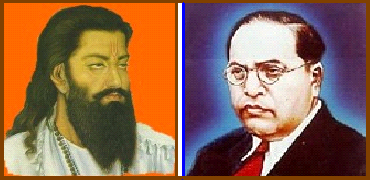
SHRI GURU RAVI DASS SABHA SACRAMENTO (CALIFORNIA)
WILL CELEBRATE BABA SAHIB DR. B. R. AMBEDKAR'S
116TH BIRTH ANNIVERSARY ON APRIL 15TH
Shri Guru Ravi Dass Sabha Sacramento (California) will celebrate 116th birth anniversary of Bharat Ratan Baba Sahib Dr. B. R. Ambedkar (A great leader of 20th century in the world) at Shri Guru Ravi Dass Temple, Rio Linda (California) at 11:00 a.m. on April 15th, 2007 (SUNDAY). The Shri Guru Ravi Dass Sabha Sacramento cordially invite every one come to the Temple to celebrate birth anniversary of Baba Sahib Dr. Ambedkar.That day, the speakers will enlight the life & mission of Baba Sahi Dr. Ambedkar.
With regards
Ajit Ram Bangar (Chairman), Tawinder Kazla (Vice Chairman), Kewal Bolina (President),
Karnail Virk (Vice President), Amar Baidvan (Gen. Secretary), Hans Raj Kajla (Secretary),
Dhyan Singh (Cashier) , Daljit Jassal (Cashier)
For further information, please contact:
Head Granthi Bhai Sital Singh (916) 992 1710
=====================================================
THE D E S T R U C T I O N
The destruction of Dr. B.R. Ambedkars’ statue in Kanpur UP, India
has been no doubt a national uproar. Many riot in rebellion against the
destruction and demand that the Parliament take proper actions. Fortunately
the parliament will seek its justice; however we as the advocates for
reform under the name of Dr. Ambedkar have to maintain structural
organization. We must apprehend that although statues can
be brought down; the values and moral principles of Dr. Ambedkar lie
with in our own means of justification. Our belief remains within us, and therefore under no means can it be brought down.This
is the vary man who drafted the Constitution of India. The vary
individual who fought for equality amongst individuals of depressed
social and economic classes. This
is the individual who began the movement of equality and justice
amongst religions, men, and women. Therefore in spite of current
pandemonium; it is in our best efforts as advocates of political
justice to continue the work of Dr. B.R. Ambedkar.
Kewal Bolina President of Sri Guru Ravi Dass Temple, Rio Linda, (California)USA =====================================================
SHRI GURU RAVI DASS SABHA PITTSBURG
WILL CELEBRATE
DR. B.R. AMBEDKAR'S BIRTH ANNVERSARY
Shri Guru Ravi Dass Sabha (CA) Pittsburg is going to celebrating the birth anniversary of Bharat Ratna Dr. Bhim Rao Ambedkar at Shri Guru Ravi Dass temple Pittsburg on Sunday, April 29th, 2007. Everybody is cordially invited to join us in this great function and pay their respect to this prominent leader.
On Saturday, March 10th, 2007 there was an initial meeting with the committees of all Shri Guru Ravi Dass Sabha’s in California at Shri Guru Ravi Dass Temple Rio Linda (California) to discuss our community concerns and share ideas on how to bring the community together to accomplish aims, objectives of our community worldwide.
As a result of that meeting it was decided to schedule another meeting to sit down and begin to collectively collaborate on a plan to resolve various issues for welfare and advancement of our community.
This meeting has been scheduled for Sunday, April 29th, 2007 at 2:00 PM. to be held at Sri Guru Ravi Dass Temple, Pittsburg. Your kind presence and participation in this meeting with your respected views and suggestions will be highly welcomed. We hope to make great strides in our community through these meetings.
Dashvinder Paul (Gen.Sec.)
Shri Guru Ravi Dass Sabha Pittsburg
2150 Crestview Drive, Pittsburg, CA. 94565
====================================================
V.T. RAJSHEKAR
Mr.V. T. Rajshekar is the Editor of the powerful Dalit Voice.India’s oldest and the largest circulated English journal, published in several Indian languages.Originally a senior journalist from the Indian Express, he is considered the country’s most original thinker, scholar and also philosopher. As India’s most famous Dalit writer he has authored over 50 world famous books dealing with the problems of caste, Muslims, Christians, Sikhs, Brahminism, etc.
======================================================
SILVER JUBILEE OF DALIT VOICE
Dear Friends,
Dalit Voice, the voice of persecuated nationalities in India has proudly completed 25 year. It is time to celebrate the achievments of Dalit Voice in developing a razor sharp Dalit intellegentsia and providing an alternative view point to thousands of its readers. Editor of Dalit Voice will be joining this programme in Delhi on April 8th. As a member of Dalit VOice Silver Jubliee Celebration Committee, I exend my warm invitation to you all to join this deliberations and facilitate Mr. V.T. Rajshekar, editor Dalit Voice. A short programme sheet is being attached here. Hope to see you at the Gandhi Peace Foundation on April 8th, 2007. A number of activists, writers have already confirmed their participation in the event.
DALIT VOICE SILVER JUBILEE CELEBRATION COMMITTEE
PROGRAMME SCHEDULE
10:00am: Welcoming the guests by Rajni Tilak and V.B. Rawat
10:10am: Release of Hindi version of Caste vs Nation by V.T. Rajshekar
10:10am: 25 Years of Dalit vocie by V.T. Rajshekar, editor Dalit Voice, Banglore
10:20am-1pm: Facilitation by Dalit voice readers and supporters
1:00-2:00pm: Lunch Break
2-4:00pm: Dalit voice reader's direct interaction with editor V.T. Rajshekar
4-5:00pm: Future of Dlait voice: V.T. Rajshekar, editor, Dalit Voice
5-5:30pm: Vote of Thanks
Date: April 8th, 2007, Sunday Time: 10am-5:30pm Venue: Gandhi Peace
Foundation, Deen Dayal Upadhyay Marg, Near ITO, New Delhi-11002
With warm regads,
Vidya Bhushan Rawat Contacts: 65902846. 22462528,
Rajni Tilak: 9871514040, Sati Nath Chaudhury: 9350041088
=====================================================
THE BLACK BUDDHIST COMMUNITY THANK
TO MR.V.T. RAJSHEKHAR
Jai Bheem
The Black Buddhist Community in America wishes to thank Mr. V.T.Rajshekar for his unending service to humanity.As you list the many achievements of Dalit Voice please mention the thousands of Black Americans who are today being awakening to the message of Dalit Voice. Through Dalit Voice as well as Mr. V.T. Rajshekar's other numerous publications we are inspired to join the struggle for Dalit rights and to inform our people in America all about our brothers and sisters in the east. Please pass-on our congratulations and heart-felt thank you to Mr. V.T. Rajshekar and Dalit Voice for the influence he is today having around the world.
Paul Guthrie
Founder
Black Buddhist Community in America
paul@blackbuddhist.com =====================================================
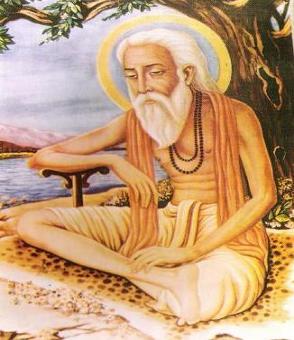
SHRI GURU RAVIDASS SABHA VANCOUVER
ELECTED THEIR NEW BOARD FOR THE TERM 2007-2009
By Jai Birdi
Vancouver: The Shri Guru Ravi Dass Sabha of Vancouver held elections on March 17 andelected a new board for the term 2007 to 2009. All candidates under the banner of Bill Basra were duly elected with an overwhelming support of Sabha's membership. The Sabha has 909 members and 695 of these members turned up to cast their vote. While Bill Basra received 477 votes (68%), his opponent, Kewal Singh Sidhu, received 246 votes. For details of election result, please visit http://www.gururavidasssabha.org/events.htm
"I am very pleased to see how peacefully members participated in the democratic process of electing a board", said Lamber Rao, Presiding Election Officer for the Sabha. More than 76% of the membership came to participate in the process and exert their right to vote in the Sabha's first election.
Following is a list of the board and the executive committee for the term 2007 to 2009:
Mr. Bill Basra (President), Mr. Sital Dass Kaler (1st Vice President), Mr. Santokh Ram Jassal,(2nd Vice President), Mr. Jaswinder Singh Mehmi (General Secretary) Mr.Harmesh Lal Owan(Assistant Secretary), Mr. Ram Sarup Chandharh (Treasurer), Mr. Paramjit Singh Kainth (Assistant Treasurer), Mr.Paramjit Lakha (Director), Mr. Mohan Lal Bains (Director), Mr. Ajit Ram Kaler (Director), Mr. Raj Kumar Bangar (Director), Mr. Hans Raj KatariaDirector), Mr. Ram Kishan Chander (Directo (r)
=====================================================
DEBATE ON DALITS
IN THE HOUSE OF LORDS (LONDON)
Lord Alton of Liverpool asked Her Majesty's Government:
26 Mar 2007 : Column 1434 India : Dalit 2.46 pm
What representations they have made to the Government of India about
human rights and exploitation of the Dalits in India .
Baroness Royall of Blaisdon: My Lords, officials at the British High Commission have regular discussions on human rights, including rights for Dalits, with the Government of India. My right honourable friend Ian McCartney, the Minister of State for Trade and Investment, raised human rights issues during his recent visit to India and subsequently wrote to Anand Sharma, the Minister of State in the Ministry of External Affairs.
Lord Alton of Liverpool : My Lords, I thank the Minister for that reply. Is she aware that 200 years ago William Wilberforce described what he called “the cruel shackles� of the caste system as, “a detestable expedient ... a system at war with truth and nature� With the launch this week of the film “India's Hidden Slavery�, which highlights the violence, exploitation and discrimination experienced by India's 167 million Dalits, will we work with the Government of India to challenge, not least through education, the persistence into the 21st
century of this degrading and pernicious system, which threatens the social stability and economic progress of India? Does the Minister agree with India 's Prime Minister, Dr Manmohan Singh, that, “Untouchability is not just social discrimination, it is a blot on humanity�?
Baroness Royall of Blaisdon: My Lords, I agree with the noble Lord and with the Prime Minister of India—it is indeed a blot on humanity. Discrimination on the basis of caste identity constrains the human rights, livelihoods and life chances of millions of men, women and children. It is a systematic injustice and a routine violation of the
most basic human rights. For that reason, we are working with the Government of India to assist them in
addressing the issue and in implementing the rather good legislation that they have but which is not yet being
properly implemented.
Lord Avebury: My Lords, as one means of helping the Government of India, would the noble Baroness consider the suggestion made by a member of the United Nations Committee on the Elimination of Racial Discrimination that social data collected in India should be disaggregated by class, so that the relative disadvantage suffered by Dalits and Adivasis can be measured, particularly their relative attainment of the millennium development goals, compared with the population of India as a whole?
26 Mar 2007 : Column 1435
Baroness Royall of Blaisdon: My Lords, I regret that I do not have a specific view on the data mentioned by the noble Lord, but I will certainly look into them. One of the programmes that DfID is funding concerns data in respect of Dalits, so I hope to be able to give him a full reply, a copy of which I will place in the Library.
Lord Anderson of Swansea : My Lords, India is a vibrant, modernising democracy and a good friend within the Commonwealth. Should not our message be that, in so far as it does not deal sympathetically with the Dalit problem, that is not only wrong in itself but blunts India 's excellent record on human rights outside its borders?
Baroness Royall of Blaisdon: My Lords, my noble friend is absolutely correct. As I pointed out in my earlier response, it is why my right honourable friend has written to the Minister responsible in India . We raise this issue frequently and our High Commission regularly raises it with officials in India . It is a matter that we will not leave because it is a blatant injustice and has to be dealt with. The Indians are our very good friends and we want to
work with them to help them to eradicate it.
Lord Harries of Pentregarth: My Lords, in view of India 's very rapid economic growth, does the Minister agree that there is an historic opportunity to ensure that the Dalits are included in this growing employment? Will she accept on behalf of government employees in India the Ambedkar principles of fair employment, particularly for Dalits? Will she encourage the many British companies now investing in India also to accept those principles of fair employment?
Baroness Royall of Blaisdon: My Lords, we certainly support the Ambedkar principles and we are encouraging all companies that have a relationship with India , trading or whatever, to support those principles as well. Our main approach on labour standards is via the UN's Global Compact, which is an agreement, launched by Kofi Annan in 2000, between the UN and business to uphold and promulgate 10 principles covering human rights, labour, the environment and combating corruption, but the Ambedkar principles are very good.
Lord Desai: My Lords, is my noble friend aware that India has a policy of reservation, both in employment and for slots in higher education, for scheduled castes—the Dalits—and scheduled tribes? Does she agree that a more important task for India is to pay attention to primary and secondary education for the Dalits and others so that they can progress to higher education and good government jobs?
26 Mar 2007 : Column 1436
Baroness Royall of Blaisdon: Indeed, my Lords, we applaud the policy of reservation for the moment, but we hope that one day, with more education opportunities for Dalits, it will no longer be necessary. For that reason, many of our programmes are to do with education, especially of women and girls in India .
Baroness Cox: My Lords, is the Minister aware that, in contradiction to India's national constitution, nine out of 28 states have passed anti-conversion laws, which deprive people of the freedom to choose and change religion and deprive Dalits of the right to move out of the caste system?
Baroness Royall of Blaisdon: My Lords, I am aware of those anti-conversion laws. They are a subject of our regular dialogue with the Government of India and with states.
...................................................................................................................
DALIT SOLIDARITY NETWORK UK
Thomas Clarkson House, the Stableyard, Broomgrove Road, London SW9 9TL
Tel: +44 (0)20 7501 8323 Fax: +44 (0)20 7738 4110 Email: dalitsnuk@yahoo.co.uk
Registered Charity Number -1107022
Press Release
TIME NOW FOR ABOLITION OF CASTE
The celebrations to mark the Act of abolishing the Slave Trade in 1807 were invoked at a meeting in Parliament seeking an end to caste discrimination. Chairing the meeting the Bishop of Chelmsford, Rt Revd John Gladwin, said what an important weekend this was, marking the 200th anniversary of Abolition, and drew parallels with the need to abolish caste discrimination also. Dr Joseph D’Souza from the Dalit Freedom Network quoted Wilberforce who had achieved his aim 200 years ago in this same Parliament. Wilberforce said, 'Caste is a system at war with truth and nature'.
The meeting was organised by the Dalit Solidarity Network, in conjunction with Christian Solidarity Worldwide which is hosting the delegation for two weeks, to brief MPs and others on the current situation in the caste struggle. Professor Kancha Ilaiah drew attention to the recent statement by the Prime Minister of India, Manmohan Singh, who drew a clear parallel between untouchability and apartheid. He said the situation was getting worse and could lead to civil war. The police continue to be severely repressive towards the 250 million Dalit and Tribal Peoples, with beatings and killings. 'What has changed', said Professor Ilaiah 'is Dalit consciousness and that at a global level'. He spoke also of the need for Dalits to be taught English as that was the language of opportunity.
Indira Athawale spoke about the particular repression experienced by Dalit women. She recounted the incident last September at Kherlanji where - over an argument on land ownership - a mother and daughter were paraded naked, beaten, raped and killed. Two sons were also murdered. Scores of people were involved, thirty were arrested but all have now been freed. Thousand of Dalits came out in protest and such acts of resistance are growing more frequent.
The next speaker Moses Parmar told the story of a village where his organisation was offering support to the Dalit communities. One Brahmin family had controlled a village of 500 Dalits, until finally they rebelled and the Brahmin family were almost murdered. He said that Christianity offers liberation and a future for Dalits.
Dr D’Souza, also speaking about the Kherlanji incident, said that in the past it would have been swept under the carpet - now it is being exposed even by the media, largely controlled by the oppressive castes. 'What is being done to Dalits and Tribals is unpardonable and intolerable', he said. He noted that at the beginning of the year the Indian Finance Minister had crowed that with 'India is rising’ there had been 9% growth last year. What he did not say however that this was only for 20% of the population, little is changing for the many millions of Dalits.
Jeremy Corbyn MP, Chair of the Dalit Solidarity Network (UK), commented afterwards, ‘In the light of what has been said today we have a real responsibility continue the struggle, inside the UK Parliament and outside, to raise the consciousness of people in the UK’. Revd David Haslam, Chair of the Network Trustees, said, ‘We must get people to realise this is an international struggle for human rights on the same level as the battle against apartheid in the last century, and against slavery the centuries before’.
March 23rd 2007
For further information please contact:
Revd David Haslam (020) 7274 6633
Meena Varma (020) 7501 8323 or 07966081558 David Griffiths (CSW) 07823 329661
..........................................................................................................................................
FREE MEDICAL CAMPS IN JALANDHAR
BY DR. AMBEDKAR WEAKER SECTION WELFARE SOCIETY PUNJAB
Harmesh Jassal
Jalandhar: Harmesh Jassal, chief organiser of Dr. Ambedkar weaker section welfare society, said that the series of “Free Medical Camps” to be continued under 10 points programme, at the time of issuance of annual report of the year 2006-07. Till today, the society have organised three Free Medical Camps under “Health-Care-Programme” with the help of its sister organisation- Dr. Ambedkar mission society Bedford. In these camps approximately 3000 patients were checked by the doctors and medicines of Rs.50, 000/- were distributed (Free of Cost) to the patients by Dr. Ambedkar weaker section welfare society. Every section of the society took the benefit of these camps including 02 to 70 years old patients. Brief detail is given below:
First free Medical Camp was organised from 11 Feb. to 13 Feb. 2006, in Shri Guru Ravi Dass Birthday, at Ramdas Pura, Bootan Mandi, Jalandhar (Punjab) which was inaugurated by Seth Sat Pal Mall.
Second free Medical Camp was organised on 08 Oct. 2006 at the 50th Dhamma Diksha Diwas of Dr. B.R. Ambedkar and opening of Takshila Maha Buddha Vihara Ludhiana. Inauguration ceremony was performed by Bhante Dhamma Vireo in the presence of all India Bhikkhu Sangha.
Third free Medical Camp was organised from 01 Feb. to 2 Feb. 2007 on Shri Guru Ravi Dass birthday at Ramdas Pura Boota Mandi, Jalandhar which was inaugurated by mayor of Jalandhar, Shri Surinder Mahey.
Doctors, who serve the peoples in this series of camps are Dr. Charanjit Singh, M.B.B.S.P.C.M.S, Dr. Chander Prakash M.B.B.S.P.C.M.S, Dr. Jaswinder Singh, M.B.B.S.M.D, Dr. Ravi Kumar M.B.B.S.M.D,( heart specialist)t, Dr. Avinash Sondhi, B.A.M.S., Dr. Gurpal Singh Chauhan, B.A.M.S, Dr. Paramjit Jassal and Dr. (Mrs.) Gurbax Kaur, M.B.B.S, D.G.O (Ladies Specialist).
Main donors of the society are Seth Sat Pal Mall, Seth Mool Raj Kalair, Mayor Surinder Mahey, Shadi Lal Kalair, Roshan Lal Kalair, Jaipal Kalair, Hikmat Rai Kalair, Hari Ram Sampla, Darshan Bodhi, Dev Raj Heera, Sohan Lal Amrohi, Malkiat Khambra, Surinder Pal Rana, Sewa Singh Kajla, Dalbir Chand, Gurdev Chand, Arvind Mehmi, Kashmiri Lal Jassi, Naveen Kamal, Ram Chand Jassal, Harmesah Jassal, Ramji Dass, Sukhdev Raj and Shri Guru Ravi Dass Mandir Memorial Trust Bootan Mandi, Jalandhar. Except this, all members of Dr. Ambedkar mission society Bedford namely Chanan Chahal, Hukam Chand Mehmi, Arun Kumar, Dhanpat Rattu, Satpal Paul, Mehar Singh Dhariwal, Rampal Rahi, Rattan Lal Sampla, Chaman Chahal, Suresh Sunda, Banarsi Dass Sunder are especially mentionable.
Harmesh Jassal heartily thanks to all doctors, members and donors and also express hope of cooperation in future.
...............................................................................................................
VEN. CHANDER BODHI ON WORLD TOUR
Manohar Lal UK
Dear Upasaks,
Ven. Chander Bodhi's journey around the world is not stop after the Takshila Maha Buddha Vihara. This Takshila Maha Buddha Vihara was officially opened in October 2006 to celebrate the Golden Jubilee years of Baba Saheb’s conversion to Buddhism in 1956. Ven. C. Bodhi is still visiting different countries and groups to collect funds to run and for the maintenance of Takshila Maha Vihara. Even though he is not quite good in health wise but tirelessly he is traveling for the betterment and development of Buddhist movement in Punjab.
During the collection of funds he has traveled and went to visit not only Buddhist organizations and individuals but also many different religious and faith groups. It helped to promote Buddhist activities of India especially of Punjab. On the other hand, as the Buddha said make many kalyanamittas for the development of equality and social cohesion in the community or friendship alone can make better place to live in the world. Therefore, Ven. Chander Bodhi is not collecting the funds but also promoting peace and social cohesion indirectly through visiting different faiths and religious organizations.
Further, Takshila Maha Buddha Vihara or Seema, which most of the parts has been build still needs lots of funds to run and maintain. Therefore, taking this opportunity would like to invite all the members and supporters to keep their help and support for the future development and achievement.
Presently, one head monk with other novices staying at the Seema and running day to day activities. Besides of that, Full moon day celebration is also carried our every month. So, anyone if you would like to support any kinds of generous donation, help and supports will be welcome.
Every donation for the development and propagation of Buddha Dhamma is the greatest donation amongst the donation.
Justice K G Balakrishnan,
First Ambedkarite Chief Justice of India
FIRST TIME IN THE HISTORY OF INDIA
Justice K. G. BalKrishnan, the senior-most judge of the Supreme Court, became the new Chief Justice of India on January 14, 2007. He is the first-ever Dalit/Mulnivasi (First Ambedkarite) in the history of independent India.
Ambedkar Mission Toronto Paid Tribute
To Our Savior, Bodhisattva Babasaheb Ambedkar
Anand Balley
General Secretary of Ambedkar Mission Toronto
Bodhisattva Babasaheb Dr. B.R. Ambedkar passed away on December 6, 1956; this was a very sad and an unfortunate day for his many followers. Our savior Babasaheb Ambedkar was only 65 at the time of his passing away, it came unexpected and a shock to everybody who believed in him and his teachings. Due to his many sacrifices and the commitment to his community, his followers have begun to lead a life of certainty, respect, and equality; he introduced the ways of the Buddha to us and gave us an opportunity to have a fulfilling future away from ignorance and irrationality.
We started the Pooja with the school Children, members and supporters of the Buddhist community offering flowers to the Bodhisattva Babasaheb Dr. B.R. Ambedkar and to the Lord Buddha.
At the Indian Buddhist Temple, a special prayer was recited by our temple residence monk Venn. Bhante Gyanosiri ji. He blessed those who had attended and presented a strong speech about Babasheb’s achievements and dedication to the Indian Nation.
Mr. Sunil Raju, who represented the Sri Guru Ravidass Sabha Ontario, gave his special thoughts on Buddhism and Buddha’s Dhamma. He also encouraged us to adopt the Dhamma given by our savior, Bodhisattva Babasaheb Ambedkar and requested to follow the right path and the mission of Dr. B.R.Ambedkar.
Talwinder Singh who represents International Bahujan Organization, also gave a heartening speech about the life of Dr. Ambedkar, and gave suggestions to the mission on how to work together and evolve into a larger organization.
Darshan Chaudary, President of Dr. Ambedkar Mission Toronto, requested everyone to support and contribute to the development and maintenance of the temple. The goal is to build a bigger temple, where more Indian Buddhists can come to pray, meditate and receive blessings from our residence monks.
Sunday school teacher Monica Sallan gave an inspiring speech to the kids and the elders on the meaning of being Buddhist. She has just returned from a visit to India, and has developed a lot of insight on the social dynamics of India. Monica particularly studied the caste system and the inequalities led by this irrational system. She touched upon two important themes that the Mission is based on, first realizing the sacrifice Dr. Ambedkar made for our community and the idea of escaping the idea of Caste system instead of embracing it as a Buddhist, and secondly, the idea of blind faith. She encourages everyone to understand the true meaning of Buddhism, and asks children to come to the Sunday school to educate their mind and lead a life away from ignorance.
The stage was organized by Anand Balley who requested all members and supporters to put their moral and financial support into the Ambedkar Mission Toront. We are indebted to Dr.Babasahib Ambedkar for leading us to path of Dhamma the way out to total liberation.
PHAGWARA CREATES A NEW HISTORY
Holding Three day Manavwadi Mahapurshan Da Mela on Dikhsha Divas
Dr. S. L. Virdi, Advocate
October 22, 23, 24, 2004 have gone down as red letter days as Phagwara, the industrial hub of Doaba region in the Punjab created a new history by holding the three day 'Manavwadi Mahapurshan Da Mela' on the eve of Dusehra now known as Dikhsha Divas. The Mela was jointly organised by the two dozen Social, Religious and Literary organisations at historical place Shiromani Shri Guru Ravi Dass Mandir, G. T. Road, Chak Hakim, Phagwara, District Kapurthala (Punjab). Total eleven Seminars were conducted on the Social, Cultural, Religious and Economic problems of the Dalits and Women during the day and night running three day Mela. Dozens of Book Stalls and a Photo Pardarshani (picture exhibition) depicting the axis of the Mela was also organised on the occasion at G. T. Road. Meaningfully enough, the insignia of the Sammelan also showed a fettered man lifting a globe with determined bold bids to break the Shackles and that too, Globally!! Advocate S. L. Virdi was the Convener.
The Mela was presented to the great personalities like Bhagwan Buddha, Shambook, Babrik, Eklavya, Kapsh, Rishi Valmik, Khusro Bhangi, Baba Namdev, Satguru Kabir, Guru Ravi Dass, Guru Nanak, Baba Sain, Sant Tuka Ram, Sant Chakardhar, Sant Hari Chand, Sant Ghasi Dass, Guru Gobind Singh, Baba Jiwan Singh, Baba Sangat Singh, Jyotiba Rao Phooley, Virsa Munda, Shahoo ji Maharaja, Gobind Guru, Muthukuti, Mata Din, Jhalkari Bai, Giani Dit Singh, Sant Gadgebaba, Narayana Guru, Mahabiri Devi, Avantibai, Dr. Baba Sahib Ambedkar, Ghaddri Baba Babu Mangoo Ram Mugowalia , Phoolan Devi, D.K. Khaperday etc. who contributed their endless efforts in order to make the human beings civilized.
Sant Niranjan Dass Ji, Head Dera Sach Khand Ballan inaugurated the Mela and Sant Puran Nath Ji, Head, Gian Ashram, Bhagwan Valmik Tirth, Amritsar inaugurated the Book Fair.
Dharam Sansad Held
On 22nd October the first day of the Mela, First Dharam Sansad was held. A serious discussion was held on day by day increasing violence, class conflict, corruption, Communalism and casteism towards humanity. Huge congregations gathered on the occasion Pledge to fight dowry, drugs, corruption, and human rights violation and vowed to educate children and unite the community for liberating the aggrieved and deprived sections of society from their misery. The pledges for administered by spiritual leaders of dalit community.Dharam Sansad issued a joint message for the downtrodden section of the society, stressing that ignorance was the mother of all sufferings, privation, social injustice and exploitation. Ignorance could be removed only by education.The Sansad said everybody should be provided with the free uniforms and compulsory education up to class XII. It also demanded a ban on the sale and intake of every kind of intoxicants. Sant Rama Nand, Dera Sach Khand Ballan, Sant Mahinder Pal, Dera Baba Hans Raj, Guru Ravi Dass Tirth Pandwa, Sant Aatma Dass, Kalewal Bhagtan, Sant Sumitar Dass, Sant Iqbal Muhammad, Kuthar, Sant Satnam Singh Adampur, Sant Om Prakash Bhulla Raee, Sant Gurpal Dass Taragarh, Sant Pakhar Dass, Dingrian, Sant Mohan Dass Nurpur and others also spoke in Dharam Sansad. Two calendars relating to the Manavwadi Mahapursh and Dalit History were also released by Dharam Sansad on the occasion.
Second Dalit Sahit Sammelan
On 23rd October Second Dalit Sahit Sammelan was held in which four seminars were conducted relating to Dalit Literature. Prominent Scholars from different Universities and Colleges i.e., Dr. Paramjit Singh Jaj, Dr. Rattan Singh, Dr. Tarsem Sagar, Dr. Harnek Singh Kaler, Madam Banso Dev Lecturer, Dr. Praveen Paul Singh, Dr. Jagir Singh Noor, Dr. Avtar Singh Esewal, Dr. Inderjeet Singh Wasu, Prof. G.C. Kaul, Sohan Sehjal, Prof. Narinder Singh etc. took part in discussion. Bharat Da Dalit Itihas Ate Akhoti Sthapit Itihas, 56 Sal Di Azadi, Bharti Samvidhan Ate Dr. Ambedkar, Dalit Sahit Ate Mojuda Akhoti Sahit, Aurat Dian Samasiyamma Ate Unah Da Samadhan,70 Salan Reservation Ate Vidhaekan, Sansadan Ate Afsaran Di Kargujari, Samaj Parivartan 'ch Ad Dharam, Dalit Panther, Bamcef Ate Bhavadhas Da Yogdan.Nijikaran, Bhoomandalikaran Ate Bahujan Dalit Shoshit Garib Samaj. Safai Service, Military Vaang Surakhia Service Kiu Bane? Bahujan Dalit Shoshit Samaj Da Aapna Media Kiu Zaroori Hai? were the Subjects for Discussions. Any one who was deprived, depressed and downtrodden was dalit, Anyone who pens the plight of the dalit and prepares the down to be up and daring snapping all shackles was a dalit writer and his writings a dalit-sahit. A dalit writer was distinguished form other pen-wielders as a writer, who was also a fighter. A lekhak-laraku (writer-fighter) concept was mooted as dalit-writer was to be a torch bearer in dalit movement and to both write and fight for manav-mukti (Salvation of the human-beings) relationship of agony, pain and persecution that transcend all barriers and boundaries of caste, class, color, creed, country etc. A dalit has a common bond of "Dard". In the Sammelan, all the scholars asserted that Dalits have had pre-Aryans democratic tribal units. They alleged that ancient literature was distorted; adulterated and new things were created and added to re-cast the original writings into a Manuwadi mould and brahminical bent for the disadvantage of dalits. In this way Brahmanism had halted the smooth flow of the social stream and sullied the clean waters with varan-vivastha that had mothered all social ills. Now two parallel literatures, Sthapit Sahit and Dalit Sahit, Brahmin Sahit and Boudh Sahit had existed from the very beginning. They predicted that today's Brahmins will become tomorrow's dalits while today's dalits will become tomorrow's Buddhists. Demand of setting up of a Dalit Sahit Academy to promote Dalit Literature. Dalit Literature should be introduced in the syllabus of schools and colleges. In night a Kavi Darbar was also held, Ulfat Bajwa, Beeba Kulwant, Darshan Singh Shaunki, Baldev Komal, Suneeta Mehmi, Pal Panther, Jeet Virdi, R. L. Jassi, Dr. S .L. Virdi and Arif Gobindpuri regaled the audience.
Free education for girls and strict ban on feticide
A special seminar on problems of the women and their solutions was also held in which Prof. Paramjit Kaur read her paper and Madam Banso Devi, Dr. Som Prabha, Gurdev Kaur and well-known poetess and dramatist Beeba Kulwant discussed the problems of women in the seminar. Free education up to the post graduation for girls and strict ban on feticide was demanded. The couples who had married inter caste were feted.
Bahujan Azadi Andolan launched
23rd October on the concluding day of the three day 'Manavwadi Mahapurshan Da Mela' Dalit Chintan Sammelan was held, in which prominent personalities i.e. Dr. Rattan Singh, Advocates Chaman Singh Bhatoya, Ch. Chunni Lal Duseela Arjan Singh, K. R. Bhatia, Punjab & Haryana High Courts, Dr. Harnek Singh Kaler, Dr. Naval Viyogi, Puran Singh, G.L. Rai, Dr. Noor, Prof. Sandhu Viranvi, etc. took part in discussion.
They asserted that Indian thinkers had kept their eyes shut to the ground social reality and failed to feel the pulse of society. Brahminwadi Vivastha had crushed the Bahujan dalits of India. Human Rights, Religion, Language, Culture and Identity of the dalits and minorities are in grave peril but the dalit Chetna had stood stead fastly against the status quoits. They declared that future belongs to dalits, who had now understood the power of vote. Power capturing alone can decide and shape dalit destiny.
Adoption of four resolutions demanding declaration of the Guru Ravi Dass Mandir G.T. Road Chak Hakim as a historical place and a grant of Rs. 25 Crore for it. Hurdles in the way of on going construction work at Bhagwan Valmiki Tirth at Amritsar should be removed and a grant of Rs. 25 Crore released for it.
The third resolution pertains to the removal of encroachments by land lords on the land of Buddhist place at Sanghol Village near Chandigarh and handing it over to the All India Bhikhu Maha Sangh. Attempts to dissociate the name of Dr. B. R. Ambedkar from Technical University Punjab, Jalandhar should be given up, says the last resolution.
Chintan Sammelan has demanded that a white paper be issued about the reservation for the Scheduled Caste in the past 50 years,. A separate ministry be created for addressing the issue of the Dalit, Poor, the deprived, added the Chintan Sammelan.
Bahujan Azadi Andolan, a non political movement was launched at the 'Manavwadi Mahapurshan Da Mela'. Noted Dalit stalwart Dr. S. L. Virdi Advocate has been appointed its convener.
The Sammelan concluded with a clarion call to all manav-mukti (Human-Oriented) literatures to both write and fight for dalit upliftment, liberation of the chained 'manav' with view to ushering in an era of social justice, casteless and classless society.
Two dozen Organisations dedicated to humanity i.e. Dr. Ambedkar Mission Employees Federation, Punjab (Regd.) Ludhiana, Dalit Sahit Sabha Punjab, All India S.C./ S.T. Railway Employees Association, R.C.F, Kapurthala, Guru Ravi Dass Seva Dal Punjab, Punjab Buddhist Society Jalandhar, Ambedkar Sena Phagwara, Pradesh Valmiki Dharam Samaj Punjab, Guru Ravidass Sabha Punjab, Ludhiana, Mahatma Jyotiba Rao Phooley Prakashan Ludhiana, Dr. Ambedkar Bhavan Trust Philaur, Adbi Mehak Nawan Shehar, Vigyanak Soch Weekly, Philaur, Dr. Ambedkar Mission Society Kapurthala, Dr. Ambedkar Mission Society (Virk) Jalandhar, Sant Tehal Dass Memorial Committee, Shri Guru Ravidass Sabha Gulab Garh, Shri Guru Ravi Dass Seva Dal, Shri Guru Ravidass Mandir Management committee Chak Hakim Phagwara were organisers of the Mela and;
Dr. Santokh Lal Virdi Advocate, Mr. Sohan Sehjal, Dr. Jagdish, Nirmal Singh Bhatti, Balbir Dass,Gurnam Singh Aujla, Mohan Lal JE, Jagjiwan Ram, Hans Raj, Sat Paul Sahlon, Resham Sidhu, Husan Lal Janagal, Dharam Paul Panther, Harbahjan Suman, M.Chaman Lal, Giani Najar Singh Jassomajara, Joginder Lal Rai, Puran Singh, Paramjit, M. Malook Ram,Pyara Lal , Tirth Singh, Kishan Dass Shindi, Kundan Lal Bandhan, Mahinder Singh Sodhi, Sushil Kumar, Jasso Majara , Tarsem Lal Panthar, Baldev Chaudhary, Santokh Lal Ambedkar Nagar Dhadey, Dr. Harbhajan Lal, Ram Swarup, Ret. D. S. P, Avtar Chand Kothran etc. were frontliners of the Mela.
National Insult:
Vandalisation of Dr. Ambedkar's Statue at Kanpur
Dr.S.L.Virdi,Advocate
Phagwara : Bahujan Azadi Andolan's convener prominent writer and scholar Dr. S. L. Virdi Advocate strongly condemned the desecration/vandalisation of the statue of Dr. Baba Sahib Ambedkar in the industrial city Kanpur of Uttar Pradesh by the anti social and anti nation bad elements.
Dr. Virdi said that Dr. Ambedkar was one of the illustrious sons of the India who struggled throughout his life to restructure the Indian Society on humanitarian and egalitarian principles. He was not only a great national leader but also a distinguish scholar of international repute. He not only led various social movements for the upliftment of the depressed sections of the Indian Society but also contributed to the understanding of the Socio-Economic and Political problems of India through his scholarly works on caste, religion, culture, constitutional law and economic development. India's name in the world is due to Dr. B. R. Ambedkar’s biggest Constitution and Democracy of the world. Dr. Ambedkar was a liberator and emancipator of the dalits, minorities and women of India. His crusade was to uplift these disadvantaged people who were subjected to inhuman treatment for many centuries due to the caste system and untouchability. He restored their human dignity and self-respect, which is a glorifying chapter in the History of India.
Dr. Virdi also condemned the brutal murder of Rangnath Shankar Dhale, a 23 year old resident of hutments at Muktidham in Nasik city and police in action and unnecessary firing on the protesters in Maharashtra. He requested bahujan dalits to protest against the insult of Baba Sahib but avoid violence because it is against the ideology of Dr. Ambedkar.
GURU RAVI DASS JI WAS A GREAT REVOLUTIONARY
Sacramento: Shri Guru Ravi Dass Ji was a great revolutionary in his time.When he was born the caste system had deeply entrenched in the Indian society & observance of untouchability was at its height. Shri Guru Ravi Dass Ji was a great social & religious reformer & his ‘Sacred Bani” in Shri Guru Granth Sahib is divine message to all humanity without any caste & creed. His heritage shabad ‘BEGUMPURA’ is a very great but most of people still could not understand & we need to follow up the teachings of Guru Ji. These words said Shri 108 Sant Rama Nand Ji on Saturday evening of Nov.25, 2006 at Shri Guru Ravi Dass Temple, Rio Linda, California & Sant Shri 108 Sant Naranjan Dass Ji was also present. Sant Rama Nand Ji recited all hymns from the holy Shri Guru Granth Sahib Ji & he also remembered to Baba Sahib Dr. B.R. Ambedkar,Babu Kanshi Ram Ji & also Lord Buddha.
Sant Rama Nand Ji also made some announcements of achievements & projects of future about the Dera Sach Khand Ballan, Jalandhar (Punjab).All sangat listened whole time to Saint Rama Nand Ji. Bhai Harcharan Singh & Bhai Rajinder Singh also recited some hymns of Holy Gurbani.
Some an other speakers Baldev Madahar, Parmjit Bhutta, A. R. Bangar, Gurmukh Randhawa from U. K. delivered their speeches. Mr.Baldev Madahars speech was in detail about projects & achievements of the Dera Sach Khand Ballan,Jalandhar.
Shri 108 Sant Naranjan Dass Ji, Shri 108 Sant Rama Nand Ji, Sanjeev Chohan from U.K., & Gurmukh Randhawa, Kewal Bolina, & A. R.Bamgar were honored with SIROPAS by the head garanthi of Shri Guru Ravi Dass Temple, Rio Linda, Bhai Sital Singh. Mr. Kewal Bolina (President of Shri Guru Ravi Dass Sabha Sacramento) did thanks to all & Mr. H. R. Kajla performed his duty very well as stage secretary.
Sant Naranjan Dass ji & Sant Rama Nand Ji Dera Sach Khand Ballan (Jalandhar)
The Dera Sach Khand Ballan district Jalandhar (Punjab) India is a very well known name in the history of India, especially in Mulnivasi Lok (original inhabitants of India). The Dera has unique history of contribution and preaching mission of Guru Ravi Dass Ji and Baba Sahib Dr.B.R.Ambedkar through their Dera, Guru Ravi Dass Temples, Literatures, Acadmic education, Computer education, Media print and electronics and also internet services etc.
This Dera has been honored so many men, women, students & scholars in different fields more over the Dera has their own weekly news paper named Begampura Shaher, publishing continue from Jalandhar since last six year and Sant Rama Nand is a chief editor of that news paper.An other great thing , this Dera is also serving medical services through their own hospital since last 26 years, named SANT SARWAN DASS CHARITABLE HOSPITAL,KATHAR, located on Jalandhar-Hoshiarpur road.(For more information read article & contact Dera Sach Khand Ballan,Jalandhar).
These days both saints are in California on their religious visit and to see so many great causes done by the Dera especially by their side by side preaching a great and ever last mission of Baba Sahib Dr. B.R.Ambedkar, www.ambedkartimes.com WELCOME TO BOTH SAINTS on their kind visit today ,(Nov.25,2006) to Sacramento, a capital of California (USA).
SHRI GURU NANAK DEV JI's GURPURB CELEBRATED
Sacramento -A great revolutionary in humankind Shri Guru Nanak Dev's gurpurb celebrated all over the world by his followers.The Guru Ravi Dass Sabha:Fresno,Selma,Yuba City,Bay Area,Pittsburg & Sacramento celebrated Guru Nanak Gurpurb on different day & date in the Guru Ravi Dass Temples with great dedication & spirit.The people belong to different religions gathered in the Guru Ghar for prayer.The ragi/dhadi/speakers & singers enlightened the sangat with Holly Gurubani as well as teachings of Guru Nanak Dav Ji.
The Guru Ravi Dass Sabha Sacramento also celebrated Gurpurb at Guru Ravi Dass Temple, Rio Linda (California) on last Sunday.That day Bhai Hacharan Singh & Bhai Rajinder Singh Jatha, Bhai Komal Singh Komal,Nabhewalian Bibian da jatha recited hymns from the Guru Granth Sahib Ji & president of G.R.D.Sabha Sacramento Mr.Kewal Bolina expressed his views about Guru Nanak's teachings.
Mr.Gian Chand Kajla family served Langar & path sewa.
GREAT IMPRESSION OF CONVERTION
GOLDEN JUBILEE YEAR CELEBRATION
Dr. Rahul Deepankar
I had great experience during my travel in India and I visited Mumbai, Nagpur, Agra, Aligarh, and of course, my village. We had a large press conference in Mumbai to emphasize our opposition to and rejection of Modi’s action in Gujrat. I must emphasize that Jain Community has also expressed their anger and rejection of the idea that Jainism and Buddhism are being declared as same as Hinduism in the recent legislation passed by Gujrat Assembly.
I was in Nagpur for a week and had life changing experience during Golden Jubilee Celebrations at Deeksha Bhumi. I have so many observations and memories of my visit that I intended to give a detailed write up, however, due to paucity of the time and overwhelming work routine upon my return, I have not been able to accomplish that. A few of my main observations are as following…
In 2 ½ days on October 1st, 2nd, and 3rd, I witnessed approximately 3 million visitors to Deeksha Bhumi, however, except for few local newspapers, there was complete blackout by national print and electronic media.
The entire celebration there was a palpable and visible environment of deep civility and fraternity among all visitors. Despite 3 million people visiting, there was not even a single incidence of any conflict or misconduct.
There was no part of the Country that was not represented in the gathering.
Local Police had completely handed over the entire job of order and discipline to volunteers of Samata Sainik Dal coming from various parts of the country. It was a matter of pride and great satisfaction to see the smooth functioning.
On October 1st there was a march conducted by Monks under leadership of Bhante Sessai. It is established that about 25 thousand Monks participated. I had the opportunity to interact with a few dozen international Buddhist leaders who came to join Bhante Sessai and the march.
I’m greatly impressed by the work and devotions that Bhante Sessai has provided to the Buddhist movement in India. In my view, he is the most important and accomplished leader to advance Buddhism in India after Baba Saheb. On 3rd of October, he inaugurated the College of Buddhist Studies at Manser near Nagpur. It is a large 2-story college building with all the needed facilities. Many friends from U.K. were part of the inauguration and I presume they may have contributed towards creation of the above facility.
There were dozens of conferences held during this week. Notably, Mr. Camble from Canada organized a successful international meet on the 28th and 29th of September and there was a 3-day retreat of training and discourses related to Buddhism at Naglok. I was impressed with their compound and tradition of bringing Buddhist training to thousands of Neobuddist from all over the country every year.
Ravidasi movement inOverall, I see a great momentum of Buddhism revival in the country. I do believe that organized evangelical Christianity and traditional Punjab create alternative venues to escape B.S.O.
I am unable to write all that is in my mind at present, but hope to put it together sometime in future. I’m also sending a few pictures and later on I will send you many more prints when they are ready.Wishing you all the best of health and spirits.
Dr. Ambedkar Buddhist Resource Centre Punjab
Inaugration 14th Oct. 2006
Dr. Ambedkar Buddhist Resource Centre Punjab is an ambitious Project situated at Behram-Mahalpur Road, near Soond (Banga), that has been undertaken by Dr. Ambedkar Memorial Committee of Great Britain for the purpose of Spreading and propagating Buddhist and Dr. Ambedkar's Mission effectively in Punjab for the realisation of Dr. Ambedakr's dream. The Resource Centre will be inaugrated by Hon'ble Ven. Bhadant Anand Dev Mahathero, President All India Bhikhu Maha Sangh on 14th Oct. 2006.
Committee's President Mr. Raj Kumar Pal and prominent writer and thinker Dr. S. L. Virdi disclosed here today that this multi-purpose complex will be a unique and outstanding one of its kind in Punjab. It has been designed to undertake a variety of activities. However it will consist of three major facilities within the complex, Buddha Vihara, Community Centre and School. It will also include a skill centre undertaking skills including learning computers, Sewing, sport and Dispensary. At times seminars will also take place covering issues against the use of drugs, alcohol abuse and will hold health camps on eyes etc. One Eye Camp will take place prior to the opening of the Buddha Vihara at the Dr. Ambedkar Buddhist Resource Centre Punjab on the 12th October 2006.
It will also endeavour to provide support and resources to other organisations in this field work to spread the mission of Dr. Ambedkar in a positive way.
Due to the efforts of Dr. Ambedkar, our people are now able to live like human beings, and it is our duty to take forward his message amongst those who are still longing for their freedom and liberation.
Our deepest thanks both to Mr. Gurdial Chand Sandhi and family for donating one acre of land for the Centre and Mr. Darshan Ram Jassal, the founder President of the Committee, whose unparallel donation of one crore Rupees, towards the construction of the Centre will never be forgotton in the mission of Dr. Ambedkar.
President
R. K. Pal
TAKSHILA MAHA BUDDHIST VIHARA
GRAND OPENING CEREMONY WAS HELD AT LUDHIANA
On the 8th October 2006 with the 120 Sangha members from all parts of India and other countries such as Canada, Taiwan, Malaysia and Burma and over 3,000 participants which was chaired by Industrial and Energy minister Mr. Ram Bilash Paswan Takshila Maha Buddhist Vihara Uposathagara/Seema was officially inaugurated at Ludhiana Punjab.After hard working and dedications of Punjab Buddhist Society’s members and other supporters and sponsored to established Bhikkhu Training Centre to train Buddhist monks who will spread the Buddha dhamma and mission of baba Saheb is officially inaugurate. May the Protective power of Buddha dhamma and sangha be happy, peace and successful life and achieve ultimate happiness of NibbanaOnce again on behalf of Punjab Buddhist Society would like to heartily thanks to all the members, supporters, sponsers and all concerns for their tireless supporting.
Thank you very much.
Chander Bodhi Bhikku
|
Congratulation to all the Valmiki Community
RELEASE OF BHAGWAN VALMIKI TEMPLE – AMRITSAR
(CASE WITHDRAWN BY HINDU MAHANTS)
BY
BIRMINGHAM Valmiki SABHA, U.K.
AJAR AMAR TIRKAAL DARSHEE BHAGWAN VALMIK JI MAHARAJ KI JAI!
SAHIB SHRI:SHRI:108 SAT GURU GIAN NATH JI MAHARAJ KI JAI!
It is very pleasing and a great pleasure to hear that we have won the case of Valmiki Tirath Amritsar. It is great to see that our community have been successfully in its mission.
It is a unique achievement for all the all fellows of Bhagwan Valmik ji Maharaj.
Congratulation to all the Valmiki Community
On behalf of Jagat Guru Valmik Ji Maharaj Mandir Gian Ashram
Yours truly,
P.N.Bhagania (G. Secretary)
5,7,9 Boot Street, Handsworth Birmingham, B21 ONG.
President: Teju Nath Gill, Tel: 0121 551 1222
G. Secretary: Pargan Bhagania, Tel: 01922 616362
Treasurer: Natha Singh Nahar, Tel: 0121551 5562
***** |
RELEASE OF BHAGWAN VALMIKI TEMPLE – AMRITSAR (CASE WITHDRAWN BY HINDU MAHANTS)
The long struggle for the release of Valmiki Tirath Amritsar was solved on October 12, 2006 at Patiala & another meeting at Chandigarh. While talking to the local newspaper Chairman of Dhuna Sahib Trust & Deputy Mayor of Amritsar Sh. Omparkash Gabbar ji said that a written agreement was made between four Hindu Mahants (Mahant Kansraaj, Mahant Ramlubhaya, Mahant Satpal & Mahant Mangal Dass who had file a case) before the Chief Minister, Minister Sirdool Bandala and Mahant Malkiat Nath Ji of Dhuna Sahib on Thursday at Patiala. The stay will be taken back.
Only Mahant Baldev Giri was not satisfied with the decision. Only he did not attend the meeting at Patiala decision.
Construction of Bhagwan Valmiki temple in the Ashram Sarovar was given the consent by the Mahants. A amount of Rupees Thirty Lacs was given to the Hindu Mahants to withdraw the case with the Court. Very soon the construction will be starting by the Valmikis over the Sarovar area, which was on stay by the Hindu Mahants.
The decision completely agreed by all the Valmiki community. Mahant Baldev Giri was the only person who strongly condemn the decision and during addressing the News said that the mahants who gone for the agreement were offered Ruppees Three Crores whereas they agreed at the amount of just Rupees Thirty Lacs.
CAPTAIN AMRINDER SINGH SOLVED THE ISSUE OF VALMIKI TIRATH
ANOTHER MEETING AT CIRCUIT HOUSE, JALANDHAR
DR. RAJKUMAR VERKA WORKED AS INTERMEDIATORY PERSON BETWEEN CAPTIAN AMRINDER SINGH, VALMIKI COMMUNITY AND AMOUNG HINDU MAHANTS TO SOLVE THE ISSUE FOR THE RELEASE OF VALMIKI TIRATH. THE HINDU MAHANTS ASSURED THAT THEY WILL ALSO CONTRIBUTE IN THE CONSTRUCTION OF VALMIKI TEMPLE AT SAROVAR AREA (10 CANALS). THEY ALSO ASSURED THAT THE PRESIDENTS FROM SRI DURGYANA MANDIR, MATA LAL DEVI MANDIR, SHIVALA BAGH BHAIYAAN AND OTHER HINDU TEMPLE WILL ALSO INVOLVE IN THE CONSTRUCTION AND DEVELOPMENT OF VALMIKI TIRATH.
THE CHIEF MINISTER OF PUNJAB CAPTIAN AMRINDER SINGH DECIDED TO PAY RUPPEES THIRTY ONE LAC TO THE MAHANTS TO WITHDRAW THE CASE FROM THEIR PERSONAL FUNDS. ANOTHER MEETING WAS ORGANISED AT CIRCUIT HOUSE ( www.bhagwanvalmiki.com HAS ITS VIDEO RECORDING). ORGANISED BY DR. RAJKUMAR VERKA. OTHER PRESENTED PEOPLES FROM AADI VALMIKI DHARAM SAMAJ -BHARAT WERE DISTRICT PRESIDENT VIR RAVI THAPAR, SUKHRAJ, SUBHASH THAPAR, LOVELY THAPAR, VIKRAM GILL, SURINDER GAURI, RAJNISH BAGGA, VISHAL SONDHI, JASWINDER LADDI, PINKA THAPAR, BOBBY THAPAR, KAKKA PEHALWAAN, ETC...
DISTRICT YOUTH VALMIKI WELFARE COMMETTEE PRESIDENT RAJESH BHATTI WELCOME ALL THE MEMBERS AND ESPECIALLY DR. RAJKUMAR VERKA JI WHO CONTRIBUTED A LOT AS AN AMBASSADOR TO SOLVE THIS ISSUE.
WE WILL ADD THE PICS OF THE MEETING VERY SOON OVER BHAGWANVALMIKI.COM . SO KEEP IN TOUCH ON ITS UPDATES.
With regards,
Virender Singh Gill
www.bhagwanvalmiki.com - Community website on Maharishi Valmiki & their followers
***** |
|
|
JAI VALMIKI HAR HAR VALMIKI
I WOULD FEEL GLAD TO WRITE HERE THAT WE HAVE FINALLY WON THE AMRITSAR VALMIKI TIRATH CASE. CASE WAS WITHDRAWN BY THE HINDU MAHANTS WITH THIRTY ONE LAC RUPPEES FROM THE GOVERNMENT.
COMPLETE DETAIL SHALL WRITE YOU BACK SOON.
With regards
Virender Singh Gill
Jai Valmik Ji,
Dear Virendeer,
With sense of pride, congratulations to all for this great win. That is spiritual win for all Valmiki community . Also it is a big win for self-respect in our daily lives. Please send full report in this case.
With many regards,
Yash
Vancouver
Dalit centennial celebrated
by the Shri Guru Ravidass Sabha of Vancouver (Canada)- with the blessings of Shri 108 Sant Niranjan Dass Ji and Shri 108 Rama Nand Ji of Dera Sach Khand Ballan, Jullandhar (India)
By Jai Birdi
Vancouver: Dalit-Canadians from across Canada gathered at the Shri Guru Ravidass Community center in Burnaby in the morning of August 20 and then in the evening they gathered at the Surrey’s Bombay Banquet Hall to pay tributes to the pioneers of Canada.
To have these celebrations blessed, the organizers invited Shri 108 Sant Naranjan Dassji and Shri 108 Rama Nandji of Dera Such Khand Ballan (Jullandhar, Punjab). Among other occasions, the Sabha had also previously invited Sant Niranjan Dass Ji and Sant Rama Nand Ji in 2000 to officially inaugurate the community center (and a temple) at 7271 Gilley Avenue in Burnaby.
Among organizations that came to participate included Shri Guru Ravidass Society of Calgary, Shri Guru Ravidass Sabha of Montreal, Shri Guru Ravidass Sabha of Ontario, Shri 108 Sant Sarwan Dass Charitable Trust of UK, Shri 108 Sant Sarwan Dass Charitable Trust of Vancouver, and Chetna Association of Canada. These organizations were represented by Sunil Raju, Sewa Virdi, Jaswinder Rana, Charanjit Banga, Tilak Toora, Sukhdev Rattu, Santokh Sund, Nirmal Chandarh, Kamlesh Chandarh, Virinder Bangar, and others.
Religious celebrations in the morning at the temple and social celebrations at the banquet hall were packed. All participants were displaying a sense of pride in their heritage and were cherishing the occasion that was one of the significant milestones in the Dalit history of Canada.
While the morning was blessed by the grace of Sant Niranjan Dass Ji and with the kirtan by Sant Rama Nand Ji, the evening was entertained by the pop-singer Kaler Kanth who provided a delightful entertainment with the music that was played by Kishore Kaler on the keyboard, Raymon Bhullar of Dhol Nation Academy on the Dhols, and Vijay of Vijay Academy and his team on other instruments.
The celebrations were organized by the Shri Guru Ravidass Sabha of Vancouver under the chairmanship of Bill Basra and with the support of the honorary chairs Mayor Derek Corrigan (Burnaby) and Commissioner Lahori Ram (Economic Development, State of California).
The Indian Consul General Mr. Ashok Kumar also shared his greetings. The greetings and message of the Indian High Commissioner Ms. Shyamela Cowsik that “The Dalit Centenary celebrations will naturally give pride of place to one of the giants of the Indian independence movement, Dr. B.R. Ambedkar, who was also one of the leading architects of the constitution of independent India” was also acknowledged and appreciated.
Others who participated and graced the occasion by their presence included councilor Sav Dhaliwal (Burnaby), MLA Raj Chauhan (Burnaby-Edmonds), MLA Dave Hayer (Surrey), MP Peter Julian (Burnaby), MP Sukh Dhaliwal (Surrey-N. Delta), MP Ujjal Dosanjh (Vancouver), MLA Sue Hammel (Surrey), MLA Bruce Ralston (Surrey), councilor George Chow (Vancouver), and Deputy Commissioner Paul McDonnell (Burnaby, Parks and Recreation). MLA Hayer added to the celebrations by making a special presentation of a proclamation to the Shri Guru Ravidass Sabha.
Gurpreet Singh, broadcaster with Radio India also participated in these celebrations along with Ram Partap Kaler, Nirmal Chandarh, Harjinder Mal, Roop Ahir, Satpaul Mahey, Kamlesh Chandarh, Nagina Bangar, Gulshan Kalsi, Dyal Karra, Rajesh Angral, Sucha Jassi, Dr. KP Singh, Sunil Raju, Sewa Singh, Jaswinder Rana, Tilak Raj Toora, Charanjit Banag, and others.
Early settlers who came to Canada included Mr. Mahia Mehmi of village Mathida, Mr. Basanta Ram of village Mahilpur, Mr. Essar Ram of village Lageri, and Mr. Gurditta Ram of village Upplan. Descendents of these early settlers who came to receive the recognition included Jai Mehmi (from Victoria), Kamal Bhullar (of Surrey) and her brother Kewal (from Delta), Hukam Chand from Burnaby, and Sudarshan Ardhawa of Burnaby.
The primary reason for organizing these celebrations was to pay tributes to pioneers and the other reason was to display pride in the Dalit heritage”, said Bill Basra, president of Shri Guru Ravidass Sabha and the chair of the Dalit centennial celebrations committee. “We have a strong history, and our forefathers have survived the most secluded conditions that were imposed by the caste system and we are grateful to our forefathers for persevering and keeping the heritage alive ”, continued Basra.
The same sentiments were expressed by Lamber Rao and Gurmit Sathi, members of the Shri Guru Ravidass Sabha.
“This was a great occasion to reflect on our Dalit identity and heritage”, says Rao.
One of the other milestones that were laid at these celebrations was the national meeting of the Ravidassia organization that took place on August 19th at the Shri Guru Ravidass temple in Burnaby.
“This is the first time in the history of Canada that the Ravidassia organizations have come together to discuss their common platform and plan for establishing the national or international federation of the Ravidassia organizations”, says Amarjit Lealh, the 1st vice president of Shri Guru Ravidass Sabha.
Dalits celebrate arrival
By Gurpreet Singh, Surrey
Those who are still considered “untouchables” in the orthodox Indian society celebrated the centenary of their arrival in Canada last Sunday, August 2. The Dalit community held a big event at the Bombay Banquet Hall in Surrey that was marked by Punjabi pop music and dancing.
The hall was packed by members of Dalit community, whose ancestors first came to Canada in 1906. In all six pioneer families were honored. Three of these families now live in Surrey. Their ancestors arrived in Canada between 196 and 1908. They all worked as farm or mill workers and struggled hard to establish themselves.
The Dalit pioneers had to face dual challenges of caste and color discrimination in an alien land. IN ancient times, Indian society was divided in four caste groups. The Dalits are considered untouchables by the upper caste zealots, who do not let them enter Hindu temples or fetch water from common village wells in some parts of rural India.
Despite that India had a Dalit president or the Indian government tries to uplift them by giving reservation in jobs, there is no end to such humiliation. The celebrations were organized by the Dalit Centennial Planning Committee established by Guru Ravidass Sabha, Burnaby.
“Although our forefathers had to endure racism and caste discrimination by their own Indian counterparts, the event was a plain celebration without any political statement. We only wanted to recognize their success stories,” said Bill Basra, chairman of the Dalit centennial planning committee and the president of Shri Guru Ravidass Sabha (Vancouver) in Burnaby.
The Burnaby Mayor Derek Corrigan and the California Commissioner of Economic Development Lahori Ram were the honorary co-chairs of the celebrations planning committee. A souvenir issued on the occasion has pictures of Dalit pioneers.
Seema Bandhan & Opening Ceremony of (Uposatha Seema)
Takshila Maha Buddha Vihara, (Ludhiana, Punjab )
Invitation from the organizer of
PUNJAB BUDDHIST SOCIETY
U.K. & PUNJAB
1. Ven. Chander Bodhi +44 1902 656665
2. Mr. Gurnam Chand Mall +91 9872433765
3. Mr. Vijaya Deshawar +91 9888011704
4. Ven. Dhammapal Thero +91 9815297528
With the great blessings of Buddha Dhamma & Sangha, Punjab Buddhist Society under the grace of Bhikkhu Sangha request the honour of your benign blessing & Gracious presence along with your family, friends & missionary colleagues on the auspicious, sacred & historical occasion of the opening ceremony of Uposatha Seema Bandan & Inauguration of Takshila Maha Buddha Vihara (near Village Kaadian, Backsides hardyworld Picnic Spot, G.T. Road, Ludhiana, Punjab)
Takshila Maha Buddha Vihara is the First Historical Bhikkhu Training Centre of Modern Punjab established in the memory of ancient Takshila now in Pakistan .
Venerable Bhadant Dhammavireo Mahathero
General Secretary, All India Bhikkhu Sangha)
Venerable Bhadant Agga Mahapandit
Bhikkhu Gyaneshwar Mahathero
Burmise Buddha vihara, Kushinagara
Presiding over the function:
Venerable Bhadant Sadanand Mahathero
Sangha Anushasak All India Bhikkhu Sangha
Representatives of Different Buddhist Countries & Politics, Social & Religious Organization
will also deliver lectures & pravachan regarding
Contact Address:-
Punjab Buddhist Society UK
83 Lea Road, Pennfields, Wolverhampton ,
WV3 OLN, UK
punjab_buddhist_society@yahoo.co.uk
+44 1902 656665
Punjab Buddhist Society Punjab
Takshila Maha Buddha Vihara
Village Kadian, (Backside Hardyword Picnic Spot)
G.T. Road, Ludhiana, Punjab , India
takshilavihara@yahoo.co.in
+ 91 1826 285392
PUNJAB BUDDHIST SOCIETY UK
After the establishment of Punjab Buddhist Society in Punjab Most Ven. Sadananda along with Ven. Bodhipalo visited England . Similarly, an organization of NRI’s was established in UK on 28 March 2004 under the name as Punjab Buddhist Society UK (PBS UK ). Five trustees were nominated namely as: Ven. Dr. W. Kassapa from Birmingham, Ven. Chander Bodhi from Wolverhampton, Ven. Nagasena from Birmingham, Mr. Mehar Chand Jassal and Mrs. Vidya Kumari Midha.
This Punjab Buddhist Society UK, referred as ‘Buddhist Society’, shall establish a Buddhist monastery (Seema/Vihara) under the patronage and control of the Bhikkhu Sangha and provide necessary financial and upasak/upasika support to facilitate the Bhikkhu Sangha to be independent and self sufficient to propagate the Dhamma as admonished by the Buddha for the happiness and welfare of the society at large.
On the very same day an executive Management Committee was also formed as:
President Ven. Chander Bodhi
Vice President Mr. Chanan Chahal
Gen. Secretary Mr. Manohar Birdi
Assist. Secretary Mrs. Vidya Midha
Treasurer Mr. Chaman Lal Chahal
Assist. Treasurer Mr. Sohan Lal Gindha
With the efforts and hard work of Mrs. Parminder Sroy from Wolverhampton, Punjab Buddhist Society UK acquired a charitable status registered with Charity Commission of England and Wales to work at local, national with international level. The charity number of the society is 1108360. She has also drafted the constitution of Punjab Buddhist Society UK . This constitution will be adopted by all Buddhist organization at local, national and international level. The main feature of Punjab Buddhist Society UK is that Buddhist monks will be leading the work of Dhamma.
The Charity’s objectives are to:
“To advance the Buddhist faith throughout the world, particularly by the establishment and support of Buddhist monasteries�
Head office
Presently, Punjab Buddhist Society UK is situated at 83 Lea Road , Pennfields, Wolverhampton WV3 0LN , England . This building is a three-bedroom semi-detached house bought for the residence of monks and Buddhist activities with the help of devotees namely; Mr. Sohan Lal Gindha, Mr. Hans Raj Sampla, Mr. Rattan Lal Sampla, Mr. Chanan Ram Chahal, Mr. Malkit Singh Bahal, Mr. Bihari Lal Midha, Mr. Balwant Singh Sroy and Mr. Harbans Virdee. Presently, Ven. Chander Bodhi and Ven. Sujan Maharjan are occupants at the property.
TAKSHILA MAHA BUDDHA VIHARA
Background
Bhikkhu Sangha is one of the main channels for the spread and development of Buddhism. The members of All India Bhikkhu Sangha after visiting Punjab in October 2003 observed that all the monks visiting Punjab are basically non-Punjabis. They came from Maharashtra, UP and Bihar states of India . However, there are very few monks who are from Punjab . The Bhikkhu Sangha felt the need to ordain new monks from Punjab . For this purpose Seema/ uposatha requires monks to be ordained inside the Seema. Literary Seema is a boundary area, within which official Sangha activities take place. The main use of seema is for upasampada, the ceremony of acceptance into the Bhikkhu Sangha (ordination). It was decided in the meeting of Punjab Buddhist Society UK to build a Seema in Punjab . This would be the only Seema in Northern India and owned by all India Bhikkhu Sangha. The first Seema was situated at Amaravati in Maharashtra . After deciding that Punjab Buddhist Society UK should build a Seema in Punjab one acre of land in District Ludhiana was donated to the All India Bhikkhu Sangha by Buddha Dhamma Prachar Samiti Punjab, whose convener is Mr. Sohan Lal Gindha along with Mr. Chaman Virdee and Mr. Mulakh Raj Gindha. Devotees for the formation of Buddha Dhamma are the first time in the history of modern Punjab that a piece of land has donated this to All India Bhikkhu Sangha.
Why Named Takshila Maha Buddha Vihara
The Name of Seema was decided as ‘Takshila Maha Buddha Vihara’ in the memory of ancient educational centre Takshila. Takshila has a great significance in the Buddhist history related to Punjab . Takshila was a great city and educational centre even at the time of the Buddha. Takshila University in ancient India is considered by some to have been the world’s first university dated back to around 700 B.C. It was well known as an institution of higher learning in ancient India . Princes and other scholars received their education at Takshila in Punjab . Great supporter and disciple of the Buddha, King Pasendi of Kosala, Chief of Licchavis Mahali, and Prince of Mallas Bandula were all classmates at the university of Takshila . Jivaka one of the foremost physicians of those days and a disciple of Buddha had also studied at Takshila. Many students from foreign countries come to study here. Takshila continued to be a great Buddhist centre for more than 800 years, from the time of king Ashoka until Takshila met its tragic fate at the hands of the Savages Huns, who ransacked and devastated the city in the 5th century B.C. Keeping in mind the historic importance of this great ancient learning centre of India, the new Seema has been given the name as ‘Takshila Maha Buddha Vihar’, where new ordination ceremonies will be organized along with other Buddhist activities. Newly ordained monks can learn the teachings of the Buddha and practice them in daily life. It is envisaged that the newly trained monks will enhance Buddhist teaching and mission of Baba Saheb, in the state of Punjab, across all over India and throughout the world.
The Glimpse of Takshila Maha Buddha Vihara
This seema Takshila Maha Buddha Vihara is located in district Ludhiana , Punjab , which is in the Northern Part of India. The project is being built over land of one acre at G.T. Road , village Kadian, P.O. Bhatian Bet, Ludhiana , 141008, Punjab . Under the leadership of Ven. Chander Bodhi, founder of Punjab Buddhist Society UK along with all Members and devotees involved have dedicate their time and efforts generously towards the construction of Seema project. A renowned architect of Punjab Mr. Harbhajan Singh, who was assisted by Mr. Kamal and Mr. Balvinder designed this project. On behalf of All India Bhikkhu Mahasangha Ven. Mahapanth Mahthero laid down the foundation stone along with members of Bhikkhu Sangha on the full moon day of Baisakh in 2004. The Sangha performed religious ceremony and Bhumi Puja. The project includes the main Seema/Uposathagara, 20 rooms, multipurpose hall, dining room, Kitchen, Guest rooms, and Sanchi Gate etc.
Lord Budha's2550th Jayanti
celebrated inVancouver by IBSC
Hundreds of Buddhist from western part of Canada gathered in Vancouver to celebrate 2550th Buddha Jayanti June 18, 2006 with great enthusiasm in well decorated Raja Banquet Hall with colorful Buddhist flags and portrait of Lord Buddha (painted and donated by well known artist Shital Anmol from Vancouver) Celebrations started with candle light and flower offerings in front of Lord Buddha’s statue. This ceremony performed by Khushi Ram, President of Indian Buddhist society of Canada(IBSC). Ven. Chander Bodhi (UK) and Ven. Opananda (Calgary) chanting Five Precept and Puja .
Kamlesh Ahir performed Gatha on Buddha's life and his teachings. Samindi Fernados, Dhillon Perrreri, Kasum Somaratine from Sunday school Buddha Vihara Society (Sri Lankan), gave their speeches on Buddhism.
Represented from various Buddhist Societies attend this auspicious Buddha Jayanti Celebrations such as Mr Somin (President of Burma Buddha Vihara), Ven Monk (Vietnamese Buddha Viahra) , Ven. Monk Saranatissa (Buddha Vihara of Sri Lankan). Ven Monk from International Buddhist Society(Chinese Buddha Vihara).
Other dignities present Bill Basra (President of Guru Ravidass Sabha Vancouver), Sukh Dhaliwal MP (Newton-North Delta), Dave Hayer MLA (presented a plaque on the behalf of premier Gordon Campbell British Columbia to newly formed Indian Buddhist Society of Canada), Harry Bains MLA, Bruce Rolston MLA ,Mr Mohinder Mahi (President of Guru Ravidass Sabha of Seattle USA), Nirmal Thind (Convener of Dr Ambedkar Education Trust Canada, that education trust put a scholarship of $1000 annually in Simon Fraser University Vancouver on the life of Bodhisattva Dr.B R Ambedkar), Tanmay Wagmare (Seattle), Joginder Bagha(Vernon),Jas Cheema, Amrit Diwana (poet), Lal Padhianavi (writer), Virender Bangar (convener of Sri 108 Sant Balan Trust Vancouver)
Kamlesh Ahir read a congratulation message received from Her Worship Mayor of Surrey, Diana Watts. Other speakers were Mohan Banga, Lembher Rao, Gurpreet Mehay, Virta Ahir, Parmjit Banga, Karan Bhullar, Vikash Ahir, Jai Birdi, Gian Thind, Dharanpal Laka, Gurmeet Singh Sathi.
Children dressed in traditional white outfits and put candle lights with great enthusiasm and respect for their father and the religious master of Dr BR Ambedkar ,the Lord Buddha.
Khushi Ram thanked to all those who attend this historic event of 2550th Buddha Jayant, celebrated by IBSC formed on 50th anniversary of Buddhism revival in India by Dr BR Ambedkar back in 1956 with his 700 000 followers at Nagpur India . Further he thanked the persons behind to form this society such as Rajan Thind, Yash Mehay, Kulwant Sandi, Bhagwant Sandi, Kamlesh Ahir, Sutey Ahir , Satish Aujala and other for their tireless work and appreciated the good guidance and assistance extended amidst usually very busy schedules.
Yash Mehay thanked all devotees, supporters, erudite writers and artists for their propagation Buddhism in their daily activities. A plaque presented as recognition to artist Shital Anmol for his newly painted Lord Buddha’s portrait.
Stage was organized by Raju Kamble and Yash Mehay.
Buddhist literature was distributed through donation. Dhamma news printed by IBSC distributed free to propagate Buddhism.
From Indian Buddhist Society of Canada thanks all volunteers and attendees for their support to make this event a successful one.
May you be well, happy and peaceful! May the blessing of the noble triple gem be yours.
With Metta,
Yash Mehay (Indian Buddhist Society of Canada)12507-91A-ave, Surrey, BC, Canada,V3V 7C7
604-763-7097,604339-2040, Fax-604951-6345
E-mail: India.budhaland@yahoo.ca
Dr. Ambedkar International Mission
strictly committed to pay back to community
.Naresh Barsagde
Around two hundred Dalit Ambedkarites gathered at fremont,California to celebrate 115th birth anniversary celebration of Bharat Ratna, father of our constitution Dr BR Ambedkar. Prof Larry Glasco was chief guest of the function andProf Angana chatterji and Mr Raju Kamble were few of the notable speakers of the function.The entire function was organised in grand style by Ambedkar educational Society and Ambedkar International Mission California.Women and children particiapted actively in various cultural programs like ongs,dances,fashion show for kids. Women performed the skit on Savitribai Phuley and Kids performed skit on little Ambedkar's life. Another group of kids performed pubjabi dance, bhangra. A 10 year old girl, Angelina danced on the punjabi song, Mrs. Sudesh sang a very beautiful Gazal, Chandan and group sang songs on Dr Ambedkar. Ladies gave speeches on the message of Dr. Ambedkar for women and students. It was really a festival for dalits in California. Another important thing is ladies used the latest technology, Conference call to practice skit as they are geo-graphically dispersed. Dr Larry Glasco,a professor of American History,Pittsburgh University, USA spoke on the black movement vs Dalit movement and asked dalits to follow the win-win strategy by showing the advantages of participation of dalits in the nation building, which will be useful for both, dalits and non-dalits and in return to the country. Dr. Angana Chatterji, an associate Professor of Social and Cultural Anthropology, California Institute of Integral Studies, San Francisco, USAspoke on the Dalit Human Rights in India and their struggle for Justice. She spoke for 30 minutes by giving the statistics and examples of human rights violation in India. She also told that she is writing a book on hindu violent gods. Mr Raju Kamble, the founder of Ambedkar International Mission, a dedicated practical ambedkarite spoke about the importance of celebrating babasaheb's birthday like a festival of buhujan. At the end, prizes were given to the kids who participated in the program. Babasaheb's writings and Speeches volumes were give to Prof Chatteji and Prof Glasco for further study. Prof Glasco promised to dedicate rest of his life studying Dr Ambedkar. Ambedkar educational trust is a non profit organisation based in Fremont, california which which was established in the early ninties provides scholarships to dalit students in all academic areas,extend financial help to dalit widows,conduct marriages of poor people in dalit community. Ambedkar internation mission,california formed three years back recently organised one Seminar in Banglore on topic of reservation in private sector.They are also actively involved in providing scholarships to Dalit students,establish and run english speaking training centers,sponsor educational and professional oriented projects.Ambedkar International mission has been annualy organising Ambedkar birthday celbrations for the past three years. Both these organisations arestrictly commited to payback to their community in what ever way it is possible. We will upload more pictures and clips from the function on the website (www.Ambedkarmission.org) soon.
=====================================================
MAKHAN BIRDI
SEPTEMBER15, 1942---JUNE 19,
2007
IS NO MORE IN THIS WORLD
HE WAS TRULY THE HEART OF GOLD
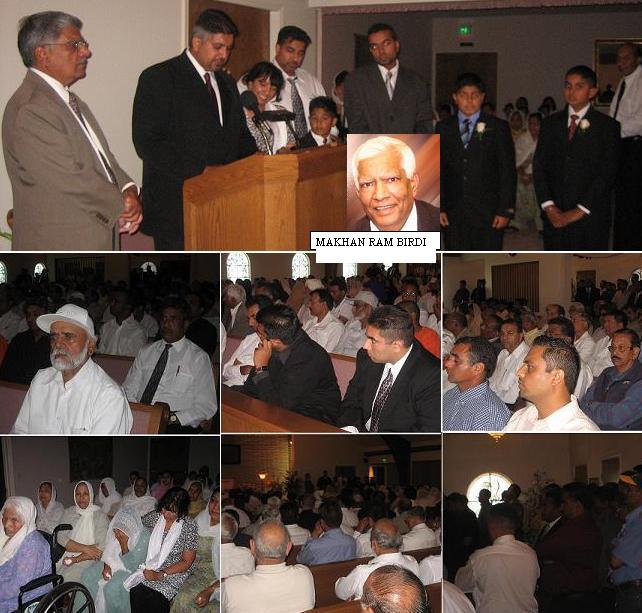
MAKHAN
RAM BIRDI'S
ELDER SON, MADAN BIRDI IS PAYING HIS FINAL RESPECT TO HIS FATHER WITH
VERY DEEP
SORROW ALONGWITH OTHER FAMILY MEMBERS: L. TO R.
MADAN BIRDI, JANAK , RAJ BIRDI, BOBBY BIRDI & KIDS (JORDAN S/O
BOBBY BIRDI,
AARON S/O MADAN BIRDI & BRANDON S/O RAJ BIRDI). O. P. BALLI &
SOHAN
SINGH DAMARIA ALSO STANDING WITH THEM & SITTING / STANDIN ALL
RELATIVES & FRIENDS AT FRY MEMORIAL CHAPEL TRACY (CALIFORNIA) ON
JUNE 23, 2007)
Photos: www.ambedkartimes.com
Makhan Ram Birdi was born on September 15, 1942 to the proud parents of Nasib Chand
& Dhano Kaur, he was the eldest of the six siblings, a total of 4 brothers
and 2 sisters.He grew up in a city named Montgomery
in Pakistan and
even as a little boy worked on his parents Kheth (Fields). He was eager to
complete his education so that he could find a job to help support the family,
he took a post at the Jullandhar Post office and he was responsible for
delivering mail to several villages within a radius of 26 miles. He always
bragged how he was the “Popular mailman!”
In 1961 the parents arranged his marriage to Simro &
they were married in a village named Dholeta in Punjab,
India. In 1971 he immigrated to the United
States with their family. He came to the US
with very little money and wanted to provide a better opportunity for his
children, by this time his family had grown. His first residence was in Pleasanton
(California) where he worked off
jobs to support the family. In 1975 he started his first permanent position at
Sky Chefs at the San Francisco Airport,
this enabled him to move his family to Pacifica
and buy a home large enough for his wife and four children. His last career
change was in 1984 were he began working for Lufthansa and remained there for
16 years.
In 1983 he moved from Pacifica
to Union City (California),
he married his 3 sons from that home and was very proud of his family. At time
past, his family grew with the addition of his grandchildren; here is the order
of the kids Jordan, Brandon, Aaron, Anekha, Asha and Siobhan. During this time,
his sons had settled in Tracy (California).Being that he wanted to live closed to his grandkids, He
moved from Union City to Tracy
in 2005.
Last time when he was asked if he needed anything, he said
he wanted to see everybody together and needed nothing else. He loved life but
loved his family even more! He survived by his mother, wife, his 3 sons (Madan
Birdi, Raj Birdi, Bobby Birdi), 1 daughter (Janak), 3 daughters in laws
(Sunita, Pamila , Nina) and six grandchildren
For
all those that knew him they all know that he had kind
words to say to everyone, he was knows as a jokester, not only having a
smile
on his face but also putting a smile on others, both young and old. He
truly
had a heart of gold. With deep sorrow O. P. Balli, Azad Jalandhari,
Bansi Lal Bangar, and Madan Birdi paid their last respect to late
Makhan Ram Birdi at Fry Memorial Chapel, Tracy, On June 23, 2007 POSTED ON JUNE 25, 2007 www.ambedkartimes.com
=====================================================
SANSARA "JACK" JAGUR
MAY 13, 1943 --- APRIL 30, 2007
Sansara “Jack” Jagur was born on May 13, 1943 in Suva, Fiji Islands where he attended Rishikul
and Arya Boy
elementary schools. He
also attended Sangam High School. At the age 17, he went to New Zealand for seasonal
work on a
sheep ranch in North Island. He was born into a large loving family
including nine brothers and three sisters.
Sansara Jagur was the fourth eldest of his siblings.
In 1962, he migrated to the United States alone, where he joined his
friends in Yuba City/ Marysville (California) and worked on the
farms. This was the beginning of his
legacy.In
1964, he worked in El Dorado Hills Golf Course which is located outside of
Folsom, CA. Later that year he helped
develop the Lindale Golf Course in Sacramento, CA. In
1967, he returned to the Fiji Islands where he got married to his
life-long partner Sisso. During their
marriage they had three boys (Dave, Harbagh, Balwant) and two daughters
(Jacqueline and Sharlene). His immediate
family expanded to two son-in-laws, two daughter-in-laws, two grand sons, and
three grand daughters. His family always
meant a whole lot to him.
In
1968, he became the Golf Course Superintendent of El Macero Country Club in El Macero, California where he worked for
approximately eighteen years. During his
tenure he employed many relatives, friends, and others for whom this was their
first employment and financial means of survival in the United States. During that same year he also started his own
landscaping and sod farming business in West Sacramento and later in Lodi, California. His sons Dave, Harbagh and Balwant worked
tirelessly with their dad in making their family business a success. The business continues to operate under the
name of Jagur Sod Farm and Landscape.In 2003,
he took a vacation to India where he unexpectedly had a
heart attack which left everyone in a great shock. His children immediately took a flight to India and brought him to the United States to afford him the best
treatment. He was hospitalized at the UC
Davis Medical Center in Sacramento, California for a lengthy period where
he underwent an open heart surgery.
Despite his health issues,
and due to his unselfish nature along with his feeling of an obligation to the
community and the family, he continued to participate in all matters, events,
and gatherings. For example he even
attended many of these matters immediately upon receiving his early morning
dialysis treatments.Sansara Jagur was
a very religious person who was extremely instrumental and was one of the
original founders of the Pittsburg Shri Guru Ravidass Temple, West Sacramento Sikh
Temple, and the Sacramento Shri Lakshmi Narayan Temple. He actively served on the Board of Directors
for the West Sacramento Sikh Temple and the Pittsburg Sri Guru Ravidass Temples.
On April 30, 2007, Sansara “Jack” Jagur suddenly passed away at his residence
in West Sacramento, California, while watering his plants (which was one of his
passions). Sansara Jagur was a very loving person who
touched many hearts (young and old). He
was very instrumental in fulfilling the dreams of many people in the Indian
community especially in establishing residency, acquiring employment, and
medical/financial benefits in the United States. Many of his family members as well as those
in the community attest their successes and quality lifestyles to Sansara’s
direct contributions. He was very direct in
expressing his thoughts without reservations.
He had no problems letting others know where he stood on certain issues. He also had a very special way of bringing
out the best in people, be it through laughter, jovial company or experienced
knowledge. All those that knew him
enjoyed his company very much.He was dearly loved and will
be deeply missed by many.
Posted on May 5th, 2007 (Time 1930)
|
|