|
|
|
|
 |
|

MY VISIT TO CALIFORNIA
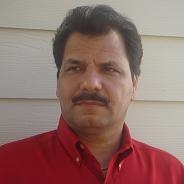
Raj Kumar Oshoraj
Vice President
Indian Buddhist Society Toronto (Canada)
During my recent visit to California (USA) from August 16th -27th, 2007 I had
the pleasure meeting with our organizations that are working actively for the
upliftment of our community.
Among these organizations there were Shri Guru Ravidas Sabha Bay Area, Ambedkar
Education Aid Society Fremont, IBO and Ambedkarite Buddhist gentlemen.
Firstly I met, an Ambedkarite and Buddhist who had spent a great deal of time
serving our community in Toronto and now he is actively working for our
community from Yuba City (California, USA) and he is very well known to
the active workers of our community: he is Mr. Mohan Gill.
He shared his wealth of practical experience with me about how we can be
released from the leprosy of castism that has been around us for thousands and
thousands of years.
Mr. Gill commended Baba Sahib Dr. B.R. Ambedkar's contributions for our
community and at the same time he felt sad for all those who claim to
understand Baba Sahib's mission but do not follow his path to liberation
from castism by embracing Buddhism. He also felt grief-stricken for people who
are propagating Baba Sahib but don't spend enough time to understand his
mission by themselves. But he was very optimistic about the future of
Buddhism in India
and abroad.
Secondly, Mr. Prem Kumar Chumber (Ambedkartimes.Com) was
kind enough to lend his time to meet me. We had a great time discussing about
the advantages of Electronic Media in 21st century and the role of
Ambedkartimes.com. His website is the first of its kind that is
bringing our people together to share their thoughts and also making
them aware about the community activities around the globe. Mr. Chumber
also shared his thoughts about facing and upgrading the website in near future.
He seemed to me that he is very well up to date with the new technology and
very keen to provide his services for the community. I was really
impressed with his interest and dedication to continue this project without any
personal financial benefit to him.
The credit goes to Mr. Prem Kumar Chumber for making arrangements for
me to meet Shri Guru Ravidas Sabha Bay Area, California (USA) on Sunday. It was
great opportunity for me to share my views with our brothers and sisters in
this gathering which had blessing of Sant Shri 108 Sant Amar Dass Ji Dera
Sherpur Dhakkon Near Mahil Pur Barian District Hoshiarpur (Punjab) I was able
to share the common mission with the sangat to get social equality for our
people from the times of Lord Buddha - Shri Guru Ravidas and all the way
to the struggle of Baba Sahib Dr. B. R. Ambedkar. Sangat was very appreciative
and they provided me their full co-operation to deliver my message.
After the Sunday Gurudwara at noon we had a meeting with some of the active community
workers in the evening. They all felt the burning need of electronic media
in today’s world. Mr. Prem Clumber’s services of his website were
appreciated by all and also everyone assured him the ongoing support. Everyone
also shared their practical experiences of social injustices here and in India.
All were concerned to remove the social
inequality based on castism and commended Baba Sahib's contribution
for our community to show us social, economic, political and religious
direction.
The following gentlemen were present in the meeting...Vinod Kumar
Chumber, Sucha Ram Bharta, Baldev Suman, Dharam Paul Jhamat, Prem Kumar
Chumber.....
The following Saturday, Mr. Amrik Chand, a great personality, a great
Ambedkarite and a great Buddhist also arranged another collective meeting with
all representatives of the local organizations. The meeting was scheduled
at Golden Peacock Banquet Hall in San Jose.
Mr. Ram Murti Saroy, a well known personality in San Jose
and the owner of the Banquet Hall also participated in the meeting. The meeting
lasted for almost for five hours. The following gentlemen were present in
the meeting: Amrik Chand, Kewal Bolina, Ram Murti Saroy, Ramesh Chander,
Surinder Soni, Chander Mohan, Satnam Ram, Ram Lal, Surinder Saroy, Balbir
Thind, Sonu Ambedkar, Bhupinder Singh, Major Kumar, Ram Gopal, Paramjit Rai,
Randhir Suman.
A great extent of thoughts was exchanged in this meeting. I was given the
opportunity to present my thoughts first and share my views with all present in
the meeting which was followed by questions to me. All possible opportunities
and challenges were discussed during this meeting by all participants. The main
theme of the meeting was to find the best possible opportunities for all
active workers to help promote the message of our Maha Purkhas and make every
possible effort to achieve their dreams.
I was impressed by the questions raised by the participants since all
those questions were very common for our community living in India
and abroad except some questions. Issues were raised as to what we can do
to improve the current condition of our community living in India
and abroad. How can we get together and what could be done to bring our
community at one platform. But the underlined concern of all participants was
the same as all others living abroad that we must stand together for our
community. All agreed to commend Guru Ravidas, Baba Sahib Dr. Ambedkar
for their struggle to help our community to bring it where we are today. I
felt a burning flame in their hearts to do something good for our community.
I enjoyed my trip with my family to California,
USA even though
I must admit the weather in California
35-40 Celsius was above normal for us as compared to our weather in Canada.
On behalf of INDIAN BUDDHIST SOCIETY TORONTO, CANADA .......I personally thank
all of them who took their time to meet me during my trip to California
and shared their thoughts with me. I assure them that their time is appreciated
and all their thoughts will be considered and given a collective attention to
help and support our community.
Some pictures during my visit to California:
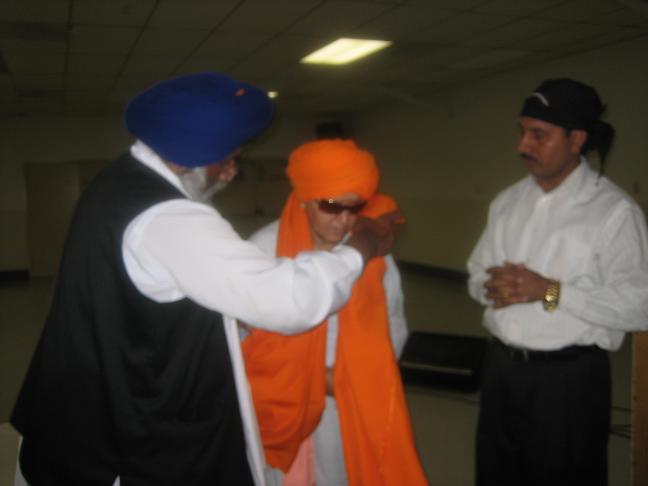
Sant Amar Dass Ji (Sherpur Dhakkon) honored by Shri Guru Ravi Dass Sabha, Bay Area
Bhai........ .............., Sant Amar Dass (Dera Baba Kalran, Sherpur Dhakkon, Hoshiarpur), V.K. Chumber
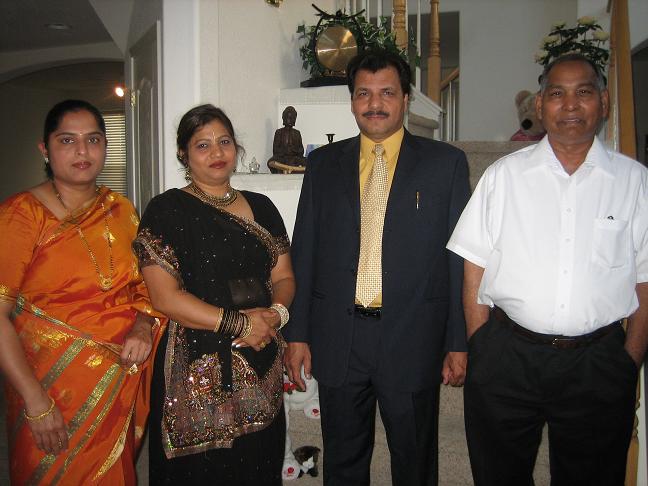
Raj Kumar Oshoraj at Ambedkartimes office Left to Right: Mrs. P.K. Chumber, Mrs. R. K. Oshoraj, R. K.Oshoraj & M.L. Gill
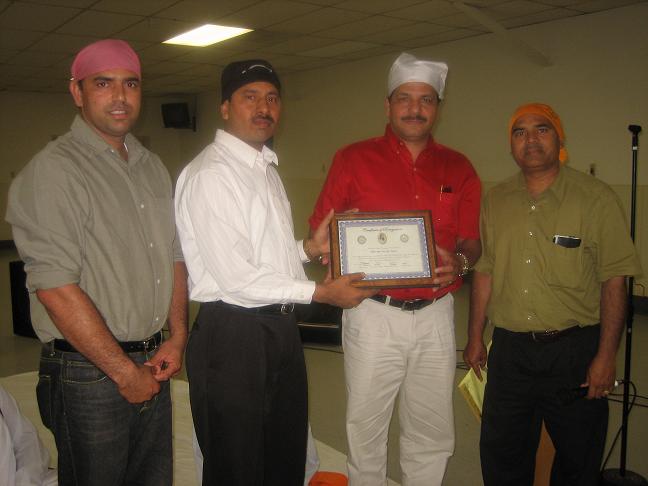
Raj Kumar Oshoraj honored by Shri Guru Ravi Dass Sabha, Bay Area
........, V.K. Chumber, R.K. Oshoraj, Randhir Suman
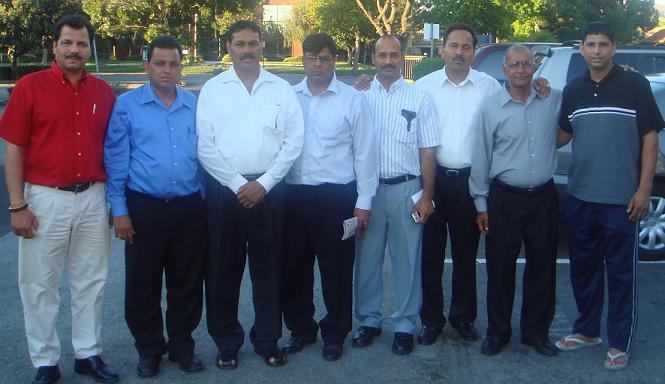
Raj Kumar Oshoraj with community members in Bay Area R.K. Oshoraj, D.P. Jhamat, S.R. Bharta, B.S. Suman, P.K. Chumber, V.K. Chumber ......., ......
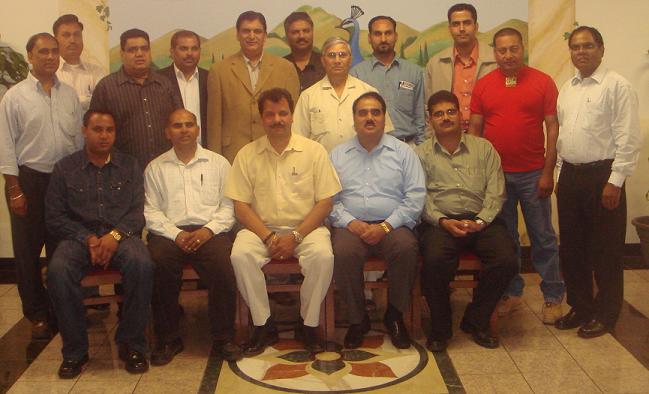
Raj Kumar Oshoraj with community members in Bay Area Siting: ......., Randhir Suman, Raj Kumar oshoraj, R.M. Saroya, Balbir Thind Standimg: Ram
Kumar, ...., Surinder Saroya, Chandan Mohan, A.C. Lakha, Paramjit Rai,
K.K. Bolina, Surinder Soni, Ram Gopal Bains, Sonu Ambedkar, Rakesh
Chander.
POSTED ON SEPTEMBER 1ST, 2007
|
|
|
What is Ambedkar Mission? 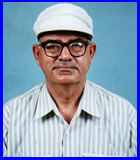
L. R. BALLEY
Editor , Bheem Patrika, Jalandhar.
Mission
means Message; it is from MISSIO, a Latin word. Therefore, Ambedkar Mission
means the message i.e. the philosophy of Dr. Ambedkar. The
first foremost question is: Has Ambedkar left any mission, any message, any programme
to be carried forward to its fulfillment? Yes, Dr. Ambedkar has definitely left
a mission to be fulfilled. In a message he exhorted his followers to carry
forward the CARAVAN. He said: “My
message is struggle and more struggle, sacrifice. It is struggle, more
struggles, without counting sacrifice or sufferings that will bring their
emancipation. Nothing else will”. Exhorting
the real proletariat Dr. Ambedkar said:
“The untouchable must develop a collective will to rise and.
1.
The untouchables have been and are the real working class in India.
Ralph Miliband, Marxist scholar that part of the “collective labour” which produces Surplus value, from a position
of subordination, at the lower ends of the income scale, and also at the lower ends of what
might be called the “scale of regard”. These three criteria absolutely apply to
the untouchable now called the scheduled castes resist and must believe in the
greatness of their task and develop a common determination to achieve their
goal. Their task is so great and the purpose so noble that all that
untouchables should commit themselves to the following: Blessed are they who
vow to give the flower of their days, their strength of soul and body and their
might, to further the campaign of resistance to slavery. Blessed are they who
resolve: Come good, come evil, come sunshine, come tempest, come honour, come
dishonoured not to stop until untouchables have fully recovered their manhood.”
In
his speech broadcast from all India
radio, New Delhi
on the 3rd
Oct. 1954 he said, “My Philosophy has a Mission
I have to do the work of conversation for I have to make followers of triguna
theory (based on Bhagavad-Gita) to give it up and accept mine. Indians are
today governed by two different ideologies. The political ideal set out in the
preamble to the constitution affirms a life of liberty, equality and
fraternity. Their social ideal embodied in their religion denies them.
Basis of Society Ambedkar
Mission aims at the reconstruction of society basing it on scientific
materialism with Man its pivot. In one of his essays Ambedkar said: My ideal
society would be a society based on liberty, equality and fraternity. “He has
explained these cardinal principles of his ideal society as Follows---
LIBERTY: Allow
liberty to benefit by an effective and competent use of a person’s powers
liberty in as much as it involves liberty to choose one’s profession to object
to this kind of liberty to perpetuate slavery. Fordoes not merely mean a
legalized from of subjection. It means a state of society in which some control
their conduct. This condition obtains even where there is no slavery in the
legal sense. It is found where, as in the caste system, some people are
compelled to carry on certain prescribed calling which are not of their choice
‘Thus according to Ambedkar, essence of liberty is: Absence of all sorts of
exploitation, forced division of labour and that of the labourers.
EQUALITY: One
must accept to equality as the governing principal. A man’s power is dependent
upon, (1) Physical heredity, (2) social in heritance or endowment in form of
parental care, education, accumulation of scientific know-ledge, everything
which enables him to be more efficient than the savage and finally, (3) on his own efforts. In all these three
respects men are undoubtedly unequal because they are unequal? This is a question which the opponents of
equality must answer. From the stand- point of the individual-list it may be
just to treat men unequally so for as their efforts are unequal, it may be
desirable to give as much incentive as possible to the full development of
every- one’s power. But what would happen if men were treated unequally as they
are, in the first two respects’? It is obvious that those individuals alone in
whose favour there is birth, education, family name, business connections and
inherited wealth would be selected in the race. But section under such
circumstances would not be a selection of the able. It would be the selection
of the privileged. The reason therefore, which forces that in the third respect we should treat man unequally demands
that in the first two respect we should treat men as equally as possible. On
the other hand it can be urged that if it is good for the social body to get
the most out of its members it can get most out of them only by making them
equal as far possible at the very start of the race .That is one reason why we
cannot escape equality.
FRATERNITY:
Fraternity is another name for brotherhood... An ideal society should be
mobile, in other words there must be social endosmosis. This is fraternity,
which is only another name for democracy. Democracy is not merely a form of
Government .It is primarily a made of associated living of conjoint
communicated experience. It is essentially an attitude of respect and reverence
towards fellowmen’.’
The
economic programme of Ambedkar Mission is thus to establish socialism through
the law of constitution retaining parliamentary democracy. If this cannot be
achieved through constitutional means then, says Dr. Ambedkar, people will be
at liberty to apply non –constitutional methods to achieve the desired end.
In
short, Ambedkar Mission demands and requires a person, if he or she has to
become a true Ambedkarite, to be practically:
(1)A
Rationalist: Negatively, one who does not believe in the supernatural God and
Soul, one who does not believe in the sacredness and infallibility of religious
books; One who does not believe in speculation and one who does not believe in
and does not practise religious observances, rituals and ceremonies.
Positively,
thinking and a creative being, judicious person, endowed with reason,
intelligence and scientific temper.
(2)A
Moralist: of good universal moral
conduct; VOLUNTARILY OBSERVING PRINCIPLES OF SOCIAL GOOD.
(3)
A Socialist: He must be believing and working for the establishment of
casteless and classless society.
(4)
A Missionary: Sincere to the cause, friend, philosopher and guide of the
people, contribute his mite to courageously and relentlessly carry forward the Mission.
The
exploited people, the victims of castism, the toiling brave men and women, come
forward, organize them selves and let us strive to shatter the centuries old
shackles so that the aspirations of man are fulfilled and Ambedkar’s ideals are
realized. Posted on August 31, 2007==========================================================================
FUTURE OF
BUDDHISM
(With Special reference to
India)
L. R. Balley
The
causes that led to disappearance of Buddhism from its land of birth need to be
pointed out so as to comment upon
and determine the future of Buddhism especially in India. Historians
have pointed put many causes for the decline rather ruination of Buddhism India.
Some of the main causes were as under:
1. Brahmins
propounded the system of four varnas which ultimately created more than ten
thousand castes and sub-castes, graded and inequality, monopolisation of state
power, property all around domination of Brahmins. Buddha scathingly attacked
Brahmins system and did his to uproot it. He opened the doors of the Sangha to
the women. He converted lowly people such as Sopaka and Suppiya, the
untouchable, Sunita the sweeper, Upali the barber, Sumangala and the other low
caste people. He converted Prakrati, Chadalika. The conversation of these
people gave a blow to the position and prestige of the Brahmins. Therefore they
had a grudge against Buddhism and were very impatient to regain their power and
prestige by whatever means and methods they could imply. In 800Ad the Brahmins made a united from with Abu-bin-Qasim the first Muslim invader of India.
The Buddhist King Brihadrath was got murdered by his own commander- Push Mitra.
Thus a Brahmin- Muslim combine ruined
Buddhism. A counter- revolution was started against Buddha’s revolution of
Humanism that was with service of mankind.2. The Brahmins incorporated some of the noble
teachings and good qualities of Buddhism in their scriptures and rituals and
even social set up. Bhagavad Gita is one conspicuous example of religious manipulation.
As one intellectual has correctly said, “Buddhism is the resistor and Hinduism
is debtor.” 3. The
Brahmins spread disinformation about Buddhism. 4. Brahmins
Intruded into the sangha and corrupted it in many respects. 5. Lethargic
attitude of the laity who proved incapable of d the sangha. To
ensure better and brighter future of Buddhism in India
the causes mentioned above should always be kept in view.
The falgbearer of Brahmanism has not long
ago demolished a mosque in Ayodhya. There have been cases of rape of Christian
nuns, plundering of their churches. The Buddhists have been the continuous
victims of Brahmins persecution and oppression. At many places the statues of
Buddha were broken and Buddhist shrines were desecrated. The management of the
Bodh Gaya is still in the hands of such Hindus as have no affection for
Buddhism and many unbuddhistic practises are being observed in the Maha Vihra
of Bodh Gaya.The Brahmist leaders often boast that India
is the birth of Gautama Buddha. But the social set up is not congenial to
Buddhism. Therefore the new Brahminic
zeal is a potential danger to Buddhism.
The lowly people of India
who are termed as the scheduled castes in the constitution of India
and who numbers more than 150 million are the descendants of the Buddhists. The
majority community being the Hindu, its governing class being the Brahmins,
they don’t like Buddhism to flourish because in Buddhism lies the annihilation
of the graded inequality, monopolisation of administration and financial
resources. There would have been atleast 100 million Buddhists in India
by now had the Hindu majority not created legal impediments in the cultural
advancement of the oppressed section of the Indian Society. It may be noted
here that it was provided in the Indian Constitution, through an amendment,
that “no person can be a member of the Scheduled caste unless he professes
Hindu religion.” After a strenuous struggle this legal bar has been removed. In
the next census the number of Buddhists will certainly increase tremendously.
If the disinformation is being spread
against the Buddhist movement of India
– continues, it may result into misleading those who desire to see the movement
becoming more strong and wide spread.
Some points here need to be clarified:
1. It
is alleged that Dr. Ambedkar (By his followers) is equated with Buddha. This is
a balatant lie. In one of his speech he called ‘BUDDHA , MY MASTER, MY ONLY
TEACHER,” ( Speech on voice of America 1954) 2. It
is said that the Buddhist movement in India
is a political movement. For those Indians who suffered for centuries, Buddhism
is a vehicle of all-round change-ethical, social and even economic. Buddha
preached against exploitation of man by man, to wage a struggle for civil
rights’, social justice and economic emancipation. If it all is considered
politics, then Indian Buddhist do candidly accepts this charge. Buddhism has
taught them to be moral and free from want and worry so they feel pride in
waging struggle for their human and constitutional rights. 3. Often
the lowly people are looked down upon because they are very backward
economically. Their present condition is not of their making. Instead of
contempt they deserve sympathy, compassion and help. This kind of mischievous propaganda against the
Indian Buddhist movement shall have to be disbelieved and totally rejected if
it desired that Buddhism should spread in India. India
has great potential for spreading of Buddhism. Its future can be bright, Very
bright, if needed precautions are taken. And a programme
for the all round emancipation of the people is formulated and organisational
machinery is established and sincerely operated for the benefit of the needy
mankind. I close this brief narration with 3Cs
(1) Clarity about programme (2)
Coordination and (3) Common resources.
If my submissions are given serious thought, I
hope, then the future of Dhamma in India
would be very bright and it may regain its original glory and purposefulness.
It is gratifying that the Punjab Buddhist Society U.K under the benevolent
guidance of Ven: Chanderbodhi has taken lead for fulfilling the historic noble
task of spreading the Buddhism.
Posted on August 08, 2007 ===========================================================================
DR. B. R. AMBEDKAR
INDIA’S GREATEST SOCIAL REFORMER
L. R. Balley
Editor , Bheem Patrika, Jalandhar -144 003
While paying tribute to Dr. Ambedkar,
on his death, on 6th December 1956, the then Prime Minister of
India, Mr. Jawaharlal Nehru said: “Dr.
Ambedkar would be remembered mostly as the symbol of revolt against all the
oppressing features had kept peoples mind awake. Although he was highly
controversial figure, he played a very constructive and very important role in
the government activities. He revolt against.”
What he revolted? Though Mr.
Nehru has given an indication, yet his rebellion need to be explained more as
he devoted whole of his life to its success. Among many theories Dr. Ambedkar
propounded, one is very prominent, it is this:
“History bears out the proposition political revolutions have always
been preceded by social and religious revolutions”.
Indian Society is still a tribal society,
steeped in orthodoxy and superstitious, divided in thousands of castes-sub
castes. It is continuously practicing even today inhuman practices in the midst
of the present modern world. Dr. Ambedkar personality was unique. Numerous
author, Indian as well as foreigners, have described his contribution to the
economic development of his country and the emancipation of Indian masses in
different ways. One such author has said:
“Dr.
B.R. Ambedkar was an intellectual, a educationist, a thinker and an advocate of
Humanism.”2
The author has rightly and truly
mentioned the qualities and qualifications are to reconstruct the Indian
Society on the principles of the liberty, equality and fraternity the
principles he learnt not from French “his master, The Buddha.” He persistently pursued his idea of bringing
out basic reforms in the Indian Society as he said:-
1936: “if the source of the power and the dominion
is at any given time or in any given society social and religious then social
reform must be accepted as the necessary sort of reform. 1953:
in India
social structure must be altered.
1954: To leave inequality between
class and class between sex and sex which is the soul of Hindu Society
untouched and to go on passing legislature relating to economic problem is to
make a farce of the constitution and build a palace on dung heap.”
In order to achieve his object of
reformation of Indian society particularly its Hindu part, he piloted code
bill. As the Indian Parliament was, then dominated by orthodox Hindus, the bill
could not be passed. Therefore, in protest, Dr. Ambedkar resigned on 28th September, 1951 as
law Minister of India. After his resignation within 4 Years the Hindu code Bill
was passed in parts.
As a result of enactment of Hindu
marriage Act, Hindus of different Sects, Castes and the Communities and Gotras
could inter- marry which was not possible earlier. It is worth noting the Hindu
code Bill was applicable to all sorts of Hindus – Sikhs, Buddhist and Jains.
This was the first legal step Dr. Ambedkar took to reform the society.
Article 13: All Laws – ordinance, order by law, rule, regulation,
notification, custom or usage having in the territory of India the force
of the Law, immediately before the commencement of this constitution, in so far
they are inconsistent with the provision of fundamental rights shall, to the
extent of inconsistency, be void.
Article 14: The state shall not deny to any person equality before
the law or equal protection of the law within the territory
of India. Article 15: The state shall not discriminate
against any citizen in matters relating on ground only for religion, race,
caste, sex, place of birth or any of them.
Article 16: There shall be equality of
opportunity for all citizens in matters relating to employment or appointment
to any office under the state.
Article 17: “Untouchability” is
abolished and its practice in any form is forbidden. The enforcement of any
disability running out of “untouchability” shall be an offence punishable in
accordance with law.
Article 23: Traffic in human beings and
beggar and other similar forms of forced labors are prohibited and any contravention
of this provision shall be an offence punishable in accordance with law. As a
decisive lasting step Dr. Ambedkar gave a historic verdict on Hinduism, its
proper name being “Brahmanism.”
He opined:
“As Prof. Max Muller observers: Modern Hinduism rest on the system of
caste on a rock which is no argument can shake.”
“Hinduism is overwhelmed with fear of
pollution. It has not got the power to purify. It has not the impulse to serve
and that is because by its very nature it’s inhuman and immoral. It is a
misnomer to call it religion. Its philosophy is opposed to very thing for which
religions stands.”
“Religion is every where else is engaged in
the task of rising and ennobling mankind Hinduism is busy in debasing and
degrading it.”
“The
Philosophy of Hinduism neither satisfies the test of social utility nor does it
satisfy the test of individual justice.”
He therefore
discarded Hinduism and got converted with Buddhism on October, 1956 at Nagpur
in Maharashtra with millions of his followers. Why did
he embrace Buddhism? On this question he
clarified as under:
I prefer Buddhism because it gives three
principles in combination which no other religion does. All other religions are
bothering themselves with god and soul and life after death. Buddhism teaches
‘Prajana’ (Understanding as against superstition and supernaturalism). It
teaches ‘karuna’ (Love). It teaches ‘Smata’ (equality). This is what a man
wants for a good and happy life on earth. These three principles of Buddhism
make their appeal to me. These three principles should, also make an appeal to
the world. Neither God nor soul can save society.”
Thus Dr.
Ambedkar not only presented his theory of social re-construction, he took
measures to do so would be evident from the details given above. It is Dr.
Ambedkar and none else from the Indian leader ship may be social, religious or
political who could be so realistic, so courageous and so farsighted who could
lay principles of social reform and become an example to be followed faithfully
and sincerely.
Indians as a
nation are therefore, grateful to Dr. Ambedkar for his all round constructive contribution
to the Society.
REFERENCES;-
(1) Dr. Baba Sahib Ambedkar Writings
and speeches Bombay 1979, Vol.,
page 43. (2) Mainstream Weekly, New
Delhi, dated 8
May, 1999, page 20. (3) Dr.
Baba Sahib Ambedkar Writings and speeches Bombay
1979, Vol., page 45. (4) Daily
Hindu, New Delhi, Dated 26th June 1953 (5) Dr. Baba Sahib Ambedkar Writings
and speeches Bombay 1979, Vol.14,
part 2 page 1326. (6) Science of Religion page 28 Dr. Baba Sahib Ambedkar Writings
and speeches Bombay 1989, Vol.3,
page 92. (7) ibid page37 (8) ibid page71 (9) Talk on BBC London on 12th
May, 1956.
Posted on August 03, 2007 |
UNTOUCHABILITY AND STARVATION LIVE TOGETHER IN INDIA
Palash Biswas
Untouchability and Starvation Live
together in India! This is the ultimate truth of sense shining, to be Hindu Superpower
India!
Local
goons raided a Dalit hamlet and attacked women and children for allegedly
‘frolicking’ in a community temple in Shivalapar village under Shahpur police
station in Danapur of Patna district on Friday evening.A tiff erupted between
the Dalits and Ramavtar Yadav, when he objected to the Dalit children ‘dirtying
the premises of the Goddess Durga temple.’
Yadav and
his three sons Sanjay, Umesh and Dinesh raided the hamlet, comprising 50
families.
They
caught hold of Gyanati Devi, pulled her hair, beat her up and poured boiling ‘Dal’
on her.
Her six-month-old
daughter Sunita, too, suffered burns.
Untouchability
Offenses Act (1955, India)
Encyclopædia
Britannica: Related Articles
A
selection of articles discussing this topic.
Influence
on status of untouchables
...the
constitution provides these groups with specific educational and vocational
privileges and grants them special representation in the Indian parliament. In
support of these efforts, the Untouchability (Offenses) Act (1955) provides
penalties for preventing anyone from enjoying a wide variety of religious,
occupational, and social rights on the grounds that he is a Harijan,
the name...No results were returned.
Please
consider rephrasing your query. For additional help, please review Search Tips.
Search Britannica for Untouchability Offenses Act
The
Ministry of Social Justice and Empowerment is responsible for all round
development of Scheduled Castes and to bring them in the mainstream of national
life and ensure their full participation in socio-economic development of the
country.
Nearly 50
percent of the world's hungry live in India, a low-income, food-deficit country. Around
35 percent of India's population - 350 million - is considered food-insecure, consuming less
than 80 percent of minimum energy requirements. In 1947, untouchability was
banned by the Indian constitution established after independence from the
British. Yet, as a social organization and economic constraint, untouchability
is very much alive today. Its grip and that of the caste system, from which it
derives, will necessarily be challenged to the very core if India is to become an industrialized nation. This
question has now become urgent for India's 800 million people. As the 21st century
nears, either India will find within itself the capacity for cultural regeneration
permitting economic development, or as Mahatma Gandhi predicted, Hinduism will
perish, and India with it.
Nutritional
and health indicators are extremely low. Nearly nine out of 10 pregnant women
aged between 15 and 49 years suffer from malnutrition and anemia. Anemia in
pregnant women causes 20 percent of infant mortality. More than half of the
children under five are moderately or severely malnourished, or suffer from
stunting.
More than
160 million people in India are considered "Untouchable"—people
tainted by their birth into a caste system that deems them impure, less than
human.
Human
rights abuses against these people, known as Dalits, are legion. A random
sampling of headlines in mainstream Indian newspapers tells their story:
"Dalit boy beaten to death for plucking flowers"; "Dalit
tortured by cops for three days"; "Dalit 'witch' paraded naked in
Bihar"; "Dalit killed in lock-up at Kurnool"; "7 Dalits
burnt alive in caste clash"; "5 Dalits lynched in Haryana";
"Dalit woman gang-raped, paraded naked"; "Police egged on mob to
lynch Dalits".
Dalits
are not allowed to drink from the same wells, attend the same temples, wear
shoes in the presence of an upper caste, or drink from the same cups in tea
stalls," said Smita Narula, a senior researcher with Human Rights Watch,
and author of Broken People: Caste Violence Against India's
"Untouchables." Human Rights Watch is a worldwide activist
organization based in New York.
India's Untouchables are relegated to the lowest
jobs, and live in constant fear of being publicly humiliated, paraded naked,
beaten, and raped with impunity by upper-caste Hindus seeking to keep them in
their place. Merely walking through an upper-caste neighborhood is a
life-threatening offense.
Nearly 90
percent of all the poor Indians and 95 percent of all the illiterate Indians
are Dalits, according to figures presented at the International Dalit
Conference that took place May 16 to 18 in Vancouver, Canada.
National
Commission for socially and economically backward sections among religious and
linguistic minorities
A
decision has been taken to appoint a National Commission to recommend measures
for welfare of socially and economically backward sections among religious and
linguistic minorities.
The Terms
of Reference of the commission are:
to
suggest criteria for identification of socially and economically backward
sections among religious and linguistic minorities.
to
recommend measures for welfare of socially and economically backward sections
among religious and linguistic minorities, including reservations in education
and government employment.
to
suggest the necessary constitutional, legal and administrative modalities as
required for the implementation of their recommendations, and
to
present a Report of their deliberations and recommendations.
http://socialjustice.nic.in/newpolicies/welcome.htm
RESEARCH/EVALUATION
STUDIES SPONSORED UNDER THE SCHEME OF GRANT IN AID FOR RESEARCH PROJECTS.
The
Ministry of Social Justice & Empowerment is implementing a number of Schemes
for the welfare and development of Scheduled Castes, Other Backward Classes,
Minorities, the disabled, children in need of care and protection, the aged,
victims of alcohol and drug abuse, etc. It is necessary that the impact of
these Schemes/Programmes should be assessed and evaluated from time to time, so
that these can be suitably modified /revised to make them more effective or
phased out if their utility is found to be doubtful. It is also necessary to
identify through research, areas where social problems are likely to arise in
future so that the Ministry can plan timely interventions. The Ministry,
therefore, sponsors research and evaluation studies under the Scheme of Grant
in aid Rules for Research and Publications to assist in the task of review and
future planning.
Under the
Scheme, Universities/Research Institutions and Professional bodies are given
financial assistance to meet the expenditure on research and evaluation studies
in the broad areas of Social Policy, Social Development and Social Welfare,
particularly to evaluate the Programmes/Schemes implemented for the welfare and
development of Disabled Persons, OBCs, and Minorities and in the field of
Social Defense.
Research
proposals on the specified priority areas from established research
institutions and universities are considered.
In cases,
where it is felt that the problem needs to be studied on larger scale, a common
research design is devised and the study on the subjects carried out
simultaneously in several States/UTs.
The types
of studies sponsored by the Ministry are (i) Evaluation Studies; (ii)
Diagnostic Studies; and (iii) Documentation Studies. In the case of evaluation
studies, the Ministry's programmes/schemes implemented at the field level are
evaluated to know the effectiveness of the schemes and to modify/revise the
schemes appropriately. The diagnostic studies are those on social problems
relating to the areas of prostitution, drug abuse, the aged, children in
difficult circumstances, minorities and OBCs and the disabled population. The
documentation type of studies are - Preparation of summary of research
projects, Preparation of Handbook of Social Welfare Statistics, Preparation of
Compendium of Schemes, Directory of voluntary organizations in the field of
Social Welfare, etc.
Since the
inception of the Scheme from 1973-74, 433 Research/Evaluation Studies have been
sponsored. The findings and recommendations of all these studies have been
useful for the Ministry for evolving further intervention at the policy and
implementation level. The reports are being utilized by research professionals
working in related fields to review the progress of work and to identify social
problems requiring urgent intervention.
The list
of Research/Evaluation Studies sponsored from 1973-74 to 2003-04 (up to 31st
December, 2004) is
annexed.
The
National Campaign on Dalit Human Rights (NCDHR) has decided to launch a state
wide agitation in Haryana in protest against the "continuous atrocities on
dalits" in the state. A decision to this effect will be taken at a joint
meeting of various Dalit organizations which has been convened by NCDHR on
September 15 at Delhi. According to Arun Khote, secretary of the NCDHR, the Dalit organization
have taken a serious note of the alleged murder of Rakesh alias Lara and
incidents of violence and arson in Gohana town and else where in the country
and they have decided to call a joint meeting on September 15 in Delhi to chalk
out the future course of action on this issue. He said that the Dalit organizations
wanted to impose President's rule in Haryana and declaration of Haryana as
Dalit Utpeeran Grast Rajya. He also disclosed that the NCDHR has already
apprised the Chairman of the National Human Rights Commission and Kumari Selja
Union Minister of State about the incidents of atrocities on dalits in Haryana
and demanded immediate taking of steps to check such cases in future. Referring
to the alleged murder of Rakesh alias Lara, Khote said that it was a conspiracy
and per-planned murder and the police have utterly failed to ensure the safety
of dalits. If such types of atrocities continued, the Dalit organizations have
no alternative but to launch a statewide agitation on this issue.
The
Communist Party of India on Saturday demanded an end to the intimidation of Dalits
in the Gohana area of Sonepat district in Haryana. This demand was made a day
after CPI national secretary D. Raja visited Gohana, where a Dalit youth was
killed last week resulting in clashes in several districts of the State. Posted on September 4, 2007
===========================================================================
MANUSMIRITI PROMOTED BY
INTELLIGENTSIA
Palash Biswas
The largest circulated Hindi daily
which is incidentally most popular amongst the Dalits in eastern part of India
including Kolkata and aspires to become national very soon- publishes quotes
from Manusmiriti daily on its Edit page!
Bengali
and English Dailies in Kolkata do not quote Manusmiriti. The ruling Left in Bengal is said to be up against Manusmiriti and it
launches a Marxist Dalit movement with a platform named Dalit Samanyaya Samiti.
CPIM Hyderabad conference officially passed Dalit agenda.
Our Constitution
is based on justice, liberty, equality, fraternity! Even Manusmiriti sustains. So much so Namboodaripad
supported castism and the People’s president APJ missile man Abdul Kalam quotes
from Manusmiriti.
In Bengal, the Brahmincal system is most organized,
systematic and scientific. It is never as rough and rigid as the Hindi daily
representing feudalism persistent in rest of India.
In fact,
media as well as so called Mainstream Intelligentsia promotes Manusmiriti in
most sophisticated way. Take any Bengali or English daily you may get the tone.
They have sophisticated the folk and the dialects and use them against the
indigenous people. Politicians play vote bank game. We may identify the caste
logy in the polity. But the most dangerous type of discrimination is monopoly
on knowledge, information, art, literature and culture.
Indian Intelligentsia has the single
agenda of post modern Manusmiriti Galaxy Order under Zionist Hindu Imperialism.
Thus, while they pose standing United with Nandigram singur resistance, they
never allow a real Dalit movement in India!
The former Bihar Governor, M. Ramajois,
said here on Sunday that despite the propaganda against it, the Manusmiriti
remained a source of eternal values for humanity. At a popular lecture on the
role of professionals in enforcement of contractual obligations in the
construction industry, Justice Ramajois said the good points in this ancient
law text must be taken and the irrelevant and unsuitable ones discarded. He
opined that Manusmiriti elaborated on the "right to happiness" which
contained within its ambit all other rights developed by western jurisprudence.
Dalit
activists in Jaipur have taken strong exception to then President A. P. J.
Abdul Kalam making a reference to "Manusmiriti" while extolling the
virtue of not accepting gifts that come with a purpose, saying his citation
from the ancient Hindu treatise was "unwarranted" and had "hurt
the sentiments of Dalits" by according respectability to Manu’s
pronouncements.
Mr.
Kalam, addressing a function at the India Islamic Cultural Centre in New Delhi on Thursday, had remarked while quoting from
"Manusmiriti" that by accepting gifts, the divine light in the person
gets extinguished. Centre
for Dalit Rights (CDR) chairperson P. L. Mimroth said the outgoing President
need not have quoted from the archaic Hindu code of law that had created the Varna system under which the higher castes for
centuries denied all basic human rights and dignity to Dalits. "For us,
Manu only symbolizes the unjust social order imposed on Dalits from time
immemorial."
Mr.
Mimroth said Mr. Kalam, shortly demitting the highest constitutional office in
the country, should not have made the "unwarranted reference" to an
antiquated treatise which was squarely responsible for discrimination against
Dalits and flew in the face of the constitutional ideal of a casteless society.
"Quoting
from Manusmiriti amounts to paying homage to a figure who represents all that
is unjust in the Indian society," said Mr. Mimroth. He added that Mr.
Kalam could have mentioned any of the hundreds of literary, spiritual or
religious figures – such as the acclaimed Tamil poet Sumbramanya Bharathi – to emphasize
his point.
The
Rajasthan convener of the National Campaign for Dalit Human Rights (NCDHR) and
PUCL State president, Than Singh, said Mr. Kalam’s reference to Manusmiriti was
"shocking and strange" in view of the known fact that the unabated
oppression of Dalits was because of the edicts prescribed in the treatise.
"The President’s remarks have without doubt injured the emotions of Dalits
who looked up to him for upholding constitutional values all these years,"
he added.
Dharma is
the everlasting friend. It is essential not only for the individual’s happiness
but also for the happiness of other individuals who constitute the family and
the society," said Justice Shri Rama Jois, the Governor of Jharkhand.
Speaking on his latest book, "The Eternal Values in Manusmiriti", at
the Indian Institute of World Culture under the aegis of IGNCA - Southern
Regional Centre, he elucidated upon the ancient text, regarded as the oldest
codification of rules of dharma.
Posted on August 04, 2007 |
ANTI CONVERSION BILL OF RAJASTHAN
FORWARDED TO THE PRESIDENT
Freddi Joseph Khudai
Khidmatgar.
Chief Editor Masihi Sansar
Before leaving the Raj Bhawan to contest forthcoming presidential elections
Rajasthan Governor Pritbha Patil has forwarded the controversial anti
conversion religious bill 2005 to the President Abdul Kalam for his approval. The Governor did not give her
judgment on the bill. The assembly had passed the bill on May 7, 2006. The governor returned it to the
government with some objections and suggestions. Patil had observed that
the bill could have an adverse impact on the secular credential of the nation
and state. She also pointed out a lack of clarity in some of the clauses like
conversion through "deceit" and 'force' but the BJP government passed
the bill again in assembly without changing its draft and returned it to her
mid–May this year. The Bill says:-
* A person indulging in conversion through allurement, force or deceit
will be punished with imprisonment of 2 to 5
years.* A fine up to Rs 50,000 can be imposed on the guilty.* Institutions can
lose their recognition for indulging in conversions.* The investigation officer
will not be less than a Deputy Superintendent of Police.* Interestingly the
bill says converted Hindus can revert to their original religion. But a
Christian or Muslim adopting Hinduism cannot return to Christianity or Islam as
well.
According to the constitution India is secular country and not a theocratic state. The
government neither can control the religion of the citizens nor interfere it.
But it is a matter of great surprise that government is controlling
and interfering the religions of the Indian citizens by making laws that
are absolutely against the spirit of the Indian constitution. According to the
constitution religion is not an issue for the government but practically to-day
the religion is the biggest issue for some of the political parties and these
parties are misusing their political power to snub the religious freedom of the
citizens. It is also notable that so far no case of conversion through 'deceit'
and 'force' has been detected throughout the country. So far anti-secularism
parties have passed anti - conversion bill/ laws in nine states of India. That means in one third of India the religion of the Indian citizens is being
controlled by the state. It is a clear indication that the country is heading
to wards becoming a theocratic state.
It
is a matter of great regret that the Indian Christian leadership has
miserably been failed to realize the seriousness of the present situation and
is totally unaware of its afterwards consequences. Neither it could bring
awareness among the Christian masses nor make the society at large to realize
that the religious rights of the Christians are virtually being killed in
this country. Silence of the Christian leadership over this issue has given the
signal to the nation that the Christians are guilty.
Our Lord Jesus Christ has cleared once far all that the Caesar has
no right over the religious right of the people by saying that give God what
belongs to God and to Caesar what belongs to Caesar. It is a matter of some relief and earnest hope that Paritbha
Patil is going to be the President of India. Hopefully she will discharge
her duty to force the Indian Government to work according to the secular spirit
of the Indian consitution of the country..
RE-POSTED ON JUNE 27, 2007 (REVISED)
====================================================================================
VTRICKERY OF CREAMY LAYER THEORY Freddi Joseph
Khudai Khidmatgar
Opponents of reservation policy for
Dalits have found another trick to oppose the development of the Dalits. Now
they are raising hue and cry against the benefit of reservation to the creamy
layer among the Dalits. These people are not other than those who have been
oppressing the Dalits since last four thousand years in this country. They
plead when a Dalit reaches a certain point of development he should not be
allowed to enjoy the benefit of reservation policy. They further say that
reservation should not exceed the limit of 50%. If this formula is to be
adopted it must not be imposed on Dalits alone. It must be imposed on all the
sections of the society. 50% agricultural land must be given to the Dalits, 50%
factories be given to the Dalits. They must have 50% seats in the parliament
and states assemblies. On the same lines all the sources of income and honor
must be divided between Dalits and other groups of the society.
Then there is a theory of capability or competency.
They say that ‘Dalits’ are not competent for certain high level professions.
Where as practical fact is that when a man is given responsibility only then he
will be able to show his competency. Britishers were of the opinion that not
only Shudras but all the Indians including Brahamins and Kshatreis were not
capable for ruling India. They presented an offer to Pt. Jawahar Lal Nehru to
let them stay in India for 20 years more, during this period they will train
the Indians to rule the country. Pandit ji rejected their offer and said that Indians
were competent to run their country. So the Indians took the charge of the
country from them and proved their competency to rule the country. Lalu Parshad
a Dalit has been given the charge of railway, in India he is the first railway
minister who not only stopped the heavy annual increase in the railway fare and
freight but also gave new better look to the railway within the same sources of
income. In India Christian educational and health institutions are leading ones
in their respective spheres. Just see! who are the people that are running
these institutions? Majority of them are Dalits. So hue and cry of competency
theory is another trickery to prevent the development of the Dalits.
There is still another fraud, which is being tried to
prevent the development of the ‘Dalits’. It is being pleaded that the base of
reservation policy should be economy and not caste. They people are trying to
hide the fact that ‘Dalits’ were victimtized on the base of caste and not
economy. So the remedy of their sufferings lies in the reservation based on
caste and not on economic factor. ====================================================================================
The Himachal Pradesh Anti
Conversion Bill is not yet enacted as Law
but started Harassing Christian
Minority in the State
The Care and service to the destitute orphan children
by Pastor Behal from Kangra in Himachal Pradesh – an army retired captain has
been charged as anti social activist by Siva Sena, Bajrang Dal and Vishwa Hindu
Parishad (VHP) - the World Hindu Council. A Drug Addict Rehabilitation Center at Kullu attacked and counselors arrested with false
charges.
Mr. Sam Abraham a senior Christian leader from
Himachal Pradesh informed to All India Christian Council that a large number of
Hindu fanatics led by the leaders and activists of Bajrang Dal, Siva Sena and
VHP assembled at the gate of Pastor Behal’s resident on January 21, 2007 and
demanded him to close down the children home and leave the place. Dr. Abraham
Mathai – Vice President of Maharashtra Minority Commission informed Ajay Yadav
– Superintendent of Police, Kangra that any unwanted incident should be
prevented and Pastor Behal, his family and orphan children must be protected
from Hindu fanatics groups.
Latter Ms. Sudha Devi – Sub-Division Magistrate of
Kangra told to All India Christian Council that the Police forces have
dispersed the Hindu Fanatics assembled at the resident of Pastor Behal. Ms
Sudha Devi also told that Hindu fanatics have submitted a memorandum against
Pastor Behal with charges that Pastor Behal has mistreated the orphan children
and converting them to Christian.
Pastor Behal and his family have been living in Kangra
for last twenty years. He hails from Punjab and started
rendering his service of care to the destitute children after he retire from
army.
Another attack happened in Himachal Pradesh. The Drug Addiction Rehabilitation Center “Last Restore” at Kullu has been under Hindu fanatic
attack. Four of the counselors have been booked and arrested on January 17, 2007 with false charges.
Mr. Doorja – Sub Inspector of Kullu Police station
told to the All India Christian Council that Mr. Rajesh Toppo, Mr. Nizam
Minthang, Mr. Gopal Singh Bhatia and Mr. Lalboi have been booked (FIR NO.
44/07) under the section of IPC 295A, 341, and 342. Latter they were produced
before the magistrate and released on bail.
Mr. Lalboi – one of the accused told to All India
Christian Council that Mr. Amos – the complaint from Gaziabad and Binod Naini
from Delhi were going through the rehabilitation with the
consents of their parents, ran away from the center without any information.
Both the addicts did not have money to reach their
home and they approached a man for financial help but latter the man happened
to be an activist and leader of VHP. Instead of helping them financially, he
took both the addicts to Kullu Police station and helped them to file complain
against the rehabilitation center. Mr.
Lalboi said that they were accused falsely for very service of care and love
rendered to drug addicts. Dr. John Dayal
– Member of National Integration Council, General Secretary of All India
Christian Council said that The Himachal Pradesh Anti Conversion Bill 2006 is
not yet enacted as law of the state but started harassing minority Christian
NGOs rendering humanitarian service to destitute of the state. He strongly
condemns the police forces, district authorities and Hindutva forces for accusing
falsely to the Christian minorities in the state.
The Last Resort – the Drug Addiction Rehabilitation
center still has 34 drug addicts who are under going the rehabilitation
process. This service is rendered through Thangboi Haokip – son of Mr. Sanson Haokip
– former minister of Manipur state.
Many human rights organizations and political parties
have appealed to State Government to repeal the Himachal Pradesh Freedom of
Religion Bill 2006 which was passed on December 29, 2006 at Dharamsala. The bill bans any force conversion and
defaulters will be imprisoned up to 2 years and/or fined Rs. 25,000.00. Bill
also require 30 days prior information to state authorities if any person wants
to change faith and religion which is totally against the freedom of religion
provided in Article 25 of Indian Constitution and 18 of UN Universal
Declaration.
All India Christian Council
has appealed to Mrs. Sonia Gandhi - President of All India Congress Committee
to use her office to appeal Himachal Pradesh Government to reverse the
controversial and draconian bill. Christian Council has also appealed Mrs.
Gandhi to set up an anti party activity against Shri Virbharda Singh - Chief
Minister of Himachal Pradesh. ( George
MS )
|
An Open Letter to Dr. Manmohan Singh, Prime Minister of India : By Nishikant Waghmare
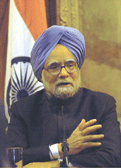
Dr.Manmohan Singh
Hon'ble Prime Minister Of India
7 Race Course Road,New Delhi -110011.
Most Respected Dr. Manmohan Singh Ji,
I am happy to know that our Nation's Government
of India celebrating the 2550th "Buddha Mahaparinirvana Anniversary"
is being commemorated with great solemnity throughout India.
Government of India
for this purpose in the Ministry of Culture has set up a National Committee
under your Chairmanship.
The Minister of Tourism & Culture, Mrs.
Ambika Soni, is the Vice-Chairperson of the National Committee and also heads
the Implementation Committee entrusted with the task of implementing the
various programmes chalked out for a year and for the whole country. 2550 the
Buddha Anniversary programme was inaugurated on 13 May 2006 (Buddha Purnima Day) by yourself and was
attended by many important leaders including religious leaders.
A number of events have been planned including an
important International Conference at Bodhgaya on the theme of Buddhism and the
21st Century from February 4 to 6, 2007.
The closing ceremony will be held at Kushinagar (the place of the
Mahaparinirvana in eastern Uttar Pradesh) on the Buddha Purnima day.
It gives me great pleasure to inform you that The
three Sub-Groups of Implementation Committee has set –up and for Conferences
and Publications Committee Convener Dr. Bhalachandra Mungekar invited me to
attend Bodhgaya International conference on February 4-6, 2007 on this historic
occasion I wish to hand over my "Resolution relating to Ambedkarites and
Buddhist of the World." Along with Dr.Bhalachandra Mungekar in Conference
at Bodhgaya on February 4, 2007.
Mr. Prime Minister, after 60 years of
Independence we must give due justice and human face to Buddhist people of
India in the land of Buddha and Nation of Dr. B.R. Ambedkar who has given us
one of the finest Constitution in the world which we all love and respect
Bharat Rattna Dr. Babasaheb Ambedkar for his contribution and Chairmanship.
Dr. Ambedkar's role as a prominent constitution
maker of India
is quite well known. However, his views on religion, particularly his reasons for
renouncing Hinduism, the religion of his birth, are not as widely known.
Ambedkar who was born in an "untouchable" family carried on a
relentless battle against untouchability throughout his adult life. In the last
part of his life, he renounced Hinduism and became a Buddhist. What were his
reasons for doing so?
A detailed
answer to this question can be obtained by studying his Buddha and His Dhamma,
Annihilation of Caste, Philosophy of Hinduism, Riddles in Hinduism etc.
Nonetheless, some of his articles, speeches and interviews before and after his
conversion to Buddhism throw some light on this question.
Ambedkar's statement in 1935 at Yeola Conference
is quite instructive in this regard. Ambedkar believed that the untouchables
occupied a "weak and lowly status" only because they were a part of
the Hindu society. When attempts to gain equal status and "ordinary rights
as human beings" within the Hindu society started failing,
Ambedkar thought it was essential to
embrace a religion which will give "equal status, equal rights and fair
treatment" to the untouchables. He
clearly said to his supporters "select only that religion in which you
will get equal status, equal opportunity and equal treatment."
The Government of India must hand over the
management of one of the Holiest Shrines of world the Maha
Bodhi Temple,
amending the Management Act of 1949. Millions of Buddhists across the world are
upset as non-Buddhists have the control over the Holiest Shrine of Buddhists.
We Buddhist must have control over the management.
We the Buddhist of India wish to make an appeal
to all the world's religious and political leaders to demand immediate
dissolution of the temple management committee to hand over control of Maha
Bodhi Temple in the hands of Indian Buddhists.
If the managements of Hindu Temples, Churches, Mosques and Gurudwaras are
not under the control of other sects, then why not so in the case of the Maha
Bodhi temple in the hands of Buddhists. Buddhists had been given very little
role in managing the affairs of the temple for over five decades. Maha
Bodhi Temple
was given a UNESCO Heritage...
Wisdom and compassion – the way forward! May peace prevail in India!! May peace prevail on Earth!!!
Yours in the Mission,
Nishikant Waghmare Posted on August 31, 2007==========================================================================
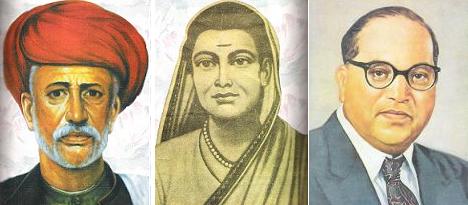
JOYTIRAO PHULE-----------SAVITRIBAI PHULE--------------DR. AMBEDKAR
INDIA'S LOWER CASTES
Nishikant Waghmare Mahatma Jotirao Phule, Social Reformer of India,
stared the fight against castes exclusion in our education system . His
book titled Slavery took the Marathi world by storm in 1873. It was
Phule who told the Hunter Commission in 1882 that the British were
collecting revenue from Shudras (Backwards) and Ati-Shudras (Dalits) to
educate upper-caste Brahmins. This, he claimed, was atrocious and the
remedy he suggested was universalisation of primary education. Later
his disciple Dr. B.R.Ambedkar demanded equality of opportunity from
the Simon Commission in 1928. It is from his memorandum one discovers
that enrolment of lower castes in colleges was zero in 1882 and just
one per cent in 1923-24. These facts have never been discussed in our
mainstream discourses.
Government of India's decision to extend 27 per cent proposed
quota to OBC (Other Backwards) in higher educational institutions. The
attack by elites and the corporate sector against the proposed quotas
for OBCs in the IITs, IIMs, and Central Universities, and reservation
in the private sector for SCs and STs is deplorable though predictable.
They condemn the proposals on the ground that quotas would jeopardize
merit and efficiency, which are the two main planks of a globalize and
competitive economy. It is distressing that the defenders of merit
forget that they
are condemning nearly 80 per cent of the country's population as
non-meritorious, inefficient and unworthy of occupying a due space in
the overall structure of entitlements.
Note what M. K. Gandhi said about the Caste. And how shamelessly he
defended it "Caste has nothing to do with religion. Varna and Ashrama
are institutions which have nothing to do with caste. The law of Varna
teaches us that we have each one of us to earn our bread by following
the ancestral calling. It defines not our rights but our duties. The
callings of a Brahmin- spiritual leader-and a scavenger are equal and
their due performance carries equal merit before God and at one time
seems to have carried identical reward before man. Both were entitled
to their livelihood..." The Harijan, July 2, 1936.
Occupation was the defining category that determined hierarchies in
Manus's Varnaashrama. Manu assumed that economic and social orders
complemented each other. Abraham Lincoln says; "As I would not be a
slave, so I would not be a master. This expresses my idea of
democracy." Various philosophers, political scientists and writers have
given numerous definitions of democracy. A relentless champion of human
rights and staunch believer in democracy, Dr B.R. Ambedkar says,
"Democracy is not a form of government, but a form of Social
Organization."
Dr
Ambedkar believed that in democracy revolutionary changes in the
economic and social life of the people are brought about without
bloodshed. The conditions for that are as follows: (1) there should not
be glaring inequalities in society i.e. privilege for one class; (2)
the existence of an opposition; (3) equality in law and administration:
(4) observance of constitutional morality: (5) no tyranny of the
majority: (6) moral order of society: (7) public conscience."
Addressing the Constituent Assembly, he suggested certain
devices essential to maintain democracy: "(i) Constitutional methods
(ii) not to lay liberties at the feet of a great man (iii) make
political democracy a social democracy."
Empowering India "Bring into the mainstream all those kept
out"? It involves the establishment of a social-political order in
which no discrimination takes place on the basis of race, caste, creed
or sex and where all citizens enjoy equal opportunities and at least an
acceptable minimum quality of living.
Dr. Ambedkar is one of the most famous Indians of the last
century. Father of the Indian Constitution and one of the greatest
Indian intellectuals and political agitators, Dr. Ambedkar was born
into an "Untouchable" Caste. After 2000 Years of Man's anti-human laws
when India needed a new lawgiver, she turned to one who was born an
"Untouchable". On October 14, 1956 in Nagpur, Central India, Dr.
Ambedkar, along with half a million other Dalits, converted to
Buddhism- Dr.Ambedkar's interpretation of Buddhism is a modern and
humanistic one. Such is the intensity of he problem and the yearning
for dignity.
Dr. Amertaya Sen Said, The real reason why the erstwhile
"untouchables" or the poorest of the poor have the freedom to argue
today is that the working of democracy - with all its inadequacies -
has created a real shift in power to the deprived and dispossessed. "I tell you, religion is for man and not man for religion. If you
want to organize, consolidate and be successful in this world, change
this religion, […] The religion that does not teach its followers to
show humanity in dealing with its o-religionists is nothing but a
display of a force. The religion that teaches its followers to suffer the touch of animals but not the touch of
human beings is not a religion but a mockery. The religion that compels
the ignorant to be ignorant and the poor to be poor is not a religion
but a visitation!"----Dr. B.R Ambedkar. Today's UPA government got 80
Secretary's posts in New Delhi one SC and one ST holding a post as
Secretary of Union Government, as per my reading goes in last 59 years
not even 10 IAS officers being appointed to Secretary post in Union
Government or Chief Secy. in State? In politics though 22% MLAs and MPs
are from our lot, portfolios like Home, Finance, Industry, Commerce, Power, Revenue, Commercial taxes,
excise, transport, irrigation, and H.R.D. and Communication are still
the privilege of the Upper Castes. What we can
achieve?
My fear is that when the State, the Central Government and
the PSUs in the country could not achieve even 22% reservation in the
last 59 years, how would affirmative action help? I wish to inform you
that it is urgent need to revamp the administrative reforms and most of
the government agencies in the county. "Reservations per se are not the
Solution. The focus should be on high-quality education for all."
An empowered India bereft of the respect for women, values
of civilised existence and morality will collapse in the face of the
disaffection and discontent of those who have suffered for centuries.
Day in and day out we take pride in claiming that India has a
5000-year-old civilization. But the way the Dalits and those suppressed
are being treated by the people who wield power and authority speaks
volumes for the degradation of our moral structure and civilized
standards.
Education is a change agent. What kind of change and progress
can we anticipate if the education system is burdened with stereotype
of the inherited merit of the few? How do we expect Universities to
flourish and compete so long as we keep them as islands of caste
prejudices and vanities?
The only substitute to quota and reservation is to create a
more egalitarian social order guaranteeing equal opportunities to all
and, simultaneously, to fight against all sources of inequality,
exclusion and discrimination.
==========
The writer is a Government Officer, Views expressed are personal.
POSTED ON JUNE 4TH, 2007
|
PREACHING
IN FOREIGEN COUNTRIES BY
DERA SACH KHAND BALLAN SAINTS
Gaddi
Nasheens of Dera Sach Khand Ballan Shri
108 Sant Garib Dass Ji and Shri 108 Sant Niranjan Dass ji have undertaken
visits to many European countries including Britain, United States and Canada
on various occasions from time to time to spread the mission of Shri Guru Ravi
Dass Ji, to lay foundation stones of temples in the sacred memory of Shri Guru
Ravi Dass Ji and attend inaugural ceremonies in these countries. In all these
visits Sant Rama Nand Ji accompanied the Gaddi Nasheens. A detailed account of
these visits is given below.
- 1st Holy
Visit 14th August 1985 to 21st September
1985 United Kingdom.
- 2nd Holy
Visit 2nd August 1986 to 27th September
1986 United Kingdom.
- 3rd Holy
Visit 8th August 1988 to September 1988 United Kingdom.
- 4th Holy
Visit 26th September 1990 to 19th November
1990 United Kingdom.
- 5th Holy
Visit 12th March 1992 to 8th May 1992 United Kingdom and USA.
- 6th Holy
Visit 9th October 1993 to 26th November
1993 UK, USA and Canada.
- Shri 108 Sant Garib
Dass Ji Maharaj inaugurated the opening ceremony of Shri Guru Ravi Dass
Temple 181 Dudley Road Wolver Hampton West Midlands on 1st
September 1985.
- Shri 108 Sant Garib
Dass ji Maharah and Sant Rama Nand Ji laid down the foundation stone of
Shri Guru Ravi Dass Bhawan Union Row Hands worth Birmingham on 15th April 1990. Shri 108 Sant Garib Dass Ji paid 1100 pounds
to the Birmingham Committee to commence the construction work of Shri Guru
Ravi Dass Bhavan.
- Shri 108 Sant Garib
Dass Ji Maharaj and Sant Rama Nand Ji inaugurated the opening ceremony of
Shri Guru Ravidass Bahavan Union Row Hands worth Birmingham on 12 Match 1992. On this inauguration programme
the sangat vowed in the Holy feet of Shri 108 Sant Garib Dass Ji Maharaj
in front of Holy Book Sri Guru Granth Sahib. The total of 84000 pounds
approximately was denoted by the sangat in the holy feet of 108 Sant Garib
Dass ji Maharaj on the inauguration day and all the funds were given to
the Executive Committee of Shri Guru Ravi Dass Sabha Birmingham.
- Shri 108 Sant Garib
Dass Ji Maharaj and Sant Rama Nand Ji laid foundation stone of Shri Guru
Ravi Dass Temple Leicester on 22nd March 1992.
- Shri 108 Sant Garib
Dass Ji Maharaj and Sant Rama Nand Ji inaugurated the opening ceremony of
Shri Guru Ravi Dass Temple Southampton on 22nd
March 1992.
- Shri 108 Sant Garib
Dass Ji Maharaj and Sant Rama Nand Ji laid foundation stone of Shri Guru
Ravi D ass Temple Coventry on 19th April 1992.
- Shri 108 Sant Garib
Dass Ji Maharaj and Sant Rama Nand Ji visited all the Guru Ravi Dass Temples in United Kingdom and also some of the Sikh, Hindu Ram and Krishan Temples during their visits to United Kingdom. Shri 108 Sant Garib Dass Ji further
motivated the entire population belonging to the Indian Subcontinent to
unite and follow the philosophy of Shri Guru Ravi Dass Ji.
- Shri 108 Sant Garib
Dass Ji Maharaj and Sant Rama Nand Ji inaugurated the opening ceremony of
Shri Guru Ravi Dass Temple Sacramento, California United States of America
on 16th May 1992.
- Shri 108 Sant Garib
Dass Ji Maharaj and Sant Rama Nand Ji inaugurated the opening ceremony of
Shri Guru Ravi Dass Bhavan 1 Vicarage Road Strood Kent on Sunday 31st
October 1993.
- Shri 108 Sant Garib
Dass Ji Maharaj and Sant Rama Nand
Ji laid foundation stone of Shri Guru Ravi Dass Temple New York United
States of America at the end of 1993.
- Shri 108 Sant Garib
Dass Ji Maharaj and Sant Rama Nand Ji inaugurated the opening ceremony of
Shri Guru Ravi Dass Temple 28 Carlyle Road Manor Park London E 12 6BN on Sunday 28th
November 1999.
- Shri 108 Sant Garib
Dass Ji Maharaj and Sant Rama Nand Ji inaugurated the opening ceremony of
Ravi Dass Community Center 26 Carlyle Road Manor Park London E 12 6BN on Sunday
28th November 1999.
- Shri 108 Sant Garib
Dass Ji Maharaj and Sant Rama Nand Ji laid foundation stone of the
Extension Hall and adjoining balcony of Shri Guru Ravi Dass Temple 282
Western Southall Middlesex.
- Shri 108 Sant Garib
Dass Ji Maharaj and Sant Rama Nand Ji inaugurated the opening ceremony of
New Hall of Shri Guru Ravi Dass Bhavan I Vicarage Road Strood Kent on Sunday 17th
September 2000.
- Shri 108 Sant Garib
Dass Ji Maharaj and Sant Rama Nand Ji inaugurated the opening ceremony of Shri Guru Ravi Dass Temple and Community Center Letch worth and Hitch in
Hearts.
- Shri 108 Sant
Niranjan Dass Ji Maharaj and Sant Ram Nand laid foundation stone of Shri
Guru Ravi Dass Temple Auckland New Zeeland on 31st
December 2000.
- Shri 108 Sant
Niranjan Dass Ji Maharaj and Sant Rama Nand Ji laid foundation stone of
Shri Guru Ravidass Temple Paris France on 16th
April 2001.
- Shri 108 Sant
Niranjan Dass Ji Maharaj and Sant Rama Nand Ji inaugurated the opening
ceremony of Shri
Guru Ravi Dass Temple Vernon City Italy.
- Shri 108 Sant
Niranjan Dass Ji Maharaj and Sant Rama Nand Ji inaugurated the Launching
ceremony of Shri Guru Ravi Dass International Organization for Human
Rights (Regd.) as International incorporation on Sunday 25th
May 2002 at Shri Guru Ravi Dass Temple 26/28 Carlyle Road Manor Park
London E12 6BN. This organization will safeguard the human rights of the
poor and disadvantaged and downtrodden society of India and anywhere in the world and to stop its
abuse throughout the world.
- Shri 108 Sant
Niranjan Dass Ji Maharaj and Sant Rama Nand Ji inaugurated the release of
Special Publication of Souvenir 2003 on Shri Guru Ravi Dass International
Organization for Human Rights Regd. as incorporation in United Kingdom at
IL LEONE D ORA VIA- DANTE -17,
2030-TLEGATE (BG) *BERGAMOIALY* on 25th May 2003.
- Shri 108 Sant
Niranjan Dass Ji Maharaj and Sant Rama Nand Ji inaugurated the 2nd
International Religious Function of Shri Guru Ravi Dass Darbar Voltaire
Rome Italy on 17th August 2003.
Millennium Awards:
1.
Millennium
award 2000 presented to Shri 108 Sant Niranjan Dass Ji Maharaj, Sant Rama Nand Ji
in appreciation of their significant services and cooperation towards the
uplift of Ravidassia community all over the world by Shri Guru Ravi Dass Sabha
Bedford. The Lane (Ashburnham Road) Bedford MK 40 IED.
2.
Millennium
award 2000 presented to Shri 108 Niranjan dass Ji Maharaj, Sant Rama Nand Ji Dera Sant Sarwan Dass Ji Maharaj, Sach Khand
Ballan (Punjab) by Shri Guru Ravi Dass Sabha, Southall, Middlesex
London on 6th August 2000.
3.
Award of Honor
by Shri Guru Ravi Dass Sabha Bay area, Fremont proudly presented Millennium
award to Shri 108 Sant Niranjan Dass Ji Maharaj, Sant Rama Nand Ji Dera Sant
Sarwan Dass Ji Maharaj, Sach Khand Ballan district Jalandhar (Punjab) for
upliftment of Dalit Community in India, for spreading the teachings of Shri
Guru Ravi Dass Ji Mahraj and motivate the community to construct more Guru
Ghars in India and abroad. And for brave efforts to construct and manage the
historical Temple Begumpura (Shri Guru Ravi Dass Janam Sthan Mandir) at Seer
Goverdhanpur Varnasi U.P. India (Birth place of Shri Guru Ravi Dass Ji), and
for establishment of Sant Sarwan Dass Charitable Hospital and education
institutions in India on August 11, 2000 at Shri Guru Ravi Dass Temple,
Sacramento, California USA.
4.
Award of Honor
by Shri Guru Ravi Dass Sabha Bay area, Fremont California USA proudly presented
Millennium award to Shri 108 Sant Niranjan Dass Ji Maharaj award to Shri 108
Sant Niranjan Dass Ji Maharaj, Sant Rama Nand Ji Dera Sant Sarwan Dass Ji Maharaj,
Dera Sach Khand Ballan, District Jalandhar (Punjab) for upliftment of Dalits/Ramdasia
Community in India, for spreading the teachings of Shri Guru Ravi Dass Ji
Mharaj and motivate the community to construct more Guru Ghars/Temples in the
name of Guru Ji in India and abroad. And for brave efforts to construct and
manage the historical Temple Begumpura (Shri Guru Ravi Dass Janam Sathan
Mandir) at Seer Goverdhanpur varanasi U.P. India (Birth place of Shri Guru Ravi Dass Ji), and for establishment of Sant
Sarwan Dass Charitable hospital and educational institutions in Punjab. This
award was presented on 12th August 2000 at Shri Guru Ravi Dass Temple, Pittsburgh, California USA
5.
Millennium
Award presented to Shri 108 Sant Niranjan Dass JI Maharaj, Sant Rama Nand Ji
Dera Sant Sarwan Dass Ji Maharj, Sach Khand Balln, District Jalandhar (Punjab) by Shri Guru Ravi Dass Sabha, Vancouver Canada on 13th August 2000.
6.
Millennium
Award presented to Shri 108 Sant Niranjan Dass Ji Maharaj, Sant Rama Nand Ji
Dera Sant Sarwan Dass Ji Mharaj, Sach Khand Ballan, District Jalndhar (Punjab) by Shri Guru Ravi Dass Marg, Astoria, New York on13th august 2000.
7.
Shri Guru Ravi
Dass Sabha (Medway) Strood Kent, Millennium award 2000 presented to Shri 108 Sant
Niranjan Dass Ji Mahraj, sant Rama Nand Ji Dera Sant Sarwan Dass Ji Maharaj, Sach
Khand Ballan, District Jalandhar (Punjab) India in acknowledgement of the Social services for the
Ravidasia Community on 17th September 2000. |
SAHIB KANSHI RAM'S EARLY LIFE AND POLITICS
Kanshi Ram was born to Bishan Kaur and Hari Singh at Khawapur village in Ropardistrict of Punjab. After completing his Bachelor's degree in Science (B.Sc) from the Government College at Ropar affilated to The Punjab University he joined the offices of Survey of India through a reserved quota for Dalits.During his tenure in the Survey Department in 1965 he joined the agitation started by Scheduled CasteEmployees of Government of India to prevent the abolition of holiday commemoration Dr. B.R.Ambedkar's birthday. In 1970 he formed the All India Backward and Minority Employees Federation. He started his attempt of unifying the Dalit vote bank in 1981 and by 1984 he founded the Bahujan Samaj Party.He represented the 11th Loksabha from Hoshiarpur Constituency and in 2001 he publicy announced Kumari Mayawati as his successor.Last Days as of April, 2005, Kanshi Ram has spent more than a year recovering from health problems and has not appeared publicly during that time. He has been convalescing at the home of Mayawati, and members of his family have claimed that she has been essentially holding him captive in order to control the BSP. On April 8, 2005, the Supreme Court of India ordered a team of doctors to examine his physical and mental condition.[1] On October 9, 2006, he died of severe heart attack in New Delhi. Ram, who has been suffering of multiple ailments like stroke, diabetes and hypertension, was virtually bed-ridden for more than two years.Author as an author Kanshiram wrote two books "Birth of BAMCEF"
"An Era of the Stooges" (Chamcha Age) Kanshi Ram: from BAMCEF to the Bahujana Samaj Party Kanshi Ram was born in 1934 as a Raedasi Sikh, a community of Punjabi Chamars converted to Sikhism. The family had 4 or 5 acres of land, some of it inherited and the rest acquired through government allocation after Independence), a small landed background is characteristic of many Scheduled Caste legislators but remains acomparative rarity for Dalits in general. Kanshi Ram's father was himself 'slightly' literate, and he managed to educate all his four daughters and three sons. Kanshi Ram, the eldest, is the only graduate. He was given a reserved position in the Survey of India after completing his BSc degree,and in 1958 he transferred to the Department of Defence Production as a scientific assistant in a munitions factory in Poona. Kanshi Ram had encountered no Untouchability as a child, and overt discrimination was not a phenomenon within the educated circles of his adult life. But his outlook underwent a sudden change in 1965 when he became caught up in a struggle initiated by other Scheduled Caste employees to prevent the abolition of a holiday commemorating Dr Anibedkar's birthday.'4 During this conflict Kanshi Ram encountered a depth of high-caste prejudice and hostility towards Dalits that was a revelation to him. His almost instant radicalisation was completed soon after by a reading of Ambedkar's Annihilation of Caste: he read the book three times in one night, going entirely without sleep. Kanshi Ram's introduction to the political ideas of Ambedkar - he has never been attracted to Buddhism - was through his Mahar Buddhist colleague and friend at the munitions factory, D. K. Khaparde. Together the two of them began formulating ideas for an organisation to be built by educated employees from the Scheduled and Backward castes. Such an organisation would work against harassment and oppression by high-caste officers, and also enable the often inward-looking occupants of reserved postions to give something back to their own communities. So Kanshi Ram and Khaparde began to contact likely recruits in Poona. Kanshi Ram talked persuasively about how Ambedkar had struggled for all the down-trodden classes, and how the Scheduled Castes, Tribes and also the Backwards and Minorities were all victims of Brahminism. This was conceived as a political organisation parallel to BAMCEF: it shared the same President in Kanshi Ram, the same office, and many of the same members. DS4 was aquasi- rather than fully fledged political party, partly because government servants were forbidden to take part in electoral politics. But DS4 made little concrete progress, and late in 1984 Kanshi Ram took the plunge and formed the Bahujana Samaj Party (a variant on the name of Phule's nineteenth-century organisation). Inevitably, this caused major strains in BAMCEF ranks. Their agitational activities had placed many of his colleagues from the Poona and early Delhi periods in a delicate position asgovernment servants and, in any case, the political loyalty of many of them was to the several strands of the Republican Party. There were also strains arising fromKanshi Ram's will to total domination of all three organisations. And the need for money was rising with the push into politics: one of the Maharashtra workers recalls delivering Kanshi Ram a purse of forty thousand rupees collected from Maharashtra in 1984. These several strains grew more severe over the next two years, and early in 1986 a major split took place. Kanshi Ram announced at that time that he was no longer willing to work for any organisation other than the Bahujana Samaj Party. His transition from social worker to politician was complete. Kanshi Ram is more an organiser and political strategist than an innov-ative thinker or charismatic public speaker. While his Ambedkarite ideol-ogy has remained constant and lacking in any innovation, there has been a progressive sharpening of hisrhetoric. The early issues of BAMCEF's monthly magazine, The Oppressed Indian, were full of his didactic exposi-tions of Ambedkar's views on Indian society. While Kanshi Ram and Mayawati denied authorship of such slogans, they served as a simple and dramatically offensive marker of the party's ideological position.Kanshi Ram's strategy and his larger understanding of social change are now considerably evolved. He no longer believes in the primacy of social reform. Rather, expenditure of effort on any object other than the capture of government is seen to besuperfluous. It is administrative power that will bring about desired social change, not vice versa. So he declines to spell out policies on basic issues such as the liberalisation of the Indian economy or on land reforms. His view is that such issues are irrelevant to the project of gaining power, and that the appropriate poli-cies will fall into place once power is attained. His picture of India is of a kind of holy war on the part of the bahujan samaj against their Brahminwadi oppressors. In the context of this war debates about policy are almost frivolities. This is a stance of pure fundamentalism, but it also frees him to engage in the most ruthless pragmatism in the name of capturing power.Consistent with this stance, Kanshi Ram has become increasingly critical of the institution of reservation in government employment. Reservation is a 'crutch' - useful for a cripple, but a positive handicap for someone who wants to run on his own two feet (Kanshi Ram interview:1996). He now throws off the line that once thebahujan samaj get to power throughout India, it will be they who can condescend to the Brahmins by giving them reservation proportional to their own meagre population. There is more than a little bravado in this, but there is no doubt that Kanshi Ram is now hostile to the system of institutional preference that was the indispensable basis of his own personal and polit-ical career. It seems that he believes that reservation has now done enough for the Scheduled Castes. He notes that of some 500 Indian Admin-istrative Service (LAS) Officers in Uttar Pradesh, 137are from the Scheduled Castes. By comparison, there are only seven lAS officers from the Backward Castes, six of them Yadavs (Hindustan Times, 6 April 1994). His point is not that there are now too many Scheduled Caste officers -their number conforms strictly to the legal quota - but too few from the Backward Castes. He apparently assumes that the capture of political power will automatically transform the composition of the bureaucratic elite. The Bahujana Samaj Party first made headway in Punjab, Kanshi Ram's home State, but his primary political task was to wean the Chamars of Uttar Pradesh from Congress. It was Kanshi Ram's fortune that he built the party at the historical moment that the long-term Congress decline became a landslide. The formal entry of his party into Uttar Pradesh was in a by-election in 1985 for the Lok Sabha seat of Bijinor, in which its candidate was Mayawati. She is a Jatav (or Chamar), the daughter of a minor government official in Delhi, and had completed a BA and LLB from the University of Delhi. Mayawati had made contact with Kanshi Ram in 1977 while she was a student, and had gradually been drawn into his organisation. Kanshi Ram had prepared the ground carefully. He had selected organisers and candidates from a variety of social backgrounds.The party won only two Parliamentary seats in 1989, and one in 1991; Kanshi Ram himself subsequently won a by-election from UP in 1992. Among Backward Castes, Kanshi Ram's strongest support has come from the Kurmis. They have shunned Congress for what they see to have been its culpable failure to prevent the demolition of the mosque, and have given considerable support to Mulayam Singh's Samajwadi Party and some support to Kanshi Ram. Thus in the municipal elections of Uttar Pradesh in November 1995 and in the national and UP elections of 1996 it seems that UP Muslims were prepared to vote for whichever party was locally the strongest anti-BJP force. In short, the politics of post-Congress Uttar Pradesh are currently cast largely in terms of community vote banks. Political strategy is a matter of positioning one's party so as to retain one s core vote bank and also attract others at the margins. At least as much as any other player, Kanshi Ram has adapted to this game with calculating skill. |
-
GURU RAVIDASS SABHAS
ROLE AND RESPONSIBILITIES
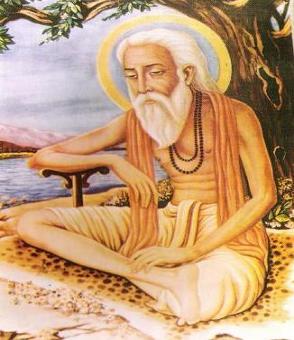
SATGURU RAVI DASS
Raju Kamble
Introduction
After India’s independence in 1947, Indians slowly started venturing on the shores outsides India. India’s
membership with Commonwealth countries helped immigration to U.K and
other countries. Movement to U.K was more apparent and visible. Dalits,
especially the ones from Punjab became part of
this move. However in the case of Dalits, the major contributing factor
in making this immigration possible was the extention of Dr.Ambedkar’s
powerful movement to empower dalits in India. The beginning of
implementation of reservations to SC/ST started appointing dalits as
officers. One of such appointment of a dalit (SC/ST) was in the
position of Under Secretary for Passports in 1952 in Punjab.
The officer was Mr.Ishwar Dass Pawar(1). Between 1954 till 1961 he
issued on an average 500 passports to the dalits every year. Those days
getting passport was enough to make the move to U.K possible. This rule
of issuing about 10% visas to the dalits was implemented until 1968.
Thus it can be easily visualized that those SC/STs/ dalits, who entered
England in the 50s and 60s could do so because of Dr.Ambedkar’s struggle to secure the rights of dalits.
50s and 60s was a boom time for industrialized activities in England and hence the Indias,
dalits too became part of the process of regular employment. Once they
settled down with plenty of employment opportunities, they started
looking for social interaction, religious activities. Dalits in England
started organizing themselves under the Guru Ravidass Sabhas, Balmiki
Sabhas and under the Dr.Ambedkar/Buddhist Organisations. Number started
growing. Families started joining. Due to the significant number of
dalits, they started settling down in different cities. In each city,
the Guru Ravidass Sabhas and Ambedkarite Organisations sprang up. In
this article, an attempt has been made to review the growth as well as
analyse the functioning, the role and responsibilities of the Guru
Ravidass Sabhas, towards the society to which it belong.
Emergence of Guru Ravidass Sabhas
The first Guru Ravidass Sabha was built in Wolverhampton,
U.K in 1968. Due to the constant flow of new dalit immigrants (thanks
to the Scheduled caste Joint Secretary, passport division, Shimla) to England in the last 30 years, 26 Guru Ravidass Sabhas have been built in England alone. It is by no means a less achievement. U.S.A has about 10 Guru Ravidass Societies, while Canada
has 4. Not every society is named as Guru Ravidass Sabhas; some are
Sabhas, some are societies and some have different names. In this
article, Guru Ravidass Sabha will be used as a generic representative
name for all the societies under the name of Guru Ravidass.
To
organize oneself under the banner of Guru Ravidassji’s name is a
straight pointer that the member who joins in this Sabha/Society is a
dalit by default. This implies that the people who joined these Sabhas
have declared and established their separate identity as a dalit
community – who were once untouchables. Establishing a separate
identity, identifying oneself openly with whatever ex-caste background
thus matches with Dr.Ambedkar’s self-respect movement. Though the
Ravidass Sabhas and Ambedkarite organizations of NRIs have been
functioning separately, the one advantage is that they have not lost
the common cause of being part of the Self-Respect movement, though in
their own way. Guru Ravidass Sabhas have done a wonderful job of
organizing the dalits, especially the Chamars of Punjab, outside India. It has kept a particular section of dalits organized. This is a step forward, when we see dalits all across India suffering from the syndrome of hiding their identity.
Let
us now analyze the organization, the activities and objectives of the
Guru Ravidass Sabhas. Guru Ravidass Sabhas, basically organize Sunday
congregations (Satsangs). The Satsangs comprise an aarti (a prayer),
the kirtan, reciting the verses of Guru Ravidassji and that of Kabir
and Guru Nanak. Verses are also recited from the Guru Granth Sahab. The
kirtan/aarti is then followed by the community lunch (langar).
These
Sunday satsangs bring all the dalits together at a place. The advantage
is that the dalits meet at a reasonably good frequency (weekly). This
frequency of interaction would help the dalits in the long run to
protect themselves as a community, since they are already organised.
One cannot forget that this same community was made to suffer as
slaves, untouchabes for more than 2000 years. As of now, not much of
debate takes place among the members to find out why they were made to
suffer for such a long time. But one day this mystery will make them
restless and force them to ponder over the cause of their past slavery.
They do feel the caste discrimination by the fellow caste Hindus/Sikhs
in day to day life in England, Canada
and U.S.A also. But its severity is quite toned down; plus they are not
dependent on the caste Hindus for their employment like in India where 90% of dalits in Punjab
are landless labours, who have to work in the fields of feudal lords
for their survival. But their ( the dalit NRI’s) self esteem will some
day force them to challenge this caste discrimination, even though it
is a low profile one. Even when the youth get into browls, they go back to castiest abusing. Some of the dalits in England
have reported that the dalit youth are called by specific derogatory
identification such as stinkers. I am sure, again some day, the dalit
NRI youth will challenge these derogatory words.
Guru Ravidass Sabhas and Dalit Movement
As
far as social movement is concerned, one of the drawbacks of Guru
Ravidass Sabhas, is their almost complete disconnect with the
mainstream dalit movement in India.
There are practically no discussions at the Sabha temples about the
development of dalit society backhome. Afterall Ravidass community has
too ripped the benefits of social movement of Dr.Ambedkar during the
period of 1916-1956. Even if we take the exclusive case of Punjab
dalits, it was Dr.Ambedkar who was responsible for the abolition of
Punjab Land Alienation Act of 1902. This was the single biggest
stumbling block, which prevented dalits in Punjab from owning land. They even could not buy the houses in their own name. If
a scheduled Caste ever wanted to buy a house, he has to a make an
arrangement with the member of a farming community and has to make the
payment to the member of the farming country and the purchase would be
done in the name of this member of the farming community. This was
brought to the notice of Dr.Ambedkar when he visited Punjab as the member of Lothian Commission in 1932(2). Dr.Ambedkar struck down this law when he became the Law Minister of India.
Hence Scheduled Castes of Punjab are exclusively indebted to
Dr.Ambedkar for having made the legal provision to own houses and
property in their own name. This paved the way for the Punjab Scheduled
Castes to become eligible for acquiring the Indian passoport without
which the scheduled castes would not have got the chance to migrate
abroad. This is the single largest contribution of Dr.Ambedkar to the Punjab scheduled castes.
Having
thus indebted even to the extent of acquiring the passport, Punjab
Scheduled Castes are oblized to pay it back to the society. This is
what was Dr.Ambedkar’s expectation from the beneficiaries of social
movement.
What needs to be done to fulfill this obligation? Ravidas Sabhas must create Social Cells
under their own organizations to discharge this obligation. The social
cell should put aside a definite amount of funds for social development
like education, creating self-employment, owning land and distributing
among the landless scheduled castes, providing scholarships for higher
studies abroad etc.
In spite of a strong presence of the Punjab scheduled castes in U.K, Canada and U.S.A startling statistics has been reported about the large number of landless laborers among the scheduled castes in Punjab. Scheduled Castes landowners of Punjab are less than 10%; that is to say that 90% of the Punjab
scheduled castes are landless labourers (3). This data must bring the
NRI Punjab scheduled castes out of the state of complacency. Punjab
Scheduled Castes own 2.4% of Punjab’s land. That means the scheduled castes did not get any benefits of the green revolution in Punjab.
Other communities got benefited by the green revolution but not the
scheduled castes. Guru Ravidass Sabhas can play a vital role in
bridging this gap between the scheduled castes and non-scheduled castes
in the matter of landholding. They should try to buy some land in Punjab
and distribute among the landless scheduled castes. This may look a
stupendous task looking at the dimension of the problem. But it is
better to make a positive contribution howsoever small it may be. In
the coming 25 years one would see the results easily if this is started
now on a micro-level. Even 5 acre land bought by one Guru Ravidass
Sabha and distributed to 5 families; easily 200 families would become
landowners assuming that there should be at least 40-50 Guru Ravidass
Sabhas all over the world. Even though a small help, but it will create
a chain reaction in establizing a strong sense of brotherhood in the
community. This sense of brotherhood is by and large non-existent among
the scheduled castes.
Guru
Ravidass Sabhas should also provide financial assistance to the
landless scheduled caste laborers to set up their own small businesses
including their own grocery shops, vegetable shops and small scale
industrial units. This will make them stand on their own feet. It will
also help them to get out of the generation to generation transferred
bondage of the feudal lords. The extent of exploitation of the landless
scheduled castes by the feudal lords came to the surface during the
episode of Talhan when :”Social Bycotts” were imposed on the
landless scheduled caste laborers as a means to suppress the upsurge at
scheduled caste dominant area like Boota Mandi in Jullander district.
It was a shocking observation to note that in the 21st century, the scheduled castes in the prosperous state of Punjab
which has been the land of social reforms of Guru Nanak and Sikh Gurus.
It was all the more reflective of the weak and almost non-existent
Dalit movement in PunjabPunjab
population as against a national average scheduled caste population of
15%. One can imagine Guru Ravidass Sabhas (so also the Ambedkarite
organizations) have to shoulder this responsibility. I am confident the
Guru Ravidass Sabhas can accept this challenge and bring about the
social and economic equality in Punjab. They must play this role of empowering the dalits in Punjab. This will provide the role model to all the states. inspite of the fact that the scheduled castes are 28% of the
Guru Ravidass Sabhas and Dr. Ambedkar
It
has been observed that by and large the Guru Ravidass Sabhas have kept
themselves away from the social struggle of Dr.Ambedkar. Guru Ravidass
Sabhas must play a matured role now and say that Ambedkar and his
struggle is not the monopoly of the Ambedkarite organizations. Guru
Ravidass Sabhas should formulate their own acceptance level from among
the vast dimensions of Dr.Ambedkar’s struggle. They, if they wish, can
be selective in this. Dr.Ambedkar or Ambedkarism is no more a name of a
person. It has much more diverse and comprehensive connotation. It has
already become a theory of fight against human repression. Gail Omdevt
defines AmbedkarismIndia,
much as Marxism is; it defines the ideologies of the dalit movement and
to a larger extent an even broader anti-caste movement.”(4). More so
there is practically, barring the controversial spiritual aspect there
is no difference between what Guru Ravidassji did in 15th century and what Dr.Ambedkar did in 20th
century. The objectives of both the leaders of the dalit community were
the same- to destroy the caste system, to create a casteless society
and to provide social justice to the dalits/untouchables. The
only difference is the timing. Dr.Ambedkar did highlight the
contribution of Guru Ravidass when he dedicated his book “The
Untouchables” in 1948 to three saints who were born among the
untouchables; namely Guru Ravidass, Nandnar and Chokha Mela. thus, “Ambedkarism is the theory of dalit liberation. Ambedkar is today a living force in
The
Delhi Ambedkarite activists used to tell that it is Dr.Ambedkar who
advised them to take out a procession on the birth anniversary of Guru
Ravidass, way back in 1949. This is when Delhi dalits wanted to create their own festivals.
So
it is hightime, Guru Ravidass Sabhas take the strong and modern
struggle of Dr.Ambedkar in the right earnest. They must introduce vast
literature of Dr.Ambedkar to its members and encourage its members to
derive inspiration from this literature. This they can do it through
its own organizational set up.
Guru
Ravidass Sabhas must not stay away from the struggle and vast
literature of Dr.Ambedkar. If they wish they could separate social
struggle of Dr.Ambedkar from his message about religion and accept at
least the non-religious aspect of Dr.Ambedkar’s struggle. This must be
done urgently before it gets too late. Dalit movement needs the vital
support of the resourceful Guru Ravidass Sabhas urgently. The suffering
millions of dalits can not wait for too long.
Conclusions:
- Guru Ravidass Sabhas,especially, the ones outside India have done an excellent job in organizing the Ravidass community of Punjab.
- The
Guru Ravidass Sabhas have provided courage to the Ravidassi community
to come out openly and get organized under the name of Guru Ravidass,
who is identified by all the Indians as a medieval saint born in the
Chamar community. Thus Guru Ravidass Sabhas have become a symbol of
fearless identity by the Scheduled Caste communities.
- Guru
Ravidass Sabhas have done very little to play a role in the development
of the poor, suffering landless scheduled caste community in Punjab.
- Guru Ravidass Sabhas must on an urgent basis create “Social Cells”
under its organization to carry out the socio economic developmental
and educational program for the deserving Scheduled Caste community in Punjab. Afterwards the same model can be extended to other states.
- Guru Ravidass Sabhas must set aside a sizable but small %age of their regular collection as “Education Fund” or “Social Fund” to run developmental program through its social cells.
- As part of developmental program, Guru Ravidass Sabhas can take the following activities in India:
- Sponser scholarship to SCs in Punjab for higher studies outside India.
- Run/support dalit schools in Punjab.
- Buy land in Punjab and distribute among the landless scheduled caste laborers in Punjab.
- Provide
financial assistance to landless, poor SCs to set up their own grocery,
vegetable shops, automobile repair workshops etc.
- Provide
financial assistance to landless poor SCs to set up small scale
industrial type of businesses, self employment schemes etc.
- Guru
Ravidass Sabhas must encourage their members to read and learn from the
vast literature of Dr.Ambedkar. They must also encourage their members
to derive inspiration from Dr.Ambedkar’s struggle’ especially the young
generation.
- Sponser at least one family per Sabha for immigration to Canada or U.S.A. This will help our community grow in developed western countries.
References
1. “Religion as Social Vision” by Mark Juergensmeyer
2. Dr.Ambedkar and Punjab by D.C.Ahir
3. Dalit Sikh by Ronki Ram in Dalit International Newsletter.
4.Dalits and the Democratic Revolution by Gail Omdevt |
THE
RECONSTRUCTION OF SOCIETY
THROUGH BUDDHISM
By
Justice P.B. Sawnt (Retd.)
No national society can be
constructed, and if constructed will survive today, without at the same time
reconstructing the international order on the same lines. Economically, environmentally
and militarily, the concept of the nation – State belongs to the past. The
world has become interdependent and the mankind has become a global family in
the more ways than one. The advances in science and technology in the
production, distribution and marketing of the goods and services,
including the military hard and software, weapons of mass destruction, the
invasion of the space, the fast development in the communication and
transportation industry, the increasing concentration and control of the
economic and military power in fewer and fewer hands and the growing cultural
homogenisation of the people spread far and wide, have left no option to any
national group but to fall in line, submit to and be a part of the dominant
power. The struggle of the national states today is not so much to maintain
there independence as to remain as much unscathed as possible from the
devouring influence of the powerful onslaught of the all persuasive authority.
This does not mean that unless
the international order becomes congenial, the nation – state should not
construct themselves on rational, humanitarian, just and equitable basis. On
the contrary, if the international order is to be rational and equitable, the
beginning will have to be made by reconstructing the national societies on
scientific, rational and egalitarian basis. However, it has to be constantly
borne in mind that the dominant international forces opposed to the creation of
such societies, will keep making constant endeavours to sabotage the emergence
of such societies, and to topple them when created. It is therefore necessary,
while striving to build such societies, that the nation States remain alert and
ready to meet both external and internal challenges, make alliances with similar
national societies, and build a counter international force to prevent the
destruction of their internal experiments. It is the lack of sufficient
attention paid to the anti-reconstruction forces, and the failure to muster
sufficient internal and external forces against them, which has so far mostly
resulted in the miscarriage of all such attempts.
II
What should be the principles,
which must be borne in mind for building any rational national and
international social order today? Whatever the means and methods adopted to
construct such order, the following irrefutable truths cannot be ignored, while
building it.
Our Planet Earth
1. This planet, with all its
resources on, under and above the earth, belongs to all men and women, wherever
they may be born, living and working.
2. Every man and woman has right to
reside, settle, work and move throughout and share equitably its
physical, intellectual and cultural resources.
3. Every man and woman is under an
obligation to live in co-operation with the nature, and not to pollute, or destroy the environment, or disturb
the ecological balance.
4. No man or woman shall consume or
use more resources than what
isabsolutely necessary for his/her comfortable living and working.
5. No goods or services shall be
produced, used or consumed which
will pollute, damage or destroy air,
soil, water or the non-renewable
resources irreparably or endanger the
ecological balance.
The National Social Order
6. The social order in every country
shall be so organized that every man and woman shall have the right to live
with dignity, and for that purpose he/she shall be secured all the human rights
throughout his/her life.
7. The human rights will comprise of
the physical, mental, intellectual and spiritual rights on the individual
plane; and of the economic, civil, political, cultural and environmental rights
on the social plane.
8. There shall be no social and
economic discrimination or inequality between man and man and no individual
shall dominate or exploit another.
9. All disputes between individual
or groups of individuals shall be resolved by amicable methods and without
resort to violence.
10. Men and women shall have equal
rights in all spheres and in all matters. The establishment, preservation,
protection and promotion of the family shall be the equal responsibility of
both.
The International Order
11. There
shall be no war or violence of any kind between nation and nation, or between
social groups. All disputes between the nations and social groups shall be
resolved by recourse to amicable methods. The peace and non-violence shall be
the articles of facts and will be observed as matters of principle.
12. All
nations and social groups shall enjoy equal rights, and no nation or social
group shall exploit or dominate another by any means.
13. All
weapons of mass destruction shall be banned and their designing, testing,
manufacture, possession and use shall be made a criminal offence both by
national and international law.
14. The
nations shall be entitled to possess only the conventional weapons and only for
the purpose of self-defence.
15. No
nation shall interfere in the internal affairs of another. Every nation shall
respect the territorial and political integrity of the other. Every nation
shall also respect the right of the other to develop itself according to its
genius and desire, and shall not directly or indirectly impose its will or
culture on another.
16.All
nations shall be under an obligation to live peacefully and in co-operation wit
h each other and to aid and assist each other in times of want and calamity,
and disasters of all kinds.
17. All
nations shall be under an obligation to ban fanaticism, fundamentalism and
terrorism of all kind within their borders, and prevent such activities across
from within their borders.
God
and Religion
18. The
natural force which pervades the entire universe is the creator of all the
animate and inanimate objects. All plant and animal life owes its birth to that
force. They grow, survive and perish according to the laws of that force. The
concept of God is invented by the unenlightened Man to describe that force. The
enlightened ones do not and should not harbour such illusions. The religion is
nothing but an ethical code of conduct for the individual to govern his own
conduct, his relations with the other individuals with the society at large,
those who believe in God or cannot sustain or enforce the code without the
awe-inspiring myth of God, ascribe the origin of religion to God.
Humanism,
equality and righteous conduct constitute the only true religion, and all
conduct of Man has to be oriented in them and judged by them. A code of conduct
i.e. a religion which is bereft of them, is no religion at all. The self –
sacrifice is the highest spiritualism and Man and women should try to cultivate
it.
No religion
i.e. the code of conduct may teach hatred of, and violence against, another or
look down upon it. All religions i.e. the codes of conduct must respect each
other and live in peace and co-operation with each other. Being the creatures
of the same universal life-force, all human beings are equal, irrespective of
the sex, race, region, religion, caste, creed or culture. Bearing the above in
mind, Man is free to pursue his belief and abide by his faith, provided it does
no harm to others.
III
A careful
study of Buddhism will reveal that it in terms implies the above principles and
envisages the construction of human society consistent with them. It is amazing
that the Great Buddha, 2500 years ago, in 600 BC, when much of the world that
we know today, was in a barbaric state, and violence, plunder and exploitation,
slavery, intolerance, hatred and all other raw animal instincts of Man were
governing his relations with others, could formulate these humanist principles,
as the guiding beacon light for mankind. That a Great Master should have
emerged on the scene in those times to preach and profess these rational
principles is itself an unusual phenomenon. In those time, this was a unique
revolution in thinking. Buddha was the first to think rationally on the
relations of man with man and with the society; of the concept of God and the
true nature of religion: of the root causes of man’s sufferings and of the
means of their removal, of the goal that the man should keep and pursue in
life; of the importance of education; and of the need of a social structure
which will take care of the oppressed, the poor, the helpless, the unprotected
and the orphan, and most importantly of the man – made and not divine nature of
the society.
What are the
main precepts of Buddhism?
The Buddha
was the first to preach equality between Man and Man. He debunked the caste
higherarchical system of Chaturvarnya and asserted that the merit of a person
is to be measured not by his birth, but by his worth. He advocated pulling down
of all barriers between Man and Man. According to him, it is not the
fittest but the best who is important from the point of view of the society.
The best is one who contributes the most to the promotion of weal and welfare
of the society. The equality was also necessary according to him for promoting
the best and consequently, the prosperity of the society. The religion, which,
according to him, does not preach equality, is no religion.
Fraternity and universal brotherhood
based on love, compassion and friendship was another main plank of the
philosophy he preached. The fraternity with all sections of the populace and
with mankind at large, and compassion and respect not only for human beings but
for all beings was the essence of his message. He preached living in co-operation
with nature and not in confrontation with it. He emphasized that happiness was
not to be attained at the cost of others, nor was oppression to be tolerated.
Liberty or freedom of his conception was essentially
emancipation from mental and intellectual slavery. He did not believe in the
authority of any individual or scripture. That is why he exhorted his followers
not to consider either him or what he preached as infallible, and to be
constantly on alert and be inquisitive. He was against any dogma, or divinity
of any individual, theory or system. He believed that man alone was responsible
for his sate of affairs and he can improve it by his own endeavours. He
believed in persuasion and in free expression of thought. He preached respect
for other’s views, free and frank discussion, and resolution of disputes by
peaceful debate.
He deplored poverty and at the same time also acquisitiveness. He believed in
sharing resources, self help and collective endeavours. Poverty and hunger
according to him were the cause of many social diseases and they were avoidable
in a properly organized society. The abundance for some and the misery for
others were the symptoms of an ill-organized society. The misery of man made
him most unhappy and he devoted his primary attention to its removal. The
social structure according to him it was not divine, but man-made and man can
change it.
He did not
believe in the existence of God or super nature. He debunked the theory of
union with Brahman and dubbed it as false. He did not believe in rituals,
prayers, worship, ceremonies, sacrifices to the so called deities, the
existence of the soul apart from the body, the theory of rebirth or life after
death or the theory that deeds of the past life (Karma) determined the course
of life in the present.
On the other
hand he believed that the righteous conduct in the present life repays the man
in the same life, and determines his fate. According to him, the so called
religion is nothing but a code of conduct for the private and social life of
the individual. He made a distinction in the religion advocated by others and
the Dharma preached by him. According to him, the religion concerned itself
with the supernatural, the origin of the God, soul, rituals etc. and indulged
in speculation. It ignored the present life, the miseries and suffering and
their causes, and the ways of their removal. The religion preached morality but
wads not based on it.
On the other
hand the Dharma concerned itself with the reconstruction of the world. The
Dharma was concerned wit the causes of misery and suffering of the man in this
life and their removal by practical means. The root of dharma is morality.
Morality is Dharma and Dharma is morality. The morality in Dharma arises
because of the direct necessity for Man to love Man for his own good. While
morality is a wagon attached to Religion which can be attached to it and
detached from it according to convenience, the morality is the very basis of
Dharma. The morality must be sacred and universal. It is righteous conduct of
Man and not the rituals and prayers, which alone help him to live a happy life.
Likewise,
the Buddha preached peace, non-violence, absence of conflict and war. According
to his preaching, the violence was not to e willed but was resorted to only as
a last resort and when it becomes absolutely necessary. Man has to strive to
create a world without strife and violence, and of men, women and societies
with the righteous conduct.
IV
It may be
appreciated from the above brief exposition of the Buddha’s Dharma, that it
answers all the queries of Man, analyses his problems and provides practical
and realistic solutions to them. Of all the attempts made on the religious or
spiritual plane, to offer solutions to the Man’s doubts, mental, physical and
spiritual sufferings and the anxieties on account of the insecurity and
uncertainty about the future, the Dharma is so far the only rational and
scientific endeavour. Yet, the Buddha, unlike others neither claimed himself to
be a divine messenger nor claimed his message a divine origin. That was as it
should have been, since he disowned the existence of God. The Dharma is not a
religion but a social order, a way of life. It is rooted in the morality, and
righteousness in all activities is the only guide it offers to Man for his
happiness in life. The preachings of Dharma appeal to reason and stand the test
of scientific inquiry. The Dharma is the first precept to analyse the
sufferings of Man and attempt to find its causes in the social system. That is
why it proclaims its purpose to be to reconstruct the world which no religion
either there before or since then, has even remotely suggested. The Dharma does
not want to be grouped with religious orders and rightly so, because the religions
so called concern themselves with the origin of the world, and the non-existent
God, and the speculations about both, and their appeasements by fruitless,
wasteful and slavish rituals, prayers and worship. The religions from their
inception have a mystical origin and have the sole purpose of enslaving the
mind of Man. The fanaticism and fundamentalism have their origin in the mysticism
associated with the religious orders which irrationalism the Great Buddha
deprecated again and again.
The need of
Man always has been to build a just and humane social structure based on
rational and scientific foundation. We have in Buddhism, the basis of such
reconstruction. Our Constitution in its Preamble, and in the chapters on
Fundamental Rights and the Directive Principles of the State Policy, provides
an outline of the contents of such rational society. What is needed is a
political will to reconstruct the society on those lines. That will, will never
emanate from the present ruling class entrenched as it is deeply in the present
social order. It is the people and the people alone who may, by their organized
collective effort succeed in ushering in such society, both internally in each
country and internationally on global level. |
|
|
|
|
|
|
|
|
| |
|